eBook - ePub
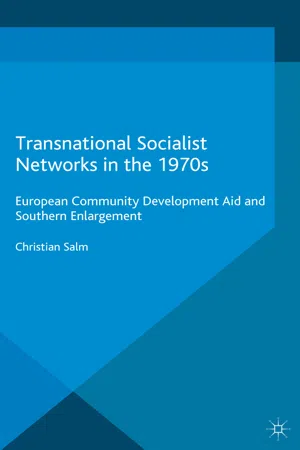
Transnational Socialist Networks in the 1970s
European Community Development Aid and Southern Enlargement
- English
- ePUB (mobile friendly)
- Available on iOS & Android
eBook - ePub
Transnational Socialist Networks in the 1970s
European Community Development Aid and Southern Enlargement
About this book
Transnational Socialist Networks in the 1970s argues that western European socialist parties' transnational cooperation across national borders significantly influenced politics and policy-making in what was the European Communities (EC). It focuses on the network-like informal structures that characterised transnational cooperation between the party members and leaders of different socialist parties involved in European affairs. Taking the example of two case studies, namely EC development aid policy and EC southern enlargement policy, the book demonstrates that the socialist parties strengthened their informal transnational network structures for the purposes of debating ideological and programmatic issues and finding policy solutions to common challenges in both policy fields. Moreover, it shows that the networks developed various functions to influence European governance. Against this background, the analysis in this book makes not only a significant contribution to the study of transnational networks of western European socialist parties and the history of European integration, but also adds to the understanding of the role of transnational networks in European politics and policy-making.
Information
1
Formal Weakness and Informal Strength? Transnational Socialist Party Cooperation in European Integration
Formal dimensions of transnational party cooperation are characterised by structures, decision-making processes and functions that are codified in the statutes of partly or fully institutionalised transnational political networks of parties. Informal cooperation is not codified but, rather, is shaped by habits among and links between individuals. The formal dimensions of politics can have effects on the informal dimensions of politics and vice versa. As these effects depend on the structural conditions of political networks, the specific form of both political dimensions can be stable for a long time. Due to external impacts, internal shocks, reforms, and social and value changes, the formal and informal dimensions can alter rapidly, however. The formation and impact of the policy- and decision-making processes of a political network depend on the reciprocal effects between the formal and informal dimensions of politics.1
In the case of the western European socialist parties in the 1970s, institutionalised or fractional institutionalised transnational political networks formed the basis of their transnational cooperation. The parties’ relations in these partly overlapping and partly interacting transnational political networks were characterised by complex patterns. Two organised transnational political networks formed the backbone of the formal cooperation of socialist parties in Europe and the EC in the 1970s: the global network of the Socialist International (SI) and the Liaison Bureau of the Socialist Parties in the EC transformed into the Confederation of Socialist Parties in the EC in 1974. The formal transnational socialist party cooperation in and through both political networks took place on a permanent basis. In this chapter, it will become clear, however, that the formal degree of integration within both political networks was rather weak throughout the 1970s. In making this argument, I will therefore challenge the more positive assessment by contemporary neo-functionalist studies of the level of formal integration of transnational party cooperation in Europe and the EC in that decade.
In addition to exploring the weakness of the formal dimensions of transnational socialist party cooperation through institutionalised or fractional institutionalised transnational political networks, this chapter will outline the role of socialist political foundations. Party-affiliated political foundations can be important engines for the successful transnational cooperation of political parties in and through transnational political networks. One of their main functions is to set up broad formal and informal contacts and networks of a great variety of actors from different national, European and international organisations and institutions. Furthermore, the chapter will address the role of leading politicians in socialist transnational party cooperation. Based on purely informal links and exchange, these politicians developed political ideas, discussed policy concepts and agreed on strategies to be treated as guidelines for transnational party cooperation.
Within all these patterns, the transnational cooperation of the socialist parties in the context of the EC was very intensive. Moreover, it went far beyond cooperation of EC socialist parties only, including socialist parties from non-EC member states at the time. Against this background, this chapter will show that informal strength compensated for the formal weakness of transnational socialist party cooperation in European integration in the 1970s.
The Socialist International
After the end of World War II, socialist parties in Europe reconnected their traditional transnational links through the revival of the SI. The roots of their transnational cooperation reached back to 1864, when the first Socialist International was established.2 At its congress in Frankfurt in June 1951, the SI attempted to reconstitute itself formally as a global network of socialist parties and adopted new statutes. Of the 34 participating parties, however, 27 were European socialist parties and only 7 were non-European socialist parties.3 Not surprisingly, the SI adopted a Eurocentric character and the question of European unity was high on its agenda.4
The new statutes provided for the institutionalisation of four institutions: firstly, the SI congress as the supreme institution, consisting of full members and members with observer status; secondly, the SI council, forming a ‘little congress’ including only full members and taking major decisions; thirdly, the SI bureau as the working institution composed of a limited amount of member parties elected by the SI council and meeting on average every two months – the meetings usually being attended by the international secretaries of the parties and high-ranking foreign affairs politicians;5 and fourthly, the SI secretariat as the administrative institution based in London.6 The main functions of these four institutions were to foster relations among the member parties and to make possible a rapprochement between different viewpoints and policies.7 Common policies could only be adopted by unanimous agreement, however. Crucially, the statutes did not include any formal instruments to force the member parties to adopt particular policies or strategies. Rather, the opposite was the case; that is, the SI acted mainly as a platform for discussing and coordinating political matters and to form networks through informal exchange. Thus, in spite of the formalised institutions, the degree of formal integration of the SI was low when it was re-founded in the early 1950s.
By the 1970s, the situation of the SI had hardly changed with regard to its Eurocentric character and its formal cooperation. Although the network had started to intensify contacts with socialist parties in Asia and elsewhere since the early 1950s,8 about 20 years later, the main SI actors were still the western European member parties. For instance, members of the Austrian SPÖ filled the position of president (Bruno Pittermann) and of secretary-general (Hans Janitschek, who succeeded Albert Carthy, a member of the British Labour Party, in April 1969).9 With very few exceptions, SI bureau meetings were held in western European countries throughout the 1970s.10 Furthermore, the important SI finance and administration committee mainly consisted of western European socialist parties. Given a committee membership of only seven, they formed a clear majority in the finance and administration committee with the Austrian SPÖ, the British Labour Party, the German SPD, the Swedish Social Democratic Workers’ Party (Sveriges socialdemokratiska arbetareparti: SAP) and the French Socialist Party (Parti socialiste: PS).11 Moreover, because of the close relations many western European socialist parties had developed between each other,12 they could maximise their influence on transnational party cooperation in the SI. Although the SI was keen to present itself as a global network of socialist parties in the 1970s, it still had a strongly Eurocentric character.
A number of factors blocked the development of a more efficient, formal cooperation. Firstly, the four institutionalised SI institutions had created inflexible structures that contributed to a failure of several formal communication mechanisms. For example, meetings of the SI council rarely took place.13 In the case of the SI bureau, for internal party reasons, important western European member parties such as the Danish SD, the Belgian Socialist Party (Parti socialiste belge: PSB, Belgische Socialistische Partij: BSP), the Italian Socialist Party (Partito Socialista Italiano: PSI) and the Norwegian Labour Party (Arbeiderpartiet: AP) often did not attend meetings.14 This frequently led to the postponement of decisions and delays in the preparation of policies.
Secondly, the principle of agreeing on common policies only by unanimity contributed to rigid formal decision-making processes in the congress and the council. In both institutions, resolutions were only adopted on the basis of the lowest common denominator that the member parties could find. As a result, SI resolutions usually had little substance and relevance.15 Resolutions, however, were by far the most significant possibility of formal cooperation.
Thirdly, the SI secretariat permanently lacked staff and a solid financial basis. Throughout the first half of the 1970s, the staff of the secretariat consisted of only two individuals, the secretary-general, Janitschek, and the assistant secretary, Rodney Balcomb. As a consequence, reports and drafts for political activities were not written and meetings of study groups or the bureau not organised.16 Indeed, the financial situation of the SI was so dire in the 1970s that SPD representatives urged their SI partners to treat the budget as confidential in order not to make the network look ridiculous in public.17
Fourthly, the weakness of formal cooperation within the SI resulted from the less influential role that its president Pittermann played in the network in the late 1960s and the early 1970s. Pittermann had been Vice Chancellor of Austria from 1957 to 1966 and leader of the SPÖ from 1957 to 1967. He lost the chairmanship of his party and, with it, his influence in Austrian politics to Bruno Kreisky, who replaced him as the SPÖ leader and became Chancellor of Austria in 1970. Pittermann became president of the SI in 1964. His election reflected the SI’s orientation towards compromises. Coming from a small state, Pittermann seemed to be in an ideal position for mediating between the SI member parties belonging to the large western European states. When, in 1972, the election of SI president was on the agenda once more, there were a few candidates who expressed interest in the position – among them, for example Sicco Mansholt, a Dutch high-ranking member of the PvdA and, for a long time, Vice President of the European Commission. However, neither of these candidates could muster a majority and, as a result, they did not run for election. Moreover, as Pittermann was not in a sufficiently powerful position to control the network in any way, he was re-elected as SI president in 1972, as he had already been in 1968.18 Against this background, however, he was not able to assume the role of an influential mediator for the purposes of lifting the SI out of its desolate financial situation and improving its weak formal cooperation. In addition, being without political influence in his own country, Pittermann also proved of little use to the SI in the early 1970s. In the years to come, a number of member parties were to become progressively more dissatisfied with him.19
Crucially, the informal cooperation within the SI remained largely unaffected by the poor state of formal cooperation in the 1970s. Informal cooperation compensated for the low degree of formal integration. In particular, party leaders’ conferences of a highly informal character had already been held annually since 1960.20 These party leaders’ conferences were not laid down in the SI statutes. Of course, the Eurocentric character of the SI in the 1960s and 1970s also applied to the party leaders’ conferences. With the exception of Tokyo in 1977, throughout the 1960s and 1970s all of these conferences were held in west European countries. Leading western European socialists, including socialists in high positions in the European Commission, attended the conferences with the purpose of enabling confidential discussions. People who were not from member parties were not permitted to attend the conferences. No official reports on the conference proceedings were issued.21 Compared with the 1960s, this form of cooperation of western European socialist party leaders within the SI became more intense in the 1970s. From the beginning of that decade onwards, the congresses of the party leaders often took place biannually. A gain in formal accession to political power following the electoral success of several socialist parties in their western European home countries and international crises, such as the breakdown of the Bretton Woods System and the first oil crisis in 1973, triggered this development.22 Overall, the informal cooperation of socialist party leaders was much more relevant for policy- and decision-making in the SI and its transnational activities in the 1970s than their formal cooperation.
Additionally, informal regional conferences of high-ranking European socialist politicians were held from time to time. Such regional conferences generally had the objective of giving substance to the transnational cooperation in the framework of the SI and its party leaders’ conferences, with a focus on particular political or policy issues. However, the organisation of such regional conferences was only indirectly connected to the cooperation of socialist parties in the SI. The so-called ‘Harpsund meetings’ in Sweden were a prime example of such regional conferences. These meetings allowed for a confidential exchange of information and views among leading European socialists from Scandinavia, Britain, Austria and Germany.23 Tage Erlander, long-time Prime Minister of Sweden and leader of the SAP, had established these regional meetings in the 1960s to allow discussions across the emerging divide between the European Economic Community (EEC) and the European Free Trade Association (EFTA) – founded in 1960 by the so-called ‘outer Seven’; that is, Austria, Britain, Sweden, Norway, Denmark, Switzerland and Portugal.24 In the 1970s, Olof Palme, Erlander’s successor as Swedish Prime Minister and SAP leader, continued to hold the Harpsund meetings.
Furthermore, a tight network of international secretaries and secretaries-general of the western European socialist parties supported the informal transnational cooperation of the SI party leaders.25 The members of this network regularly exchanged information on new developments in European and international politics.26 Moreover, the executive committees of the European socialist parties were continuously informed of the political activities of their sister parties. By deputising for the party leaders at ...
Table of contents
- Cover
- Title Page
- Copyright
- Contents
- Acknowledgements
- Series Editors’ Preface
- List of Abbreviations
- Introduction
- 1. Formal Weakness and Informal Strength? Transnational Socialist Party Cooperation in European Integration
- 2. Shaping EC Development Aid Policy
- 3. Facilitating EC Southern Enlargement Policy
- 4. Comparative Assessment: Structures, Actors, Functions and Impact
- Conclusion
- Notes
- Bibliography
- Index
Trusted by 375,005 students
Access to over 1.5 million titles for a fair monthly price.
Study more efficiently using our study tools.
Frequently asked questions
Yes, you can cancel anytime from the Subscription tab in your account settings on the Perlego website. Your subscription will stay active until the end of your current billing period. Learn how to cancel your subscription
No, books cannot be downloaded as external files, such as PDFs, for use outside of Perlego. However, you can download books within the Perlego app for offline reading on mobile or tablet. Learn how to download books offline
Perlego offers two plans: Essential and Complete
- Essential is ideal for learners and professionals who enjoy exploring a wide range of subjects. Access the Essential Library with 800,000+ trusted titles and best-sellers across business, personal growth, and the humanities. Includes unlimited reading time and Standard Read Aloud voice.
- Complete: Perfect for advanced learners and researchers needing full, unrestricted access. Unlock 1.5M+ books across hundreds of subjects, including academic and specialized titles. The Complete Plan also includes advanced features like Premium Read Aloud and Research Assistant.
We are an online textbook subscription service, where you can get access to an entire online library for less than the price of a single book per month. With over 1.5 million books across 990+ topics, we’ve got you covered! Learn about our mission
Look out for the read-aloud symbol on your next book to see if you can listen to it. The read-aloud tool reads text aloud for you, highlighting the text as it is being read. You can pause it, speed it up and slow it down. Learn more about Read Aloud
Yes! You can use the Perlego app on both iOS and Android devices to read anytime, anywhere — even offline. Perfect for commutes or when you’re on the go.
Please note we cannot support devices running on iOS 13 and Android 7 or earlier. Learn more about using the app
Please note we cannot support devices running on iOS 13 and Android 7 or earlier. Learn more about using the app
Yes, you can access Transnational Socialist Networks in the 1970s by Christian Salm in PDF and/or ePUB format, as well as other popular books in History & European History. We have over 1.5 million books available in our catalogue for you to explore.