eBook - ePub
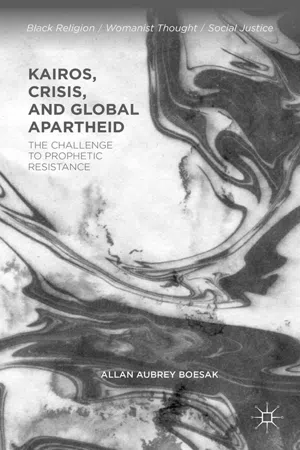
Kairos, Crisis, and Global Apartheid
The Challenge to Prophetic Resistance
- English
- ePUB (mobile friendly)
- Available on iOS & Android
eBook - ePub
About this book
In 1985, the Kairos Document emerged out of the anti-apartheid struggle as a devastating critique of apartheid and a challenge to the church in that society. This book is a call to discern new moments of crisis, discernment and kairos, and respond with prophetic resistance to global injustice.
Information
1
Hearing the Cry and Reading the Signs of the Times: A Humanity with a Kairos Consciousness
Kairos Consciousness
South Africans who stand in the prophetic tradition of the Kairos Document that came out of South Africa in the dark days of the antiapartheid struggle and the first state of emergency in 1985, are the first to admit that the Palestinian Kairos called them to a moment of awareness of that prophetic tradition they seemed by and large to have forgotten. It was a reawakening of kairos in a community where the prophetic voice has not only been scarce, but even when hesitantly raised, also not gladly heard since the birth of a democratic South Africa in 1994. This holds true, I suggest, for the church in the United States as well, and perhaps elsewhere.1 It seems that every response to Kairos Palestine begins with some confession of guilt.
In December 2009 the Palestine Kairos Document was published. It could easily have been one more kairos document in addition to all those other kairos documents that followed the original kairos document from South Africa.2 But this time it was different. It set in motion what some are calling a “global kairos movement” and through the responses from the United States and South Africa to begin with, triggered serious attention for what has been named “the rebirth of kairos theology.”3 It also raised a question that indicated that the response to the Palestinian Kairos Document was considering something much more profound, and which will prove to be much more durable, namely the question of a kairos consciousness.
“Is there such a thing as a kairos consciousness?” was the question I was asked by Rev. Edwin Arrison, one of the leaders of Kairos Southern Africa in 2011. It was one year after a series of conversations in circles of progressive, concerned persons in faith communities; the year, essentially in response to the Palestinian Kairos Document, “Kairos Southern Africa” was launched stating its sweeping vision: “A Humanity with a Kairos Consciousness.” I then responded with some preliminary thoughts on what I thought was an important and intriguing question, now more so than ever.4 In light of the reemergence since then of a “kairos theology” and the concomitant establishment of not just a Southern African, but, as the bold vision statement of Kairos Southern Africa makes clear, a global kairos movement,5 we should reflect more carefully on what such a kairos consciousness might be.
Kairos is not so much a “time” or a “season” but a moment, unique, for people of faith to see, understand, and act upon. But speaking of a “kairos consciousness” already indicates that what is meant here is more than just the realization of some matter of mere momentary import. It suggests an abiding awareness, what one could call a prophetic alertness, a readiness for when such a moment might arrive. The phrasing of the vision statement also suggests more than an individualized consciousness, indeed, a consciousness that stirs, embraces, and inspires “humanity.” The understanding is clear: in 1985, a group of prophetic Christians were overwhelmed by a moment of truth for the situation in South Africa, and the Kairos Document spoke specifically to the South African context of racist domination, political oppression, socioeconomic exploitation, and the silence of the church in regard to all these. Almost to our surprise we discovered how others, in their specific contexts across the globe—and not only in the global South—understood their situations of political, social, and theological crises as a kairos moment for themselves. Hence the birth of several kairos documents across the world since 1985.6 Now, however, there is a deliberateness to the call not merely for new kairos documents, but for an abiding kairos consciousness for humanity. The crisis we are facing now is a global crisis, the call to understand this moment as a kairos moment is for all humanity.
It is, moreover, a moment of truth, revealing the falsehoods without which an unjust status quo cannot exist, but which blind, beguile, and disable us. Without seeing, discerning, and acting the moment passes us by. Hence the kairos moment is decisive. A kairos consciousness is a consciousness awake and open to the discovering of, and responding to the decisiveness and uniqueness of that moment. Such a kairos moment also reveals the truth about ourselves, strips us of all pseudo-innocence,7 and as such it is a moment of discernment, repentance, conversion, and commitment. In that moment we discover the truth: about the situation with which we are faced, about ourselves and the Other; about the realities of pain and suffering, about the demands of love and justice, and about the God-given possibilities for real and fundamental change. It is also the truth that sets us free. It is simultaneously a shocking and a liberating moment.
Crucially, however, a kairos consciousness knows that the discovery of that moment of truth is not a moment of triumphalist gloating, confirming and celebrating our own spiritual superiority, but rather of profound and humble joy for the gift of discernment, discontentment, and dissent. Discernment of what is wrong in a situation and the crisis it creates for the most vulnerable, discontent with that situation of injustice, and a refusal to leave things as they are; and dissent from the dominant judgment that the status quo is acceptable, unchangeable, or irreversible.
The discovery of a moment of truth in history is not the result of our intelligence and extraordinary cleverness. It is revelation, the gift of the Holy Spirit. We are not the truth: the truth has found, recovered, and reclaimed us. We are not the light: the light illumines and leads us. We are not the voice: we speak and act because we heard the Voice that calls us to do justice, love mercy, and walk humbly with our God. The voice we hear and respond to is the voice of the voiceless, the poor, and oppressed, those who are the faces at the bottom of the well. In those voices, is the forceful argument of John Calvin, we hear the very voice of God:
Tyrants and their cruelty cannot be endured without great weariness and sorrow . . . Hence almost the whole world sounds forth these words, “How long?” When anyone disturbs the whole world by his ambition and avarice, or everywhere commits plunders, or oppresses miserable nations, when he distresses the innocent, all cry out, “How long?” And this cry, proceeding as it does from the feeling of nature and the dictates of justice, is at length heard by the Lord . . . [The oppressed] know that this confusion of order and justice is not to be endured. And this feeling, is it not implanted by the Lord? It is then the same as though God heard Himself, when he hears the cries and groaning of those who cannot bear injustice.8
This is an insight from Calvin I have had cause to return to and reflect upon again and again,9 and in this context it is most helpful in understanding what I mean by a kairos consciousness. This is how I understand Calvin on this issue. Notice first how such a consciousness understands the indivisibility of justice. Martin Luther King Jr., was right: injustice anywhere is a threat to justice everywhere. Calvin’s repeated “the whole world” is not just rhetorical hyperbole or a manner of speaking. It is a keen awareness of the impact of injustice on humanity as a whole, to quote yet another famous word of Martin Luther King Jr., of the “inescapable network of mutuality” and the “single garment of destiny,” of our common yearning for justice and of the need for human solidarity in resisting injustice and striving for justice. It understands the workings of power and the destruction wrought by power “divorced from the fear of God” as Calvin states elsewhere. It is remarkable how relevant this insight has become in our globalized political and economic power realities and in the deadly stranglehold of a few—the now universally recognized 1 percent!—on the rest of humanity and on creation as a whole.
Second, still engaging Calvin, a kairos consciousness understands the difference between “order” and “justice” and refuses to accept that tyranny, injustice, and oppression should be tolerated as necessary for “order,” or more precisely, mistaken for order. Calvin calls this a “confusion.” For Calvin—despite his grave concern for order in society and his fear of chaos, or perhaps better put, because of his concern for proper order in society—“order,” or in its other, often used, and always lethal combination, “law and order,” in our global reality more and more parading as “national security”—is not the enforced state of confusion when the law, violence, and the abuse of power are used to protect the position of the powerful and privileged and to keep the poor impoverished and the subjugated silent. Order prevails when compassionate justice is done and there is no confusion about right and wrong in society. A kairos consciousness, in reading the signs of the times, making political judgments and calling upon the church to act will, I think, embrace Paul Lehmann’s contention about what he calls “the proper priorities of politics,” namely that “Freedom is the presupposition and the condition of order: order is not the presupposition and condition of freedom. Justice is the foundation and criterion of law; law is not the foundation and criterion of justice. These are the proper priorities of politics.”10
Third, the cry for justice is not only implanted by the Lord; it is as though God hears Godself when the oppressed cry “How long?” Their cry is God’s cry, emanating from the heart of a God wounded by the injustices inflicted upon the poor and defenseless.11 If a renewed Kairos movement is “now conceived and established to nurture the prophetic voice that recognizes the face of God in the face of the poor and most marginalized people” as Kairos Southern Africa proclaims in its constitution,12 then a kairos consciousness that understands injustice and injury inflicted upon God’s children as wounds inflicted upon God is absolutely vital.13
It is the “poor and oppressed” of whom Calvin speaks, who form “the people” in the language of the Kairos Document. Their cries are not the plaintive cries of helpless resignation and desolate hopelessness. These are cries of pain in protest to their suffering. These cries are constituted by their pain and their resistance to injustice. These are cries of struggle: the oppressed are not sitting idly by, waiting for some miracle to be performed in their behalf. They are the active, hopeful sizwe, who refuse to be silenced by the opium of post-apartheid civil religiosity (in other words, state theology) employed by politicians who speak blandly of South Africa as a “Lord-fearing nation, a God-fearing country,” where Christians are called to “raise the moral consciousness of the nation” while leaving politics and economics to the politicians and experts. This dichotomy is called for because the ANC already has a chaplain-general “to ensure that the ANC stays close to God’s light,” and that it does “everything in accordance with what God requires” as Deputy President Cyril Ramaphosa assures them.14 The people reject these post-1994 state theological heresies and continue to challenge both church and state in the name of a prophetic theology that arises out of the cries of the people which are indeed “heard by the Lord.”
But Calvin is quite radical in this and we must not miss it: if it is true that God is not just hearing the poor and oppressed when they cry out against injustice, but God is hearing God’s own self in their cries, it means that God is not just the God of the poor; God presents Godself as the poor and oppressed. Their cries are God’s cries. Those cries may be the cries of the powerless, but they make their appeal upon us with inescapable authority. Furthermore, Calvin speaks of all those “who cannot bear injustice.” He means not only those upon whom injustice is inflicted, but also those who cry out on their behalf, and therefore do what is right and just. In their cry as well God hears Godself, and in their doing of justice the wounds of God are healed.15
A kairos consciousness will observe, experience, and judge the world as seen through the eyes of the suffering, the poor, and the marginalized, in so doing seeing the world through the eyes of Jesus.16 This means, besides much else, that one is no longer blinded by the propaganda of the powerful, by the pressures of contemporary society or global imperial powers to conform to what those powers may deem normal or acceptable. One will, instead, resist being dictated to by one’s own fears or desires to be part of a world that scandalizes Jesus because that world lures us with privileges and the comfort of protection against the powerful or against the appeal (or the wrath?) of those brothers and sisters we are leaving behind. For the Palestinians who produced the Palestinian Kairos Document and living under Israeli occupation, witnessing the relentless destruction and the weeks of civilian deaths in Gaza, “seeing through the eyes of Jesus” has existential, and extraordinarily poignant significance, as Palestinian liberation theologian Naim Stifan Ateek makes clear:
Like many Palestinians today, Jesus was born under occupation and throughout his life knew only a life under occupation. All his travels, his eating and drinking, his teaching and healing ministry, his relationships with others—every aspect of his life—were carried out under the oppressive domination of the Romans. Finally, he was executed by the occupation forces in collusion with the religious leaders of first-century Jerusalem.17
It also means that one can no longer avoid making choices, and those choices will reflect God’s choices: for the poor, the wronged, the destitute, and the vulnerable. This depicts an engaging consciousness, an understanding that because one is no longer blind to injustice, one can no longer be neutral. One cannot but join the struggle for the sake of justice and righteousness. A kairos consciousness becomes an engaging, liberation-oriented consciousness, intent on the humanizing of God’s world.
A kairos consciousness is a critical and simultaneously self-critical consciousness. It is critical because it discerns and critiques the situation in which we live, understanding that it is a situation of life and death, and seeing through the eyes of those who suffer and are most vulnerable, it offers prophetic critique of that situation, and calls for prophetic resistance in that situation. Such a consciousness understands that there is a conflict, a struggle going on for the sake of those whose lives are precious in God’s sight and that the moment calls for the church to take sides. Because it is a ...
Table of contents
- Cover
- Title
- Introduction
- 1 Hearing the Cry and Reading the Signs of the Times: A Humanity with a Kairos Consciousness
- 2 At the Heart of It All: Kairos, Apartheid, and the Calvinist Tradition
- 3 The Time for Pious Words Is Over: Kairos, Decision, and Righteous Choices
- 4 The Inclusiveness of God’s Embrace: Kairos, Justice, the Dignity of Human Sexuality, and the Confession of Belhar
- 5 The End of Words? Kairos, Challenge, and the Rhetoric of the Barricades
- 6 Speaking Truth to the Tower: Kairos, Dissent, and Prophetic Speech
- 7 Combative Love and Revolutionary Neighborliness: Kairos, Solidarity, and the Jericho Road
- 8 That Which Avails Much: Kairos, Public Prayer, and Political Piety
- Notes
- Bibliography
- Index
Trusted by 375,005 students
Access to over 1.5 million titles for a fair monthly price.
Study more efficiently using our study tools.
Frequently asked questions
Yes, you can cancel anytime from the Subscription tab in your account settings on the Perlego website. Your subscription will stay active until the end of your current billing period. Learn how to cancel your subscription
No, books cannot be downloaded as external files, such as PDFs, for use outside of Perlego. However, you can download books within the Perlego app for offline reading on mobile or tablet. Learn how to download books offline
Perlego offers two plans: Essential and Complete
- Essential is ideal for learners and professionals who enjoy exploring a wide range of subjects. Access the Essential Library with 800,000+ trusted titles and best-sellers across business, personal growth, and the humanities. Includes unlimited reading time and Standard Read Aloud voice.
- Complete: Perfect for advanced learners and researchers needing full, unrestricted access. Unlock 1.5M+ books across hundreds of subjects, including academic and specialized titles. The Complete Plan also includes advanced features like Premium Read Aloud and Research Assistant.
We are an online textbook subscription service, where you can get access to an entire online library for less than the price of a single book per month. With over 1.5 million books across 990+ topics, we’ve got you covered! Learn about our mission
Look out for the read-aloud symbol on your next book to see if you can listen to it. The read-aloud tool reads text aloud for you, highlighting the text as it is being read. You can pause it, speed it up and slow it down. Learn more about Read Aloud
Yes! You can use the Perlego app on both iOS and Android devices to read anytime, anywhere — even offline. Perfect for commutes or when you’re on the go.
Please note we cannot support devices running on iOS 13 and Android 7 or earlier. Learn more about using the app
Please note we cannot support devices running on iOS 13 and Android 7 or earlier. Learn more about using the app
Yes, you can access Kairos, Crisis, and Global Apartheid by Allan Aubrey Boesak in PDF and/or ePUB format, as well as other popular books in Social Sciences & Social History. We have over 1.5 million books available in our catalogue for you to explore.