In the beginning of the 21st century, European theatre-makers have sought to consider the disastrous events of the 20th century as the unfinished business of the contemporary. In this book, Kear argues that by thinking through the logic of the event, contemporary performance offers an affective interrogation of 'the event' of the European century.
Song of the Century: Jan Lauwers and Needcompany’s Sad Face/Happy Face Trilogy
Thinking back
In a recent introduction to Jan Lauwers’ theatre work, Janelle Reinelt draws attention to his Sad Face/Happy Face trilogy (Salzburg, August 2008) as being an ‘extraordinary summing-up of twentieth-century Europe; it is, in a sense, “where we are at”’ (2010: 208). Lauwers’ theatre makes manifest Alain Badiou’s assertion that ‘the real function of theatre consists in orientating us in time, in telling us where we are in history’, operating as ‘a machine for answering “where”, a localizing machine’; an aesthetic-political assemblage producing ‘a topological relation to time’ (2008: 229). Whilst the significance of Isabella’s Room (2004), The Lobster Shop (2006), and The Deer House (2008), doubtless bears the trace of something of the phenomenological affect of watching the trilogy in a single sitting, as Reinelt suggests by recalling the intellectual and emotional impact of this remarkable theatrical performance, the works’ primary concern lies in demonstrating how ‘the event is what grounds time, or rather times, event by event’ (Badiou 2006: 86). Experienced together as an event – as an event experienced together – these works offer a way of accounting for the European century both historiographically and ontologically, as something lived through as well as reflected upon.
The Sad Face/Happy Face trilogy utilises the complex materiality and contradictory temporality of theatrical performance – the interrelation of presence in the here-and-now and the spectral appearance of a there-and-then – to think back on the century from the perspective of the present, or, rather, those still present. This process of thinking back not only takes the form of memory, ‘the thinking back of what is to be thought’ (Heidegger 1977: 376), but also of a reciprocal inquiry into the ontological meaning of the century. The presence of the audience – those of us there, together in the theatre space, watching the real-time of the performance – provides the artistic ground for both its representation of historical memory and contemporaneous explication of the present in its historicity. But in order to understand how this theatrical event situates us historically, it is necessary to first investigate ‘where we are at’ – and how we get there – phenomenologically.
Austria, 3 August 2008. I’m at Perner-Insel, Hallein, near Salzburg, along with a few hundred other members of an audience gathered together for the second full performance of the Sad Face/Happy Face trilogy. Collectively we are ‘an international audience, largely European’, prepared for the kind of multilingual, multicultural, multivalent address delivered by main-stage Festival stars such as Jan Lauwers and Needcompany. Our presence here seemingly provides embodied sociological evidence of the emergence of a new cosmopolitan ‘European identity’ – facilitated at least in part by the expansion of the festival market and the availability of cheap air fares to European destinations such as this – at the same time as appearing culturally attuned to the process of bringing it about (Reinelt 2001: 385).
The venue for this event is a refurbished industrial complex – a former salt works – decommissioned in 1989 and given over to the festival industry in 1992. Whilst the vast site has undergone an impressive transformation, itself indicative of the enormous structural changes at the centre of post-wall Europe, it nonetheless feels remote, marginal and strangely inaccessible for a major festival venue. Like theatrical performance itself, the location seems somehow both at the edge of things, geographically, and yet absolutely central, symbolically. It is perhaps not a coincidence, in this respect, that this place, a tiny inland island at the heart of the continent of Europe, should provide a specific vantage point from which to watch the unfolding of a drama specifically concerned with excavating the event of twentieth-century European history and its continuing relationship to contemporary European political subjectivities.
‘Living on the outside of things’: relating the event in Isabella’s Room
The set-up of the stage at the beginning of Isabella’s Room is curiously open for a diegesis that takes place in a domestic interior: the white floor, side-panels, and pedestals on which are mounted glass display cabinets and light-box exhibition frames seem very much arranged for public view, suggesting that Isabella’s room is as much theatrical sallede spectacle as fictional chambre. The space is already populated before the actors enter, by the ethnological artefacts and fabricated objects that occupy positions in and on the cabinets and cases composing the scenographic environment, by these remnants of history – specifically European colonial history – and their staged return as revenants ghosting the contemporary. The objects are, in the main, part of the extensive collection of art, artefacts and curiosities left to Lauwers by his father Felix on his death in 2002, reanimated in the theatrical mise en scène as a means of negotiating the fact of their having been present in the family home and history (Reinelt 2010: 206). It is a bold gesture on the part of the director, placing the ambivalent relation of the personal and the historical centre-stage in the unfolding of a dramatic histoire which takes the form of both an individual life-story and a singular account of lived imbrications in the historical apparatus/anthropological machine. Lauwers is well aware of the ethical impropriety of his choice of re-appropriating already-appropriated objects for theatrical performance, but is equally cognisant of their material and explicatory quality in an artistic act ‘caught in the pages of history’ (2008). He appears to present them in the matrix of the theatre event as a form of dis-appropriation, distancing them from institutionalised representation in order to open up an ethical encounter in the form of a theatrical engagement with the politics of spectating (Lehmann 2006: 106). This gesture of display – of making visible – remains paramount even if this means he himself has to be prepared to be ‘caught in the act’ of appropriation, staging a self-implicating confrontation with history in its difficulty, in its materiality, and its residual sentimentality.
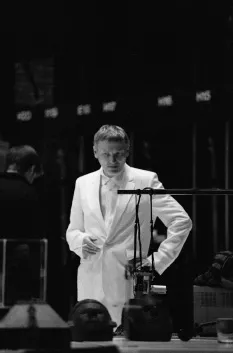
At the beginning of Isabella’s Room, Lauwers strides onto the stage with the rest of the company and sets up the scene by introducing the actors and their roles to the audience. These are the people here, with us, in front of us, in their individuality – Viviane, Anneke, Benoît, Hans Peter, Maarten, Julien, Yumiko, Tijen, Misha – but equally importantly they are collectively ‘the company’, Needcompany: the audience’s company for the duration of the performance, which we appear to have sought out, perhaps to need, by going to the theatre to watch others acting; the company that Jan needs to make theatre in its concrete materiality as bodies, voices, movements, sounds, objects, gestures (Lauwers 2010: 452); the company of actors needed to perform the parts of the play – Isabella, Anna, Arthur, Frank, The Desert Prince, Sister Joy, Sister Bad, Narrator – upon which the event depends dramaturgically. He even introduces himself and his role in the show – ‘the man playing The Man in the White Suit’ (Figure 3), part performer, part observer, part author, part mourner – a role which is clearly already marked by his maleness and whiteness, the given form of his being historically. In presenting himself in this way, alongside the rest of the company, Lauwers is drawing attention both to the materiality of their presence and to the materiality of their making present something like the remembrance of a living history, history as lived and lived through in all of its exigency. The theatre event being set-up is therefore not an act of private commemoration (remembering the father to whom it is dedicated), or public memorialisation (collective recognition of the significance of named people and events), but rather an active representation to be formed by both thinking back, recollecting, and thinking anew, re-imagining, a theatrically constructed past in order to think through the present’s need for relation – to history, to each other – which seems inimical to the very form of the theatrical occasion.
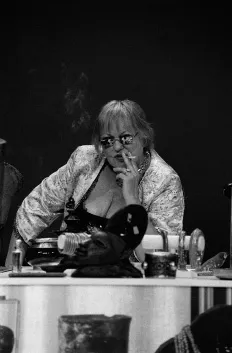
Lauwers appears to inscribe these principles in the heart of the theatrical apparatus, augmenting them dramaturgically with a technical device that draws attention to their specific operation within the show. He introduces Isabella (Viviane de Muynck) as a 90-year-old blind woman, born at the beginning of the twentieth century, who lives alone in a room in Paris. Perhaps because of the coincidence of her age and ‘The Age’ (Le Siècle) she has lived through, she has been chosen as a participant in a unique scientific experiment to project images directly from her brain via a camera installed in her opaque glasses, which she wears throughout (Figure 4): a technological theatron, no less. As an optical instrument this has not, of course, been invented yet; but at the same time, it is something the theatre as techn
has worked with as one of its default ideas for centuries. The device allows Isabella, the blind seer, to represent her memory and imagination, knowledge and desire, experience and insight (and lack thereof) in embodied form so that what she sees, the audience sees (or so it appears at least). Moreover, it enables her to look back over the events of her life, to produce a narrative account of their interrelation, and to have them re-presented in the space and time of Isabella’s Room as still-living ‘reality’. The present is thereby established as a site of remembrance, of re-presenting that operates through both affective storytelling and critical reinvestigation. Janelle Reinelt describes this theatrical apparatus as ‘a memory machine’ (2010: 221), which, following Paul Ricoeur, she characterises as facilitating the creative transition from subjective recollection to historical testimony (Ricoeur 2004: 21). But at the same time, the apparatus also functions as an ‘anthropological machine’ – a machine for the production of the appearance of the human – the process of which might also be described as the subjectivating project of history as such (Agamben 2000: 93). As Ricoeur himself reiterates, ‘we make history, and we make histories, because we are historical’ (2004: 284, 349). Lauwers’ dispositif seems primarily designed to remind us of that, situating Isabella’s story within the context of the experience of the subjectivating events of the twentieth century.
The dramaturgical form this takes is primarily that of a post-epic exposition of dated events and episodes, cross-cut with the aesthetic codes of post-dramatic theatrical performance. The narrator’s opening line establishes the rhythm of the piece with a definitive enunciation: ‘1910: The Desert Princess’, the colon each time underscored by a percussive beat from a synthetic drum reverberating into the auditorium. He gestures with his left hand towards the seated, centre-stage figure of Viviane de Muynck, opening up his bare chest by extending his arm outwards, exposing the beauty and fragility of his physical presence to the audience, drawing attention to the fact of his human being-there, and to the performers’ being-there-together in the theatrical mise en scène. Following the trajectory of the gesture, he pulls away to leave the stage to Viviane to begin to tell the story as a first-person narrative, an embodied account of the life and loves of Isabella Morandi, her lived relations and speculative fantasies. The first bars of the opening song offer a gentle underscore to the speech, reinforcing the musicality of its rhythm at the same time as establishing the simultaneous unfolding of the stage action and retrospective narration. Although all these elements – somatic, scenic, sonic – combine to produce the material fabric of the performance collectively, at the outset it is clear that there is something singular about the effect of de Muynck’s voice on the composition. It resonates with a granular gravity that both bespeaks Isabella’s strength, passion and fortitude, and, equally importantly, de Muynck’s own unique ontology and specific articulation of humanity.
Adriana Cavarero contends that ‘uniqueness resounds in the human voice; or, in the human voice, uniqueness makes itself sound’ (2005: 177). It is certainly something of this order that the audience hears invoked by vocal presence at the same time as being called into a relation with human uniqueness both through the story and its auditory experience. In relating it, de Muynck seems to draw the audience into its reverberation, into its relation of a specific life lived in relation to others, in relation to history, theatrically; or, at least, through theatre as a material form for articulating what Cavarero calls an embodied, contextual, relational ontology of vocal uniqueness (2005: 173). The theatrical apparatus is therefore set up to operate through the play of presence – the presence of the performers on stage in relation to our presence in the auditorium; the unique ‘stage presence’ of de Muynck as an extraordinarily accomplished actor, accomplished precisely by the appearance of ‘not acting’ – in order to draw attention to the historical resonance invoked by the sonorous communication of ontological experience.
And so the story begins. It begins with the description of a scene, a primal scene even, which Isabella claims to be her earliest memory: a scene of looking and listening, of desire and violence, of being a spectator to events whose narration is inscribed with a marked detachment and intimate distance (Lehmann 2007: 74). Isabella recounts watching the nuns in the cellar of the convent where she had been abandoned as a baby, stripped to the waist, washing their hair in ice-cold water with a bar of hard soap; she recalls hearing shots ring out in the courtyard above from soldiers practising for the coming war and the tremulous quivering of the nuns’ naked flesh in their startled response. ‘Everything wobbled’, she says, laughing, echoing the disruptive power of the event on this otherwise enclosed environment at the outset of the century.
Gunshots have a significant subjectivating – and sexualising – effect in Isabella’s life-story, as both narrative turning points and materialisations of the violence of history. She meets her lover, Alexander, after he accidentally shoots her at a book-reading, and loses her sight after another incident involving him shooting her pace Willem Tell; she also loses her grandson (and lover) Frank, to a copper bullet with his name on it forged through his forlorn attempt to live out her blind colonialist fantasy. But all of this comes later in the story. Each event it records and relates resonates through the auditorium like the ricochet of a spent cartridge, underscored by a reverberating thud from the sound-desk. For now, though, we remain at the beginning, with Isabella’s foundational fantasy: the fantasy of her own beginning.
She tells us of her adoption by Arthur, a lighthouse keeper, and his wife Anna; of their drunken but happy lives together on the tiny island outpost; and, most importantly, of their account of the mystery of her ‘real father’, a chimerical desert prince vanished without trace in the course of an expedition. Isabella subscribes to this Orientalist fantasy by christening herself ‘Isabella, the Desert Princess’, and vowing to solve, in true Freudian fashion, the mystery of her father’s secret and her own identity. But, of course, the quotidian reality closer to home proves just as significant to understanding her subjectivity.
1918: at the end of World War I, after Ypres and the devastation of the Flanders fields, after the weaponisation of poison gas and the catastrophe of trench warfare, and yet still at the beginning. The music underscoring Isabella’s exordium erupts from sound into song, a song of the century, whose Beckettian lyric captures with clarity and economy the ethic of perseverance underpinning the trilogy’s aesthetic affirmation of lived experience:
He’s the man, who never stops/ … He’s the man, he’s the man who never stops/ … He just goes on, and on, and on, and on/ … He just goes on, and on, and on, and on …/He just goes on, and on, and on, and on …/
The lyric is then pluralised, speaking for more than a singular existence:
We are the people, who never stop …/We just go on, and on, and on, and on …/We just go on, and on, and on, and on …/We just go on, and on, and on, and on …/We are the people, the people who never stop …/We just go on, and on, and on, and on …/We just go on, and on, and on, and on …/We just go on, and on, and on, and on …/We just go on, and on, and on, and on.…
At the same time as the song goes on, Benoît dances Arthur’s ‘Budhanton Dance’, demonstrating the joyous, sensuous physicality of a recognisably ordinary life, rolling shoulders, chest and arms together in a simple physis of human movement to the obvious pleasure of the other members of the company watching its appearance. Anna accompanies him in parts, singing the song in places, and generally trying to join in the happiness. But as the song ends and Anna’s contribution to Isabella’s narrating of their lives together becomes more dialogical, a certain sentiment of sadness enters the scene, a depressive darkness unable to be staved off by the warmth and brightness of Arthur’s lighthouse fire. Isabella tells of Anna’s consumption by ‘gloominess’, the product of a life lived in the shadow of a secret violence (her violation) which is finally given vent in her funeral dirge, viscerally and somewhat unusually sung by the corpse. That aside, we’re still firmly in the dramatic territory of the nineteenth century, of lives ruined by the misery of the life-lie that comes to define them.
Isabella’s story has already reached back generationally, enacted through her interaction with Anna and Arthur, exposing lives lived in relation to each other. Accordingly, blind Isabella is as much spectator as actor in this memory theatre, with her dead parents resurrected both in order to be present in her story – to enable her to relate it as a series of relationships to others, telling their stories along with her own – and to represent it to her, to tell her who she is through the retroactive revelation of events and their significance. The dramatic unfolding of the story is, then, as much biographical as autobiographical, driven by the desire for relation as narration over and above the memorialisation of the dead or the exposure of their secrets. As Cavarero argues, the encounter with storytelling is an encounter with an ‘interactive theatre’ in which the subject shows ‘who he [sic] is to others’, following the ‘impulse to self-revelation’ to the point of recognising that rather than controlling the narration, the subject discovers in the process of their acting that the meaning of their identity remains an as yet unknown ‘patrimony of an other’ (2000: 22).
1926: in the depths of the great depression, following Anna’s funeral and his descent into the underworld of drink, Arthur leaves Isabella with nothing more than the photograph of a man with a beard, an address in Paris written on the back, and a letter in his own hand, not to be opened until after his death. This a...
Table of contents
Cover
Title
Copyright
Contents
List of Illustrations
Series Editors’ Preface
Acknowledgements
Introduction
1 Song of the Century: Jan Lauwers and Needcompany’s Sad Face/Happy Face Trilogy
2 Naming the Event: Alvis Hermanis and Jaunais Rigas Teatris’ Sonja
3 Falling into History: Romeo Castellucci and Socìetas Raffaello Sanzio’s Tragedia Endogonidia and Divina Commedia
4 Theatre in the Open: Mike Pearson and Mike Brookes’ The Persians and Coriolan/us, National Theatre Wales
5 De-creating the Step of the World: Faustin Linyekula and Studios Kabako’s La création du monde 1923–2012, Pour en finir avec Bérénice, and More more more … Future
Afterword
Bibliography
Index
Trusted by 375,005 students
Access to over 1.5 million titles for a fair monthly price.
Study more efficiently using our study tools.
Frequently asked questions
Yes, you can cancel anytime from the Subscription tab in your account settings on the Perlego website. Your subscription will stay active until the end of your current billing period. Learn how to cancel your subscription
No, books cannot be downloaded as external files, such as PDFs, for use outside of Perlego. However, you can download books within the Perlego app for offline reading on mobile or tablet. Learn how to download books offline
Perlego offers two plans: Essential and Complete
Essential is ideal for learners and professionals who enjoy exploring a wide range of subjects. Access the Essential Library with 800,000+ trusted titles and best-sellers across business, personal growth, and the humanities. Includes unlimited reading time and Standard Read Aloud voice.
Complete: Perfect for advanced learners and researchers needing full, unrestricted access. Unlock 1.5M+ books across hundreds of subjects, including academic and specialized titles. The Complete Plan also includes advanced features like Premium Read Aloud and Research Assistant.
Both plans are available with monthly, semester, or annual billing cycles.
We are an online textbook subscription service, where you can get access to an entire online library for less than the price of a single book per month. With over 1.5 million books across 990+ topics, we’ve got you covered! Learn about our mission
Look out for the read-aloud symbol on your next book to see if you can listen to it. The read-aloud tool reads text aloud for you, highlighting the text as it is being read. You can pause it, speed it up and slow it down. Learn more about Read Aloud
Yes! You can use the Perlego app on both iOS and Android devices to read anytime, anywhere — even offline. Perfect for commutes or when you’re on the go. Please note we cannot support devices running on iOS 13 and Android 7 or earlier. Learn more about using the app
Yes, you can access Theatre and Event by A. Kear in PDF and/or ePUB format, as well as other popular books in Media & Performing Arts & European History. We have over 1.5 million books available in our catalogue for you to explore.