- English
- ePUB (mobile friendly)
- Available on iOS & Android
eBook - ePub
About this book
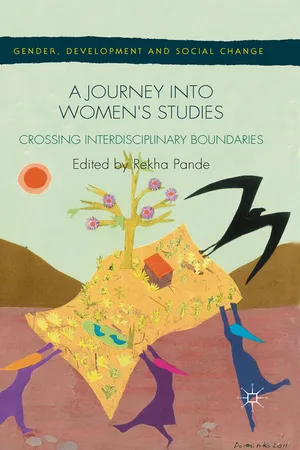
The present book is a journey of many women across the world who have struggled to give women's studies visibility. Drawing upon the contributors' diverse experiences and concerns, it explores the metamorphosis of women's studies from the early days to date.
Information
Part I
Crossing Interdisciplinary Boundaries
1
From the Ground Up
I’d never heard the word “feminist,” and certainly not “suffragette.” This was the late 1960s, and my ignorance was not only stunning but, given my upbringing, it was downright odd.
My California-born mother had gone to an all-women’s college, Mills, in the 1920s; she was one of the first generation of young American women to come of age having the right to vote. After going to co-ed public schools in post-Second World War suburban New York, I also chose to attend an all-women’s college, Connecticut College. For graduate school I returned to my mother’s home state to attend the University of California, Berkeley, where I pursued a doctorate in political science, focusing on Southeast Asia. Joining others at Berkeley, I went on student strike in 1966, carried picket signs, heard Joan Baez sing on the steps of the administration building and switched my adolescent Republican Party affiliation to a more (I imagined) progressive Democratic Party affiliation. Still, I barely noticed that all 50 of my political science professors at this allegedly “radical” Berkeley were men.
Recalling my own prolonged ignorance of women’s subjugation – and of women’s activism to roll back that subjugation – has provided me with a valuable platform for teaching women’s studies. It has stoked my curiosity. How has knowledge of women’s lives been kept so well hidden, even from those girls and women whom one might expect to have had the best chance of gaining that knowledge? Students who come into an “Intro to women’s studies” class never having heard of Virginia Woolf or knowing nothing of women’s roles in the Chinese, Mexican or Algerian revolutions are not empty-headed. Remembering my own ignorance, I realize that they are products of a concerted patriarchal effort to make women’s lives appear – even to women themselves – trivial, irrelevant and boring.
By the early 1970s I was teaching in Ohio. As a Southeast Asian politics specialist, I’d opposed the US war in Vietnam. Having recently returned from doing research in Malaysia, I was then living in southern Ohio, on the borders of Kentucky and Indiana. I was at Miami University (the Miami were originally a local Indian tribe whose members were driven out of Ohio in the nineteenth century by white settlers), a large state university, whose political science department had never before had a woman faculty member. My 15 male colleagues were welcoming, however, and taught me the academic ropes. Though I was a “first” at Miami, I didn’t assign my students to read a single woman author (I’m not even sure I knew of any), and my courses were silent on women’s politics. It was while at Miami that I wrote my first book, Ethnic Conflict and Political Development (1973). I learned so much doing that research, about the dynamics of ethnic politics in colonial rule, in revolutions, in political party rivalries, in state structures and in economic development. But despite all of those men who populated the pages of my book, I didn’t know to pay any attention to their problematic masculinities. And women remained mere ghosts on the page.
During 1971–72, I taught as a Fulbright scholar in the Caribbean country of Guyana. I was drawn to Guyana because it shared with Malaysia a legacy of British colonial rule, an economy dependent on the export of raw materials (bauxite and sugar) and, of special interest to me, a divisive racialized ethnic politics. The students in my University of Guyana seminar (held at night on the edge of a large sugar plantation) were civil servants, both Afro-Guyanese and Indian-Guyanese. They were all men. In fact, all of my friends that year in Georgetown were men, several of them involved in quite risky opposition politics. Focusing so hard on ethnic politics continued to blind me to the crucial gender dynamics both within and between these two communities. Only later would I wonder where women were in sugar, bauxite and banana politics, in electoral politics and in the cultural politics of West Indian literature.
And today, as I’m trying to make sense of the ongoing complex politics of wartime and post-wartime Iraq, I keep recalling how easy it was for me then – as it still is for most commentators today – to pay attention to ethnic and sectarian politics’ analytical primacy over attention to gendered politics. Looking back now at how narrow my questioning was then, the lesson I have learned is always to pay close attention to ethnic, racial and communal politics, but never imagine that one can fully understand those politics unless one vigorously investigates the politics of femininities and masculinities.
The first feminist publication I ever subscribed to was Ms. Magazine. That was in the spring of 1972. I had still never heard of Gloria Steinem, I didn’t know anything about abortion rights and I had never heard the phrase “domestic violence.” But as I read that special first issue of Ms. – an insert inside New York Magazine – I was excited. Here was a whole world of political thinking and political action that was new to me.
It was students at my new university who woke me up to women’s studies. In the fall of 1972, I began teaching at Clark University in Worcester, Massachusetts. Once again I had the dubious distinction of being a “first” in a political science department. Luckily, this time, I shared that distinction with another woman, hired onto the department faculty at the same time. Sharon Krefetz was an American politics specialist, while I focused on comparative politics. Sharon and I didn’t look at all alike, yet male faculty colleagues routinely called each of us by the other’s name. Although women had not been admitted to Clark as undergraduates until the Second World War (to make up for the young men being drafted to fight), the university did enjoy several attributes that made it hospitable to unconventional ideas. Unlike most New England colleges, Clark was thoroughly secular; it had no Christian chapel on campus. Masculinization was diluted by the fact that it didn’t have a football team and fraternities were peripheral. Moreover, Clark’s two most influential departments – geography and psychology – had European intellectual roots. Together, these attributes made Clark especially attractive to post-war American Jewish students and their parents. When I arrived in the fall of 1972, though Jews were a mere 2 per cent of the total US population, they comprised 68 per cent of Clark’s undergraduates. So, teaching at Clark, there was little chance that one could slip into a lazy presumption of American cultural homogeneity.
It was students who initiated women’s Studies at Clark. In 1974, a group of undergraduate women went to the dean, the university’s first woman dean, and said that they had heard from friends at other colleges that there was this new academic field called women’s studies. They weren’t quite sure what it was but it sounded exciting.
The dean called together all of the women faculty on campus (less than a dozen of us) to have a lunchtime conversation with students about this surprising new field. That modest noontime meeting marked a turning point. The students’ eagerness was infectious. None of us faculty had been trained to teach about, or to conduct research on, women, but, with the dean’s support, we plunged in. Sharon Krefetz developed a new course on women in American politics (at the time, women were a mere handful of US congressional representatives and senators, and they were barely visible as governors or mayors). Serena Hilsinger, a professor of English, daringly offered to create a pioneering course that explored fiction by English and American women writers from the seventeenth through the twentieth centuries. Both new courses became instant hits with students.
I promised to work up a new cross-national course on the comparative politics of women (whatever that was!) to start a year later. Developing that course changed my entire understanding of what “political” was. In the mid-1970s there were scarcely any books by political scientists on the comparative politics of women, so I drew heavily on wonderful new books being published then by young feminist historians – on women as textile and garment workers in the early decades of the Industrial Revolution, and on the origins of British, Chinese and Russian women’s organizing and theorizing. This early reliance on feminist historians has had a lasting impact on my thinking: I’ve learned never to imagine that focusing on present-day events is sufficient; causality has deep roots. Still today I avidly read publishers’ catalogues devoted to history. Moreover, it has been my teaching that has continued to shape my research on women’s politics. I do love teaching. I’m still learning from students.
By the 1970s, I was spending several weeks a year doing research in London. At first I continued to concentrate on ethnic politics. At that point, my research interest was particularly on the ethnic and racial politics that shaped both colonial and post-colonial state elites’ strategies for creating and manipulating militaries. I tracked Muslims in the Soviet military, Scots in the British military, Sikhs in the Indian military, indigenous soldiers in the Australian and New Zealand militaries, French in the Canadian military, Kurds in the Iraqi, Syrian and Iranian militaries, whites in the Rhodesian and South African militaries, Kikuyus in the Kenyan military and, of course, Native Americans, Chinese, Japanese and Filipinos, as well as Latinos and African-Americans, in the US military. I tracked states’ recruitment strategies, deployment formulas, regimental mutinies, coup d’etat attempts and elites’ nervousness. I found it all fascinating.
Out of this work came what would be (though I didn’t know it then) my last non-feminist book, Ethnic Soldiers (1980). It was published first in Britain. Despite the glaring lack of gender analysis, publishing this book initially outside the United States had the positive effect of making me think of non-American readers as my first readers. I began consciously to try to avoid making all-too-seductive America-centric assumptions. I realized that being a cross-nationalist analyst wasn’t enough. I had to try to be a transnational thinker/writer as well. That involved not denying my US location but seeking to stretch beyond it. Ethnic Soldiers – or, rather, working with the trade editors of Penguin UK – did something else for me: it made me imagine that my books might be available to readers outside academia. I had become a fan of Penguin paperbacks that year in Malaysia, so I could picture these tantalizing books lining shelves in British and commonwealth bookstores, places where all sorts of readers browsed. That vision was thrilling, but it also made me worry. If Ethnic Soldiers were coming out in a Penguin paperback, I would have to learn how to write accessibly; I couldn’t hide behind arcane “insider” academic language. In fact, I would have to apply the lessons I was learning about how to teach effectively to my writing. My sense of myself as a teacher and as a writer could not be split into two.
Women friends in London soon thereafter started drawing me into the exciting new circles of feminist research and activism. I was introduced to a feminism that sprang out of socialist labor politics (and was critical of masculinized labor union politics and of sexist interpretations of Marxist thinking). I listened to British feminists in standing-room-only halls dissect heterosexism and patriarchy (I had never before heard either term). I added to my subscriptions two British publications, the feminist research journal Feminist Review and the feminist news magazine Spare Rib. I met Jane Hawksley, a then-young British feminist editor at a labor-union-supported small publisher, Pluto Press, who urged me to take a fresh look at all of the militaries I’d been investigating and to start looking for women in those militaries.
Out of this London encounter came my first feminist book, Does Khaki Become You? (1983), which compared the diverse roles of women both in the ranks of, and serving as civilian supporters of the US and British militaries. For the first time I delved into the history and current politics of prostitution and of marriage, topics that no political science professor at Berkley ever suggested I should consider. Once again, I was writing for a British publisher and one whose editors conceived of their potential readers as spanning more than academics. I had begun to realize, too, that to be a feminist book, a book had to be useful to both researchers (students and faculty) and activists. More than that, while writing Khaki I began to see that to be a feminist writer, a writer had to be accountable to readers, and that one could not be held accountable to one’s readers unless those readers could figure out exactly what one was saying.
During 1981–82, as I wrote Khaki, I also suddenly realized that in my earlier books (six of them, none of them gender-curious) there were scarcely any voices of “ordinary” people – that is, of women and men who didn’t wield either intellectual or official authority. Yet the burgeoning feminist histories (and, increasingly, ethnographies) I was then devouring were chock full of women’s voices – voices of textile workers, plantation workers, nurses, labor organizers, writers, wives and reformers. So I deliberately began to look for first-person accounts, newspaper interviews, diaries and memoirs, and I conducted more interviews myself. Women, I thought, should have the chance to speak for themselves in my books, whether or not I found what they had to say uncomfortable or disquieting.
Publishing Khaki expanded my feminist engagements exponentially. It turned out that in the 1980s, scores of women in countries as different as Finland, Israel, Canada, Sweden, Japan, Korea, India, Australia and Turkey were becoming alarmed not just by rising militarism but by women’s complicity in militarization and by male peace activists’ refusal to take seriously feminists’ analyses of militarism. As Khaki took on a transnational life of its own, I had the opportunity to trade hunches with feminists in more and more countries. And that, of course, made me ask more and more new questions. Those questions prompted me to wonder about how all sorts of dynamics in international politics might be better understood if women’s lives were made visible and taken seriously as a source of analysis.
That is when I began asking: where are the women – in the history of colonialism and anticolonialism, the international textile industry, in the political economies of rubber, sugar, tea, and bananas, on and around military overseas bases, in the growing tourism industry and in globalizing domestic work? All of that asking and the resultant digging led to my writing Bananas, Beaches and Bases (1989). It too first appeared in Britain, published by a small feminist press, and then soon after in the United States.
Bananas was published at exactly the time when more and more women were entering the academic field of international relations, one of the most thoroughly masculinized fields of social science. Some of those women – for instance, Ann Tickner and Spike Peterson – were courageously starting to ask explicitly feminist questions that would challenge the masculinist assumptions that, until then, undergirded the study of international politics. The fact that this gutsy band of feminist international relations academics embraced Banana would give the book a wider readership than I could ever have imagined.
Though I found researching and writing energizing, I was still, happily, first and foremost a teacher. Back at Clark in the fall of 1975, women’s studies was off and running. However, we only became a women’s studies faculty group – and, more importantly, a women’s studies faculty community – three years later, when Ximena Bunster arrived on campus from Chile as a visiting professor of sociology and anthropology. Ximena had been one of the last doctoral students trained by famed American anthropologist Margaret Mead. Returning home to Santiago with her doctorate, she introduced feminist ethnographic research methodologies and soon rose to become Chile’s youngest-ever full professor. But a military junta’s brutal authoritarian rule can turn even such an accomplished academic into an exiled, short-contract, non-tenured, visa-dependent visiting professor. That was what Ximena Bunster, driven into exile by Augusto Pinochet, had become in the late 1970s. Despite the insecurity of her position at Clark, Ximena took on the job of transforming the women’s studies faculty group into a genuine community.
Even though they have been hard to hang on to in practice, I still think a lot about Ximena’s feminist academic community-building strategies. First, she opened up our fledgling faculty group to anyone interested in developing a women’s studies course, even if they weren’t quite sure when or how they might do it.
Second, there were no cookie-cutter definitions of who was deemed to be a “real feminist.” Our personalities and styles were varied, a few rough around the edges, but there were never ideological divisions among the wonderfully motley faculty group that came together.
Third, from the outset, Ximena insisted that there should be no status distinctions among us. Visiting faculty, tenure-track untenured faculty, tenured faculty, full professors (a few of us had by then climbed up the ladder) all shared laughs, interests, strategies and gossip (we entitled our first modest, occasional women’s studies newsletter Gossip after its original old-English meaning, “god sister,” a woman who sponsored a child at their baptism – that is, a supporter). I think one of the reasons why so many members of Clark’s women’s studies faculty have gone on to become effective department chairs, program directors and deans is all of the lessons that we taught each other in that group.
Fourth, Ximena, with her feminist anthropologically wide-ranging curiosity, invited women on the staffs of the library, the school of continuing education, the admissions office, and the health and counseling services to join in the Women’s Studies faculty discussions and the meals. We became a lot more realistic about students’ lives and about all the skills and all the women’s labor it takes to run a modern university.
Fifth, Ximena built bridges with the campus’s new student-run women’s center. We held occasional joint discussions about issues such as pornography, meeting in the students’ own space (a basement room in a men’s dormitory!). It was undergraduate women’s studies students that successfully led the campaign to end the student government-funded “porn night” of campus movies. (In the 1970s, many colleges around Boston had student-run, administration-allowed “porn nights.” These were ended only when women students, campus by campus, organized protests against them.) Not long after, a duo of an undergraduate woman, Beth Herr, and a untenured sociology professor, Betsy Stanko, launched Worcester’s first shelter for battered women, Daybreak. Later it was another feminist duo – G’abriel Atchison, a women’s studies doctor...
Table of contents
- Cover
- Title Page
- Copyright
- Contents
- Series Editor’s Preface
- Acknowledgments
- Notes on Contributors
- Introduction
- Part I: Crossing Interdisciplinary Boundaries
- Part II: Articulating Regional Experiences
- Part III: Transnational and Diasporic Experiences
- Index
Trusted by 375,005 students
Access to over 1.5 million titles for a fair monthly price.
Study more efficiently using our study tools.
Frequently asked questions
Yes, you can cancel anytime from the Subscription tab in your account settings on the Perlego website. Your subscription will stay active until the end of your current billing period. Learn how to cancel your subscription
No, books cannot be downloaded as external files, such as PDFs, for use outside of Perlego. However, you can download books within the Perlego app for offline reading on mobile or tablet. Learn how to download books offline
Perlego offers two plans: Essential and Complete
- Essential is ideal for learners and professionals who enjoy exploring a wide range of subjects. Access the Essential Library with 800,000+ trusted titles and best-sellers across business, personal growth, and the humanities. Includes unlimited reading time and Standard Read Aloud voice.
- Complete: Perfect for advanced learners and researchers needing full, unrestricted access. Unlock 1.5M+ books across hundreds of subjects, including academic and specialized titles. The Complete Plan also includes advanced features like Premium Read Aloud and Research Assistant.
We are an online textbook subscription service, where you can get access to an entire online library for less than the price of a single book per month. With over 1.5 million books across 990+ topics, we’ve got you covered! Learn about our mission
Look out for the read-aloud symbol on your next book to see if you can listen to it. The read-aloud tool reads text aloud for you, highlighting the text as it is being read. You can pause it, speed it up and slow it down. Learn more about Read Aloud
Yes! You can use the Perlego app on both iOS and Android devices to read anytime, anywhere — even offline. Perfect for commutes or when you’re on the go.
Please note we cannot support devices running on iOS 13 and Android 7 or earlier. Learn more about using the app
Please note we cannot support devices running on iOS 13 and Android 7 or earlier. Learn more about using the app
Yes, you can access A Journey into Women's Studies by R. Pande in PDF and/or ePUB format, as well as other popular books in Social Sciences & World History. We have over 1.5 million books available in our catalogue for you to explore.