eBook - ePub
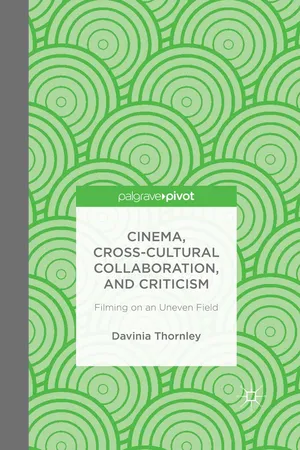
Cinema, Cross-Cultural Collaboration, and Criticism
Filming on an Uneven Field
- English
- ePUB (mobile friendly)
- Available on iOS & Android
eBook - ePub
About this book
Cinema, Cross-Cultural Collaboration, and Criticism provides a platform for a new politics of criticism, a collaborative ethos for a different kind of relationship to cross-cultural cinema that invites further conversations between filmmakers and audiences, indigenous and others.
Information
Subtopic
Art General1
Introduction – Cinematic Cross-Cultural Collaboration: Filming on an Uneven Field
Abstract: As Therese Davis has suggested in her work on Australian collaborations between indigenous and majority filmmakers, the term “collaboration” quickly loses its commonsense meaning: a group of creative people working together on a shared goal. This reading flattens out any conflicting ideologies participants bring to the work, imagining them all on a level playing field – culturally, economically, and spiritually. It is often the reverse: a highly uneven field, weighted strongly toward one side. Rather, Davis sees cross-cultural collaboration as more nuanced, involving conflict, contestation, and compromise (2009). Cinema, Cross-Cultural Collaboration, and Criticism highlights these nuances, using cinematic case studies spanning several countries, indigenous groups, and methodologies. This leads to new kinds of critical understandings and policy implications, addressed in the book’s Conclusion.
Keywords: cinema; collaboration; communication; criticism; critique; cross-cultural; film; filming; Fourth Cinema; Fourth World; indigenous; motion pictures; movies; Native; reviews
Thornley, Davinia. Cinema, Cross-Cultural Collaboration, and Criticism. Basingstoke: Palgrave MacMillan, 2014. DOI: 10.1057/9781137411570.0005.
In this chapter, I introduce two very different events. Both, however, hold promise for collaborative theory and practice more generally, while informing the overall thesis of Cinema, Cross-Cultural Collaboration, and Criticism. The first example points to years of work with several Native communities regarding exhibition planning in preparation for the 2004 inauguration of the National Museum of the American Indian (NMAI) in Washington, DC. The second covers a mid-2010 symposium held at the Australian Centre for the Moving Image (ACMI) in Melbourne to celebrate three decades of indigenous community filmmaking and video by the Yanyuwa people (from Booroloola in the Northern Territories, Australia).
NMAI consultations stretched over a period of years and involved numerous Native communities, with 24 finally featured in the initial exhibitions. Several exhibitions are permanent, others are up for a period of some months or even one or two years; during which time, hundreds of thousands of visitors will interact with them. By contrast, the symposium, which required extensive preparatory work, dealt in the main with one Australian Aboriginal group and lasted for only two days. That said, connections have continued from the symposium, including online publication of the papers presented1 and an ongoing ACMI digital storytelling project. This project involved one of Victoria state’s key indigenous agencies, Koorie Heritage Trust, along with indigenous filmmaker Kimba Thompson and the ACMI, in a collaboration to support many Victorian indigenous communities in “taking back” their stories in (and on) their own terms through digital storytelling (Symposium booklet). I will weave descriptions throughout this first chapter: introducing the collaborative curatorial process at the NMAI and, later, outlining perspectives from the indigenous symposium. Both events raise ideological and thematic issues because of their collaborative nature, which I apply to cinematic projects. These connections in turn point to the end goal of this book: a collaborative criticism that allows for ongoing conversations between filmmakers and audiences, indigenous and other.
The NMAI used a collaborative curatorial methodology, termed the “five-phase process,” in consulting with community groups. The five phases were:
1Meetings with the leadership body to present invitations to participate in the exhibit.
2Fieldwork, including meetings with community curators and research for content development.
3Presentation of draft content and design to community curators (for their suggested revisions).
4Presentation of revised exhibit content and design to community curators (for further review and comment).
5Presentation of final content and design to community curators (150).
Associate Curator Cynthia Chavez Lamar discusses how the process actually unfolded, particularly given that it was necessarily both more fluid and more rigid than originally conceived. It was more fluid because final approval was inserted into the overall five-step process, specifically during steps 3, 4, and 5. As a result, “the co-curators [were] in as much of the decision making as possible (this was not limited to the final approval phases),” despite the geographical and technological hurdles that presented themselves. Lamar states that ongoing collaboration “proved essential to maintaining the integral involvement of the community curators” (151).
However, rigidity often constrained the process as well, largely because of the NMAI’s inherent bureaucracy. Lamar acknowledges, “power and authority were at play, with the NMAI having all the power yet the community curators seemingly granted all the authority to make decisions,” albeit only when requested to by the NMAI as part of the five-phase process (153). Throughout this book, it is emphasized that collaborative film production runs up against many of the same inequalities as those in any kind of power-sharing enterprise, inequalities that are often exacerbated when groups with such different (and often directly conflicting) histories, agendas, and worldviews attempt to work together.
Concerns of this kind are inherent to a book such as Cinema, Cross-Cultural Collaboration, and Criticism. It is a truism that talking about the cinematic representation of indigenous/minority peoples and the issues surrounding those representations is difficult. It is difficult enough when the person speaking is not a minority. It becomes even more difficult when the groups discussed are wary of academic discourse, which has an entrenched history of speaking for them long before yet another book is added to the pile.2 Perhaps it is most difficult when, taking a position considered naive by many critics, the speaker argues that the trend of analyzing indigenous media and finding it lacking is at risk of becoming a theoretical and political dead-end.
This is precisely what I attempt in this book.
Locating our tūrangawaewae (“place to stand”): Where can we speak from?
It is impossible to ignore the fact that many cinematic representations of indigenous and minority peoples have been and continue to be incorrect and even racist. Others are hackneyed and superficial, while perhaps the majority at this point in time try hard but do not meet the mark (a claim often made against one of the films under discussion here, Niki Caro’s Whale Rider (2003)). Both indigenous and nonindigenous scholars have leveled this last criticism, directing it at work created by both indigenous and nonindigenous film personnel about indigenous topics.
For example, Brendan Hokowhitu (Ngāti Pukenga) writes about defending his critical judgment of Whale Rider, particularly given indigenous support for the film from around the world:
To be sure, the reenvisioning of a pre-enlightened Self, seeking spiritual connections with the natural world and surrounded by an insular community, is part of the film’s appeal for indigenous and nonindigenous audiences alike. Indigenous people are not immune to sentimentality and the idealism of humanism. Yet I believe there is a very real danger that the persuasive humanistic romanticism of this simulacrum can dupe indigenous people into confusing the representation with reality. I would suggest that through the privileging of certain portrayals of Māori culture and the “Disneyfication” of a complex neocolonial context, the film freezes and fixates traditional Māori culture as patriarchal. [ ... ] I chastise the filmmakers for creating a simplistic and possibly dangerous depiction. (133)
While Hokowhitu acknowledges positives in Whale Rider as well as concerns, it remains that his article critiques the film and ultimately finds that it falls short. I question why theorists of indigenous and minority representation so often dismiss work on the grounds of cultural inaccuracy,3 without considering other ways a representation may be useful – and successful – for describing a unique culture, especially to audiences unfamiliar with that group. I prefer to begin from the other end and concentrate my energy on examining collaborative aspects of this cinematic project (and others) that were productive – and which have created change on industrial, as well as discursive and ideological, levels. For example, I ask: even while Whale Rider resorts to well-worn cinematic conventions that essentialize Māori culture, how does the film enable cross-cultural collaboration at the levels of narrative and production? Further, how may progress that is apparent make possible theoretical positions that normalize and foreground indigenous epistemologies?
This perspective comes out of questions I have about my own work: as a nonindigenous academic writing about indigenous cinematic representation, it is politically less precarious and often theoretically easier to come down on the side of least resistance, the side that concludes ‘close but no cigar.’ But how does this type of decision-making blind my own and others’ thinking regarding multiple aspects of different films, including production circumstances, thematic concerns, aesthetics, and audience reactions, to name only a few? And – more importantly – how can a different perspective, the building-up of relationships and creativity rather than the breaking-down usually associated with critique, make way for a criticism that facilitates further dialogue and collaboration?
The cross-cultural collaborative ‘conversation’
Discussing indigenous peoples in much of North America and the Pacific, David Pearson states that, despite small numbers, they have become a potent force. Ongoing negotiations for material reparation and political autonomy destabilize state sovereignty, while increasingly global recognition of their position as ‘first nations’ provides a prominent position in public iconography – particularly in relation to the recasting of foundational myths for majority groups in post-settler states (1–2).4
Fourth Cinema is one such nexus where all these concerns come together: film is a place where “material reparation” is made, “political autonomy” is fought for, even as “state sovereignty” is challenged – and, through that challenge, the very myths undergirding the nation of ‘New Zealand,’ for example, are dismantled. Coined by Barry Barclay (Ngāti Apa and Pākehā), an esteemed director, activist, and writer who recently passed away, Fourth Cinema gestures to gains made by indigenous peoples in independence and political representation throughout the 1960s and 1970s, and particularly by the long march to the 2007 United Nations Declaration on the Rights of Indigenous Peoples. “Fourth” suggests a separate, but not lower, designation (as the numerical order might suggest) for films made by and addressing indigenous peoples and their concerns. Distinct from but capable of incorporating mainstream (First) and art house/documentary (Second) formats and themes, Fourth Cinema is further set apart from Third Cinema, which originates from neocolonial Asia, Africa, and Latin America. It also differs from all the other three in its relation to the nation state and its cinematic productions, seeing them as “invader cinemas” (Barclay, “Fourth Cinema”; Bennett).
While Barclay’s formulation is productive, it contains within itself several binaries that limit the way we can think of collaborative cinema, and so it will be used only as a jumping off point for Cinema, Cross-Cultural Collaboration, and Criticism. I prefer to open up the possibilities inherent in collaborative work by seeing Fourth Cinema projects as one essential spearhead – but not the only one – in creating artistic works that benefit indigenous communities. In 1994, Mary Catherine Bateson wrote:
A certain amount of friction is inevitable whenever people with different customs and assumptions meet. [ ... ] What is miraculous is how often it is possible to work together to sustain joint performances in spite of disparate codes, evoking different belief systems to affirm that possibility. As migration and travel increase, we are going to have to become more self-conscious and articulate about differences, and to find acceptable ways of talking about the insights gained through such friction-producing situations, gathering up the harvest of learning along the way. (23)
Further, Bateson wryly notes that particip...
Table of contents
- Cover
- Title
- 1 Introduction Cinematic Cross-Cultural Collaboration: Filming on an Uneven Field
- 2 An Instrument of Actual Change in the World: Engaging a New Collaborative Criticism through Isuma/Arnait Productions Film, Before Tomorrow
- 3 My Whole Area Has Started to Be about Whats Left Over: Alec Morgan, Stolen Histories, and Critical Collaboration on the Australian Aboriginal Documentary, Lousy Little Sixpence
- 4 A Space Being Right on That Boundary: Critiquing Cross-Cultural Collaboration in Aotearoa New Zealand Cinema
- 5 Conclusion Modelling Collaborative Criticism: What Does It Mean to Collaborate Cross-Culturally in Cinema?
- Select Bibliography
- Index
Trusted by 375,005 students
Access to over 1.5 million titles for a fair monthly price.
Study more efficiently using our study tools.
Frequently asked questions
Yes, you can cancel anytime from the Subscription tab in your account settings on the Perlego website. Your subscription will stay active until the end of your current billing period. Learn how to cancel your subscription
No, books cannot be downloaded as external files, such as PDFs, for use outside of Perlego. However, you can download books within the Perlego app for offline reading on mobile or tablet. Learn how to download books offline
Perlego offers two plans: Essential and Complete
- Essential is ideal for learners and professionals who enjoy exploring a wide range of subjects. Access the Essential Library with 800,000+ trusted titles and best-sellers across business, personal growth, and the humanities. Includes unlimited reading time and Standard Read Aloud voice.
- Complete: Perfect for advanced learners and researchers needing full, unrestricted access. Unlock 1.5M+ books across hundreds of subjects, including academic and specialized titles. The Complete Plan also includes advanced features like Premium Read Aloud and Research Assistant.
We are an online textbook subscription service, where you can get access to an entire online library for less than the price of a single book per month. With over 1.5 million books across 990+ topics, we’ve got you covered! Learn about our mission
Look out for the read-aloud symbol on your next book to see if you can listen to it. The read-aloud tool reads text aloud for you, highlighting the text as it is being read. You can pause it, speed it up and slow it down. Learn more about Read Aloud
Yes! You can use the Perlego app on both iOS and Android devices to read anytime, anywhere — even offline. Perfect for commutes or when you’re on the go.
Please note we cannot support devices running on iOS 13 and Android 7 or earlier. Learn more about using the app
Please note we cannot support devices running on iOS 13 and Android 7 or earlier. Learn more about using the app
Yes, you can access Cinema, Cross-Cultural Collaboration, and Criticism by D. Thornley in PDF and/or ePUB format, as well as other popular books in Media & Performing Arts & Art General. We have over 1.5 million books available in our catalogue for you to explore.