eBook - ePub
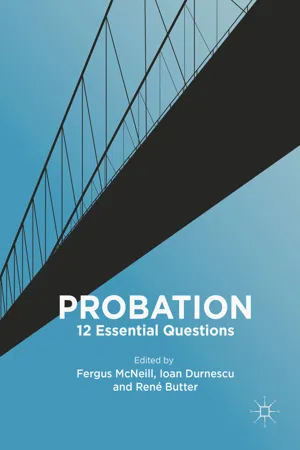
Probation
12 Essential Questions
- English
- ePUB (mobile friendly)
- Available on iOS & Android
eBook - ePub
Probation
12 Essential Questions
About this book
This volume poses a series of key questions about the practice of probation as an integral part of the European criminal justice system. The contributors are established experts in their respective fields of study and together their questions address the legitimacy, and perhaps continued existence, of probation.
The book offers analyses of why people offend and stop offending, and the wide ranging impacts of probation. This includes the impact on offenders' social reintegration, as a form of reparation for victims and communities, on public desire for justice and punishment, and on probationers themselves. The contributors further assess the state of probation and its adaptation to the current state of penality and society, the role of probation officers in pre-sentencing decision-making and the promotion of community sanctions and measures. By providing important recommendations and suggestions for application to practice, the book will be of great interest to academics,students, policy makers and practitioners alike.
Information
© The Editor(s) (if applicable) and The Author(s) 2016
Fergus McNeill, Ioan Durnescu and René Butter (eds.)Probation10.1057/978-1-137-51982-5_3What Are the Most Important Studies of Desistance and What Are the Future Research Needs?
Lila Kazemian1
(1)
Department of Sociology, John Jay College of Criminal Justice University of New York, New York, USA
This chapter draws from various sections of the following publication:
Kazemian, L. (2015). Desistance from crime and antisocial behavior. In Morizot, J. & Kazemian, L. (eds), The Development of Criminal and Antisocial Behavior: Theory, Research and Practical Applications (pp. 295–312). New York: Springer.
The Relevance of Desistance Research
The association between age and crime is one of the best- established facts in the field of criminology. It is generally agreed that aggregate crime rates peak in late adolescence/early adulthood and gradually drop thereafter, but there remains some debate about the cause of this decline. Information about protective factors that foster or accelerate desistance also informs interventions after the onset of criminal careers. Once onset has occurred, efforts should be invested in limiting the length, intensity and seriousness of criminal careers. Identifying life-course transitions and cognitive factors that contribute to desistance from crime can provide useful information for post-onset interventions. This chapter provides an overview of the most important studies on desistance and underlines future research needs.
Explanations of Desistance
This section aims to provide a brief summary of some of the key findings derived from influential studies on desistance from crime. Major findings on the social, cognitive, and genetic predictors of desistance are presented. While the focus is on desistance from crime, findings are likely to be generalizable to other forms of problem behaviors. Laub and Sampson’s (2001, p. 38) extensive review suggested that “the processes of desistance from problem behaviors such as alcohol dependency are quite similar to the processes of desistance from predatory crime.”
It should be noted that results may vary from one study to another as a result of divergent definitions of desistance (Kazemian 2007). Although several researchers have acknowledged the relevance of perceiving desistance as a process rather than an event that occurs abruptly (Bottoms et al. 2004; Bushway et al. 2001, 2003; Laub et al. 1998; Laub and Sampson 2001, 2003; Le Blanc 1993; Loeber and Le Blanc 1990; Maruna 2001; Shover 1983), the dichotomous definition of desistance as the opposite of recidivism remains common.1 Reviews of the literature have suggested that when prospective longitudinal data are not available, observation periods are short, and dichotomous measures of desistance are employed, desistance is likely to indicate a temporary lull in offending as opposed to the permanent cessation of crime (see Kazemian 2007).
Over 25 years ago, Le Blanc and Fréchette (1989, followed by Loeber and Le Blanc 1990 and Le Blanc and Loeber 1998) developed a definition of desistance that extended beyond the dichotomous measure. This definition integrated four dimensions. The authors argued that before criminal activity ceases completely, the frequency of offending declines (deceleration), offenders engage in less-diverse offense types (specialization), transition to committing less serious offenses (de-escalation), and a culmination point is reached. This definition is consistent with the operationalization of desistance as a process, but it remains underutilized in desistance research. Most (quantitative) desistance research continues to adopt a dichotomous definition of desistance, most likely owing to the convenience and availability of recidivism data as opposed to data on other criminal career parameters.
Social Predictors of Desistance
A large body of research on desistance has drawn attention to the importance of social bonds in the process of desistance. Desistance from crime is said to be gradual, resulting from an accumulation of social bonds (see Horney et al. 1995). Irwin (1970) identified three key factors in the explanation of desistance from crime: a good job, a good relationship with a woman, and involvement in extracurricular activities. Giordano et al. (2002) made reference to the “respectability package”, and argued that marriage and job stability exert a more substantial impact on desistance if they occur jointly. In this respect, turning points (marriage, employment, etc.) are likely to be interdependent. Life events can either be positive or negative, depending on the “quality, strength, and interdependence of social ties” (Sampson and Laub 1993, p. 21). In this respect, adult crime would largely result from weak bonds to social institutions, and desistance from crime would entail some “social investment” in conventional institutions.
Employment
The general consensus in the literature is that job stability promotes desistance from crime (Giordano et al. 2002). Using data from the National Supported Work Demonstration Project, Uggen (2000) explored the effect of employment on recidivism. This project recruited participants from underprivileged neighborhoods and randomly assigned them to control or experimental groups. Offenders, drug users and dropouts were targeted. Individuals in the treatment group were given minimum-wage employment opportunities. Results showed that the program had a more substantial impact on older individuals (over 26 years of age). This finding is consistent with Morizot and Le Blanc’s (2007) analyses of a sample of adjudicated French-Canadian males, which showed that employment exerted a positive effect on desistance only at specific developmental periods. Furthermore, “offenders who are provided even marginal employment opportunities are less likely to reoffend than those not provided such opportunities” (Uggen 2000, p. 542). Although the general consensus in the literature is that employment (and employment stability) exerts an impact on desistance, some studies have found that employment did not have an impact on the likelihood of desistance from crime (Giordano et al. 2002).
The life narratives explored in Laub and Sampson’s (2003, p. 129) study suggested that “stable work may not trigger a change in an antisocial trajectory in the way that marriage or serving in the military does, even though employment may play an important role in sustaining the process of desistance”. Analyzing data from a random sample of Texas male parolees, Tripodi et al. (2010) found somewhat similar results. Their findings showed that employment was not significantly associated with a reduced likelihood of reincarceration, but was linked to longer time lags to reincarceration (i.e., more time “crime-free in the community”). As highlighted by the authors, this interesting finding underlines the importance of studying desistance as a process:
The explanation for this insignificant finding, however, requires a shift in perspective from a “black and white” view of ex-prisoners as either recidivists or nonrecidivists. This traditional view of parolees leaves little middle ground for ex-prisoners who are in the process of changing. Instead, a more complex view of offenders is needed to recognize that they may fall on a spectrum of behavior change that consists of various stages. (p. 714)
Interestingly, a study drawing on a sample of recidivist Norwegian males found that employment is a consequence, and not a cause, of desistance (Skardhamar and Savolainen 2014). Modeling changes in offending behavior before and after exposure to employment, the authors found that most individuals had desisted from crime prior to obtaining employment, and that being employed did not result in additional decreases in criminal behavior. Skardhamar and Savolainen (2014) did detect a small group of individuals who exhibited reductions in offending behavior after obtaining employment, but they were a very small minority of the sample. This study is important because it demonstrates the crucial influence of selection effects in explaining the association between turning points and desistance.
Laub and Sampson (2003) argued that the processes underlying the relationship between work and desistance are similar to those underlying the relationship between marriage and desistance.
Employment promotes desistance through four main processes: (1) a reciprocal exchange of social capital between employer and employee; (2) more limited exposure to criminal opportunities and a reduced “probability that criminal propensities will be translated into action”; (3) direct informal social control; and (4) the development of a “sense of identity and meaning to one’s life” (Laub and Sampson 2003, p. 47). Finally, the impact of employment as a turning point appears to also act conjointly with other social transitions. Sampson and Laub’s (1993) results reveal interaction effects between various social institutions and desistance from crime. For example, they find that the impact of job stability on desistance is not as significant among married men.
Marriage
The strong link between marriage and desistance has been highlighted in various studies for the past few decades, and continues to hold in contemporary research (Bersani et al. 2009; Craig and Foster 2013; Doherty and Ensminger 2013; Farrington and West 1995; Horney et al. 1995; McGloin et al. 2011; Sampson and Laub 1993, 2003). The most influential findings have emerged from the Glueck data, the Cambridge Study in Delinquent Development, and Horney et al.’s (1...
Table of contents
- Cover
- Frontmatter
- Introduction: Questions, Questions, Questions
- Why Do People Commit Crimes?
- What Are the Most Important Studies of Desistance and What Are the Future Research Needs?
- What Is the Impact of Probation in Advising Sentencing and Promoting Community Sanctions and Measures?
- Has Probation Any Impact in Terms of Reparation to Victims and Communities? Complicating a Simple Question
- What Is the Impact of Community Service?
- What Is Probation’s Role in Successful Social Integration (Resettlement) of People Leaving Prison? A Piece in the Jigsaw
- What Is the Impact of Probation on Satisfying the Public’s Desire for Justice or Punishment?
- What Are the Costs and Benefits of Probation?
- Experiencing Supervision: From ‘Sparing the First Offenders’ to ‘Punishment in the Community’ and Repairing the Harm Done
- Electronic Monitoring and Probation Practice
- Explaining Probation
- Conclusion: The 12th Question
- Backmatter
Trusted by 375,005 students
Access to over 1.5 million titles for a fair monthly price.
Study more efficiently using our study tools.
Frequently asked questions
Yes, you can cancel anytime from the Subscription tab in your account settings on the Perlego website. Your subscription will stay active until the end of your current billing period. Learn how to cancel your subscription
No, books cannot be downloaded as external files, such as PDFs, for use outside of Perlego. However, you can download books within the Perlego app for offline reading on mobile or tablet. Learn how to download books offline
Perlego offers two plans: Essential and Complete
- Essential is ideal for learners and professionals who enjoy exploring a wide range of subjects. Access the Essential Library with 800,000+ trusted titles and best-sellers across business, personal growth, and the humanities. Includes unlimited reading time and Standard Read Aloud voice.
- Complete: Perfect for advanced learners and researchers needing full, unrestricted access. Unlock 1.5M+ books across hundreds of subjects, including academic and specialized titles. The Complete Plan also includes advanced features like Premium Read Aloud and Research Assistant.
We are an online textbook subscription service, where you can get access to an entire online library for less than the price of a single book per month. With over 1.5 million books across 990+ topics, we’ve got you covered! Learn about our mission
Look out for the read-aloud symbol on your next book to see if you can listen to it. The read-aloud tool reads text aloud for you, highlighting the text as it is being read. You can pause it, speed it up and slow it down. Learn more about Read Aloud
Yes! You can use the Perlego app on both iOS and Android devices to read anytime, anywhere — even offline. Perfect for commutes or when you’re on the go.
Please note we cannot support devices running on iOS 13 and Android 7 or earlier. Learn more about using the app
Please note we cannot support devices running on iOS 13 and Android 7 or earlier. Learn more about using the app
Yes, you can access Probation by Fergus McNeill, Ioan Durnescu, René Butter, Fergus McNeill,Ioan Durnescu,René Butter in PDF and/or ePUB format, as well as other popular books in Social Sciences & Criminal Law. We have over 1.5 million books available in our catalogue for you to explore.