- English
- ePUB (mobile friendly)
- Available on iOS & Android
eBook - ePub
About this book
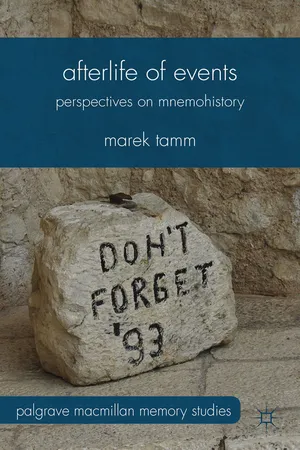
Recently, we have witnessed a rearticulation of the traditional relationship between the past, present and future, broadening historiography's range from studying past events to their later impact and meaning. The volume proposes to look at the perspectives of this approach called mnemohistory, and argues for a redefinition of the term 'event'.
Information
Part I
Theoretical Reflections
1
Historical Event between the Sphinx and the Phoenix
Wherever we look, we see testimony of the return of the event. The notions of structure, invariant, longue durée, immobile history have been superseded by those of organizing chaos, the fractal, disaster theory, emergence, enaction, mutation, rupture … . This shift affects not only the discipline of history. It is present in all the human sciences and testifies to a fresh focus of attention on the novel results that such renewed questioning of the event may bring forth. After a long eclipse of the event in the humanities, its spectacular ‘return’ that we are observing now has nothing much to do with the restrictive concept that was held by the nineteenth-century methodological school of history. The aim of the present chapter is to try to find a way of understanding this new era that we are passing through, an era of a new relationship with historicity marked by the evenementalization of meaning in all domains. It is not just a return that we are going through, but, rather, a renaissance or a return of difference.
A revived appetite for events is indicated, among other things, by the fact that a book illustrating the milestone events of French history, published in France in 2005 under the direction of Alain Corbin, a historian particularly innovative in his discipline, quickly became a best-seller (Corbin 2005). The book is based on the brilliant idea of addressing an old, antiquated history textbook published in 1923 for primary school students, revisiting its sketches of the great events of French history, and counterposing to this national gospel the scholarly vision of some 50 contemporary historians. What becomes of the event in such an experiment? Does it mean a simple return to a factual evenementality or the birth of a new understanding of the event? And, most importantly, has the question been asked: What is an event?
What is an event?
First, it will be wise to turn to some dictionaries in order to remind ourselves of how the French word événement has evolved over time. Its use in French is attested from the fifteenth century onwards, when its meaning was particularly broad and vague, signifying everything ‘that happens’. Its origins, as we are reminded by Alain Rey (1992: 751), are in the Latin evenire, meaning ‘to come out of’, ‘to result’, ‘to occur’, to happen, thus signifying a coming to pass, an advent. In Cicero’s use, for instance, it evokes the end of a process, its result. At the same time, the word événement comes from eventum and eventus, designating a phenomenon insofar as it makes a rupture, but it is rarely used unless in the plural: eventa. ‘Perhaps even more, it suggests that the outcome may be happy’ (Boisset 2006: 18). Unlike the modern meaning, the Latin definition does not intend to signify anything unexpected or the emergence of anything new. An antecedent to the idea of event can already be found in the Greek world, in the concept of Kairos. The Greeks saw Kairos as uniting in himself the power of both Aîon and Chronos, making it possible to perform an action in an opportune moment which was not to be missed. The divinity representing Kairos was a handsome young man with a thick mane of hair, which one had to grab in order to profit from his furtive passage. If successful, this operation allowed one to act efficiently, to stay on top of the situation by grasping it, in all its intricacy, with both hands, thus making a radical change possible. The term Kairos is particularly difficult to translate, as we are told by Barbara Cassin (1995), who considers it a peculiarity of sophistical temporality. The concept evokes both breakage and opening, and is opposed to telos: ‘The Kairos is autotelic, it contains its aim in itself.’ This furtive passage – through which it becomes possible to dispense with the idea of finality – only finds its identity in singularity.
In the sense dominant in the sixteenth century, the term événement refers to the fact of leading up to some issue, success or outcome. For a long time it continues to be used in this sense, even as the latter begins to fall into disuse. Then, in the seventeenth century, this meaning gradually disappears and is supplanted by that of something that has come to pass – something of some importance, and by nature a bit exceptional, breaking a routine – the sense it has retained ever since. But this stratification of meaning has enabled multiple usages, borrowing from one or another of these meanings. Thus, Flaubert uses the word to signify just about anything that fits into the temporal framework: ‘In a time like that, I have no visitors and no event, howsoever small, finds its way into my level existence graced by very little entertainment’, and as referring to the exceptional: ‘Hamilcar did not give way. He was reckoning upon an event, upon something decisive and extraordinary’ (Flaubert 1863: 90).
A triple stratification of the term événement can already be distinguished in French before the modern period. First, the term is linked with a form of causality, either by assuring an outcome or a result or by creating the conditions necessary for its realization: ‘My case will finally be heard in early winter … Not that I’m worried about the outcome [événement]: in the first place, I am completely in the right, as all my lawyers assure me.’ This use is regarded as an old legacy from the past, relegated into the literary sphere. The second sense establishes a connection with one or more human subjects and refers to that which happens to someone, whether it be positive or negative, whence the phrases ‘happy event’ and ‘sad event’. The third meaning is that of an unexpected rupture in the flow of time: ‘This is the dramatic incident; an affinity between “dramatic incident” and “dénouement” can be noticed here: dénouement being originally a form of discord’ (Boisset 2006: 23).
The evolution of these three forms of definition between the seventeenth and nineteenth centuries is easy to follow through the successive editions of the Dictionnaire de l’Académie. The edition of 1694 reveals the coexistence of the three meanings, presenting ‘the issue, success of sth’, as well as ‘a remarkable adventure’ and, finally, ‘a surprise’, all together. The edition of 1835 testifies to a reversal of priorities. Everything referring to issue or result is banished to the third position and pride of place given to the idea of rupture: ‘The word also gains in neutrality and is confined to expressing “that which happens”’ (Boisset 2006: 24). Moreover, while evolving, the term also grows more problematic and calls itself into question. This is where the whole interest of the term événement lies: that it has conserved up to the present the tension between the two poles that constitute its semantic nature. Due to its double ancestry, the term in fact refers equally to both the causal idea of issue and the notion of something unexpected, of surprise; and Emmanuel Boisset justly refers to what will be our aim in the present chapter, namely that ‘Nowadays, it would be difficult to reduce événement to such a lexical definition as would not in the end constitute an attempt to interpret it’ (Boisset 2006: 27).
The human sciences, having sought to constitute themselves around bringing out permanences and invariants, if not, indeed, laws, have long regarded the event as a perturbing, contingent, weakly defined element which it would be a good idea to do away with, in the name of a scientific approach. This approach is well delineated in an article published by Roger Bastide, towards the end of the 1960s, in the Encyclopaedia Universalis. In his view, the event is seen as occupying a twofold position, held in tension between
that of the person surprised by its ‘coming to pass’, traumatised by it, or perhaps on the contrary savouring its uniqueness, peculiarity and novelty; and that of the scholar who, although well aware that duration cannot be anything but a ‘series of events’, cannot help turning them over and over in his mind to try and distinguish behind their discontinuity the logic of their succession.
(Bastide 1968–1975: 822)
The sociologist Roger Bastide naturally gives priority to the fundamentally anthropocentric dimension of the event, whose definition, for him, cannot encompass everything that comes to pass, because ‘there is no event, other than event for the human being and through the human being’ (Bastide 1968–1975: 823). But the 1960s, overwhelmingly dominated by Lévi-Strauss’s structuralism as they were, led Bastide to regard the scholarly position as one of pursuing structural goals, leaving aside the evenemental bustle, seen as insignificant. Thus, the scholar must always and above all reproduce the logic wherein he claims to dissolve the singularity of events. The perturbing dimension of all events, whether they be happy or sad as compared with the governing equilibrium, encourages the human desire to control the potential chaos in order to gain the upper hand and better govern their own lives. This is why, according to Bastide, from archaic societies onwards man has always been devoted to creating a science of events, so as to better control them. Among the sciences pursuing this goal, he distinguishes three types. Archaic societies employ in this role the numerous divinatory systems based on the mythological foundations of their civilizations. In historical societies, beginning with the Hebrews of the Old Testament and the ancient Greeks, the role of controlling and governing is played by history insofar as it constitutes a science of chronology which organizes the uniform flow of time around a certain number of landmark events. And, finally, in contemporary society Bastide sees the emergence of a new discipline provided with a forecasting power which aims at looking into the future in order to better manage hazardous events. But this list hardly exhausts the ambivalence that continues to mark the concept of the event between its possible affiliation to a temporal logic permitting the pinpointing of its invariants, on the one hand, and ‘that which resists our mind, remaining hopelessly “opaque” to it’ (Bastide 1968–1975: 824), on the other.
The event and its traces
Today all this has changed, and the returning event is scrutinized with an eye that, while quite as scientific, nevertheless assigns to it all the due credit. Having become a significant clue or trace, the event is understood in a twofold sense, justified by its etymology, both as a result and as a beginning, as an outcome and as an opening of the possible. It might even be said that the Deleuzian idea, according to which ‘the possible is not pre-existent, it is created by the event. It is a matter of life’ (Deleuze and Guattari [1984] 2003: 216), is tending to impose itself, while previously it rather used to be that which preceded the event – the causal sedimentation that seems to provoke its emergence – that was privileged.
The monster-event, the world-event that shakes the whole nation, as well as the micro-event that merely complicates the ordinary life of an individual – both of them increasingly present themselves as unresolved riddles of the Sphinx, who comes to challenge the limits of rationality and succeeds in demonstrating not their inanity, but their inability to saturate the meaning of that which intervenes as something new, because, deep down, the enigma carried by the event survives even as its vehicle disappears. Raymond Aron already emphasized that shift, characteristic of the twentieth century, towards a modern understanding of the event as something unmasterable: ‘The French term événement (from the Latin eventus) has, on the contrary, historically emphasized the unforeseeable and unforeseen outcome of that which comes to pass’ (Aron 1961: 155).
But the event-Sphinx is simultaneously also an event-Phoenix that never really expires. Leaving multiple traces, it keeps returning to play again, in its spectral presence, with subsequent events, bringing about novel configurations every time. In this sense, there are but few events that one could with certainty assert to be finished, since they are always susceptible to later replay. Besides, the renewed interest in singular phenomena assures a new centrality to the notion of event. A few years ago we had occasion to study a similar trend that fuels the taste for biographies (Dosse 2005). Since the event destructures, it also restructures time according to new modalities. The attention paid to storytelling, narrative and traces leads to a higher esteem for the subjective aspect, the personal and individualized apprehension of time. For example, Paul Ricœur (1990: 169) writes: ‘I say that by entering into a narrative which combines person with intrigue, the event loses its impersonal neutrality.’ Some thinkers even use it in their search for an ideal-typical concept that might account for the biographical event, by taking up the ternary relation suggested by Erving Goffman between the ego position, defining the subject as a witness of and actor in the event; the position of the so-called objective referent that places the subject in the position of victim; and the position of rapport with others (Leclerc-Olive 1997: 59).
As Didier Alexandre has underlined, ‘the event may be a natural phenomenon, either catastrophic or insignificant; or a socio-historical phenomenon affecting a collective. But as long as the event has no subject in the present – that is, as long as no individual works out an understanding of it – it remains pure phenomenon’ (Alexandre 2004: 179). Crossing the ideas of the human sciences with those drawn from literary fiction, Alexandre turns to the novelistic work of Claude Simon, which rests on a foundation of omnipresent events. Thus, in his largely, though not avowedly, autobiographical novel Le jardin des plantes, Claude Simon amasses in fragmentary form a number of events that have left their mark on him from childhood. The fragments are as diverse, and of as unequal weight, as the absence of his father, his fall into a pond, and, indeed, the death of his mother. But the overarching event that dominates the whole and is revisited again and again, in various ways, as an inescapable rumination is the hour during which the author followed his colonel ‘apparently gone mad on the road from Solre-le-Château to Avesnes on 17 May 1940; certain that I would be killed in the next second’ (Simon 1997: 223). That traumatic event had already been narrated, notably in La Route des Flandres and L’Acacia. It is the red thread running through all of Simon’s fiction, overhanging the author’s life like a ‘conscious traumatism’. The scene takes place after just eight days of war and a hellish death march. At the beginning of May 1940, the Germans launched a massive offensive in the Ardennes; 33 divisions supported by artillery and air strikes pressed on between Namur and Sedan, and against them the French general staff dispatched no more than nine divisions, half of their numbers consisting of light cavalry regiments like the one Claude Simon was enlisted in. The outcome of the battle left no room for doubt. The French troops were annihilated or taken prisoner practically without battle. The only survivors in the author’s completely encircled battalion were himself and his colonel – until the latter, too, was killed.
This occurrence opening onto an abysmal absence of future, of programmed-in death, assumes the nature of a founding break for Simon – similar to what the clinical psychologists call ‘fright neurosis’ – which profoundly modified the psyche, the behaviour and, most importantly, the writing of Simon, who would go on to use paradoxical figures that drive home the fear by exposing the ever-contradictory character of the event in metaphors that almost surpass human understanding. The same goes for the anarchist insurrection of Barcelona: ‘Referring to the revolution as a stillborn child multiplies the breaks. With this reference, Simon reunites the two events prototypical for all human beings, birth and death – events so profound as to always elude the subject’s understanding’ (Alexandre 2004: 185).
Staying aloof from a too radical exploding of the notion of event in favour of the structure, Philippe Joutard launched in 1986 a conference dedicated to the event, with the professed aim of striving for a clearer articulation of the short and long timescales and ‘underlining the decisive role of historiography in understanding the notion of event, keeping in mind at the same time that any event is, in a way, a construction of the collective memory’ (Joutard 1986: 3). On that occasion, two German historians, Hans-Jürgen Lüsebrink and Rolf Reichardt, presented their study of a major event, which was the storming of the Bastille, in the capacity of a total event, looking to construct a specific approach to the event in the modern period. In this one event, they saw the coalescence of four event types. First, it was an event-sensation, referring to a fact that is out of the ordinary, normal state of things, constituting a break of the everyday uniformity in very limited space-time. Second, the storming of the Bastille depended on political eventuality and largely relied on the new printed media for spreading information. To be sure, the event was first and foremost a surprising, unexpected thing, yet at the same time the ground was prepared for it by the contemporary press. Third, it was an event-catalyst, distinguishable from the two former aspects by its social and mental roots an...
Table of contents
- Cover
- Title Page
- Copyright
- Contents
- List of Illustrations
- Acknowledgements
- Notes on Contributors
- Introduction: Afterlife of Events: Perspectives on Mnemohistory
- Part I: Theoretical Reflections
- Part II: Empirical Analyses
- Afterthoughts on Afterlives
- Index
Trusted by 375,005 students
Access to over 1.5 million titles for a fair monthly price.
Study more efficiently using our study tools.
Frequently asked questions
Yes, you can cancel anytime from the Subscription tab in your account settings on the Perlego website. Your subscription will stay active until the end of your current billing period. Learn how to cancel your subscription
No, books cannot be downloaded as external files, such as PDFs, for use outside of Perlego. However, you can download books within the Perlego app for offline reading on mobile or tablet. Learn how to download books offline
Perlego offers two plans: Essential and Complete
- Essential is ideal for learners and professionals who enjoy exploring a wide range of subjects. Access the Essential Library with 800,000+ trusted titles and best-sellers across business, personal growth, and the humanities. Includes unlimited reading time and Standard Read Aloud voice.
- Complete: Perfect for advanced learners and researchers needing full, unrestricted access. Unlock 1.5M+ books across hundreds of subjects, including academic and specialized titles. The Complete Plan also includes advanced features like Premium Read Aloud and Research Assistant.
We are an online textbook subscription service, where you can get access to an entire online library for less than the price of a single book per month. With over 1.5 million books across 990+ topics, we’ve got you covered! Learn about our mission
Look out for the read-aloud symbol on your next book to see if you can listen to it. The read-aloud tool reads text aloud for you, highlighting the text as it is being read. You can pause it, speed it up and slow it down. Learn more about Read Aloud
Yes! You can use the Perlego app on both iOS and Android devices to read anytime, anywhere — even offline. Perfect for commutes or when you’re on the go.
Please note we cannot support devices running on iOS 13 and Android 7 or earlier. Learn more about using the app
Please note we cannot support devices running on iOS 13 and Android 7 or earlier. Learn more about using the app
Yes, you can access Afterlife of Events by Marek Tamm in PDF and/or ePUB format, as well as other popular books in Social Sciences & Literary Criticism. We have over 1.5 million books available in our catalogue for you to explore.