eBook - ePub
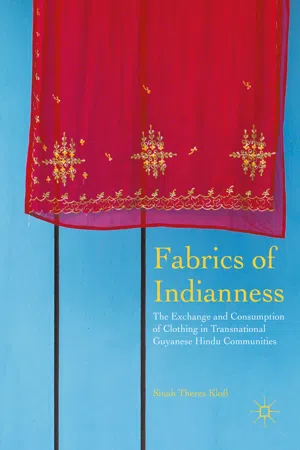
Fabrics of Indianness
The Exchange and Consumption of Clothing in Transnational Guyanese Hindu Communities
- English
- ePUB (mobile friendly)
- Available on iOS & Android
eBook - ePub
Fabrics of Indianness
The Exchange and Consumption of Clothing in Transnational Guyanese Hindu Communities
About this book
This book describes how Guyanese Hindus recreate Indian ethnic identity in contemporary Guyana and examines how Hindu traditions have been transformed in this multi-religious and multi-ethnic society. By illustrating the exchange and consumption of clothing, the book demonstrates that the practices of wearing and gifting clothes materialize and visualize relationships. The significant outward migration of Guyanese to North America has resulted in substantial international gift exchange and transnational rituals. Applying the concept of translocality, this book demonstrates that different localities continue to influence transnational networks and socio-cultural practices. It provides a study of migration that emphasizes various aspects of material and visual closeness, conceptualizing the notion of touch.
Information
Topic
Scienze socialiSubtopic
Antropologia© The Editor(s) (if applicable) and The Author(s) 2016
Sinah Theres KloßFabrics of Indianness10.1057/978-1-137-56541-9_11. Guyanese Hinduism and the Study of Clothing: An Introduction
Sinah Theres Kloß1
(1)
University of Cologne, Köln, Germany
Canefield is a village in Berbice, Guyana, situated near the Canje Creek, in the proximity of Rose Hall Estate. It is divided into eastern and western sections by a public road, a busy road that leads to the sugar estate and beyond, connecting and arranging those settlements. The boundaries of the villages have blurred due to population growth and the expansion of housing infrastructure. Today, it is hard to see where one village begins and the other ends. Newly erected signs denote village names, sponsored by either Pepsi or MoneyGram. They are hardly noticed by the local population but helped me to distinguish the villages. It was mostly the name—Canefield—that led me to stop the ‘Canje car’ there, one of the shared five-seater taxis, in May 2011.1 I was intrigued by the directness and significance of the name ‘Canefield.’ To me, it not only highlighted the impact of colonial history and the importance of sugar for the region now and then, but also created a feeling of ‘authenticity.’ It was precisely in this shared taxi that I met Divya2 from Canefield, daughter-in-law of my future Guyanese host family, who had ‘walked’ (traveled) to New Amsterdam to buy groceries for the week. Instantly, I came to enjoy the well-known and often proclaimed Canje hospitality as I was invited to her home, where I was introduced to my future hosts Seeram and Joanne, heads of the household and her parents-in-law. Seeram, repairing and cleaning his motorbike, and Joanne, ‘shakin’ (swinging) in her hammock in the bottomhouse,3 were immediately interested and curious to engage in conversation about Hinduism with me. As a white woman, and therefore obviously a foreign visitor, my interest in Hinduism was rather unusual to them, but also a delight, as most strangers eager to talk about religion are Christian missionaries, they claimed.
During fieldwork in Guyana I was asked almost on a daily basis if I was a Christian missionary. Often, when I approached Hindus for conversation, topics like ‘idol worship’ were addressed immediately.4 Initially, I was worried that the general assumption of my being a missionary would lead to people not trusting me, but by regularly attending Hindu services and by conveying a sincere interest in all aspects of Hindu ritual and philosophy, I was able to quickly discard these suspicions. Noteworthy in this regard was an occasion on which Seeram was asked by colleagues at work if the ‘white gyal’ (white girl) living with his family was a missionary. Proudly, he told me later, he had replied that I was indeed a missionary, but a ‘Hindu missionary.’ As I discuss throughout this study, this statement not only revealed my personal influence on the people I interacted with and the local society in general, but also showed the central Guyanese Hindu concern of conversion to Christianity, indicating notions of hierarchy, class, and respectability, as elaborated in Chap. 3.
From the beginning, Seeram proved to be an insightful, reflective informant, especially with regard to the Madras tradition, one of the Guyanese Hindu traditions that I focus on in this study, also referred to as Kali-Mai Puja. It was a fortunate circumstance that he had recently expanded his house, which allowed me to become part of his household and, in the course of my stay, even his family. I lived with him and his family for seven months in total during my long-term fieldwork in 2011 and 2012. Seeram is a 58-year-old Guyanese ‘Indian’ man, working at the docks on the sugar plantation. He lives with his family in a self-owned, working-class, well-kept wooden house, which he proudly asserts to have built and maintained with his own hands under constant hardship. He was born and raised in a village further ‘up the river,’ where he worked in logging and farming, and only moved to the coastal area in his twenties. He calls himself a ‘stand Hindu,’ a ‘staunch’ Hindu who is profoundly rooted in Hinduism, proud of it, and never to be converted to Christianity or Islam. He has two children with Joanne, his wife. His son, daughter-in-law, and grandsons live in the same house. His daughter migrated to New York City in the 1990s, who maintains close contact via phone and text messages. Initial communication problems resulting from my lack of ‘Creolese’ (Guyanese Creole) did not prevent us from engaging in vivid discussions on Hinduism and the Madras tradition, of which he is a convinced follower.5 He calls himself a Madrassi or devotee of Mother Kali, who commonly is referred to as ‘Mudda’ (Mother). He started attending Kali-Mai Puja about 40 years ago to ‘get help’—receiving treatment for any kind of illness—and today is a regular at Karagam and Sunday pujas (Hindu ritual) during out-of-crop season, when he does not have to work on Sundays. He and his family maintain friendly relations with the head pujari 6 of Barrington Kali Temple,7 the most influential Madras church8 in the region, and are regularly visited in their home by the pujari and his family. Seeram is included in all ritual proceedings and has been invited to the annual Karagam Puja, the major event in the Madrassi calendar, at an affiliated temple in Trinidad, to which he traveled alongside other Barrington ritual practitioners. He is keen on maintaining a good and respectable reputation, and often emphasizes that he strives to live a righteous and devoted life, regularly praying in front of the house altar, restraining himself from alcohol, and relentlessly keeping the weekly fast from Friday to Sunday, a mandatory practice in the Madras tradition.9 Together with his family he holds his annual jhandi 10 at his house, performed by a Sanatan pandit, a sign of which are the jhandi flags near the fence of his house lot, and also ‘does wuk’ (conducts puja) at the Madras church every year.
During my fieldwork I noticed that it is common for many Hindus in Berbice to attend services or to pray and ask for blessings by choosing from a particular, personalized range of religious practices, prayers, and songs. Hindu ‘traditions’ to them are not mutually exclusive. For example, I met a number of women who attend both Sanatan and Madras ‘functions’ (services, pujas, events). A Madrassi is not excluded from Sanatan mandirs, he or she might visit them on special occasions such as yajna (ceremonial readings), and usually performs jhandi, which is associated with Sanatan worship. The prevalence of eclectic practices and shifting affiliations is especially noticeable among Madrassis. Therefore, focusing solely on one Guyanese Hindu tradition seems to be misleading when society-wide phenomena like migration and ethnicity are considered, as is the case in this study.
After I attended a number of events linked to either the Sanatan or Madras tradition, I noticed that all these functions or, more specifically, socio-religious practices have certain parallels—one of the most visible parallels were the sartorial practices of the community members. A large proportion of the devotees are dressed in so-called Indian Wear on these occasions, through which they display and performatively recreate their Hindu- or Indianness. As my intention was to seek and provide a broad approach to Guyanese Hindu traditions and Indian culture in Guyana, a focus on Indian Wear and the material culture of clothing proved to be an innovative and encompassing perspective. The central questions that this study addresses therefore include the following: Is Indian Wear a means of displaying inclusion and belonging to a specific ethnic or religious group? What other ways exist through which clothing may foster inclusion to or exclusion from groups? How is ‘Indianness’ created through the use of specific kinds of clothing and specific modes of consumption? How does clothing or dress become relevant in the course of migration? How does the history of Indian dress in Guyana reveal specific contexts of cultural and religious hegemony and hierarchy?
My questions concerning clothing and its (re)distribution frequently led to a discourse of Christian charity and the threat of Hindu conversion. My informants often expressed that Hindu beliefs and practices are superior to Christian ones in this context, discussing, for example, that Jesus had been educated in India. Yet within the same conversation they would also stress that all religions are basically or ‘essentially’ the same. This discourse indeed was the dominating one of the two. For instance, in our first conversations Seeram repeatedly emphasized and convincingly expressed his respect for all religions, explaining that they are all ‘the same.’ He proclaimed that all religions, all religious practices, are only different ways of worshipping (the same) god, and that the religions ‘do the same thing, only different name.’ This statement surprised me, as I assumed that due to the variety of religions in Guyana there must be strong competition and discussion of what is the ‘true’ religion. His proposition seemed to refute this, and on a number of occasions I heard many other Hindus pronounce similar statements. At first I believed that these declarations were particularly owed to my presence. I was often involved in discussions in which I felt that my integrity and honesty about my stay were tested. New acquaintances regularly confronted me with the questions: do you appreciate the Hindu way of worship? Do you like Hinduism? Do you think we worship idols? These questions usually ended in conversations in which the discussants, including me, eventually agreed that there is ‘One god, but different ways of praying.’ When this point was reached, most concerns seemed to be discarded, and I had proven my sincerity, as well as publicly stated my equality and that I did not claim a superior status based on religion. I learned that this argument is a common way to negotiate and discuss the equality of people in rural Guyana.
Which contexts have produced this rhetoric and how did the importance of leveling evolve among Guyanese Hindus? What are the implications of statements such as ‘different ways’ but ‘essentially’ the same? Generally, the rhetoric of ‘the same’ is a means to create and emphasize an equality of all discussants regardless of their religious affiliation. This is of particular relevance in the multi-religious and multi-ethnic society of Guyana, in which social and cultural hierarchization is fundamentally based on culture and religion, and in which Christianity has been claimed by colonizers as well as other ethnic groups to be the ‘superior’ and ‘true’ form of religion, denoting other religions as ‘heathen’ and ‘inferior.’
Socio-historical Context and Religious Groups in Guyana
Interestingly, there is continuity in the Guyanese discourse ‘same but different.’ In the 1960s already, anthropologists documented that Guyanese Hindus often state that all religions worship the same god. For example, in Conflict and Solidarity in a Guianese Plantation (1966) Chandra Jayawardena states in his analysis of Guyanese Hinduism: ‘It is frequently said that all religions are the same since they all affirm the existence of a creator of the universe and of man’ (1966, 232). He elaborates that, for instance, ‘Hindu and Muslim beliefs about God are incorporated in an overriding synthesis in which both Ram and Allah are declared to be “the same God” who is worshipped under different names’ (ibid., 231). He concludes that the function of this discourse is to create a basis of group unity among Hindu and Muslim Indians, as it leads to a rapprochement, which is felt necessary in the new environment, perceived as hostile by and toward Indians. Similarly, in her ethnography Stains on My Name, War in My Veins (1991) on Guyanese culture and social stratification Brackette Williams describes that according to her informants, ‘there is only one Supreme, known by the variety of names It used when It first appeared to the different races’ (1991, 208). Her informants frequently draw parallels between the different religious traditions and ‘equate religious beliefs, figures, and ritual forms, arguing that these things are really the same; they only appear to be different’ (ibid.). This resembles my personal experiences from fieldwork, roughly 20 years later, in a different Guyanese village and among different informants, but with almost identical statements.
How can this emphasis of the ‘sameness’ of religions be explained? Quite contrary to its proposition, it indicates an existing discourse of religious difference and otherness. Guyana has a highly diverse religious environment. According to the national census in 2002 the Christian religious groups makes up 57.7 % of the population, Hindus 28.4 %, and Muslims 7.2 %. Certainly, these numbers do not reveal any truth in terms of religions actually practiced, but they provide an overview of the diverse religious affiliations, organizations, and ‘churches’ that people ascribe...
Table of contents
- Cover
- Frontmatter
- 1. Guyanese Hinduism and the Study of Clothing: An Introduction
- 2. Negotiating ‘Indianness’ Through Indian Wear
- 3. Stitching Readymade Dhotis: The Social History of Indian Wear in Guyana
- 4. Uniform(ity) Through Color: The Invention of Madrassi Vestment
- 5. (Ex)Changing the Deity’s Clothes
- 6. Staying in Touch, Dwelling in Clothes: Barrels, Gift-Giving, and Migration
- 7. Touched Clothes and Thrifty Barrels
- 8. Conclusion
- Backmatter
Trusted by 375,005 students
Access to over 1.5 million titles for a fair monthly price.
Study more efficiently using our study tools.
Frequently asked questions
Yes, you can cancel anytime from the Subscription tab in your account settings on the Perlego website. Your subscription will stay active until the end of your current billing period. Learn how to cancel your subscription
No, books cannot be downloaded as external files, such as PDFs, for use outside of Perlego. However, you can download books within the Perlego app for offline reading on mobile or tablet. Learn how to download books offline
Perlego offers two plans: Essential and Complete
- Essential is ideal for learners and professionals who enjoy exploring a wide range of subjects. Access the Essential Library with 800,000+ trusted titles and best-sellers across business, personal growth, and the humanities. Includes unlimited reading time and Standard Read Aloud voice.
- Complete: Perfect for advanced learners and researchers needing full, unrestricted access. Unlock 1.5M+ books across hundreds of subjects, including academic and specialized titles. The Complete Plan also includes advanced features like Premium Read Aloud and Research Assistant.
We are an online textbook subscription service, where you can get access to an entire online library for less than the price of a single book per month. With over 1.5 million books across 990+ topics, we’ve got you covered! Learn about our mission
Look out for the read-aloud symbol on your next book to see if you can listen to it. The read-aloud tool reads text aloud for you, highlighting the text as it is being read. You can pause it, speed it up and slow it down. Learn more about Read Aloud
Yes! You can use the Perlego app on both iOS and Android devices to read anytime, anywhere — even offline. Perfect for commutes or when you’re on the go.
Please note we cannot support devices running on iOS 13 and Android 7 or earlier. Learn more about using the app
Please note we cannot support devices running on iOS 13 and Android 7 or earlier. Learn more about using the app
Yes, you can access Fabrics of Indianness by Sinah Theres Kloß in PDF and/or ePUB format, as well as other popular books in Scienze sociali & Antropologia. We have over 1.5 million books available in our catalogue for you to explore.