eBook - ePub
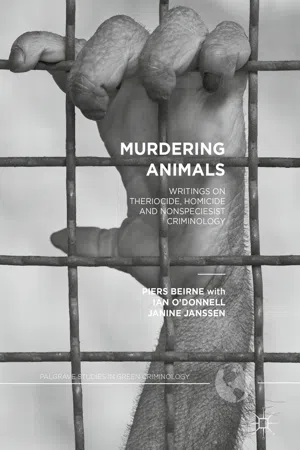
Murdering Animals
Writings on Theriocide, Homicide and Nonspeciesist Criminology
- English
- ePUB (mobile friendly)
- Available on iOS & Android
eBook - ePub
About this book
Murdering Animals confronts the speciesism underlying the disparate social censures of homicide and "theriocide" (the killing of animals by humans), and as such, is a plea to take animal rights seriously. Its substantive topics include the criminal prosecution and execution of justiciable animals in early modern Europe; images of hunters put on trial by their prey in the upside-down world of the Dutch Golden Age; the artist William Hogarth's patriotic depictions of animals in 18th Century London; and the playwright J.M. Synge's representation of parricide in fin de siècle Ireland. Combining insights from intellectual history, the history of the fine and performing arts, and what is known about today's invisibilised sites of animal killing, Murdering Animals inevitably asks: should theriocide be considered murder? With its strong multi- and interdisciplinary approach, this work of collaboration will appeal to scholars of social and species justice in animal studies, criminology, sociology and law.
Information
© The Author(s) 2018
Piers BeirneMurdering AnimalsPalgrave Studies in Green Criminologyhttps://doi.org/10.1057/978-1-137-57468-8_11. Introduction: Rights for Whom?
Piers Beirne1
(1)
Department of Criminology, University of Southern Maine, Portland, ME, USA
One winter in the late 1960s I worked as a seasonal employee in a small family-run factory and slaughterhouse—Baughan’s—in Colchester, Essex. On the sides of the delivery van that ran between the factory and its retail shop in the town centre, Baughan’s advertised itself as a ‘High Class Pork Butchers’. Its specialty: pork pies and sausages.
My workdays at Baughan’s were divided into mornings and afternoons. In the mornings I made saveloy sausages. This I did with the aid of a fearsome mechanical grinder, into the top of which I shovelled equal amounts of filling and the boiled body parts of slaughtered pigs. The filling comprised heaped onions, carrots, salt, sage and spices combined with day-old pies, bread and cakes that had been returned to the factory from the retail shop, unsold and stale. The pigs’ body parts included their brains, livers, hearts, kidneys, entrails, skin, gristle and fat—nearly everything, that is, except for the animals’ bones, heads, ‘trotters’ (feet) and ‘beers’ (ears), sold separately as special treats for domesticated dogs. The grinder thoroughly mixed, chopped and compressed all these ingredients—filling and animal parts, both—before ejecting the minced product onto trays to be wrapped in reddened casings fashioned from pigs’ intestines. Not for nothing did Baughan’s promote saveloys as ‘savoury’ and ‘highly seasoned’ pork sausages!
In the afternoons my job was to dress the heads of a dozen or so decapitated pigs. Armed with stout scissors and an electric razor, I had to shave the pigs’ heads so as to remove all evidence of their facial hair and bristle. Suitably dressed, a celebratory green apple stuffed into each pig’s gaping mouth, their heads were destined to adorn local dining tables at Yuletide and Christmas.
For a long while I suppressed all memory of my time at Baughan’s the Butcher. My self-stifling in this regard was rudely broken through, however, when, nearly a decade ago, I was confronted with the image of a decapitated pig’s head in a painting by the eighteenth-century English artist William Hogarth. The image appears in a detail in Hogarth’s 1745 oil on canvas The Lady’s Death. In it a skeletal dog frantically snatches a disembodied pig’s head from a festive dining table. Alerted to the need for some overdue, if painful self-reflection, I discovered soon thereafter that the display of pigs’ heads was an ancient English custom that had been practised in East Anglian Essex by the Saxons and perhaps even earlier by the Celtic warrior Boudica—she, the rebel queen who had led the massacre of Roman soldiers and the suspension of their imperium in Colchester and London.
As it happened, my jarring introduction to the decapitated pig’s head in Hogarth’s art coincided with an invitation to participate in a panel on green criminology sponsored by the United Nations (UN) at the annual meetings of the American Society of Criminology. My intention there was to provide a platform for dialogue between the nascent green movement in criminology and a variety of UN agencies which, in their everyday policy-making work, profess to promote the welfare of animals. But my plans in this regard were interrupted and then largely abandoned when, as part of my preparation for this task, I felt obliged to revisit the original wording of the UN’s Universal Declaration of Human Rights. Adopted by the UN General Assembly on 10 December 1948, the first two articles of the Declaration are as follows:
- 1.All human beings are born free and equal in dignity and rights. They are endowed with reason and conscience and should act towards one another in a spirit of brotherhood.
- 2.Everyone is entitled to all the rights and freedoms set forth in this Declaration, without distinction of any kind, such as race, colour, sex, language, religion, political or other opinion, national or social origin, property, birth or other status.
Aside from questions about what human rights are or might be and about the persistent gap between their presence in a document of rights and their widespread absence on the ground, of Article 1 it must be asked: Why does the UN persist in declaring that the only beings worthy of entitlement to rights are those named human? If human beings are ‘endowed with reason and conscience’, then what might this imply for the status of humans who are moral patients, that is, those who are brain dead or in advanced stages of Alzheimer’s disease or congenital analgesia? If the UN is steadfast in its view of the criteria for those who belong to the community of rights holders, then the situation of those humans who are in a coma, for example, is surely very precarious indeed. Because comatose humans are often said to have lost their reason, their conscience and their sentience, then presumably it follows that they must thereby forfeit their status as beings and as bearers of rights. On this view one has to worry whether comatose humans might be sacrificed in scientific experiments or used in blood sports.
There are numerous nonhuman animals (henceforth, ‘animals’) about whom it might accurately be said that their capacity to suffer pain or even to reason is no less than that of humans who are in a coma or who are of a very young age. So, why are comatose or new-born humans regarded as members of a moral community whose members act towards each other in a ‘spirit of brotherhood’ when animals with similar capacities are not so recognized? Moreover, in contradistinction to all other capacities, such as the capacity to suffer pain, why is the ability to reason elevated to its position as the sole criterion of rights? One answer to this question is surely that through the dogma and power of speciesism we humans tend to exclude animals from our moral community and instead to position them as insensible Cartesian automata that largely exist as our property and who may be used and abused accordingly.
Along similar lines it must be asked about Article 2 of the Universal Declaration of Human Rights: Why are animals excluded from the UN’s sheltering umbrella which, as a matter of principle, is extended to ‘everyone’ without regard to ‘race, colour, sex, language, religion, political or other opinion, national or social origin, property, birth or other status’? Why does the UN exclude animals other than humans from its seemingly inclusive embrace of everyone, as in ‘[e]veryone is entitled to all the rights and freedoms set forth in this Declaration … without distinction of any kind’? Isn’t it about time for the UN to reconsider its self-declared privileging of human lives over and above those of all other animals? So, ultimately, the UN must be confronted with the question: Rights for whom?
This Book
Murdering Animals: Writings on Theriocide, Homicide and Nonspeciesist Criminology crisscrosses the intersections of animal rights theory, criminology and the history of the fine and performing arts. It is the first text in any discipline to argue that if the killing of an animal by a human is as harmful to her as homicide is to a human, then the proper naming of such a death—‘theriocide’—offers a remedy, however small, to the extensive privileging of human lives over those of other animals. Whether the focus is on prose, painting, poetry or a play, each chapter addresses the killing of animals by humans, except for Chap. 6, the repeatedly threatening images of which unfold as the homicide of a father seemingly twice committed by his son. Though each of the chapters can stand alone, I hope it is not too fanciful to suggest that each also leads into the next and at strategic points dissects the others.
Chapter 2 (‘Theriocide and Homicide’) proceeds on the assumption that in much the same way that humans have moral rights, so also do all other sentient animas. In particular, they have the right to life, the right to respectful treatment and the right not to be treated as property. The site where animals’ right to life is most extensively violated is the modern slaughterhouse. Modernist sensibilities require that, almost from the moment of its invention in early nineteenth-century France, the slaughterhouse operates according to the principles of invisibilization. Geographically, slaughterhouses have been moved away from urban areas to spaces where, behind brick and mortar and concrete, their noisy and bloody operations are hidden away. Linguistically, their killing work has been accompanied by the invention of a vocabulary of speciesist euphemisms designed to obscure their aim and characteristics.
The chapter suggests that in major respects there are structural similarities between the killing of humans and the killing of animals. Although with just one word and without too much ambiguity all those actions, lawful or otherwise, whereby one human kills another can be named homicide, there is currently no such unitary term for the killing of animals. Yet, if the killing of an animal by a human is as harmful to her as homicide is to a human, then the proper naming of such a death offers a remedy, however small, to the extensive privileging of human lives over those of other animals.
‘Theriocide’ is the name recommended here for those diverse human actions that kill animals. Like the killing of one human by another (e.g. homicide , infanticide and femicide), a theriocide may be socially acceptable or unacceptable, legal or illegal. The major and often intersecting types of theriocide are identified as cruelty and neglect; state theriocide; factory farming; hunting and blood sports; the trade in wildlife; vivisection; militarism and war; pollution; and climate change.
Inevitably, Chap. 2 provokes the question of whether theriocide might on occasion be tantamount to murder. This is confronted directly in Chap. 7. In between, Chaps. 3, 4, 5 and 6 operate as so many canvases that are explored to see how, historically and cross-culturally, theriocide and homicide are severally made and unmade in legal cultures and in works of art, literature and theatre.
Chapter 3 (‘Hunting Worlds Turned Upside Down? Paulus Potter’s Life of a Hunter’, with Janine Janssen) was prompted by what is surely one of the most daunting tasks facing a nonspeciesist criminology, namely, the need to disengage discourse on animal abuse and animal cruelty from the historical dominance of human interests. The chapter’s focus is a case study of Life of a Hunter, an extraordinary if rather obscure painting executed at some point between 1647 and 1650 by the young Dutch artist Paulus Potter (1625–54). Nowadays adorning a wall in the Hermitage museum in St Petersburg, Life of a Hunter boasts fourteen rectangular panels and multiple narratives. It depicts a hunter and his hounds who have been captured by the very animals who had earlier been his quarry. The hunter is put on trial by the animals, condemned to death and roasted alive. The animals are about to eat his flesh.
Life of a Hunter encourages several questions. Foremost among these are: What did Life of a Hunter mean to Potter and to the painting’s audience? When and where did its viewpoint of an ‘upside down’ animal trial originate? Was its moral ...
Table of contents
- Cover
- Front Matter
- 1. Introduction: Rights for Whom?
- 2. Theriocide and Homicide
- 3. Hunting Worlds Turned Upside Down? Paulus Potter’s Life of a Hunter
- 4. On the Geohistory of Justiciable Animals: Was Britain a Deviant Case?
- 5. Hogarth’s Patriotic Animals: Bulldogs, Beef, Britannia!
- 6. Gallous Stories or Dirty Deeds? Representing Parricide in J.M. Synge’s Playboy of the Western World
- 7. Is Theriocide Murder?
- Back Matter
Trusted by 375,005 students
Access to over 1.5 million titles for a fair monthly price.
Study more efficiently using our study tools.
Frequently asked questions
Yes, you can cancel anytime from the Subscription tab in your account settings on the Perlego website. Your subscription will stay active until the end of your current billing period. Learn how to cancel your subscription
No, books cannot be downloaded as external files, such as PDFs, for use outside of Perlego. However, you can download books within the Perlego app for offline reading on mobile or tablet. Learn how to download books offline
Perlego offers two plans: Essential and Complete
- Essential is ideal for learners and professionals who enjoy exploring a wide range of subjects. Access the Essential Library with 800,000+ trusted titles and best-sellers across business, personal growth, and the humanities. Includes unlimited reading time and Standard Read Aloud voice.
- Complete: Perfect for advanced learners and researchers needing full, unrestricted access. Unlock 1.5M+ books across hundreds of subjects, including academic and specialized titles. The Complete Plan also includes advanced features like Premium Read Aloud and Research Assistant.
We are an online textbook subscription service, where you can get access to an entire online library for less than the price of a single book per month. With over 1.5 million books across 990+ topics, we’ve got you covered! Learn about our mission
Look out for the read-aloud symbol on your next book to see if you can listen to it. The read-aloud tool reads text aloud for you, highlighting the text as it is being read. You can pause it, speed it up and slow it down. Learn more about Read Aloud
Yes! You can use the Perlego app on both iOS and Android devices to read anytime, anywhere — even offline. Perfect for commutes or when you’re on the go.
Please note we cannot support devices running on iOS 13 and Android 7 or earlier. Learn more about using the app
Please note we cannot support devices running on iOS 13 and Android 7 or earlier. Learn more about using the app
Yes, you can access Murdering Animals by Piers Beirne in PDF and/or ePUB format, as well as other popular books in Social Sciences & Civil Rights in Law. We have over 1.5 million books available in our catalogue for you to explore.