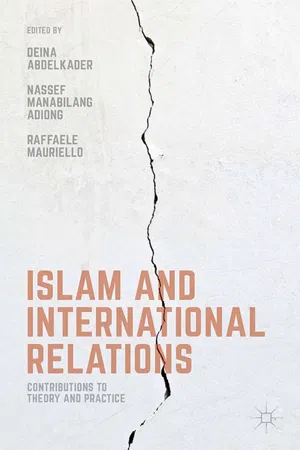
This edited volume conceives of International Relations (IR) not as a unilateral project, but more as an intellectual platform. Its contributors explore Islamic contributions to this field, addressing the theories and practices of the Islamic civilization and of Muslim societies with regards to international affairs and to the discipline of IR.
eBook - ePub
Islam and International Relations
Contributions to Theory and Practice
- English
- ePUB (mobile friendly)
- Available on iOS & Android
eBook - ePub
Islam and International Relations
Contributions to Theory and Practice
About this book
Information
Part I
Towards an Islamic Contribution to International Relations Theory: Setting the Stage
Raffaele Mauriello
As an academic discipline International Relations (IR) is still overwhelmingly based on Eurocentric foundations, whose ahistorical character is evident, for example, when research is undertaken on the international order before the rise of the West.1 When studying mainstream manuals2 of International Relations with its many paradigms (realism, liberalism, the English school, constructivism, Marxism, critical theory, postmodernism, feminism, poststructuralism, postcolonialism, green theory, etc.), or when considering its key thinkers and texts,3 one might assume that, as a field of academic inquiry, IR is based on the understanding that it is not open to non-Western contributions. When viewed together the apparently different IR theories simply reproduce Western meta-narratives and the Euro-American nature of international relations (the international practice of states) and of IR (the academic study of the international practice of states).4 This observation is particularly problematic when one notices that international relations theories represent not simply tools of analysis but, along with the different IR paradigms, also a way of conceptualizing the international and world order. Indeed international institutions are based exclusively on Western-oriented norms, intellectually sustained on the premises of IR and of International Relations Theory (IRT). This imposes important limits for IR scholars who want, for example, to understand and theorize about the rise of non-European parts of the world such as China (and, more generally, BRICS members) and phenomena such as the birth and endurance of the Islamic Republic of Iran or, on a different note, the recent declaration of the Islamic State (ISIS/ISIL) in Syria and Iraq. A basic reason for these limits derives from the fact that IR sources clearly fail to correspond to the global distribution of its subjects and their degree of involvement in the practice of both International Relations and international relations.
As pointed out by S Sayyid, since 1870 Muslims have shown a deep interest in the Western political canon, although largely this interest has not been reciprocated by Western political thinkers; the latter basically ignore Muslim political thought – other than as an Orientalist anthropological curiosity.5 Moreover, the limited studies on Muslim political theory and worldview undertaken in the West have been largely dominated by the issue of jihad (understood as holy war) as the axis of Islamic international relations and of the presumed division of the world into dar al-harb (the abode of war), dar al-Islam (the abode of Islam) and dar al-sulh (the abode of temporary peace, alternatively called dar al-’ahd) as the truly and only form of Islamic IRT.6 However, it might be argued that this element has been a distorting consequence of the fact that Western political theorists have largely accepted the conception of IR as a state of nature and hence committed themselves to viewing international relations as primarily concerned with the traditional ultima ratio of nation-state rivalries, i.e., war.7 In my opinion, the view, within mainstream Euro-American IR, of international relations as oscillating between a state of war and a troubled peace has inevitably resulted in the choice of looking at jihad and the division of the world into opposing abodes (dar al-harb and dar al-Islam, with a lesser emphasis on dar al-sulh/dar al-ahd) as the Islamic IRT; a form of Alice Through the Looking Glass. In this respect, in his preface to the first edition of his Towards an Islamic Theory of International Relations, ‘AbdulHamid A AbuSulayman points out how, in his view:
the Islamic theory and philosophy of relations among nations is the only adequate philosophy of peace in the contemporary world. It is the only philosophy, concept, and approach that emphasizes the common origin, interest, and destiny of man as the only base for understanding man’s nature, interpersonal relations, and group interactions. ... Other world ideologies and philosophies focus on conflict management and consequently war.8
Islam looks quite different from within and behind the looking glass.
In their edited volume on the state of the art of IRT in what they call “the non-West,” Amitav Achraya and Barry Buzan show how the observation made by Sayyid about the ignorance in the West as regards Muslim political thought is not limited to the Muslim world; Western political thinkers also largely ignore the political and international thinking of “the rest” of the world.9
The experiences collected in their volume seem to indicate that in the non-West, in their case represented by Asia (and by a contribution on the Islamic worldview), Western dominance has both stimulated and hindered the capacity to develop locally based international relations theories. In the case of most Asian countries we are in a stage of pre-theoretical resources that have been largely either forgotten or marginalized by both Western and local scholars.10 In this respect, however, N J Rengger points out how:
Most cultures and civilizations have, after all, long and important traditions of reflection about the subject matter of International Relations, however understood: relations between political communities, war, trade, cultural diversity and its implications. ... Scholars are more likely to turn to Western IRT first before they discover the possibility and sources of non-Western IRT.11
The single but well-researched chapter devoted to the Islamic worldview in Achraya and Buzan reveals a paradoxical situation in which Muslim scholars seem to think that Western IRT has not found the right path to explain international relations and world politics, yet it has acquired hegemonic status.12 Despite this apparently gloomy situation, Shahrbanou Tadjbakhsh points out that, as an ideational, religious, civilizational and worldview “variant,” Islam has obviously sought a distinctive foundation of truth and the good life that undoubtedly allows for the formulation of alternatives to Western IRT. In this respect, along with the expansion of capitalism, globalization has also paradoxically prompted the revival and reinterpretation of classical sources in the Muslim world, as is evident in Part I of this volume. Perhaps it is not by mere chance that two of the chapters (the first and third) are connected to Iran, one being authored by an Iranian (and Iran-based) scholar and the other related to the international relations theory that came into being with the birth of the Islamic Republic of Iran; whereas the second chapter addresses the significance of Islamic norms and values in the present global political system, with reference to Turkey’s foreign policy under the Justice and Development Party (AKP). In the case of Iran, Amr G E Sabet has argued that the advent and institutionalization of the Islamic Republic of Iran was brought about by, and at the same time opened up the space for, a self-referential method of thinking in which Islamic epistemology falls back on an Islamic, not on an “alien,” ontology.13 It might be argued that a similar, although more limited, scenario has been taking shape in Turkey.14
The different contributions in this volume, and in particular these in Part I, are premised on the consideration that Western IRT in its current form is not good for the health of our understanding of the social world in which we live, partly because, on the one hand, it is too narrow in its sources and, on the other, too dominant in its influence. They challenge and provide a more complex answer to the main question raised by Achraya and Buzan, i.e., why there is no non-Western IRT? As shown by the following three chapters, Islamic civilization is well able, in source and political culture, to contribute to the development of both IR and IRT and to provide alternative optics for theorization.
In line with the expressed aims of the International Relations and Islamic Studies Research Cohort (Co-IRIS), the chapters collected in Part I look for new directions in methodology and thought towards modern Islamic theories of international relations, going beyond the idea of the need for an Islamization of knowledge, or the assumption that the Islamic civilization has (or should have) its own single and fixed theory. They offer a general view of key principles of global politics as deducible from the Qur’an and discuss theoretical and concrete policy-making aspects in the foreign policy of two key Muslim countries, (Shi‘i) Iran and (Sunni) Turkey.
The first chapter, by Ali Akbar Alikhani, addresses the relevance to international relations in today’s world of what the author calls “fundamentals of Islam,” deduced directly from the Qur’an and Prophet Muhammad’s sunnah. To explain the fundamentals extracted from these sources the chapter refers, in some cases, to the ideas of Ali ibn Abi Talib and other Muslim scholars and Qur’an commentators. The chapter identifies three groups of fundamentals. The first group includes the cognitive and epistemic fundamentals comprising the intellectual substructure of human beings; discussions on these fundamentals clarify the attitude of Islam towards human beings, including: Islamic teachings on adopting a respectful attitude towards human beings; recognizing the plurality of religions as a reality; the authenticity of free will and the free choice of human beings; and belief in the original equality of human beings. The second group deals with the intellectual and ethical fundamentals on which a social system should be based and the topics briefly discussed are: peaceful coexistence; avoiding violence; and adherence to moral and ethical principles. The third group includes practical and behavioral fundamentals and the Islamic teachings on approaches that Muslim nations should take in terms of their interactions with other nations. The following topics are discussed in this last group: dialogue and its different levels; treaties and agreements; commitment to rights and justice; retaliation; and renewal of forces for preventive pur...
Table of contents
- Cover
- Title
- Part I Towards an Islamic Contribution to International Relations Theory: Setting the Stage
- Part II Diplomacy, Justice, and Negotiation in Islamic Thought
- Part III Contemporary Muslim Insights on Muslim Governance and International Relations
- Index
Trusted by 375,005 students
Access to over 1.5 million titles for a fair monthly price.
Study more efficiently using our study tools.
Frequently asked questions
Yes, you can cancel anytime from the Subscription tab in your account settings on the Perlego website. Your subscription will stay active until the end of your current billing period. Learn how to cancel your subscription
No, books cannot be downloaded as external files, such as PDFs, for use outside of Perlego. However, you can download books within the Perlego app for offline reading on mobile or tablet. Learn how to download books offline
Perlego offers two plans: Essential and Complete
- Essential is ideal for learners and professionals who enjoy exploring a wide range of subjects. Access the Essential Library with 800,000+ trusted titles and best-sellers across business, personal growth, and the humanities. Includes unlimited reading time and Standard Read Aloud voice.
- Complete: Perfect for advanced learners and researchers needing full, unrestricted access. Unlock 1.5M+ books across hundreds of subjects, including academic and specialized titles. The Complete Plan also includes advanced features like Premium Read Aloud and Research Assistant.
We are an online textbook subscription service, where you can get access to an entire online library for less than the price of a single book per month. With over 1.5 million books across 990+ topics, we’ve got you covered! Learn about our mission
Look out for the read-aloud symbol on your next book to see if you can listen to it. The read-aloud tool reads text aloud for you, highlighting the text as it is being read. You can pause it, speed it up and slow it down. Learn more about Read Aloud
Yes! You can use the Perlego app on both iOS and Android devices to read anytime, anywhere — even offline. Perfect for commutes or when you’re on the go.
Please note we cannot support devices running on iOS 13 and Android 7 or earlier. Learn more about using the app
Please note we cannot support devices running on iOS 13 and Android 7 or earlier. Learn more about using the app
Yes, you can access Islam and International Relations by D. Abdelkader, N. Adiong, R. Mauriello, D. Abdelkader,N. Adiong,R. Mauriello in PDF and/or ePUB format, as well as other popular books in Politics & International Relations & Comparative Politics. We have over 1.5 million books available in our catalogue for you to explore.