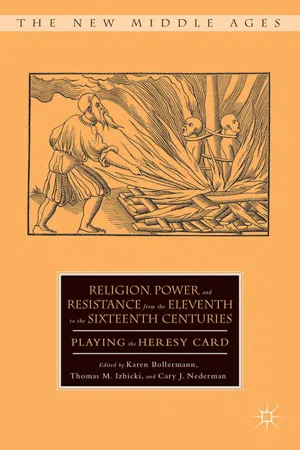
eBook - ePub
Religion, Power, and Resistance from the Eleventh to the Sixteenth Centuries
Playing the Heresy Card
- English
- ePUB (mobile friendly)
- Available on iOS & Android
eBook - ePub
Religion, Power, and Resistance from the Eleventh to the Sixteenth Centuries
Playing the Heresy Card
About this book
Addressing the myriad ways in which heresy accusations could fulfill political aims during the Middle Ages, this collection shows acts of heresy were not just influenced by religion. Essays examine individual cases, in addition to the close relationship of orthodoxy and political dominance in medieval games of power.
Information
Topic
Theology & ReligionSubtopic
European Medieval HistoryPART I
“RAZING” THE STAKES: PERSONAL TRIALS AND POLITICAL TRIBULATIONS
CHAPTER 1
STANDING IN ABELARD’S SHADOW: GILBERT OF POITIERS, THE 1148 COUNCIL OF RHEIMS, AND THE POLITICS OF IDEAS
Karen Bollermann and Cary J. Nederman
The recent study of heresy in the Latin Middle Ages has stood largely under the long shadow cast by R. I. Moore’s influential thesis concerning “the formation of a persecuting society.”1 Briefly stated, Moore hypothesizes that the growing concentration of power in both ecclesiastical and secular institutions during the twelfth and thirteenth centuries, characterized by emergent legalism and an attendant coercive apparatus, yielded a single-minded effort across Europe to “normalize” religious belief and practice. “New” heresies were discovered, denounced, and ruthlessly stamped out as a result of a concerted and coordinated effort by clerical and temporal authorities to enforce orthodoxy on a scale inconceivable in earlier times.2 For Moore, the push toward a “persecuting society” thus constituted a relentless and inexorable process of imposing doctrinal discipline, a sort of faith-based precursor to Weber’s “iron cage” of rationality.3
Because of his emphasis on social factors, Moore’s historiography focuses not on the actions of individual personalities, except incidentally and illustratively, but on broad patterns of historical development and on vast institutional networks. He evinces no concern for the substantive intellectual content of heresy, nor, more importantly, any recognition of the embeddedness of theoretical discourses in the larger ecclesio-political fabric of the times. Rather, for Moore, “the heretic is self-defined, and indeed, self-proclaimed, as the person who by his own deliberate choice denies the authority of the Church.”4 All that is required to sustain a charge of heresy is a clear-cut prohibition against the endorsement of a certain doctrine, along with a persecutorial apparatus capable of enforcing orthodoxy. As a result, matters of intellectual dispute—and, thus, the world of ideas—are deemed irrelevant to the study of medieval heresy.5 Moore admits that “among churchmen themselves . . . there were disagreements over questions of liturgy and occasionally theology which sometimes spilled over into accusations of heresy.” But, he insists that “these remained individual conflicts . . . among the intelligentsia” that had no wider repercussions for the emerging systems of power arrayed against the heterodox.6
Moore’s depersonalized and deintellectualized approach to accusations of heresy during this period, however attractive it may be in the breadth of its conception, does not always comport very well with the on-the-ground realities it purports to explain. For example, Moore’s approach resists the invocation of counterexamples (say, of authors or agents who evinced tolerance toward religious difference or dissent), dismissing them as irrelevant to, and incapable of refuting, his thesis.7 Likewise, distinctions in the attitudes and activities of inquisitors themselves (as well as of those who encouraged and/or supported their endeavors) do not command his attention, as Karen Sullivan has pointed out in her recent book.8 Perhaps even more problematically, precisely the medieval authorities who Moore regards to be the paragons of persecution were often far more exercised about “literate” or “intellectual” instances of heresy than about the spread of so-called popular heretical beliefs. Thus, Otto of Freising, writing in the late 1150s, remarks about itinerant preacher Eon de l’Etoile, who had gathered “after him a great multitude of the uneducated people,” that he was “a man rustic and illiterate and undeserving of the name heretic.”9 This comment seems to conform to the general view of prominent twelfth-century churchmen that the charge of heresy required, at a minimum, that the accused possess a modicum of learning before it could reasonably adhere.10
Moore’s account of the medieval inquisitional mentality, then, seems incomplete in a number of significant ways. For the purposes of the present chapter, we wish to focus critically on two of his key premises. First, we dispute his view that charges of heresy against intellectuals were mainly a matter of personal vendettas that may be separated from larger institutional contexts and that, therefore, bear no implications for our understanding of ecclesiastical systems of power. Second, we challenge his position that a clear line of demarcation may be drawn between “merely intellectual” heresies and those that warranted large-scale coercive repression. In our view, by contrast, ideas about supposedly arcane matters of theological dispute, while viewed as possible serious rebukes to the authoritative structure of the Church, were, in fact, considered more dangerous for their potentially destabilizing sociopolitical effects and therefore demanded careful and thoughtful appraisal, which was only partially directed toward their claim to express valid and binding universal doctrine. Indeed, as Constant Mews has convincingly demonstrated, Peter Abelard’s trial at the 1141 Council of Sens illustrates this confluence between the intellectual and the perceived political dimensions of heresy.11 Far from serving as an example of Moore’s merely “individual conflict” between two titular representatives (i.e., Abelard and Bernard of Clairvaux) of “rival intellectual traditions,” the ensuing debate reveals that the question of the doctrinal orthodoxy of Abelard’s “novel” theology served primarily as a backdrop to the high-stakes drama over its potential ecclesio-political implications.12 Abelard’s heresy trial became the focal point for a host of issues roiling Latin Christendom: the rise of local communal governments in France (and elsewhere), and their hostility to the Church’s authority over secular matters; the dissemination of ideas (such as Abelard’s) to which anticlerical uses might (rightly or wrongly) be put; schism within the Church, including the papacy itself, and the resultant weakness of both Church and pope; conflicts between regional arms of the Church and its Roman head; and, an unsettled system for assessing heterodoxy and then asserting containment of and control over it. Following his close examination of all of these factors, Mews (partly echoing Moore) views the Council of Sens both as “marking a key stage in the institutionalization of the process by which heresy was identified” and as “part of a larger process in which new structures of authority came to be imposed.”13 The key word here is “process.” As we intend to demonstrate with regard to Bishop Gilbert of Poitiers’s heresy trial at the 1148 Council of Rheims, these institutional features remained fluid after Sens, such that, yet again, an intellectual figure became the lightning rod for the resurfacing and re-energizing of key unresolved ecclesio-political issues.
We substantiate our claim that intellectual disputes over orthodox doctrine (the world of ideas) were neither “personal” in nature nor divorced from the larger currents of their times with reference to the writings of two leading churchmen of the mid-twelfth century, Otto of Freising and John of Salisbury, both of whom provide extensive testimony (some of it eyewitness) regarding Gilbert’s heresy conflict. Their interrelated and sometimes overlapping accounts implicate, to varying degrees, Abelard’s trial at Sens and the heretical activities of one of his acolytes, Arnold of Brescia. It is noteworthy that all three figures had in some manner incurred the wrath of Bernard of Clairvaux, who also drew significant comment from Otto and John. We propose that both authors, in centering their attention on the relationship between ideas and practices, were reflecting the larger concerns of their times: For them, as well as for Bernard and for the Church as a whole, the truth or falsity of sometimes highly abstract doctrines (as well as the dissemination of them) was seen to have important consequences both for the Church as an institution and for the socio-political order beyond the religious sphere. One central problem, for both Otto and John, arose from balancing legitimate freedom of inquiry and criticism with the maintenance of unity within the faith as well as within public institutions. Although their judgments about the proper solution to this issue differed, their works seem to us to afford crucial insights into the myriad complexities and uncertainties surrounding accusations of heresy during the mid-twelfth century, that is, precisely the age when Moore’s “persecuting society” was supposedly achieving its full flowering.
In many significant ways, the Council of Rheims, called by Pope Eugenius III (1145–54) for March 1148, marked the re-emergence of the multivalent dimensions attending the purportedly purely intellectual heresy charges against Abelard that had earlier been on display at the 1141 Council of Sens. It is not our intention to provide a complete account of the Council of Rheims and its context, as these have already been thoroughly examined by historians.14 The agenda for its attendees included a wide range of legal, political, and doctrinal business that had accumulated during the first years of Eugenius’s pontificate, when the pope’s problematic political situation had made it difficult for him to call together the prelates of the Church. Eugenius’s troubles stemmed largely from his inability to gain control over the unsettled condition of papal affairs. The papacy of Innocent II (1130–43) had been marred, for the first eight years, by a schism stemming from the dual election of Innocent and his rival claimant to the see, Anacletus II, both of whom were consecr...
Table of contents
- Cover
- Title
- Introduction
- Part I “Razing” the Stakes: Personal Trials and Political Tribulations
- Part II Joker’s Wild: Misappropriations of Orthodoxy and Misrepresentations of Heterodoxy
- Part III The House Always Wins: Power Politics and the Threat of Force
- List of Contributors
- Index
Trusted by 375,005 students
Access to over 1.5 million titles for a fair monthly price.
Study more efficiently using our study tools.
Frequently asked questions
Yes, you can cancel anytime from the Subscription tab in your account settings on the Perlego website. Your subscription will stay active until the end of your current billing period. Learn how to cancel your subscription
No, books cannot be downloaded as external files, such as PDFs, for use outside of Perlego. However, you can download books within the Perlego app for offline reading on mobile or tablet. Learn how to download books offline
Perlego offers two plans: Essential and Complete
- Essential is ideal for learners and professionals who enjoy exploring a wide range of subjects. Access the Essential Library with 800,000+ trusted titles and best-sellers across business, personal growth, and the humanities. Includes unlimited reading time and Standard Read Aloud voice.
- Complete: Perfect for advanced learners and researchers needing full, unrestricted access. Unlock 1.5M+ books across hundreds of subjects, including academic and specialized titles. The Complete Plan also includes advanced features like Premium Read Aloud and Research Assistant.
We are an online textbook subscription service, where you can get access to an entire online library for less than the price of a single book per month. With over 1.5 million books across 990+ topics, we’ve got you covered! Learn about our mission
Look out for the read-aloud symbol on your next book to see if you can listen to it. The read-aloud tool reads text aloud for you, highlighting the text as it is being read. You can pause it, speed it up and slow it down. Learn more about Read Aloud
Yes! You can use the Perlego app on both iOS and Android devices to read anytime, anywhere — even offline. Perfect for commutes or when you’re on the go.
Please note we cannot support devices running on iOS 13 and Android 7 or earlier. Learn more about using the app
Please note we cannot support devices running on iOS 13 and Android 7 or earlier. Learn more about using the app
Yes, you can access Religion, Power, and Resistance from the Eleventh to the Sixteenth Centuries by K. Bollermann, T. Izbicki, C. Nederman, K. Bollermann,T. Izbicki,C. Nederman in PDF and/or ePUB format, as well as other popular books in Theology & Religion & European Medieval History. We have over 1.5 million books available in our catalogue for you to explore.