eBook - ePub
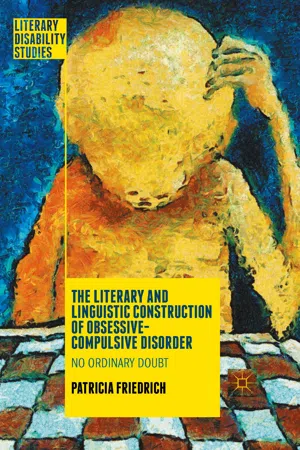
The Literary and Linguistic Construction of Obsessive-Compulsive Disorder
No Ordinary Doubt
- English
- ePUB (mobile friendly)
- Available on iOS & Android
eBook - ePub
The Literary and Linguistic Construction of Obsessive-Compulsive Disorder
No Ordinary Doubt
About this book
This book presents a literary and linguistic reading of obsessive-compulsive disorder to argue that medical understandings of disability need their social, political, literary and linguistic counterparts, especially if we aspire to create a more inclusive, self-reflective society.
Information
Subtopic
Sprachwissenschaft1
OCD Inside Out: The Forging of Disorder
People living with obsessive thoughts and engaging in compulsive behaviors (characteristics that henceforth I will call OCD) are well and often painfully acquainted with a wail that Jeff Bell eloquently describes in his memoir Rewind, Replay, Repeat. He writes:
There’s a sound BART trains make as they wend their way through the myriad curved tunnels that comprise the Bay Area Rapid Transit grid. It’s a shrill, high-pitched screech … I know this ugly wail. It’s the same one that bellows in silence from some tortured place deep inside of me. (127–128)
To Bell, the sound of OCD is shrill. It is acute and piercing. As we read his passage, we can hear the train squeal, metal on metal, until we want to cover our ears. What is worse, the sound can become eerily familiar. To me, another suggestive sensorial experience to convey the anxiety of OCD is visual, and it can be evoked by the famous painting The Scream, by Edvard Munch, with its agony-filled subject and its swirls of red and orange. This image tends to materialize spontaneously when I conjure up representations of the challenges of OCD, although there is no evidence that the artist himself used that as inspiration. For the accompanying written script, I would choose a stanza by Hughes Mearns that so perfectly embodies the duality of that which does not exist but still haunts us – the one that speaks of a man who, despite not being there, we want to wish away.1
As is obvious in these examples, we often use artistic expressions as lenses through which we try to apprehend and translate the world around us. Sounds gain new meaning when interpreted through narrative; the images in paintings sometimes communicate that for which we have no words; and poetry often says between its verses that which traditional syntactic constructions alone cannot put across. No wonder we sometimes resort to a multiplicity of artistic media to express the agony of a simple scream.
The making of OCs, OCDers, and OCD sufferers
I am about to use a term that is not all that successful in referring to those affected by OCD: the OCs. My difficulty in finding both terminology and linguistic constructs that do not reduce people whose lives have been touched by OCD to labels or to a disorder has resulted in a compromise of sorts. Throughout this text, I will be referring to people living with or through OCD as OCs, and more rarely as OCD sufferers, although I personally do not like either of these acronyms/terms. What to call a person affected by OCD is one of the issues with which not only I but also other people aware of the nature and dynamics of disease/disorder representation struggle. Nomenclature influences how a person is perceived by others, but, even more importantly, how she or he thinks of him/herself.2
Among the most common terms for a person’s relationship with OCD are the predictable sufferer and/or patient. While I will not dispute in any way that the condition can and does indeed signify suffering in a variety of ways, which I will discuss later in this book and especially in the last chapter, I believe that referring to people dealing with OCD as sufferers highlights a particular aspect of OCD’s manifestation and experience, possibly perpetuating a cycle of victimization and powerlessness. On the other hand, the word patient presupposes that a person is under medical or paramedical care, which may or may not be the case in OCD. Patient also implies passiveness and thus does not incite in the individual any desire to act and face the world; it does not foster any sense of agency.
To avoid these terms, many authors and persons affected by OCD prefer to resort to acronyms such as OCs or OCDers, but such is the difficulty with labels that these terms too tend to encompass the whole individual in ways that can cause the person’s sense of self to be shaken. The irrevocability of saying “He/she is an obsessive-compulsive” should suffice to caution us against using the terms uncritically. Yet, to come up with any expression that does not reduce, standardize, and stigmatize the person is an overwhelmingly difficult task, since for practical purposes many feel the need to come up with labels and taxonomies. That is how we arrived in the first place at the more than 300 categories of the Diagnostic and Statistical Manual, where OCD figures as a disorder.
The memoirists I will be discussing later in the book have not found much of an alternative either: Jeff Bell uses OC; Jennifer Traig uses sufferer at least twice. Yet ultimately, the fact that we make use of these terms does not invalidate the arguments I will present about the constructed nature of our understanding of the disorder. More specifically, one common thread that runs through my argumentative line is that we should be conscious that language is not devoid of social meaning and historical locus, and that even in situations in which we believe we are dealing with naturally occurring phenomena, linguistic and social forces are at play. So, rather than their being a prescription for (non)use, I hope my reflections convey that language choice is filled with responsibility.
For now, and for lack of better terms, I will use OC and OCD sufferer interchangeably, but knowingly; I am well aware of the impression they cause and of the linguist’s dilemma they pose to me and to others. Thus, the compromise to which I referred earlier comes in the shape of a proposal: that the term OC, which will be predominant in this text, be read not as obsessive-compulsive but rather as person living with OCD. While this concession might be little consolation to those who really oppose this term, it is my small way of saying that a person is much more than a vessel for the manifestation of a disorder.
The OCD invasion
Living with OCD means dealing with some version of the shrill. Yet, the scream of OCs, as Bell acknowledges, is still for the most part a silent one, an inaudible suffering, torturous in its attempt to rob the person of everything that they hold dear. Gone are a sense of security and relative silence in the mind. Additional losses may include the respect of one’s family, some (even if illusory) sense of control over the environment, and, most of all, a resemblance of certainty in the face of doubt. Adding to the stress are the remarks by well-meaning but often unaware third parties who watch, a little perplexed, a little surprised, until they can no longer refrain from commentary. Eventually, they might ask the OC, somewhat patronizingly, “Why don’t you just stop worrying?”
OCD is not too different from a Trojan Horse. It ambushes the individual from the inside. It is knowledgeable of a person’s innermost weaknesses and fears, so it knows where to target the attack to cause the most damage. Fear of disease? It will make a person think of little else. Anxiety over making mistakes? It will point out all of the past instances and the many future chances of it happening again. Thoughts of contamination? It will remind the sufferer that germs are everywhere – and invisible. In the process of highlighting every fear, every anxious thought, OCD can cause a lot of discomfort. I am indeed personifying OCD as if it were an entity capable of volition. For OCs, I would venture to say, it might often seem that way. The idea of personification is so prevalent that later I will share examples of how OCD has been concretized, used in therapy as an entity separate from oneself, and even given a man’s name in a novel.
In practice, OCD – this category we created to explain overwhelming anxiety, fear, and a need to do and redo – may feel like an angry tyrant, dictating orders that cannot be rejected or stopped. And once the dance between fear and avoidance of the feared object or idea starts, it is difficult to make it stop; the allure of repeating a behavior just one more time, of thinking a neutralizing thought “just this once,” is too great. The promise of resolution is too attractive. This one repetition, one more checking round, OCD demands, and the matter will resolve itself forever.
Only it never does. Or if by chance one fear fades away, another comes to take its place. In her memoir Devil in the Details, Jennifer Traig provides a good account of this gradual, continuous, and escalating process of avoidance and repetition:
I don’t remember what came first, but I think it was the food. At this point I’d been having problems with food in an obsessive but secular way for about a year. … By January we were down to little more than dried fruit, and my nails were the texture of string cheese. (6)
Traig points to the increasing pressures of the cycle of obsession, in this case revolving around food. The avoidance of one food item leads to the consideration that something else must be removed, and something else after that. Such considerations are accompanied by thoughts of the presumed consequences of not following through with the plan. Both the thoughts and the avoidance are intersected with anxiety.
However difficult it is to break the cycle of worry and avoidance, OCs keep trying to do it, in part because they are very aware of their own thoughts, so much so that everything seems overblown, seen through a special magnifying glass that other people do not seem to possess; and in part because it seems like the intuitive thing to do. In everyday situations, to do something again often means to make it better, to perfect it, and to be more certain. As it happens, in OCD this is not the case, and many branches of knowledge are engaged in trying to figure out just why.
OCD, madness, and rationality
Of all of the so-called psychiatric conditions, OCD is probably the one that most directly challenges the construction of what was once referred to as madness and portrayed as a form of un-reason. If anything, OCD manifests itself as a result of over-thinking, over-analyzing, and over-rationalizing scattered, random, unlikely, or irrelevant items into a rhetoric of almost perfect plausibility. If OCD were a rhetorical fallacy, it would be the slippery slope, the snowballing of one small event or thought into an avalanche of disaster. What is more, within the confines of faulty or exaggerated logic and improbability, nothing sounds more rational than an OC’s train of thought.
An analysis of such rhetoric, its social-cultural milieu, its historical antecedents, and the representation of OCD in movies and literature is what this book is about. Here the focus is on the intersection of medical explanation and social portrayal, on naturally occurring manifestation and academic categorization. Under its current, culturally mediated, and medically dictated formulation, obsessive-compulsive disorder is understood as a condition discernible through persistent obsessions (or intrusive thoughts) that cause extreme anxiety or fear, and compulsions (or powerful urges3), which are attempts, whether physical or mental, at neutralizing the anxiety. We will see that this tension of forces, of the culturally informed and the naturally manifesting, has been present in the history of OCD even before we called it by this name. Doubt, of the uncommon kind that names this book, has been one of OCD’s only certainties.
In the process of obsessing, a person can come to doubt basically anything, from the information perceived by the senses (e.g., “Did I make a mistake and not notice?”) to their own existence (e.g., “What if we are all an illusion?”), from the extent of their responsibility to others (e.g., “If I don’t collect that nail and it punctures a tire, is it my fault?”) to the degree of danger posed by germs, toxins, and diseases (e.g., “If I touch that apple and another person eats it, will they be harmed?”). Obsessing can transform neutral elements such as numbers and colors into frightful ones, or at least bothersome and distracting fixed ideas. It can throw a person’s brain into a never-ending loop in which doubt cannot be resolved. Worse than “doing something wrong” is never really knowing if they actually did. Worse than accidentally making an (imaginary) mistake is forever worrying that they might have. And what an OC feels is no ordinary doubt.
Perhaps an imperfect but useful analogy for doubt in OCD is hunger in pregnancy. It is not a nagging at the back of one’s head that can be brushed aside easily and saved for a time when it can be more conveniently satiated. Instead, it is an all-encompassing, overwhelming sensation from which the individual believes that she must seek relief immediately. The difference, however, is that in pregnancy the result of sudden hunger is only temporary discomfort, which can be relieved by food, while the result of doubt in OCD is extreme anxiety, fear, and a sense of impending doom that no process of rationalization can seem to satiate. If you feed hunger, you feel better; if you feed fear, it becomes bigger and stronger. Not engaging in neutralizing compulsions (either physical or mental) will send the feeling of anxiety to very disturbing and particularly uncomfortable levels, akin to those experienced by everyone else only in extreme situations (e.g., jumping off and having the parachute not open, or going fishing and realizing that a bear is standing right next to you). In time, OCs come to dread anxiety with such intensity that they will believe any false promises of compulsion.
The hardest part, though, is that the compulsions in which OCs typically and intuitively engage to alleviate fear and doubt only bring temporary relief – if any at all – and, as a consequence, the OC engages in the cycle of doubting and attempting to neutralize the anxiety again and again; no matter their willpower, their brain continues to send false messages, scarier and more catastrophic with each new round, which, however illusory, unfortunately feel very real (see Jeffrey Schwartz’s Brain Lock 7, for example).
In her memoir Just Checking, Emily Colas delivers, often with a hefty dose of sarcasm, vivid examples of false messages. To use self-mockery or humor as she does in her book is a common tactic for OCs looking for (comic) relief from the heavy burden of their condition. She narrates:
I hit a chipmunk. I was driving home from dropping my kids off at school when I noticed this small thing run out in the road … I watched the news to see if there had been any hit-and-run accidents in that area of town, and finally tricked my husband into coming with me to verify that he was indeed a chipmunk. (108–109)
As this excerpt indicates, sensory input can become secondary to the so-called gut feeling. Colas can see that it is a chipmunk, but she does not trust her eyes; she makes room for the possibility that they are fooling her because she does not feel right about what she sees. Sensory input and feeling do not match. What is more, she acknowledges that she “knows” it is a small animal, but this knowing is not able to provide the certainty or the relief she craves. The next alternative becomes to share the burden of doubt with another person, even if this solution is not likely to bring lasting liberation from fear either.
OCD, statistics, and secrecy
At present, almost universal consensus exists in the medical literature that OCD, having previously been considered a rare disorder, is actually quite common (Grayson 4). It is estimated that between 1 and 4 percent of the general population will be afflicted with OCD at one point in their lives. In the United States, the estimated number of OCs is in the 4–5 million range (Grayson 4). To be sure, numbers that can seem very objective may actually mask the complexities associated with this disorder in particular and mental illness concerns in general. On the one hand, it is easy to hypothesize that the number of actual sufferers could potentially be much higher, given that so many OCs endure the condition alone and mask their symptoms in ways that make diagnosis almost impossible. On the other hand, it could be argued that the numbers might actually be inaccurate if we were to assume that greater media exposure in recent years has brought over-diagnosing of symptoms that would otherwise fall within what is ordinarily deemed a non-clinical range. That is, the space between so-called normality and questionable pathology is enlarged or shrunk by social perceptions, even when numbers are presented to the population as objective, fixed, and immutable. Still, OCD’s aura of rarity and uncommonness is to no small extent maintained by the very secrecy in which those affected tend to encase the condition and the harsh social judgment faced by those not considered “normal,” especially if this lack of normality is due to one of the so-called mental illnesses. The idea that private fears tend to grow disproportionately big is certainly at play in OCD.
To add to the struggle, since reason (as commonly understood) is, outside the specific themes of the obsession, maintained intact and somewhat observant of the OCD phenomenon itself, the OC witnesses, with understandable angst and disbelief, t...
Table of contents
- Cover
- Title
- Copyright
- Dedication
- Contents
- Illustrations
- Preface
- Acknowledgments
- 1 OCD Inside Out: The Forging of Disorder
- 2 Recurrent Doubt: A Brief Story of OCD through its Literary Texts
- 3 Just for Fun: The Misappropriation of OCD for Humor and the Role of Critical Disciplines in Claiming It Back
- 4 Someone Else’s Words: OCD, Language, and Discourse Power
- 5 Me and My OCD: Memoirs and the Challenges of Self-Representation
- 6 Not “Just” a Story: Literary Invention, Innovation, and OCD
- 7 Bioconcerns, OCD Fears, and Other Worrisome Things: Healing through Narrative
- Bibliography
- Index
Trusted by 375,005 students
Access to over 1.5 million titles for a fair monthly price.
Study more efficiently using our study tools.
Frequently asked questions
Yes, you can cancel anytime from the Subscription tab in your account settings on the Perlego website. Your subscription will stay active until the end of your current billing period. Learn how to cancel your subscription
No, books cannot be downloaded as external files, such as PDFs, for use outside of Perlego. However, you can download books within the Perlego app for offline reading on mobile or tablet. Learn how to download books offline
Perlego offers two plans: Essential and Complete
- Essential is ideal for learners and professionals who enjoy exploring a wide range of subjects. Access the Essential Library with 800,000+ trusted titles and best-sellers across business, personal growth, and the humanities. Includes unlimited reading time and Standard Read Aloud voice.
- Complete: Perfect for advanced learners and researchers needing full, unrestricted access. Unlock 1.5M+ books across hundreds of subjects, including academic and specialized titles. The Complete Plan also includes advanced features like Premium Read Aloud and Research Assistant.
We are an online textbook subscription service, where you can get access to an entire online library for less than the price of a single book per month. With over 1.5 million books across 990+ topics, we’ve got you covered! Learn about our mission
Look out for the read-aloud symbol on your next book to see if you can listen to it. The read-aloud tool reads text aloud for you, highlighting the text as it is being read. You can pause it, speed it up and slow it down. Learn more about Read Aloud
Yes! You can use the Perlego app on both iOS and Android devices to read anytime, anywhere — even offline. Perfect for commutes or when you’re on the go.
Please note we cannot support devices running on iOS 13 and Android 7 or earlier. Learn more about using the app
Please note we cannot support devices running on iOS 13 and Android 7 or earlier. Learn more about using the app
Yes, you can access The Literary and Linguistic Construction of Obsessive-Compulsive Disorder by Patricia Friedrich in PDF and/or ePUB format, as well as other popular books in Medien & darstellende Kunst & Sprachwissenschaft. We have over 1.5 million books available in our catalogue for you to explore.