eBook - ePub
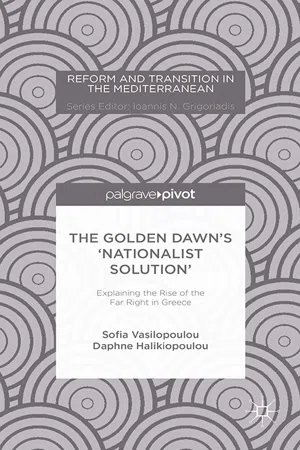
The Golden Dawn’s ‘Nationalist Solution’: Explaining the Rise of the Far Right in Greece
Explaining the Rise of the Far Right in Greece
- English
- ePUB (mobile friendly)
- Available on iOS & Android
eBook - ePub
The Golden Dawn’s ‘Nationalist Solution’: Explaining the Rise of the Far Right in Greece
Explaining the Rise of the Far Right in Greece
About this book
This book contextualizes the rise of the Golden Dawn within the Eurozone crisis. The authors argue that the movement's success may be explained by the extent to which it was able to respond to the crisis of the nation-state and democracy in Greece with its 'nationalist solution': the twin fascist myths of social decadence and national rebirth.
Information
1
Introduction
Abstract: This chapter sets out the rationale and themes of the book. The chapter first contextualises the Golden Dawn and defines it as a far right, and more specifically fascist, party. It then proceeds to examine the broader theoretical framework on the rise of far right-wing parties and movements, discussing demand- and supply-side dynamics. The chapter concludes by presenting the main argument of the book, which focuses on the interdependence of these dynamics and, in particular, what we term the Golden Dawn’s ‘nationalist solution’ to an overall crisis of the nation-state in Greece.
Keywords: crisis; far right; Golden Dawn
Vasilopoulou, Sofia and Daphne Halikiopoulou. The Golden Dawn’s ‘Nationalist Solution’: Explaining the Rise of the Far Right in Greece. New York: Palgrave Macmillan, 2015. DOI: 10.1057/9781137535917.0005.
The fall of fascist regimes in the years following the end of the Second World War marked the de-legitimisation of right-wing extremism across Europe. The ideas of radical authoritarian nationalism associated with Mussolini’s Italy, Hitler’s Germany, Franco’s Spain and Salazar’s Portugal have become progressively discredited, paving the way to democratic ideals and the predominance of representative institutions over authoritarian statism. Those societal groups and parties associated with ‘old’ fascist traditions including anti-Semitism, anti-communism, and anti-systemic principles, as well as connections with the inter-war right, have been in progressive decline precisely because of their nostalgia for fascist ideals. Increasingly on the other hand, the far right-wing parties that are successful in Europe are those who have been able to modernise their ideology, framing the debate in terms of civic principles such as democracy, citizenship and respect for the rule of law. These parties distance themselves from fascism, often rejecting the far right label and denounce violence.
In Greece in particular, fascist ideals have been unthinkable, not least because of the memory of the Nazi invasion in the 1940s and the atrocities and deprivation that followed, as well as the country’s own experience of military dictatorship in the 1960s and 1970s. And yet in May and June 2012, over 400,000 Greek citizens voted for a party that represents precisely those ideals that are so vilified in Greece. The Golden Dawn (Χρυσή Αυγή) received 7 per cent of the vote in May and 6.9 per cent in June, granting it 21 and 18 parliamentary seats out of 300, respectively. It managed to retain its support in the 2014 European Parliament Elections receiving 9.38 per cent of the vote, despite its association with a large number of violent acts, which resulted in the imprisonment of the majority of its MPs, including the party leader in 2013/2014.
The Golden Dawn is an extreme, ultra-nationalist, and racist party. Among current far right-wing parties in Europe, it is the one that most resembles fascism, and in particular Nazism, in its outright espousal of National Socialism: the endorsement of what it terms the ‘third biggest ideology in history’, that is, nationalism, combined with support for an all-powerful state premised on ‘popular sovereignty’ (Golden Dawn 2012b). The party’s logo is the Greek meander, which is reminiscent of the Nazi swastika. Its guiding two-fold principles are blood and honour. The first is defined in racial terms and the second in moral terms as the supreme ethical value. This captures the essence of its Nazi ideology. Since its election, the Golden Dawn has been careful in its public espousal of the Hitlerite regime. Although in the past it has made declarations glorifying the ‘enlightened leadership of Adolf Hitler’ (Psarras 2012: 40), the party has also been quick to argue that Nazism is case-specific, that is, the type of National Socialism as applied to Germany alone, and therefore it is inappropriate to speak of a Greek variant of Nazism. However—albeit this rhetoric—the espousal of National Socialism can hardly be disassociated from Nazism on ideological grounds.
First, the party emphasises white supremacy and equates the state with ethnicity. Its ideology centres on the Greek nation, which it understands as an organic entity defined by ethnic identifiers. These identifiers are confined to biological and cultural elements, such as bloodline, language, religion, and community of birth, making the Greek nation an exclusive club to which membership is restricted. There is a clear line of delineation between members and outsiders. Greek status cannot be acquired; it is something one is born into. As such, racism informs the party’s policy agenda. The Golden Dawn is staunchly and indiscriminately anti-immigrant, emphasizing that there is no such thing as ‘legal’ immigration. During its electoral campaign in June 2012, many of its members declared that immigration can never be legal; the party manifesto promised that if elected the party would expel all immigrants from Greece. In the same manifesto, the party denied the granting of full political rights to any non-Greek—as defined by the biological features described earlier—on the grounds that granting Greek citizenship to non-natives will ‘spoil’ the continuity of the Greek nation (Golden Dawn 2012d: 5).
Second, the Golden Dawn resembles fascism in terms of its rejection of communism and liberalism, which it describes as tyrannical (Golden Dawn 2012d: 1). The party identifies middle-class complacency, liberal democracy, and communism (Breuilly 1993) as the ‘enemies from within’: the key sources of internal threat to the nation. This explains its anti-systemicity and rejection of substantive democracy. The party denies the ‘far right’ label, which it argues equates it with other ‘traitor’ far right parties that have accepted the path of parliamentary democracy (Fragoudaki 2013: 55). It opposes democracy on a number of grounds; for example, that it cannot be applied in practice; that it was not actually approved by the ancient Greeks; and that it gives power to any layman who may not endorse nationalist ideals. Third, the party is a militant organisation defined by violence, discipline and ultimate respect for the leader to the extent that party members are required to stand and salute upon the leader’s arrival. Its members define themselves as street soldiers. Some, including its leader, have authored monographs, which tend to glorify violence.
Since the Golden Dawn’s establishment as a bulletin in 1980, its members have been consistently involved in the perpetration of violent acts. They have targeted people because of their ethnic background—as external enemies—and their political persuasion—as internal enemies. Examples of ethnically motivated violence are numerous, including attacks against Turkish and Kurdish refugees, immigrants of African origin, and Albanian immigrants on a large scale during the 1990s. The party has continued to be involved in violence against immigrants, following its election in 2012, and has been linked to many incidents of hate violence, including the murder of Shezhad Luqman in 2013. Its members are renowned for targeting market vendors, small shop owners of non-Greek origin, and manual workers. The majority of incidents have occurred in public spaces (squares, streets and public transport) and involved physical attacks, beatings, and stabbings. There have also been incidents of arson and property damage.
Notorious cases of political violence include the perpetration of grievous bodily harm against student members of mainly left-wing groups, including attacks against members of the Communist Youth of Greece (Κομμουνιστική Νεολαία Ελλάδας, KNE) throughout the 1990s and the attempted murder of left-wing student Dimitris Kousouris in 1998. More recently, the murder of left-wing activist Pavlos Fyssas, also known as Killah P, in Athens in 2013 triggered the arrest of 20 or so Golden Dawn MPs and members for their involvement in and management of a criminal organisation. Those arrested included the leader of the Golden Dawn, Nikos Michaloliakos; prominent MPs including Elias Kassidiaris, Nikos Mihos, Elias Panagiotaros and Ioannis Lagos; and a number of police officers. They faced a series of charges, including Fyssas’s murder; the murder of a Pakistani immigrant in Athens a few months earlier; two attempted murders against immigrants; several beatings and incidents of grievous bodily harm; and blackmail and money laundering. The authorities were also concerned with accusations with regard to the recruitment of children in accordance to Nazi practices. Many of these cases were brought to public attention in 2014, during the preparation of the case file against the Golden Dawn (Kathimerini 2014).
Despite its extremism, the Golden Dawn is one of the most successful far right-wing parties in the Greek post-dictatorship era and certainly the one whose ideology most resembles radical authoritarian nationalism. The arrests and the events that followed revealed the extent of the problem. Instead of weakening Golden Dawn’s support, the crackdown and imprisonment of its MPs had the opposite effect, with the party maintaining its support as third party in the 2014 European Parliament elections. The timing of the arrests also begs the question of why these did not take place earlier. The murder of Pakistani immigrant Shezhad Luqman only a few months before failed to generate such a response. It was a violent act against a Greek citizen that prompted the authorities to act. In addition, the party’s presumed links with the army and the police brought to the forefront the question of the impartiality of what is the only source of organised and legitimate violence in a state.
What has facilitated the rise of an extreme, ultra-nationalist party such as the Golden Dawn in a country that has experienced Nazi invasion and a military dictatorship? This book seeks to explain the rise of the Golden Dawn by understanding the party itself, its ideology, strategy, and voting base. We propose an explanation that, taking into account complex economic and political dynamics, focuses on a party strategic response to societal crisis. Starting from the premise that the economic crisis that Greece experienced was all-encompassing, with significant political and ideological implications, we term the Greek crisis as an ‘overall crisis of democracy and the nation-state’. We understand the rise of the Golden Dawn within the context of high levels of disillusionment, dissatisfaction with democracy, and electoral volatility. Within this context, we examine the Golden Dawn’s strategic response to the crisis in terms of the offering of a ‘nationalist solution’ through the employment of two fascist myths in its discourse: the myth of social decadence and the myth of national rebirth. It is through these two myths that the Golden Dawn promises the dispossessed an escape from their social, economic and overall human desolation.
Understanding the rise of the far right
The ‘far right’ is an umbrella term used to describe a broad range of social groups, movements, and parties across Europe whose core ideological doctrine is nationalism (Eatwell 2000). These groups are also defined by anti-immigration attitudes, authoritarianism and anti-establishment populism (Hainsworth 2008). The diversity of this party family has created debate within the discipline regarding the correct label to characterise parties belonging to it, including ‘extreme right’, ‘radical right’, ‘neo-populist right’, and ‘far right’. In this book, we adopt the term ‘far right’ as a more generic one to describe social groups, movements and parties that belong to both the ‘extreme’ and ‘radical’ right categories. The distinction between the extreme and radical right is a distinction of kind, referring to a party’s relationship with democracy and violence. While the extreme right rejects both procedural and substantive democracy, the radical right accepts procedural but rejects liberal democracy (Mudde 2010). Carter (2005) defines ‘right-wing extremism’ as encompassing a rejection of democratic principles and human equality. Extreme right-wing parties tend to be associated with fascist principles and ideals and may maintain connections with the inter-war right. Radical right parties tend to disassociate themselves from fascism and define ‘otherness’ in accordance to ideological rather than racial and bloodline criteria (Halikiopoulou et al. 2013).
The Golden Dawn belongs to the extreme right category of the broader far right label both because of its stance on democracy and because of its espousal of fascist, and more specifically Nazi, ideals. Its key values, actions and, power organisations fulfil Mann’s (2004) criteria of a fascist group including nationalism, statism, paramilitarism, transcendence, and cleansing. It may also be described as fascist in terms of its negations: it is ‘anti-bourgeois, anti-liberal and anti-Marxist’ (Breuilly 1993: 290). The Golden Dawn’s key goal is to transcend social cleavages internally and cleanse the nation ethnically by eliminating external enemies. It accepts violence as a legitimate means of doing so. The party differs from other authoritarian rightist movements and parties in Greece in that, similarly to Nazism, it rejects elitism and sees itself as a popular mass movement from below. The leader of the party aspires to be the leader of the nation embodying the singular will of the masses. The Golden Dawn’s ultimate goal is full control of state power in the name of the nation.
Explanations for the rise of the far right may be categorised in terms of demand (Lipset 1960; Bell 1964; Adorno et al. 1969) and supply (Koopmans and Statham 1999; Mudde 2010; Halikiopoulou et al. 2013). Demand-side explanations associate societal crises with the rise of the far right. The main assumption here is that societal crises significantly alter the insecurities, expectations and preferences of those segments of the population that are more vulnerable to socio-economic changes. These citizens are more likely to express their dissatisfaction by opting for a far right-wing party. Such explanations may be psychological (Bell 1964; Adorno et al. 1969), class-based (Lipset 1960) or cleavage-based (Kriesi et al. 2006). They see the far right as an undesirable part, rejection of or alternative to modernity (Eatwell 2001). The inter-war economic crisis and the wide social discontent it generated have been closely linked with the rise of Nazism and Fascism in Europe (Lipset 1960). According to Mann (2004), fascism was the result of four simultaneous crises: economic, political, ideological and military. Fascists ‘were generated in large numbers by post-war crises in ideological, economic, military, and political power relations to which a transcendent nation-statist ideology spearheaded by “popular” paramilitaries offered a plausible solution’ (Mann 2004: 365). The far right became an option by offering a solution at a time when it seemed ‘impossible to alleviate political, social, or economic misery in a manner worthy of man’ (Arendt 1951: 459). This solution was effective because it ‘bridged the ideological schism of modernity’ (Mann 2004: 365).
Supply-side explanations are top-down. As radical right-wing parties progressively substituted those with a fascist past in European political arenas, and experienced increasing support at times not necessarily linked with severe economic or political or ideological or military crises, scholars turned to supply as a way of understanding this new phenomenon. These explanations are institutional and focus upon opportunities for parties, whether they are posed by the political system itself (political opportunity structures—POS) or created by the party through organisation and rhetorical strategies (discursive opportunity structures—DOS) (Mudde 2007). POS focus on party competition and party system dynamics. Such explanations emphasise the importance of the interaction between far right-wing parties and other competitors. POS explanations tend to posit that institutional factors such as the electoral system (Carter 2002), the potential of the mainstream right-wing competitor to absorb right-wing voters (Ellwood 1995; Chhibber and Torcal 1997) and the fragmentation of the right (Marchi 2013) determine far right-wing party success. DOS (Koopmans and Statham 1999), on the other hand, are explanations internal to the party. The main proposition here is that far right-wing parties are themselves able to manipulate their own demand through moderating their ideology (Kitschelt and McGann 1995; Halikiopoulou et al. 2013), adopting specific rhetorical strategies, the charisma of the leader (Eatwell 2005) and party organisation and campaigning (Goodwin 2011).
How may we place the rise of the Golden Dawn within this broad theoretical framework? The Golden Dawn arose in Greece at a time of severe economic crisis resulting in recession, high rates of government deficit as a percentage of GDP, high levels of unemployment, and stern austerity measures. It makes sense to seek causal links between the Eurozone crisis and the rise of the Golden Dawn. However, it would be limited to assume that people’s grievances automatically translate into far right-wing party mobilisation. Other European countries that were also severely affected by the Eurozone crisis, including Portugal, Ireland, Cyprus, Spain, and Italy, did not experience a comparable rise in support for the far right. Looking to supply, the crisis in Greece also resulted in the fragmentation of the party system, allowing small parties to enter the political scene. However, it is also limited to assume that political opportunities will automatically lead to the rise of far right-wing parties. While in some of the most severely affected countries noted here the main parties were weakened, allowing for smaller parties to enter the system, it was far left-wing parties that benefitted from this. Examples include the Spanish Podemos and the Irish Sinn Feín. Taking the DOS framework into account, we could argue that the Golden Dawn has been successful because of the rhetoric it puts forward. However, the National Popular Front (Εθνικό Λαϊκό Μέτωπο – ELAM), the Golden Dawn’s sister party in crisis-ridden Cyprus, which has adopted a similar discourse, has not enjoyed similar levels of success. Therefore, neither demand- nor supply-side explanations in themselves fully capture the dynamics of far right-wing party support. In order to understand the rise of the Golden Dawn, we need to appreciate the interaction of demand- and supply-side within the context of a crisis that was more than just economic but rather shook the foundations of the Greek nation-state and its democratic institutions.
The crisis of the Greek nation-state and the Golden Dawn’s nationalist solution
This book progresses beyond the state of the art and focuses on the ways in which the Golden Dawn has capitalised on favourable demand-side conditions by offering a nationalist solution to what was seen as a crisis of the nation-state. The European sovereign debt crisis had implications in Greece that go well beyond the economic sphere. It was followed by a political crisis characterised by high levels of electoral volatility and party system fragmentation, resulting in the implosion of the party system. This reshaped long-standing dynamics of party competition and fully discredited the main political acto...
Table of contents
- Cover
- Title
- 1 Introduction
- 2 The Rise of the Golden Dawn in the Context of the Greek Crisis
- 3 Who Supports the Golden Dawn? An Analysis of the Disillusioned Voter
- 4 The Myth of Social Decadence: The Golden Dawns Populist Nation-Statism
- 5 The Myth of National Rebirth: The Golden Dawns Populist Ultra-nationalism
- 6 Conclusion
- Appendix
- References
- Index
Trusted by 375,005 students
Access to over 1.5 million titles for a fair monthly price.
Study more efficiently using our study tools.
Frequently asked questions
Yes, you can cancel anytime from the Subscription tab in your account settings on the Perlego website. Your subscription will stay active until the end of your current billing period. Learn how to cancel your subscription
No, books cannot be downloaded as external files, such as PDFs, for use outside of Perlego. However, you can download books within the Perlego app for offline reading on mobile or tablet. Learn how to download books offline
Perlego offers two plans: Essential and Complete
- Essential is ideal for learners and professionals who enjoy exploring a wide range of subjects. Access the Essential Library with 800,000+ trusted titles and best-sellers across business, personal growth, and the humanities. Includes unlimited reading time and Standard Read Aloud voice.
- Complete: Perfect for advanced learners and researchers needing full, unrestricted access. Unlock 1.5M+ books across hundreds of subjects, including academic and specialized titles. The Complete Plan also includes advanced features like Premium Read Aloud and Research Assistant.
We are an online textbook subscription service, where you can get access to an entire online library for less than the price of a single book per month. With over 1.5 million books across 990+ topics, we’ve got you covered! Learn about our mission
Look out for the read-aloud symbol on your next book to see if you can listen to it. The read-aloud tool reads text aloud for you, highlighting the text as it is being read. You can pause it, speed it up and slow it down. Learn more about Read Aloud
Yes! You can use the Perlego app on both iOS and Android devices to read anytime, anywhere — even offline. Perfect for commutes or when you’re on the go.
Please note we cannot support devices running on iOS 13 and Android 7 or earlier. Learn more about using the app
Please note we cannot support devices running on iOS 13 and Android 7 or earlier. Learn more about using the app
Yes, you can access The Golden Dawn’s ‘Nationalist Solution’: Explaining the Rise of the Far Right in Greece by S. Vasilopoulou,D. Halikiopoulou in PDF and/or ePUB format, as well as other popular books in Politics & International Relations & Comparative Politics. We have over 1.5 million books available in our catalogue for you to explore.