- English
- ePUB (mobile friendly)
- Available on iOS & Android
eBook - ePub
About this book
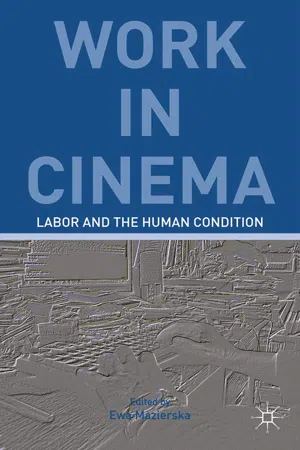
Cinema frequently depicts various types of work, but this representation is never straightforward. It depends on and reflects many factors, especially the place and time the film is made and the type of audience it addresses. Here, the contributors employ transnational and transhistorical perspectives to compare filmic depictions of work.
Information
Subtopic
Art GeneralP A R T I

NEOLIBERAL WORK
C H A P T E R 1
AFFECTIVE LABOR AND ALIENATION IN UP IN THE AIR
Ian Fraser*
The neoliberal phase of capitalism has been typified by its ruthlessness in its treatment of labor and this has been captured dramatically by Up in the Air (2009), directed by Jason Reitman, and adapted from Walter Kirn’s novel (Kirn 2001), which focuses on a corporate consultant, Ryan Bingham, whose job is to fly around the United States firing workers. He does this in such a professional and unthinking manner that the reality of what he is doing does not preoccupy him. His world becomes unsettled, however, when two women come into his life both professionally and personally. One is Natalie Keener, a new employee in his firm, who introduces the new technology of videoconferencing as a way to sack people in order to cut costs. The other is Alex Goran, a female mirror image of his own corporate self, with whom he has a relationship that appears to develop a degree of emotional empathy, but within which Bingham finds, to his great cost, that the labor he has been involved in when sacking people suddenly rebounds on him within the realm of his personal life. The alienating aspects of these labor activities begin to dawn on Bingham and Natalie both professionally and personally, forcing them to reassess their lives along more humanist lines.
To this end, I explore the film utilizing Hardt and Negri’s notion of affective labor, which is labor that produces an emotional affect in another person, to illustrate how the very intimate relationships we form with each other can be corrupted by the instrumentalism that can pervade the workplace. The theory of affective labor as applied to this film carries a normative import to suggest that the world of work and our personal lives are intertwined. Realizing this means that we should always treat people as ends in themselves rather than as a mere means to be sacrificed on the altar of corporate capitalism. Bingham’s firm exists solely to offer corporations the service of sacking their workers for them, which perceptively pinpoints the brutal consequences of neoliberalism when firms collapse and their employees are thrown on the scrapheap. Against the backdrop of the rights fought for by workers that neoliberalism has systematically attempted to eradicate since the 1970s, such an attack can seem even worse than under previous forms of capitalism and further exposes the immorality at the heart of the ideology. Marx accounted for this expulsion of labor with his theory of the tendency for the rate of profit to fall (Marx 1991: part three; cf. Fraser and Wilde 2011: 198–9). He argues that when capitalists see a reduction in their profits one way they try to counteract this is by making excessive investment in what he calls constant capital, such as technology, machines, and so on. However, as this capital is constant it does not add any new value to the production process which can be turned into surplus value, which is eventually realized in the form of profit. For Marx, only labor is the source of this surplus value but as it is expelled from the production process in favor of constant capital this leads to a further decline in profitability and can result in risky investments, business failures, and full-blown economic crises.
Indeed, the recent financial crash of 2007/8 and the massive expansion of what Marx called “fictitious capital,” money unrelated to the reality of producing actual commodities, is a further consequence of this process once debt is used to overcome crises in profitability in the real side of the economy (Marx 1991: 595–601; cf. Burnham 2010). As David Harvey also explains, these barriers to profit-maximization in the real side of the economy result in less people being employed and a redistribution of wealth away from the poor and the public to the rich (Harvey 2005: 159; Choonara 2009; cf. Hardt and Negri 2009: 266). Such an over-accumulation of wealth that is symptomatic of an aggressive neoliberalism means that the rich need to make further returns on their money. They, therefore, engage in often fraudulent investments that are further dislocated from the real side of the economy resulting in financial crisis and increasing unemployment. As Hardt and Negri also observe, neoliberalism operates in the “postindustrial economy” where labor and products are becoming increasingly immaterial, the world of work ever more precarious and the expulsion of labor a perpetual probability (Hard and Negri 2009: 266, 132–7). Against this background of an unstable and brutal capitalism that the film expertly exposes, affective labor can be seen as a means to manage the process of capital’s production of human waste. I begin, therefore, by outlining Hardt and Negri’s theory of affective labor, and then utilize this framework to consider the change in Bingham’s identity in his interactions with Natalie and Alex.
AFFECTIVE LABOR
In Empire, Michael Hardt and Antonio Negri interpreted a new phase of an increasingly globalizing capitalism. They defined “Empire” as a sovereign power governing the world and regulating global exchanges, a new form of rule in which sovereignty has begun to take a global form given the declining sovereignty of nation states (Hardt and Negri 2000: xi). Empire, unlike imperialism, has no boundaries or any centre of territorial power and the “object of its rule is social life in its entirety” (Hardt and Negri 2000: xi). As part of this new Empire age, they assert that it ushered in an era of “immaterial labour,” which is labor that “produces an immaterial good, such as a service, a cultural product, knowledge or communication,” and is mostly present in the service sectors of the economy (ibid.: 289–90).
One aspect of immaterial labor relates to the increased use of computers, which has redefined all forms of social practices and relations, particularly in advanced Western societies (ibid.: 291). For Hardt and Negri, humans “increasingly think like computers” as “communication technology and their model of interaction are becoming more and more central to labouring activities” as “interactive and cybernetic machines become a new prosthesis integrated into our bodies and minds and a lens through which to redefine our bodies and minds themselves.” They endorse the work of Robert Reich here who sees this form of immaterial labor that engages in computer and communication work, ‘“symbolic-analytical services,”’ involving a ‘“problem-solving, problem-identifying”’ approach (Reich 1991: 177). Reich sees this type of labor as having the “highest value,” according to Hardt and Negri, but he also realizes that these jobs can lead to low-skilled, or low-valued work involving word processing or data entry, ushering in a crucial division of labor in the realm of immaterial production (Hardt and Negri 2000: 291–2).
Informationalization and development of immaterial labor produces a “real homogenisation of labouring processes,” which they contrast with Marx’s time when labor was heterogeneous, such as tailoring and weaving, for example (ibid., p. 292). Homogenization was only possible then by abstracting from the concrete differences of the labor employed, which Marx grasped with his notion of abstract labor (ibid., referring to Marx 1998: 131–7). For Hardt and Negri, the increased computerization of today has involved a reduction in the heterogeneous aspects of concrete labor as the “worker is further removed from the object of his or her labour” (Hardt and Negri 2000: 292). This is in contrast to previous periods because different tools related to different activities and could be demarcated as a tailor’s tools or a weaver’s tools. However, with the advent of the computer these differences have been overcome as computerized tailoring and weaving share similar practices in terms of the manipulation of symbols and information. The computer has, therefore, become the “universal tool” through which all activities pass and so points labor toward the “position of abstract labour.”
Hardt and Negri reflect that the role of the computer is only one aspect to immaterial labor and they identify three other types driving the service sector at the apex of the informational economy. One is where informationalization and communication technology permeates industrial production so much so that the production process itself becomes transformed. Another is the analytic and symbolic tasks constituting creative and intelligent manipulation on one side, and routine tasks on the other. The final form of immaterial labor produces and manipulates affect, using either virtual or actual human contact and labor in the bodily mode, “affective labor,” which involves the use of contact and interaction to cause an affect in another person, which can either be actual or virtual but must involve the “creation and manipulation of affect” (ibid.: 292–3). They argue that this type of labor can be found in the caring services, such as health provision and the entertainment industry, where the labor is immaterial because “its products are intangible, a feeling of ease, well-being, satisfaction, excitement, or passion” (ibid). Affective labor goes far beyond the computational aspect of immaterial labor and “produces social networks, forms of community, biopower” (ibid.: 293).
Hardt and Negri see these three types of immaterial labor as driving the postmodernization of the global economy, involving cooperation and social interaction contained within the laboring activity itself, rather than imposed on it from the outside (ibid.: 294). Consequently, they claim that “in the expression of its own creative energies, immaterial labor thus seems to provide the potential for a kind of spontaneous and elementary communism.” There is, therefore, a positive connotation to affective labor because it allows those who refuse the rule of capital, the multitude, to create spaces for their own autonomy in and against the system that attempts to dominate them.
Five years later in Multitude (2005), Hardt and Negri revisit the issue of immaterial labor to reiterate much of their understanding of the concept they made earlier and to reassert how affective labor is present in the work of legal assistants, flight attendants and fast food workers, for instance, which they capture with the phrase “service with a smile” (Hardt and Negri 2005: 108). Nonetheless, the slightly overoptimistic understanding of immaterial labor as an embryonic form of communism is now tempered as they emphasize how alienation can occur when affective production becomes part of waged labor, when something as intimate as forging human relationships is sold to the “command of the client or boss” (ibid.:111). As they also said in Empire and repeat here, they do not mean to claim that immaterial labor makes all work rewarding or pleasant nor do they deny that hierarchy and command are still present in the workplace. Indeed, they contend that the notion of alienation, which they suggest “was always a poor concept for understanding the exploitation of factory workers,” is now a “useful conceptual key” for understanding exploitation in this realm of affective labor (ibid)1. Nevertheless, they do not take this much further in this work, which gives the impression that the positive aspect of affective labor is more their concern, especially as this negative aspect is not explored to any great extent four years later in Commonwealth (Hardt and Negri: 2009). Instead, as Melissa Gregg observes and endorses, they point to love as a possible antidote to corporate capital’s corrosive and corrupting power and she attempts to relate this, albeit briefly, in the final pages of her excellent book, Work’s Intimacy, to Up in the Air (Gregg 2011: 172–4; Hardt and Negri 2009: xii). However, in doing so she depicts the film as offering the negative aspects of an emasculated intimacy rather than the affirmation of love, but declares that this can be “overcome,” although not, she contends, within the context of this film (Gregg 2011: 174). Consequently, I now want to explore the role of immaterial labor in relation to Up in the Air, to suggest that it is mainly the alienating aspects of affective labor that explain the operations of capitalist corporations rather than the positive moments Hardt and Negri emphasize, but contrary to Gregg’s point, there are moments of hope present. I begin with the main anti-hero, Ryan Bingham.
RYAN BINGHAM
The alienating aspects of affective labor are evident at the opening of the film. Successive shots show a number of people looking just to their right of the camera talking to someone we cannot see yet. They all use ethical responses to their plight and aim their hostility and general disbelief at the firer, later revealed as Ryan Bingham. Expressions indicating the injustice these people feel are as follows: “this is what I get in return for 30 years’ service for my company”; “I don’t know how you can live with yourself, but I’m sure you’ll find a way while the rest of us are suffering”; to “fuck you!” and finally, “who the fuck are you?” In a voice-over Bingham states, “excellent question,” and then asks: “Who the fuck am I?” So the rhetorical question can be seen not only as introducing his character to the audience but as a possible questioning of his own identity, although he is in no state to engage in critical self-reflection about what he is and does just yet.
Bingham’s response to such attacks reveals the way affective labor produces alienation as in the case of Steve, who is on the verge of a breakdown when he is told he is being let go. When Steve asks what he did wrong or what he could have done differently, Bingham has the ready answer that he should not personalize this as it is not an assessment of his productivity. Steve sees through the jargon but Bingham hands him a packet that will answer all his questions. Steve is wise to this as well, and ironically mocks Bingham by suggesting it is bound to be really helpful. Bingham then uses his classic line when he has to get people back on track and accept what is happening to them in a more positive light. He states: “anybody who ever built an empire, or changed the world, sat where you are now. And it’s because they sat there that they were able to do it.”
It seems to work, because Steve suddenly looks hopeful, and seizing the moment, Bingham asks him for his key card. Steve asks earnestly how he can contact him, to which Bingham lies by responding that he will be in touch, but his voice-over betrays this assurance by remarking he will never see Steve again. Thus, the alienating insincerity of the affective labor engaged in by Bingham is evident from the outset, and dealing with a traumatic event in people’s lives does not bother him at all. Indeed, he smiles almost self-satisfied on a job well done.
The realm of immaterial labor haunts the film as we are then transported to Bingham’s world where he informs us that to know him is to fly with him. At the airport he marvels at how running one of his cards through the automated machines prompts a desk clerk to automatically greet him with the alienated, affective labor smile and line of, “pleasure to see you again, Mr Bingham.”
On the aeroplane, Bingham luxuriates in his executive business class surroundings as he is approached by a female flight attendant who is pushing along the drinks’ trolley. She is meant to ask Bingham, “do you want the can sir?,” but he hears it as, “do you want the cancer,” which perplexes him, until she shows him the can of drink, which he declines. In this instance, the affective labor that should be producing a comforting affect in offering Bingham a drink instead disconcerts him by his misapprehension of the words. Accidentally, affective labor becomes an alienating force against him rather than in the worker who is meant to produce a more enhancing response in the client, but there is also something else relevant here. From the outset, the film is structured to elicit our sympathies with those who have been or will be fired, and so it engages in a form of affective labor with the audience to make us see Bingham’s work as deeply alienating. The symbolism of the cancer is indicative of the alienating, affective labor that he is engaging in, a cancer he is spreading, and he is being asked if he would like the same t...
Table of contents
- Cover
- Title
- Introduction Work, Struggle, and Cinema
- Part I Neoliberal Work
- Part II National and Transnational Cinemas
- Part III Genre
- Notes on Contributors
- Index
Trusted by 375,005 students
Access to over 1.5 million titles for a fair monthly price.
Study more efficiently using our study tools.
Frequently asked questions
Yes, you can cancel anytime from the Subscription tab in your account settings on the Perlego website. Your subscription will stay active until the end of your current billing period. Learn how to cancel your subscription
No, books cannot be downloaded as external files, such as PDFs, for use outside of Perlego. However, you can download books within the Perlego app for offline reading on mobile or tablet. Learn how to download books offline
Perlego offers two plans: Essential and Complete
- Essential is ideal for learners and professionals who enjoy exploring a wide range of subjects. Access the Essential Library with 800,000+ trusted titles and best-sellers across business, personal growth, and the humanities. Includes unlimited reading time and Standard Read Aloud voice.
- Complete: Perfect for advanced learners and researchers needing full, unrestricted access. Unlock 1.5M+ books across hundreds of subjects, including academic and specialized titles. The Complete Plan also includes advanced features like Premium Read Aloud and Research Assistant.
We are an online textbook subscription service, where you can get access to an entire online library for less than the price of a single book per month. With over 1.5 million books across 990+ topics, we’ve got you covered! Learn about our mission
Look out for the read-aloud symbol on your next book to see if you can listen to it. The read-aloud tool reads text aloud for you, highlighting the text as it is being read. You can pause it, speed it up and slow it down. Learn more about Read Aloud
Yes! You can use the Perlego app on both iOS and Android devices to read anytime, anywhere — even offline. Perfect for commutes or when you’re on the go.
Please note we cannot support devices running on iOS 13 and Android 7 or earlier. Learn more about using the app
Please note we cannot support devices running on iOS 13 and Android 7 or earlier. Learn more about using the app
Yes, you can access Work in Cinema by E. Kerr in PDF and/or ePUB format, as well as other popular books in Media & Performing Arts & Art General. We have over 1.5 million books available in our catalogue for you to explore.