Sarajevo's Holiday Inn on the Frontline of Politics and War charts the rich history of the city's famous Holiday Inn hotel. Describing in detail the tumultuous events that took place within its walls and in its immediate environs, this book explores the opening of the building in advance of the 1984 Winter Olympics through the early 1990s when the hotel was utilized by political elites through to the siege of Sarajevo, when the hotel became the main base for foreign correspondents. Kenneth Morrison draws upon a plethora of primary and secondary sources, and includes extensive interviews with many participants in the drama that was played out within the confines of the hotel, contextualizing the case of the Holiday Inn by analyzing how hotels are utilized in times of conflict.
Kenneth MorrisonSarajevo’s Holiday Inn on the Frontline of Politics and Warhttps://doi.org/10.1057/978-1-137-57718-4_1
Begin Abstract
1. Introduction
Kenneth Morrison1
(1)
Department of History, De Montfort University, Leicester, UK
End Abstract
Sarajevo, the capital of Bosnia and Herzegovina, basked in the warm sunshine, the cafés and streets full of people enjoying the traditional 1 May holiday. The city was abundant with noise and colour and the small traders in Baščaršija (the old Ottoman quarter) were doing a brisk trade. Tourism seemed to be booming, no doubt bolstered by the global attention the city was receiving during the centenary year of the assassination of Archduke Franz Ferdinand and his wife Sophie von Hohenberg, shot and killed by the Bosnian Serb, Gavrilo Princip. Of course, this snapshot of Sarajevo, tourist Sarajevo, though seductive was both superficial and misleading. Bosnia and Herzegovina remains a country dogged by political, economic, and social problems and burdened by the legacies of the brutal 1992–95 war (during which Sarajevo endured a three-and-a-half-year siege), the legacies of the 1995 Dayton Peace Agreement (DPA) and, more recently, economic crisis and social unrest, peaking, thus far, with the violent protests of February 2014.
Walking westward from Baščaršija towards the Marindvor area, the rattle of the trams packed with people heading into the centre of the city only added to the general sense of well-being. But how sharp the contrast when approaching the entrance to the city’s famous Holiday Inn hotel, one of the most iconic buildings in the city (perhaps the most recognisable in Sarajevo during the three-and-a-half-year siege) and something of a metaphor for the fate of the city. Marindvor is now peppered with very modern and expensive shopping centres and fashionable (though somewhat lurid) apartment blocks. Sitting uncomfortably amidst this brash newness is the iconic Holiday Inn, known the world over as the city’s ‘war hotel’, the centre for the international media during the siege. The hotel, an aesthetically challenging modernist structure adorned with a façade of yellow, ochre, and brown, was one of the jewels of the construction boom that preceded the 1984 Winter Olympics, but now it looked run-down. Its rather idiosyncratic appearance seemed something of an anachronism, at odds with the newly built (though equally idiosyncratic) structures that now surround it. I recalled the old photographs that I had seen in the hotel’s (depleted) archive during a previous visit. They showed the newly built Holiday Inn glowing in the sunshine, the neat external areas, though constructed from grey concrete, looking every bit the picture of modernity and its clipped gardens providing a welcome contrast to the angular design of the building. These images conveyed confidence and hope; the hotel a symbol of a city on an upward trajectory, a physical manifestation of that positivity.
Now, however, the hotel looked rather dispiriting. Its garden was overgrown and unkempt, the concrete paving leading to the hotel’s entrance cracked and crumbling, and what was once pleasant green space was now surrounded by a battered corrugated iron fence covered in graffiti imploring citizens to protest against the economic uncertainty and endemic corruption that has, sadly, characterised post-Dayton Bosnia (and had fuelled the social unrest of February 2014). The feature fountain in front of the hotel’s main entrance, which usually transmitted the comforting sound of gently turbulent water, was empty and the flags that flew on the poles in front of the building were dirty and tattered. Upon entering the Holiday Inn, its vast atrium, once the place to be (and be seen in), the emptiness, and the acoustics only a vast, empty space can produce, was disconcerting. Footsteps echoed loudly—resonating around the vast, empty atrium. I had been in the hotel many times, but this time the experience was quite different. The atrium had always been cavernous, even when busy, but now it was cold, empty, dark.
It transpired that the hotel was temporarily closed for business for a then unspecified period, as the result of a botched privatisation, lack of investment, years of mismanagement, and a workers’ strike. The hotel was not receiving guests and the building was ‘occupied’ by staff who had not received their salaries for months (and their pension contributions for several years). Their protest was entirely just and driven by their shoddy treatment at the hands of the hotel’s owners, once regarded as the saviour of the iconic building. The hotel had been bought by an Austrian company Alpha Baumanagement in 2004, and the new owners had promised that the Holiday Inn would not just thrive but would be modernised and would be central to plans to construct the so-called Grand Media Centre, replete with shopping centre, fitness clubs, and a casino, with the hotel as the core of the new complex. Hopes were high that the Holiday Inn would again occupy its rightful place as one of Sarajevo’s great hotels in an increasingly competitive market. But it wasn’t to be. The promised investment never materialised and the hotel gradually accumulated significant debts. How ironic that having survived the ravages of the siege of Sarajevo and the difficulties of post-war transition, the hotel was now threatened with closure as the result of a privatisation process gone awry.
Upon arrival, it was clear that the striking workers had taken their leave for the day (it was, of course, a holiday across the country), but I was not, in any event, there per se to discuss the protests or the privatisation process that had led to the apparent demise of the hotel, but to meet with a one-time security officer in the hotel; Sarajevo-born but now, like so many of his countrymen, living abroad. We sat in the freezing cold and eerily empty atrium, discussing life in the hotel in the years after its opening in 1983, its many illustrious guests, and its place in the folklore of Sarajevo, before moving on to discuss the disintegration of the Yugoslav state, the war in Bosnia and Herzegovina, the siege of Sarajevo, contemporary political events, the country’s troublesome privatisation process, and the consequences of it, consequences that were all too clear right there in the hotel. The discussion went on for several hours, and he lamented the fate of the hotel in which he had spent many years working, and had been proud to work in. The emotional attachment he still has to the building was evident, though he expressed little hope that the future for the hotel was bright.
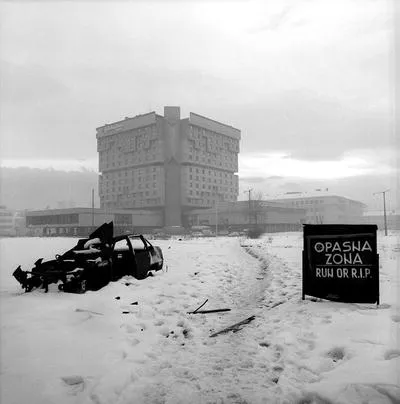
Then, with the acquiescence of the sole security guard on duty, we walked through the dark and deserted corridors, stairwells, conference rooms, kitchens, and restaurants of the hotel. Dark, cold, empty, and without electricity, it felt like the Mary Celeste, as if everyone, guests and staff, had departed in a hurry. Overflowing ashtrays were dotted around, glasses lay uncollected, discarded pieces of clothing were strewn on the backs of chairs. In the large kitchen—once state of the art—pots, pans, and unwashed cutlery lay on the work surfaces, and hastily constructed placards on which staff had written messages imploring the owners to address their concerns lay scattered on the floor. Of course, this was the residue of more recent events, but walking through those darkened, empty spaces, one could almost feel the ghosts of the past stalking the corridors—because this hotel has, despite its relative infancy, a past (Image 1.1). There was, however, no way to avoid reaching the conclusion that this fascinating past was no guarantor of the hotel’s future. It was, therefore, an appropriate time to document the history of the hotel, particularly throughout its most turbulent years, lest the building be closed permanently and the opportunity, perhaps, lost.
Image 1.1
The Holiday Inn during the siege of Sarajevo, January 1993. The sign reads: ‘Danger zone: Run or R.I.P’. (Photo: Paul Lowe)
The hotel would, however, be given a temporary stay of execution and would again open for guests for the summer of 2014 (though the hotel would again be closed in July 2015, perhaps permanently), but its future was uncertain and the importance of documenting its history remained. Embarking upon such an endeavour was not difficult to justify, because the Holiday Inn was not simply one of Sarajevo’s most aesthetically striking and symbolically important buildings, it has been an inanimate and passive witness to some of the key moments in the modern history of a city that has experienced significant social, economic, and political flux and war. If the walls could speak, there would be much to convey, for some of those events took place either within or in the immediate environs of the hotel. Consequently, history has left indelible marks on the building—some tangible, others intangible.
Constructed in advance of the 1984 Winter Olympics, primarily to host leading members of the International Olympic Committee, the hotel is only just over thirty years old—relatively youthful for a building with such a rich history. In the first six years of its existence, the Holiday Inn was Sarajevo’s finest hotel, hosting many prestigious guests. It would also host domestic political elites. Alija Izetbegović, the wartime president of the Bosnian government, launched the Party of Democratic Action (SDA) at the Holiday Inn, though it was later frequently used by Radovan Karadžić’s Serbian Democratic Party (SDS), and was briefly their headquarters. The hotel was at the centre of events during the ‘referendum weekend’ of February/March 1992, and it was from the hotel that senior members of Karadžić’s party launched, in the wake of the referendum, the ‘war of the barricades’ that brought the city to a temporary standstill. It was also from the hotel that, on 6 April 1992, some of the first shots of the war in Sarajevo were fired into a crowd of peace demonstrators assembled in front of the Bosnian parliament building. After the events of 6 April, the hotel closed, but was reopened as the siege of Sarajevo tightened, thereafter serving as a press hotel—frequented, in the main, by the international media that had descended on the city following the outbreak of war in Bosnia and Herzegovina. The Holiday Inn, while in Sarajevo was not strictly of it—the hotel was detached and subject to a specific set of micro-dynamics; subject to, but in many ways quite different from, the dynamics that existed in the city during the siege. It remained thus until the Bosnian war ended and the siege of Sarajevo was lifted after the signing of the Dayton Agreement in December 1995, whereupon the hotel entered a new era of uncertainty.
However, despite the gravity of events that have taken place either within or in the immediate vicinity of the hotel, there has hitherto been no attempt to document, in sufficient depth, the history of the building and its myriad guests. The Holiday Inn is oft-mentioned in the plethora of written material focusing on the war in Bosnia and Herzegovina and the siege of Sarajevo, be it in academic studies, journalist’s memoirs, newspaper reports, or magazine articles, yet it is mentioned, largely, in passing and treated superficially. The following book represents, therefore, an attempt to shed light upon how the hotel was utilised by different individuals and groups before (be they politicians, political parties, journalists, diplomats, aid workers, intellectuals, or peace activists), during and after the siege drawing, in part, on the recollections of those who either worked in or stayed in the hotel for long periods. It analyses how the hotel functioned under siege conditions, despite being located a few hundred yards from the frontline, and how the hotel’s guests adapted to these extraordinary circumstances.
However, while this book focuses on Sarajevo’s Holiday Inn, it is not strictly a history of the hotel in the conventional sense. It is not a traditional study of a hotel but, rather, a study of the significant historical events that have taken place within its walls or its immediate environs. And, of course, the scope of the book is necessarily narrow in focus, and it is not, nor can it be, a detailed account of the siege of Sarajevo, or indeed the war in Bosnia and Herzegovina—that has been admirably executed elsewhere and in painstaking detail by other scholars. The book does, nevertheless, provide a unique insight that other books or articles do not. Not only is this a general history of the building and of the events that have taken place there, but it also draws upon the experiences and insights of the hotel’s myriad guests, with a particular focus on those who frequented the hotel during the siege. More broadly, however, it is also a book about hotels and hostelry in wartime, how such places function in the context of a war, and how staff and management endeavour to provide the most basic of services while conveying a semblance of normality to guests in the most extraordinary of circumstances. And the history of the Holiday Inn provides us with an example par excellence of a hotel that continued to function in the context of war, but did so despite being located directly on the frontline of the longest siege in modern European history.
Open Access This chapter is licensed under the terms of the Creative Commons Attribution-NonCommercial 2.5 International License (http://creativecommons.org/licenses/by-nc/2.5/), which permits any noncommercial use, sharing, adaptation, distribution and reproduction in any medium or format, as long as you give appropriate credit to the original author(s) and the source, provide a link to the Creative Commons license and indicate if changes were made.
The images or other third party material in this chapter are included in the chapter's Creative Commons license, unless indicated otherwise in a credit line to the material. If material is not included in the chapter's Creative Commons license and your intended use is not permitted by statutory regulation or exceeds the permitted use, you will need to obtain permission directly from the copyright holder.
Kenneth MorrisonSarajevo’s Holiday Inn on the Frontline of Politics and Warhttps://doi.org/10.1057/978-1-137-57718-4_2
Begin Abstract
2. Hotels as Strategic Assets, Prestige Targets, and Sanctuaries
Kenneth Morrison1
(1)
Department of History, De Montfort University, Leicester, UK
End Abstract
Why devote an entire book to something as seemingly mundane as a hotel?1 Hotels are, after all, as ordinary as they are omnipresent.2 They exist to provide for the most basic of needs: shelter, sleep, food, and a range of other services that facilitate the paying guests’ needs, be they modest or otherwise. In the context of war, however, the mundane and the extraordinary juxtapose, and hotels take on an entirely different significance.3 Though while ostensibly created specifically for business travel, leisure, and relaxation, hotels have always been part of a security apparatus. They are occasionally requisitioned as barracks4 during war or used as locations where warring factions embark upon peace negotiations.5 They host not only tourists but also politicians, diplomats, spies, journalists, and representatives of military or paramilitary groups. Additionally, in wartime, hotels often become press hotels, bases for journalists during conflicts. In so doing, these buildings often become integral parts of the narrative and imagery of those conflicts.6
Every conflict or revolution generates memorable examples of the hospitality industry’s resourcefulness, courage, and ‘grace under fire’.7 Similarly, each has its own ‘war hotel’ (or hotels), places that often become among the most recognisable symbols of the respective wars in which they are part. As the writer and journalist Paul Harris notes, when war breaks out ‘there will always be certain types of hotel guest for the establishment that keeps its doors open’ though in the absence of normal guests, these tend to be journalists, aid workers, intelligence agents, or ‘war tourists’.8 Sarajevo’s Holiday Inn, the primar...
Table of contents
Cover
Front Matter
1. Introduction
2. Hotels as Strategic Assets, Prestige Targets, and Sanctuaries
3. Press Hotels in Conflict Zones
4. The Construction of Sarajevo’s ‘Olympic Hotel’
5. Politics Comes to the Holiday Inn
6. In Residence: Radovan Karadžić and the SDS
7. Crossing the Rubicon: The Outbreak of War in Sarajevo
8. A New Reality, A New Clientele
9. The Hazards of Living on the Frontline
10. Hostelry in Extremis
11. The Targeting of the Holiday Inn
12. The Rebirth and Demise of Sarajevo’s Holiday Inn
Back Matter
Trusted by 375,005 students
Access to over 1.5 million titles for a fair monthly price.
Study more efficiently using our study tools.
Frequently asked questions
Yes, you can cancel anytime from the Subscription tab in your account settings on the Perlego website. Your subscription will stay active until the end of your current billing period. Learn how to cancel your subscription
No, books cannot be downloaded as external files, such as PDFs, for use outside of Perlego. However, you can download books within the Perlego app for offline reading on mobile or tablet. Learn how to download books offline
Perlego offers two plans: Essential and Complete
Essential is ideal for learners and professionals who enjoy exploring a wide range of subjects. Access the Essential Library with 800,000+ trusted titles and best-sellers across business, personal growth, and the humanities. Includes unlimited reading time and Standard Read Aloud voice.
Complete: Perfect for advanced learners and researchers needing full, unrestricted access. Unlock 1.5M+ books across hundreds of subjects, including academic and specialized titles. The Complete Plan also includes advanced features like Premium Read Aloud and Research Assistant.
Both plans are available with monthly, semester, or annual billing cycles.
We are an online textbook subscription service, where you can get access to an entire online library for less than the price of a single book per month. With over 1.5 million books across 990+ topics, we’ve got you covered! Learn about our mission
Look out for the read-aloud symbol on your next book to see if you can listen to it. The read-aloud tool reads text aloud for you, highlighting the text as it is being read. You can pause it, speed it up and slow it down. Learn more about Read Aloud
Yes! You can use the Perlego app on both iOS and Android devices to read anytime, anywhere — even offline. Perfect for commutes or when you’re on the go. Please note we cannot support devices running on iOS 13 and Android 7 or earlier. Learn more about using the app
Yes, you can access Sarajevo’s Holiday Inn on the Frontline of Politics and War by Kenneth Morrison in PDF and/or ePUB format, as well as other popular books in History & European History. We have over 1.5 million books available in our catalogue for you to explore.