eBook - ePub
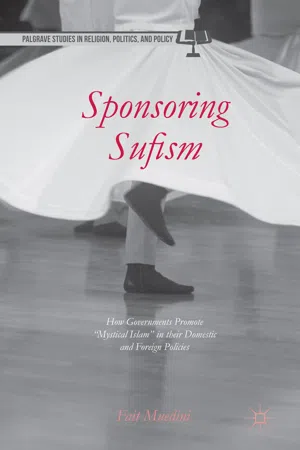
Sponsoring Sufism
How Governments Promote “Mystical Islam” in their Domestic and Foreign Policies
- English
- ePUB (mobile friendly)
- Available on iOS & Android
eBook - ePub
Sponsoring Sufism
How Governments Promote “Mystical Islam” in their Domestic and Foreign Policies
About this book
Sponsoring Sufism argues that governments are sponsoring Sufism not only because they see it as an 'apolitical' movement that won't challenge their existing authority, but also that ties to Sufi orders gives them religious credibility, something they seek as they face the rise of Islamist parties.
Information
CHAPTER 1
What Is Sufism? History, Characteristics, Patronage, and Politics
In order to understand the ways in which government leaders attempt to use Sufism in their domestic and foreign policies, it is imperative to begin the discussion by examining what is meant by the term “Sufism.” The problem with defining Sufism (tasawwuf), however, is the “difficulty” of how to “approach” the discussion of Sufism [,] particularly “[s]ince the very concept . . . is hotly contested among both Muslims and non-Muslims” (Ernst, 1997: 1–2). Sufism is the understood and “accepted term name for mystical Islam” (Schimmel, 1975: 3). But while this is the case, “[T]he terms, however, are not precisely synonymous, for ‘Sufi’ has a specific religious connotation, and is restricted by usage of those mystics who profess the [Islamic] faith” (Nicholson, 1963: 3). The term “mysticism” itself is often understood as “love of the Absolute—for the power that separates true mysticism from mere asceticism is love. Divine love makes the seeker capable of bearing even enjoying all the pains and afflictions that God showers upon him in order to the test him and purify his soul” (Schimmel, 1975: 4). The mystic, or “[t]he enlightened sees God in everything and in every space” (Bentounes, 2002: 14). And because one can see God in everything, then perceiving God in humans is not an exception. Lings (1977) explains that the Sufi theology of tawhid, or “Oneness of Being,” suggests that “what the eye sees and the mind records is an illusion, and that every apparently separate and finite thing is in Truth the Presence of the One Infinite” (Lings, 1977: 65). He relates this concept to “orthodox” Islam by citing the Quran, which explains that “Wheresoever ye turn, there is the Face of God” (Lings, 1977: 65).
Thus, while Sufism does not have one definition, it does aim for a “personal engagement with the Divine” (Chittick, 2009: 207). The goal of many of these Sufis is not only to have connections to God but also to become “absorbed” in God (Degorge, 2005: 23). Sufis place extensive value on recognizing God in the world, which includes the presence of God within the individual. Furthermore, some argue that Sufism, while recognizing the value of rituals and physical acts of prayer, “Tends to generally stress inwardness over outwardness, contemplation over action, spiritual development over legalism, and cultivation of the soul over social interaction” (Chittick, 2009: 207). Sufism places considerable value on God’s attribute of displaying “love” and “kindness” as opposed to meting out punishment (Chittick, 2009: 207). Sufism is also known for its emphasis on dhikr, or remembrance of God, a practice in which Sufis will often chant the name of God as a form of worship (Chittick, 2009).
The term Sufism actually first originated from European travelers during the Middle Ages (Schimmel, 1975) who viewed Sufism as a “sect” of Islam (Ernst, 1997: 3), while the “practice” of Sufism itself is said to have been present during the establishment of Islam in the time of the Prophet Muhammad (Fadiman & Frager, 1997), although it was only “institutionalized” between “the ninth and eleventh centuries” (Buehler, 1998: 1). There was not one single reason for the formation of Sufism. Some scholars have suggested it formed as a counterforce to Islamic movements that were solely reliant on sharia (Islamic law), while others point out that Sufism is actually built on sharia, but that other elements of faith, and namely tariqa, or the “path,” were also emphasized (Malik, 2006). In addition, Sufism should not be seen as a “unified” position within Islam. A wide range of thoughts and beliefs exist within the historical and current positions of Sufis and Sufi orders, and often these positions either influenced or were influenced by other frameworks and ideas (Malik, 2006: 3).
Early Western interpretations of Sufism saw it as a lifestyle that was often compared to that of “Catholic monks . . . [who were] known for their solitary way of life” (Ernst, 1997: 3), because of the practitioners’ dismissal of the material world. Sufi definitions have also included the terms “pure” and “wool” since it was said that Sufis would dress in wool “cloaks” to further indicate their “poor” life (Fadiman & Frager, 1997), although others suggest that mystics did not commonly wear wool in Islam (Lings, 1977: 46). Nevertheless, this notion of a “poor” life associated with Sufism was not specifically related to material wealth, but rather spiritual poverty, most notably the idea that a person has nothing, and thus needs God for everything (Fadiman & Frager, 1997). The importance of the concept of poverty in the original Sufi context was therefore more in-depth than the European interpretations of the customs of Sufi life, since Sufis believed that being poor reflected the importance of needing God (Ernst, 1997), particularly since one of the main goals of a person on the Sufi path is to become completely attached to God, and some take steps to detach themselves from the world so as to become solely reliant on God (Nasr, 2007). In fact, some suggest that the Sufi movement actually arose in opposition to what many saw as increased materialism in the early years of the Muslim community after the death of the Prophet Muhammad. Specifically, this movement positioned itself away from “[t]his ostentatiousness and display of wealth [that] were seen by those in power as a way to legitimize their position and beliefs” (Degorge, 2005: 24).
Thus, along with such understandings of Sufism, other terms for Sufism include “dervish,” which translated from Persian means “from door to door” (Fadiman & Frager, 1997: 3). This term was used for Sufis because of their habits of going to homes and asking for food, which is indicative of their simple lifestyle (Fadiman & Frager, 1997). However, Sufism further developed into more structured group organizations (understood as tariqas) that were often headed by a spiritual leader, often called a sheikh or pir. It was here that individuals would have access to spiritual knowledge, and where they were able to practice exercises in their spiritual development (Degorge, 2005). As we will see later, the role of tariqas and Sufi spiritual leaders becomes important in the politics of the different regions. However, we must remember that in early Sufism, while the sheikh had religious authority, a “systematic rule” did not exist (Ernst, 1992: 12).1 It was only later that Sufi orders began to develop (Ernst, 1992).
Historical Perception of Sufism
Thus, while Sufism itself has taken on a number of characteristics as it has developed as a mental and spiritual framework, the perception of Sufis by non-Sufis from the “Muslim world” as well as from Europe has often incorrectly generalized their beliefs and activities, sometimes labeling Sufis under a very narrow definition or identification. For example, “[i]n modern times, European orientalists sometimes argued that Sufism was not really Islamic, basing themselves on an abstract definition of Islam that was often derived from the hostile context of European colonialization of Islamic countries” (Ernst, 1992: 6). Furthermore, there existed a push to suggest that this notion of mysticism in Islam was alien to the faith, instead coming from other religious and philosophical sources (Ernst, 1992: 6). Others, in an attempt to identify what Sufism was, equated the religious philosophy with whirling dervishes (Ernst, 1997), taken from the whirling dervishes of the Mevlevi Sufi order that originated after the death of “Rumi. But while being poor and focusing solely on the need and reliance of God in one’s life was esteemed in the early Sufi Islamic tradition, European travelers failed to give the Sufi lifestyle, along with the whirling of particular Sufis, an insightful religious explanation, and instead viewed the acts as “bizarre behavior” (Ernst, 1997: 4). Understandings of Sufism by orientalists were centered on the notion of the fakir (poor man) or dervish. In discussions about the areas that the colonial powers controlled, they would report on the actions of the dervishes, often labeling these individuals as “mad” (Ernst, 1997: 8).
This perception of Sufism was not only held by Europeans, however, as Sufism was also losing standing with Muslims in parts of the “Muslim world” such as Persia, where Shi’ism was taking hold (Ernst, 1997: 4). Sufism continued to be seen as a “deviation” from Islam by early colonizers who encountered Sufi poetry that emphasized actions such as drinking, which is seen as forbidden in Islam (Ernst, 1997). Sufi orders continued to be under persecution at the beginning of the 1800s when Sir John Malcolm, who was the ambassador to Persia for the British East India Company, built ties with the Shia religious leaders (or ulama) in Persia. This group, lead by Mahomed Ali, emphasized going after the Sufis whom they saw as ruining Islam because the Sufis were viewed as not living up to high “moral” standards (Ernst, 1997).
The criticism against Sufism has not been limited to historical cases. Challenges still exist today. Julia Day Howell and Martin van Bruinessen (2007) explain that one of the major issues with which Sufism has been charged—which is one of the underlying assumptions about Sufism—is that because of its heavy emphasis on spiritual matters, the ultimate objective being to reach the divine, there is little that Sufism can contribute to “social and economic development” (7). However, this is not the only current critique of Sufism. We find that many within the Muslim tradition also take issue with Sufism on a number of other matters. For example, critics of Sufism have been upset because Sufis were often willing to downplay the importance of custom and prescribed worship, instead suggesting that any form of prayer with God in mind was acceptable (Ernst, 1997). This sort of criticism of Sufism is prevalent in Muslim societies to this day, since Sufism, while it is revered in some Muslim communities, is seen as “heretical” in many others (Fadiman & Frager, 1997: 7). Part of the reason for this “heresy” against Sufism, according to some Muslims, is because of what they see as “innovations” by Sufis in terms of what is “Islam.” For example, “[r]eformists have regarded as particularly objectionable the Sufis’ repetitive dhikr litanies, which can facilitate ecstatic experiences, especially in extended group performances where people may punctuate their utterances with emphatic bodily movements or accompany them with dance” (Day Howell & van Bruinessen, 2007: 7). However, the criticism is not only limited to what is seen as Sufi practices that are “not Islam.” Some scholars have also taken issue with Sufi orders themselves, and in particular the idea that a particular spiritual leader is necessary for the growth and development of an individual on the path to God. Along with this, some have suggested that certain practices of Sufi orders have been hidden from the outside, and this has further upset some non-Sufi Muslims (Day Howell & van Bruinessen, 2007).
Examining the persecution of Sufism in historical as well as modern contexts is relevant because of the tension that exists between Sufi interpretations of Islam by those who adhere to a “puritanical” interpretation of Islam, and those who view any other readings of the Quran as a “threat” to their control of what they have attempted to brand as “true” Islam. “Fundamentalists” view Sufism as completely opposite to their position of Islam (Ernst, 1997: 212–213). In fact, we have seen increased persecution of Sufis in modern-day Muslim countries such as the Islamic Republic of Iran, in which there have been “clashes” between Sufis and “more orthodox traditions of Islam” (Esfandiari, 2006: 1). But despite the increased persecution of Sufis, there are many Sufi orders (or tariqas) (Voll, 2009) around the world, which are often founded for a number of different reasons. While many orders are established because a particular individual has a following, other orders may be founded based on a particular attitude or action (such as orders based on “fasting”) (Voll, 2009: 218). Some of the larger Sufi orders include the Qidiriya, Naqshbandi, Chishtiya, and Tijaniyah orders (Willis, 2009), while other Sufi orders such as the Bektashiye and Mevleviye orders are also popular (Godlas, 2009).
Sufism and Worldly Detachment
A key point within the examination of Sufism and its relation to politics is the question of Sufi perspectives on the material world, and namely the belief that the Sufi aims to create distance between her-/himself and the world. This idea, which suggests that the Sufi is detached, is important, as this perception plays a key role in what current misconceptions about Sufism and politics are built upon. When one is talking about the view of Sufi philosophy, it must be recognized that a main objective within this religious approach is this understanding that “Sufism concerns itself with the relation of the soul to the other (i.e., nonmaterial) world” (Heck, 2007b: 149). This idea of Sufi “asceticism” (Afzaal, 2005) is critical in Sufi thought, and is often seen in mainly two different lights. On the one hand, not only can this asceticism help one increase her/his spiritual state but it can also serve as a foundation for consciousness in regard to ideas such as the need to protect the environment (Afzaal, 2005). On the other hand, some have the concern that “[i]n its extreme manifestation, asceticism can lead to an excessive otherworldliness and withdrawal from the world—an attitude that could lead to a disregard for the concrete social and ecological reality in favor of person union with the divine” (Afzaal, 2005: 1605). Nevertheless, thinkers have discussed the idea of asceticism in an attempt to understand effective ways for Sufis to “remove the veils” and arrive closer to this goal, namely the Divine. Because the objective of the Sufi was to reach God, “this world was thus seen as a threat to one’s salvation, making it necessary to renounce it as an abode of temptations” (152), as Paul Heck (2007b) explains.
Consideration of the connection that a Sufi should have with the world is not new, but rather, has been a highly discussed topic within the evolution of Sufi thought. For example, some of the historical Muslim mystics advocated the removal of the individual from any world concerns, which included “power,” in order to truly become closer to God (Awn, 1983). Such mystics often had the belief that internally the human was good, but that the outside world, the material world, was a hindrance, often coming between the Sufi and her/his goal of reaching God. In fact, this emphasis on the value of the material world was not lost in Islam (Awn, 1983: 245). In an examination of the historical literature of Sufi attitudes toward the material world, sufficient evidence exists to suggest that, while it was not universal by any means to believe that one had to remove oneself from the world, that some did hold the position that the world was a negative insofar as one wanted to attain God. Peter Awn (1983), in a detailed analysis of this question, shows the attitudes that early thinkers held about the material world. For example, Hasan al-Basri, in a communication with the political leader Caliph ‘Umar Ibn ‘Abd al-‘Aziz, expressed his concern for the material world by saying,
Beware of this world with all weariness; for it is like a snake, smooth to the touch, but its venom is deadly. . . . For this world has neither worth nor weight with God; so slight it is, it weighs not with God so much as a pebble or a single clod of Earth; as I am told, God has created nothing more hateful to Him than this world and from the day He created it He has not looked upon it, so much He hates it. (from Arberry, 1950: 33–34, in Awn, 1983: 245)
Awn (1983) has found that in other areas of the world some Sufis compared the material world to “a rotting corpse with a dog (i.e., the devil Iblis) perched on top” (245), or, in the case of Ibrahim Ibn Adham, saw issues of family, as well as power, as highly problematic in regard to the ultimate objectives of the Sufi on the path of God (245).
However, many Islamic thinkers (even within the Sufi tradition) have been quite critical of the idea that Sufis must be disengaged from the current world. For example, “[Bediuzzaman Said] Nursi . . . opposes the Sufi disdain for the world” (Kuru & Kuru, 2008: 106). More specifically,
[w]hen asked about the Naqshibandi method of discarding all worldly things, he rejected it. A questioner asked Nursi whether it was necessary to give up this world in order to reach the knowledge of God and human perfections, as the Sufi orders instructed. Nursi noted that if a human being consisted of only a heart, it would be necessary to renounce everything other than God, but human beings have many senses such as a mind, ego, and soul. (Kuru & Kuru, 2008: 106)
These feelings toward Sufism are not limited to historical cases. In fact, we have seen the position held by “revivalists,” who believe that Sufism is not concerned with issues in the world (Afzaal, 2005: 1604). For this reason, they do not believe that Sufis have any interest in politics (Afzaal, 2005). And since, according to Sufis, their ultimate objective is God, even some contemporaries have interpreted their actions and goals as not focusing on the here and now. Sufism itself emphasizes helping individuals through any difficulties in this life, aiming to elevate a person beyond such concerns. However, this does not mean that a person has to turn her/his back on this life (Nasr, 1972). Sayyed Hossein Nasr (1972) explains that a range of tools can be used to get an individual closer to God. Specifically,
[i]n order to express its truths Sufism can make use and has made use of every legitimate means, from weaving to archery, from architecture to music, and from logic to traditional theosophy (hikmat-I ailahu). The goal of Sufism is to lead man from the world of from to the world of the Spirit; but since man lives in the world of form and at the beginning of the spiritual path is not detached from it, by means of this very world of form Sufism turns his attention towards the spiritual world. (2)
Nasr (1972) has also discussed in detail how things such as music can be used to help bring Sufis closer to God. Thus, it is not too difficult to think of Sufis as using the political sphere, whether in terms of human rights or other approaches related to social justice, both theoretically as well as practically to become closer to God (Muedini, 2010). There is no reason why the Sufi must renounce this life. Instead, s/he can find benefit from the different activities if that allows her/him to become closer to “the next world.” In fact, many Sufis have felt that “one’s involvement in the world should be only to the extent that it foster’s one’s progress along the Path” (Awn, 1983: 246). Within this, the belief is that “[d]etachment leads to a renewed freedom since one is master of one’s psychological and emotional needs. Instead of being the pawn of his or her human instincts, the Sufi is able to employ both interior strengths and the world of...
Table of contents
- Cover
- Title
- Introduction
- 1 What Is Sufism? History, Characteristics, Patronage, and Politics
- 2 Algeria: Abdelaziz Bouteflika, Sufism, and Authoritarianism
- 3 Morocco: King Mohammed VI, Sufism, and the Islamist Challengers
- 4 Appealing to Sufi Orders and Shrines: The Case of Government Sufi Advocacy in Pakistan
- 5 Promoting Sufism in Russia, Chechnya, and Uzbekistan
- 6 The Promotion of Sufism in the West: Britain and the United States
- Conclusion
- Notes
- Bibliography
- Index
Trusted by 375,005 students
Access to over 1.5 million titles for a fair monthly price.
Study more efficiently using our study tools.
Frequently asked questions
Yes, you can cancel anytime from the Subscription tab in your account settings on the Perlego website. Your subscription will stay active until the end of your current billing period. Learn how to cancel your subscription
No, books cannot be downloaded as external files, such as PDFs, for use outside of Perlego. However, you can download books within the Perlego app for offline reading on mobile or tablet. Learn how to download books offline
Perlego offers two plans: Essential and Complete
- Essential is ideal for learners and professionals who enjoy exploring a wide range of subjects. Access the Essential Library with 800,000+ trusted titles and best-sellers across business, personal growth, and the humanities. Includes unlimited reading time and Standard Read Aloud voice.
- Complete: Perfect for advanced learners and researchers needing full, unrestricted access. Unlock 1.5M+ books across hundreds of subjects, including academic and specialized titles. The Complete Plan also includes advanced features like Premium Read Aloud and Research Assistant.
We are an online textbook subscription service, where you can get access to an entire online library for less than the price of a single book per month. With over 1.5 million books across 990+ topics, we’ve got you covered! Learn about our mission
Look out for the read-aloud symbol on your next book to see if you can listen to it. The read-aloud tool reads text aloud for you, highlighting the text as it is being read. You can pause it, speed it up and slow it down. Learn more about Read Aloud
Yes! You can use the Perlego app on both iOS and Android devices to read anytime, anywhere — even offline. Perfect for commutes or when you’re on the go.
Please note we cannot support devices running on iOS 13 and Android 7 or earlier. Learn more about using the app
Please note we cannot support devices running on iOS 13 and Android 7 or earlier. Learn more about using the app
Yes, you can access Sponsoring Sufism by F. Muedini in PDF and/or ePUB format, as well as other popular books in Politics & International Relations & American Government. We have over 1.5 million books available in our catalogue for you to explore.