eBook - ePub
Fegelein's Horsemen and Genocidal Warfare
The SS Cavalry Brigade in the Soviet Union
- English
- ePUB (mobile friendly)
- Available on iOS & Android
eBook - ePub
About this book
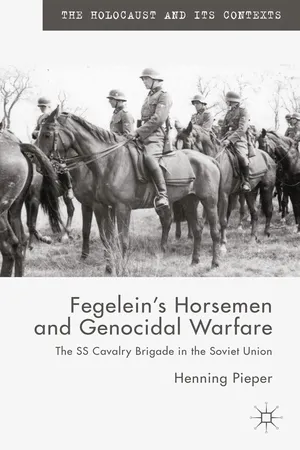
The SS Cavalry Brigade was a unit of the Waffen-SS that differed from other German military formations as it developed a 'dual role': SS cavalrymen both helped to initiate the Holocaust in the Soviet Union and experienced combat at the front.
Trusted by 375,005 students
Access to over 1.5 million titles for a fair monthly price.
Study more efficiently using our study tools.
Information
1
Elite Sportsmen: The Pre-war SS-Reiterstandarten
The forming of the units that later made up the SS Cavalry Brigade was a gradual process which began before the outbreak of the Second World War. It was intrinsically tied to the lives of several SS officers, most notably Hermann Fegelein, and also to the development of mounted paramilitary formations in Germany.
In the early 1930s, the two most important Nazi paramilitary organisations, the Sturmabteilung (SA) and the Schutzstaffel (SS), grew rapidly; they were joined primarily by war veterans and people who had been members of other right-wing organisations before. Their leaders, Ernst Röhm and Heinrich Himmler, established a strict hierarchy in their respective institutions, both of which were based on military principles and closely resembled one another in structure and terminology. In other respects, mainly regarding their tasks, they were very different: the SA was the ‘boots on the ground’ for the fight against political enemies, whereas the SS was an elite force which served as a bodyguard for Hitler and the party leadership; it was also designated to discipline the SA in the case of revolt.1 In the years before Hitler came to power and in the early days of the Nazi regime, the administration of the SS was subject to many changes. From late 1934 onwards, it became more effectively structured and took on the basic organisational form it was to keep until its end in 1945. The institution, which was also known under the generic term of Allgemeine SS, consisted of several main administrative offices or Hauptämter. Nationwide, the SS was divided into main sections, the so-called Oberabschnitte, which corresponded with the military districts. Below them came the Abschnitte, or districts, of which there were about three in each Oberabschnitt.2 On this regional level, the SS built up its manpower in regimental units, the so-called Standarten, a scheme that paralleled the organisation of the SA. There were Fußstandarten and Reiterstandarten, which were the equivalent of infantry or cavalry regiments respectively. The mounted component was summarised as Reiter-SA and Reiter-SS.3
Many of the new paramilitary detachments were understrength in the years preceding the Nazi takeover. Whereas the Standarte as the standard SS unit had been established by 1930, individual units often only grew big enough to constitute a full Standarte from 1933 onwards. Often, an individual Sturm (company or squadron) or Reitersturm (mounted company or squadron) was founded first.4 As far as new mounted units were concerned, this process was inconsistent throughout the country as there were some regional differences. As the SA had begun to establish mounted units in 1930, the Reiter-SA was already dominant in some parts of the country before the Reiter-SS started to follow suit a year later. Until 1933, civilian riding clubs of all kinds continued to exist parallel to the Reiterstandarten that had been founded so far. After Adolf Hitler had come to power, two different developments influenced the expansion of mounted paramilitary units. First, a decree issued by the Ministry of the Interior required that all rural riding associations in Germany become part of the SA or the SS, a measure which served the purpose of Gleichschaltung and militarisation of the German society under the Nazis. As a result, both organisations soon were caught up in a competition for recruitment of experienced horsemen and influence over certain interest groups, which lasted several years.5
Due to their different strength and social composition, there was a significant difference in the intention, role, and appearance of mounted formations between the SA and SS. Röhm’s organisation intended to broaden its selection of leisure-time facilities in order to appeal to people from a wider range of social backgrounds.6 Most of its members, however, were farmers. From 1933, the requirement of owning a horse was abolished, and the strength of the horse units increased rapidly: whereas in 1935, 88,000 men were members of the Reiter-SA, their number rose to 200,000 in 1939. The Reiter-SS, on the other hand, never had more than about 12,000 members throughout the 1930s.7 Also, it became more selective from about 1935 onwards as Himmler introduced the prerequisite of horse ownership, a change that was brought about by the intention to ‘expel opportunists and the unskilled’.8 This step also coincided with the beginning of national and international sporting success of the mounted units.
For the purpose of integrating the rural elites, including many members of the German nobility, into his organisation, Heinrich Himmler solicited the more exclusive rural equestrian associations and incorporated several horse-breeding farms into the structure of the Reiter-SS as well. Although the SA had followed this approach already and taken over a majority of the riding clubs and associations in Germany, the SS was more successful in the main horse-breeding areas, such as East Prussia, Holstein, Oldenburg, Hanover, and Westphalia. Despite the fact that it exerted a growing influence over all aspects of horse riding and breeding in Germany, the SS had to make concessions to influential noblemen. In order to win them over, Himmler accepted members of the equestrian associations into the SS regardless of their political views, a step which sparked protest from the ‘old fighters’ within the organisation.9 For new candidates of the Reiterstürme, he also suspended the freeze on entry into the Nazi Party, which had been introduced in May 1933.10
As a result, the horsemen within the SS became elite; the formations had a largely ceremonial and representative character, committed to the advancement of equitation. Unlike other paramilitary arms of the Nazi Party, the Reiterstandarten did not display radicalism and brutality in public, as they were not used for street fighting or intimidation of Jews and did not have to guard concentration camps. There is some evidence which indicates a preparation for paramilitary duties: SS equestrians were also trained as a mounted police force, for example in manning roadblocks and barricades, and sometimes carried out security duty at events of the Nazi Party. Due to the small size of the organisation, however, it can be assumed that they were not employed in this role very often: the focus on sports and representation was dominant.11 Successes in national and international equestrian competitions showed that Himmler’s elite policy was paying off throughout the 1930s, as opposed to the mass inclusion of new members into mounted units of the SA: the most talented horsemen could be found in the Reiter-SS.12
The mentality of the SS equestrians
In some cases the roots of a local Reitersturm can be traced back to right-wing extremist organisations that were active long before the Nazi takeover. Munich, the city which was later referred to as Hauptstadt der Bewegung, is most important in this context: the SS Reitersturm there was created in February 1931.13 Its founders were 25 former members of the Bund Oberland, the successor of the paramilitary Freikorps Oberland.14 After the Reitersturm had been set up, cooperation with a local riding school owned by a man named Johann Fegelein facilitated its training: he lent horses to them and provided regular riding instructions for its members, which he also did for members of the SA at that time.15 Fegelein was a former cavalry lieutenant of the German imperial army and veteran of the First World War. He had rented a riding hall on the premises of an army barracks where he gave lessons himself; these were very popular, especially with university students.16 Both Fegelein and his young customers shared the political views of the Nazis before 1933: university students at Munich became more and more radical at this time, and Fegelein also provided a venue for gatherings of the NSDAP at the horse-breeding farm he owned on the outskirts of town.17 Egon B., who led the equestrian section of the university sports programme at Munich, stated after 1945 that he had joined the SS-Reitersturm with all his companions in 1933 after becoming acquainted with Hermann Fegelein, Johann’s son.18
Another mounted SS formation of particular importance was the 1st SS-Reitersturm at Berlin, which stands out because at least three men who later played important roles in the SS belonged to it in the early years of the Nazi regime. In addition, it fulfilled a ceremonial duty: upon request of the Ministry of Foreign Affairs, its riders served high-ranking state guests as escorts and interpreters or formed a guard of honour during visits of foreign politicians and diplomats.19 For these purposes, knowledge of foreign languages and etiquette were essential, requirements which were easily met by the members of the unit which, like the rest of Reiterstandarte 7, consisted of ‘diplomats and attachés from the Ministry of Intelligence and the Justice Department with numerous students, high-level civil servants, and members of Berlin’s leading social circles (nobles and the financial elite)’.20 Two particularly prominent equestrians in this Reiterstandarte were Gustav Adolph von Halem, deputy Chief of Protocol in the Ministry of Foreign Affairs, and Prince Bernhard zur Lippe-Biesterfeld, the Dutch prince consort.21 Events attended by the 1st SS-Reitersturm included the annual Reichsparteitag at Nuremberg, the 1936 Olympics at Berlin, and state visits of Benito Mussolini and Miklós Horthy. The visit of the Duce, which las...
Table of contents
- Cover
- Title
- Copyright
- Contents
- List of Tables, Maps, and Images
- Acknowledgements
- Introduction
- 1 Elite Sportsmen: The Pre-war SS-Reiterstandarten
- 2 Brutal Occupation: The SS Cavalry in Poland
- 3 The SS Cavalry Brigade and Operation Barbarossa
- 4 Mass Violence in the Pripet Marshes
- 5 Partisan Warfare in the Soviet Union
- 6 The Winter Battle West of Moscow, 1941–1942
- Conclusion
- Glossary
- Abbreviations
- Short biographies of perpetrators from the SS Cavalry Brigade
- Notes
- Bibliography
- Index
Frequently asked questions
Yes, you can cancel anytime from the Subscription tab in your account settings on the Perlego website. Your subscription will stay active until the end of your current billing period. Learn how to cancel your subscription
No, books cannot be downloaded as external files, such as PDFs, for use outside of Perlego. However, you can download books within the Perlego app for offline reading on mobile or tablet. Learn how to download books offline
Perlego offers two plans: Essential and Complete
- Essential is ideal for learners and professionals who enjoy exploring a wide range of subjects. Access the Essential Library with 800,000+ trusted titles and best-sellers across business, personal growth, and the humanities. Includes unlimited reading time and Standard Read Aloud voice.
- Complete: Perfect for advanced learners and researchers needing full, unrestricted access. Unlock 1.5M+ books across hundreds of subjects, including academic and specialized titles. The Complete Plan also includes advanced features like Premium Read Aloud and Research Assistant.
We are an online textbook subscription service, where you can get access to an entire online library for less than the price of a single book per month. With over 1.5 million books across 990+ topics, we’ve got you covered! Learn about our mission
Look out for the read-aloud symbol on your next book to see if you can listen to it. The read-aloud tool reads text aloud for you, highlighting the text as it is being read. You can pause it, speed it up and slow it down. Learn more about Read Aloud
Yes! You can use the Perlego app on both iOS and Android devices to read anytime, anywhere — even offline. Perfect for commutes or when you’re on the go.
Please note we cannot support devices running on iOS 13 and Android 7 or earlier. Learn more about using the app
Please note we cannot support devices running on iOS 13 and Android 7 or earlier. Learn more about using the app
Yes, you can access Fegelein's Horsemen and Genocidal Warfare by H. Pieper in PDF and/or ePUB format, as well as other popular books in History & Eastern European History. We have over 1.5 million books available in our catalogue for you to explore.