- English
- ePUB (mobile friendly)
- Available on iOS & Android
eBook - ePub
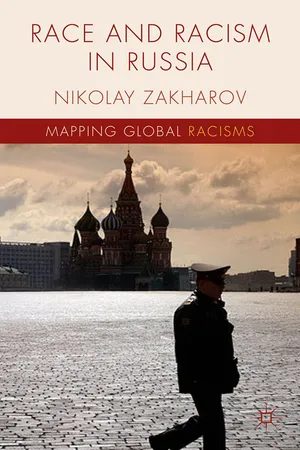
Race and Racism in Russia
About this book
Race and Racism in Russia identifies the striking changes in racial ideas, practices, exclusions and violence in Russia since the 1990s, revealing how 'Russianness' has become a synonym for racial whiteness. This ground-breaking book provides new theories and substantive insights into race and ethnicity in a Russian context.
Information
1
Global Racisms and Racism in Russia: An Introduction
The last two decades have been marked by a wide range of critical changes in Russia, the largest country of the former Soviet Union. A new name, borders, political and economic systems affirm the emergence not only of a new state, but of a new nation as well. These changes have been so profound and overarching that they affect both the social order as a whole and also the self-identity of each citizen, transforming daily practices, hopes, worldviews, and how people regard one another. Among the most striking changes is the wide dissemination of ideas of racial hierarchy, practices of racist exclusion, and racist violence. While biological conceptions of race are no longer an acceptable scholarly framework in the West for the analysis of differences, there has been a genuine renaissance in Russia of ‘scientific’ racism. Recent attempts to revitalize the ‘science of race’ that utilize proposing a new name for it, rasologiya (a rough analogue of Nazi Germany’s Rassenkunde), the issuing of numerous books and other texts on the subject, and translations of certain more ‘classical’ scholarly works, cannot be ignored. Even though they comprise – it goes without saying – an ad hoc conflation of alarmist resentment and tendentious pseudo-scientific theories, they nevertheless have had a very strong influence on both public and intellectual discourses. For example, Alexander Tkachev, the governor of Krasnodarskiy kray in the Kuban’ since 2001 and a head of the Committee of the State Duma on Nationalities Issues, declared in 2002 that ‘surnames ending in “ian,” “dze,” “shvili” and “ogly” are as illegal as their bearers’ (quoted in Shnirelman 2011(2), p. 35). Belikov (2011, pp. 38–9) estimates that the membership of skinhead racist gangs in Russia has risen to 50,000, which Arnold (2009) judges to be roughly half of the total skinhead movement in the world today.
With the collapse of the Soviet Union, the identification of belonging in respect to Russia found itself hovering in both economic and political terms between the so-called First World and the Third World. It is noteworthy in this regard that the notion of ‘civilized country’ was and remains in Russia a synonym for racial whiteness. In addition, Mikhail Gorbachev’s idea of ‘entering world civilization’ implied that the realization of the Soviet project had led both the country and society away from the path of civilization. Boris Yeltsin and Vladimir Putin have unreservedly defined the Russian Federation as a ‘great power’, but the great power image and the ongoing process of nation-building under the conditions of globalization have been accompanied by the exploitation of racial universals. Since the disintegration of the Soviet Union in fact, race imagery has been used as the reliable anchor keeping Russia firmly within the ‘family of civilized peoples’. Against this background, the main thesis of this book identifies the discourse of race as the point of reconciliation between the understanding that Russians participate in the achievements of the West and the necessity of clinging to authenticity.
Although victims, journalists, and human rights advocates alike interpret physical and symbolic violence against individuals who are ‘visually different’ as racially motivated, invocations of ‘race’ become problematic for sociological analysis when there is little agreement about whether ‘race’ correlates with skin color, ethnicity, citizenship, or social status. In addition, prospects for understanding and interpretation are made more difficult by virtue of the great sensitivity of the issue of racism and the fact that much of what is discussed today in connection with race and ethnicity is in fact related more to political rhetoric or moral issues than to scholarship. John Rex (2009, p. 174) has noted that ‘the problem of race and racism challenges the conscience of the sociologist in the same way as the problem of nuclear weapons challenges that of the nuclear physicist’. Scholars have thus been motivated to avoid use of the word ‘race’ as well as the ideas and feelings underlying it. While such avoidance can be either temporary or permanent, the goal has been to develop a new strategic vision and thereby obtain a greater capacity for and purposefulness in research.
The first step in this regard was to focus attention on the processes through which social groups have been formed, particularly the social mechanisms associated with these processes and the causes for the prominence of certain racial or ethnic attributes during a given period of time. The next step was the abandonment by the academic community of the essentialist understanding of race and of the notion that ethnicity is an objective reality that determines belonging to a group (Brubaker 2009). Narratives according to which Russians are not a ‘pure race’ because they have constantly intermingled with and assimilated members of many other ethnic groups are no longer relevant in academic discussion since ‘racial purity’ is deemed to be an ideological construction and the interaction of ethnicities and ethnic groups is treated above all as social cognition. The idea of race as it has been shaped historically constitutes the ethnoracial imaginary through the social process of racialization. Racialization has, in fact, become an important problematic and an influential concept in the sociology of ethnicity and race (Barot and Bird 2001; Miles and Brown 2003; Murji and Solomos 2005; Saperstein et al. 2013). Stephen Small (1994, p. 36) notes in respect to the acceptance of this concept
that In general it is used to suggest that social structures, social ideologies and attitudes have historically become imbued with ‘racial’ meaning, that such meanings are contingent and contested, and that they are shaped by a multitude of other variables, economic, political, religious. It emphasizes the continuing need to see the intricate relationship between ‘racial’ meanings and other (economic, political, religious) meanings.
Race is re-examined in the present study as a form of practical knowledge. As such, an understanding of the relationship between ‘blood’ and the spiritual Russianness which is embedded in culture is driven by an interest in the preservation and reproduction of specific social traits and rules. This may include such issues as population control, discourses of the rise and decline of civilizations, progress, and the ‘quality of people’, including health and vigor. Racialization as a particular process whereby racial significance is assigned to observable differences between people will be examined through the use of an analytic framework that helps us ‘identify the processes through which racial meaning can be ascribed to social relations, practices and groups that have been previously “unraced”’ (McLaughlin 2005, p. 164).
While the idea of race is not dependent solely on social structure and historical context, the notion of racialization brings it into the area that is accessible to sociological analysis. The notion of racialization is justified as the most appropriate tool for the study of the processes of racial formation in Russia presented in this book by virtue of the fact that it acknowledges that racial discourses should be investigated in respect to how they structure social relations. This book charts the modes of race construction in the Russian Federation by placing them into the sociohistorical contexts and institutional arrangements that give expression to forms of racial thinking and racist exclusion and violence. The analysis that unfolds will serve to develop my thesis that racism in Russia can be seen simultaneously both as a reaction of resistance to modernization processes and as an attribute of the process of attaining modernity. The globalized character of racism is linked to the entry of Russia into the world racial order. The process of civilizing so-called Homo Sovieticus has demanded that this former ‘Second World’ citizen should determine where she belonged, that is, her place in the world economic system, which, for the individual, means her place in the world division of labor, her mobility, and her patterns of consumption. Race can thus be viewed as the symbol of the era of globalization similarly to the way in which the nation was the symbol of western modernity at its peak. In this regard, racialization is an adaptation of the social system whereby national differences are arranged according to the logic of the global order.
I will provide a chapter-by-chapter outline of the contents of this book at the end of this chapter, but initially I will highlight some of the factors that make studying Russia more than just an isolated case for a sociologist of race, and clarify the methodology of the study.
From historical legacies to sociological challenges: the Russian case
The polyvalent discourse of race in Russia has passed through a range of changes that are manifested in a variety of representations – both in the historical-biological speculation found in literary fiction and political pamphlets, and in the system of everyday practices and interpretations. It must be noted, however, that it is not appropriate to merely transfer interpretative models built upon essentially different material into the field of Russian studies. Overcoming such methodological drawbacks demands that more attention be paid to the post- and transnational forms of globalized racialization processes. Moreover, no theorization of racial issues is possible without taking into consideration not only the models referred to above, but also the Russian case, which is clearly ‘more than just a case’.
Studying the Russian case can play an important role in the theoretical advancement of the sociology of race because it opens up the possibility of analyzing a society which was familiar with the concept of race and had explicitly used it for anti-racist propaganda and scholarly research – not in classification practices concerning population policies or censuses. As a result, the experience of state socialism and its legacy in the Russian Federation today provides us with unique material for reconsidering a number of our assumptions concerning racialization. The development of the Soviet model – with its transformation of the constructivist approach into the definition of race, and of anti-racism and affirmative action into its inverse – should thus doubtlessly sensitize both scholars and activists. We should remember that W. E. B. Du Bois – the key figure in the sociology of race – praised Soviet society for refusing to be white (Baldwin 2002, p. 161), while another Afro-American icon, Langston Hughes – one of the founding figures of the Harlem Renaissance – succinctly stated that ‘black and white can all be red’ (quoted in Baldwin 2002, p. 95). Today, however, Russia appears determined to become as ‘white’ as possible. Directing the reader’s attention to how race has been resonating in Russia is inevitable in the light of the rise of racism there, as themes that are almost unthinkable elsewhere were introduced literally overnight into scholarly practice and public discussion.
Examining the notion of racialization in terms of how it assigns indelible traits to particular groups of people encountered a number of difficulties regarding the adequate translation of Russian realities into the language of the sociology of race – and this was not a linguistic question. In Russia, as in many other parts of the world, people normally do not explicitly categorize each other as belonging to different races; at the very least, they apparently do not organize their social lives by means of references to distinct racial categories (Drobizheva 2011). The peculiarity of the contemporary Russian case is particularly interesting and complex because the process of nation-building took place under conditions generated by the unfolding of the socialist project. For decades racism was anathematized by the state and its leaders, who made race a legally unacceptable means for identity construction. Nevertheless, thinking in terms of race has not been merely a phenomenon typical of extremist groups insofar as constructing inequality has often followed an ambivalent logic and taken unexpected forms. It is necessary to note that culture may produce and employ a multitude of categories, and that modernity may produce a multitude of logics of difference that produce social knowledge about the Other. This is an extremely important factor that unfortunately is still unexplored in the literature, a fact which contributes to the orthodox understanding that socialist modernity holds the promise of being a non-racial or post-racial society. Such views make it possible for Hirsch (2002) to speak of ‘race without the practice of racial politics’ as a form of existence of racial themes during the Soviet period. Alexei Miller (2008, p. 513) notes correctly that the negative attitude many Russians have towards the concept rossiyskiy or rossiyskost’ (Russian or Russian-ness in the non-ethnic sense) is connected with the suspicion that it is an analogue of sovetskost’ (Soviet-ness), which, in certain periods, was based largely on the suppression of russkost’ (Russian-ness in the ethnic sense). Non-ethnic Russians, in turn, tend to view rossiyskost’ as a continuation of sovetskost’ understood as the Russifying pressure which existed in various periods of the Soviet nationalities policies.
Not only are interpretations of Soviet nationalities policies in today’s political discourse no less controversial, notions of the ‘racial other,’ which were characteristic of other historical periods, are intertwined in the contemporary discourse on Russianness. There is also something fundamentally problematic about the clear definition of what ‘Russian’ means. This is a question of not only choosing ‘Russianness’ as a cultural, political, or ‘ethnoracial’ entity in the public discourse (Tolz 2001), but also of how to translate it accurately into English. Russian can mean russkie, which means Russians by ethnocultural nationality, and rossiyane, which refers to the concept of the civic Russian multi-ethnic nation. Even when institutions clearly offer material rewards in their welfare policies and there are incentives associated with being (or becoming) Russian nationals who are loyal to the Russian state the word race is rarely pronounced, even though the practices of racism are instrumental in nation construction. And while official political discourses have never claimed that belonging to the nation is defined biologically, a large part of Russians nevertheless accept this point of view. Legacies of racial thinking and practices continue to inform current conceptions of ethnicity and identities in the post-Soviet space. The idea that a human being of a particular physical appearance may belong to any ethnic group is taken to be a joke, and people in general firmly believe that it is possible to deduce a person’s origin from her face (Krylova 2006; Matusevich 2008). At the same time if the myth of the nation’s origin plays a significant role in the formation of racial knowledge in Japan and China (Dikötter 1992, 1997), the Philippines (Beer 2002), it is very weakly connected with other elements of racial discourse in Russia, which practically excludes it from the sphere of interest of the sociology of race.
Placing a changed status upon people, or upon their position in relation to capital, impacts their access to power and resources as well as their identity and self-esteem. Key nodes of racial knowledge then began to merge with political and economical interests and became more coherent and widespread. Status and ethnicity in the Russian Federation are not merely institutional structures, but rather social and symbolic structures that have been created and reproduced through the invocation of collective ideas and meanings. Since the spatiotemporal dimensions of power have multiplied, such structures need to be examined from the perspective of intersectionality with a particular focus on racist practices. The operations of racial discourse are doubtlessly mediated by power relations, but the latter are performed within a context that demands a type of self-representation that is informed by the racial knowledge in society. The Russian case provides a unique opportunity to isolate the process of how a new conception of race emerges within the representation of a new order of inequality.
The sociologist Natalia Tikhonova (2008, pp. 128–9) summarizes the results of a series of surveys carried out between 1995 and 2007 with the observation that ‘Russianness’ is equally regarded as self-identification in terms of cultural criteria and as an identity ‘given by blood’. She sums up the practical functioning of this largely controversial definition, along with its rootedness and reproduction in the social practices of identification, in the following way:
Ethnic identity is not important for acknowledging someone as ‘our own’ (svoy) – the individual must instead accept the rules of the game [entrenched in the national culture] as his own because Russians think that these rules correspond to the Russian conditions and are of benefit to them. Metaphorically speaking, this is the same type of identification and discernment between our own and outsiders (chuzhoy) used by the jungle dwellers in Rudyard Kipling’s Mowgli stories. For them it was enough to say, ‘We be of one blood, though [you] and I’, which showed that they knew and accepted the Law of the Jungle – and they were accepted as ‘our own’.1
This challenges the sociologist to look more closely at the rules of the game which are entrenched in Russian culture and what the ‘Law of the Jungle’ is in the Russian Federation today. What role do ‘blood’ and racism play in it? Does the idea of race provide a new ideology of social cohesion in post-Soviet Russia?
In the long-established and dynamic field of the sociology of race, the study of Russian society has received very little attention to date. Several factors have complicated using the concept of race in this regard insofar as sociologists have typically taken it from their engagement with western narratives and sought to apply it without substantial changes to investigations of Russian society. First, sociology as a discipline held only a marginal position in Soviet Russia. It was focused strictly on applied tasks, and it simply could neither include the concept of race in its apparatus, nor construct it as an object of research. In addition, the Soviet regime declared itself immune to racism and stated that problem resided elsewhere, which rendered impossible any large-scale sociological reflexivity concerning the discourse informed by the idea of race. This led to a paradoxical situation in which the Soviet Union, the most anti-racist force in international politics, provided very few original sociological analyses of racism and the concept of race. While only physical anthropologists addressed issues connected with race, even they admitted that ‘ideological struggle in racial science (rasovedenie) unfolded solely within the framework of academic polemics on narrow, specific issues, and that it was fully devoid of anti-racist focus’ (Gerasimova and Vasilyev 2004, p. 10).
The second important factor is that studies of racism were limited, for obvious reasons, to criticism of the ideology of racism and of the political order in capitalist and colonial countries. Very rarely were they theoretically innovative and, as a rule, they never examined race as a universal sociological phenomenon generated by social functions and activated by certain mechanisms, such as by various types of ascriptive social stratification. Even though Soviet scholars after World War Two argued that it could be possible for race to acquire a social quality, they did not deny its biological reality (Efimov 1966). Nevertheless, Soviet scholarship in fact provided the first advanced Marxist theoretical text on racial issues which argued, for the first time, that race should be straightforwardly regarded as a social construction, and that ‘problems of race’ arise directly from the class structures of capitalist society. The work in question is Endre Sík’s (Andrey Shiyk) unjustly forgotten Rasovaya problema i marksizm [The Racial Problem and Marxism], which was published in Moscow in 1930 – a full 18 years before Oliver Cox’s (1948) seminal study.2 However, Sík’s work addressed neither Soviet, nor pre-Soviet Russia, and it utilized examples drawn solely from North American cases in support of its theoretical argumentation.
These two factors, coupled with the very specifics of the country’s historical development, gave rise to a situation in which the relation between, on the one hand, a notion of race imported from the natural sciences and, on the other, original Russian sociohistorical concepts that constituted the conception of race in social and politi...
Table of contents
- Cover
- Title
- Copyright
- Contents
- Acknowledgements
- Chapter: 1 Global Racisms and Racism in Russia: An Introduction
- Chapter: 2 Race and Racism in the Russian Past
- Chapter: 3 Race, Racialization and Racism: A New Theoretical Framework
- Chapter: 4 Making Race in the Russian Academia
- Chapter: 5 Rioting for Whiteness: Doing Race on the Squares of Moscow
- Chapter: 6 Becoming Racial: Race as a New Form of Inequality
- Chapter: 7 Geopolitics of Racism and the Nation-Building Processes
- Chapter: 8 Concluding Discussion
- Notes
- References
- Index
Trusted by 375,005 students
Access to over 1.5 million titles for a fair monthly price.
Study more efficiently using our study tools.
Frequently asked questions
Yes, you can cancel anytime from the Subscription tab in your account settings on the Perlego website. Your subscription will stay active until the end of your current billing period. Learn how to cancel your subscription
No, books cannot be downloaded as external files, such as PDFs, for use outside of Perlego. However, you can download books within the Perlego app for offline reading on mobile or tablet. Learn how to download books offline
Perlego offers two plans: Essential and Complete
- Essential is ideal for learners and professionals who enjoy exploring a wide range of subjects. Access the Essential Library with 800,000+ trusted titles and best-sellers across business, personal growth, and the humanities. Includes unlimited reading time and Standard Read Aloud voice.
- Complete: Perfect for advanced learners and researchers needing full, unrestricted access. Unlock 1.5M+ books across hundreds of subjects, including academic and specialized titles. The Complete Plan also includes advanced features like Premium Read Aloud and Research Assistant.
We are an online textbook subscription service, where you can get access to an entire online library for less than the price of a single book per month. With over 1.5 million books across 990+ topics, we’ve got you covered! Learn about our mission
Look out for the read-aloud symbol on your next book to see if you can listen to it. The read-aloud tool reads text aloud for you, highlighting the text as it is being read. You can pause it, speed it up and slow it down. Learn more about Read Aloud
Yes! You can use the Perlego app on both iOS and Android devices to read anytime, anywhere — even offline. Perfect for commutes or when you’re on the go.
Please note we cannot support devices running on iOS 13 and Android 7 or earlier. Learn more about using the app
Please note we cannot support devices running on iOS 13 and Android 7 or earlier. Learn more about using the app
Yes, you can access Race and Racism in Russia by N. Zakharov in PDF and/or ePUB format, as well as other popular books in Social Sciences & Criminology. We have over 1.5 million books available in our catalogue for you to explore.