- English
- ePUB (mobile friendly)
- Available on iOS & Android
eBook - ePub
About this book
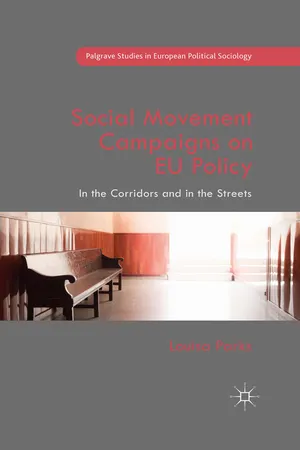
This book assesses how much influence social movements have on EU policy and the means through which influence is secured. Using wide-ranging case studies of campaigns from GMOs to water rights and Internet freedom, it elucidates the important differences between technical and political campaigns.
Information
1
Introduction
The idea for this book began with the broad intention to study social movements in the transnational arena of the European Union (EU). Singling out social movements, or organisations that sometimes form part of social movements and claim to represent the public good, flowed from what the literature has to say on the role of these collectivities in the development of European nation states. Charles Tilly (1978;1984) showed how these groups gradually came to direct their claims to national governments as modern nation states emerged. This shift was critical in legitimising these governments’ decisions, linking the emergence of the national social movement in Western Europe to the advent of electoral democracy. The question that arose was this: if social movements were important to the development of the European nation state, would it logically follow that they are similarly important to the EU? Like other intergovernmental organisations, the EU has altered the landscape that social movements act within, providing new threats and opportunities (Passy 1999, p. 149; Smith 1999, p. 177; Lahusen 1999, p. 190).
Yet campaigns by social movement organisations (SMOs) at the EU level often do not appear related to social movements as defined in much of the literature (see Chapter 2). The groups that campaign at the European level seem at first blush to be too organised, and their coalitions too short-term and instrumental, to be termed ‘social movements’ at all (for a similar assessment, see Warleigh 2000). Nevertheless, some overlooked similarities with social movements remain – the threat of protest and the involvement of networks of citizens to say the least. If not social movements as they are commonly understood within national boundaries, social movement organisations in the EU are at least the cousins of those movements. Indeed, if changes in the power structure provided the impetus for the emergence of social movements as they are now understood from earlier, parochial forms, then a similar situation could reasonably be expected to accompany the transfer of power to the EU (Tarrow 1995; Marks and McAdam 1999; Imig and Tarrow 2001; Bandy and Smith 2005). As they changed to better challenge new structures within the nation state, so they will adapt to the peculiarities of the European arena. There is evidence of a change in associational life to fit this view. In particular, after the extension of the EU’s competences that came with the Single European Act in 1986, the number of European public interest groups increased substantially (Mazey and Richardson 1993; Lahusen 2004).
The focus of the project was thus narrowed slightly to look at social movement organisations that had adapted to deal with the unique arena of the EU and, importantly, to find out if they were able to exert any influence over EU decisions. There is little literature focusing on movement organisations and how they act within the auspices of the EU to influence specific decisions, although there is more literature on movements that protest against the EU writ large (della Porta and Parks 2013). Those studies that discuss social movements in their European level guise tend to use the tools and theories developed specifically for the study of movements at the national level without adapting them to the peculiar arena of the EU (see, e.g., the chapters by Imig and Tarrow in Imig and Tarrow 2001). In Chapter 2, it is argued that the various institutions and procedures of EU politics exert different and sometimes contradictory pressures on movement organisations, necessitating the re-specification of the tools of social movement studies to the study of campaigns in this arena.
With few studies on social movement organisations acting within the EU available, the literature on interest representation and the focus within that literature on public interest groups is another valuable source. Much of this literature however tends to analyse social movement organisations as merely another category of interest group (see, e.g., Greenwood 2011), though differentiating between different types of group. Such an approach has the disadvantage of not paying enough consideration to the possibility such groups have to draw on (or at least threaten) popular mobilisation. Interest representation literature has also concluded that social movement activity at the EU level is weak, either because movement groups are so outnumbered by interest groups representing industry and other interests or because they have not yet managed to achieve truly transnational protests (Bédoyan, Van Aelst and Walgrave 2004). The assumption that transnational protests form the best measure of the strength and presence of movement organisations at the EU level (a concern repeated in literature rooted in the social movement tradition – see Imig and Tarrow 2001) is problematic, particularly given that movements are recognised to function through much wider repertoires at national and local levels. Since the member states of the EU are (arguably the most) important actors in that system, ‘domesticated’ protests (Imig and Tarrow 2001) that tackle EU issues from the national level may be just as relevant to EU campaigns as more strictly defined transnational protests – as the cases presented here will show. In other words, these assessments may not be wrong in their conclusions, but to arrive at such a judgement on the state of movement activity at the EU level a different approach may be needed. The EU is still made up of nation states that call the shots on most of the Union’s business. In this sense, actions by social movements at the national or local level can indeed be ‘European’ whilst still interacting with the work carried out at the supranational institutions by Brussels-based groups. The latter must, however, play by the rules of the different institutional, political and social contexts found in this space. The study thus attempts to fill a gap by paying attention to the ways in which EU social movement campaigns ‘join up’ these different levels, mirroring the structure of the Union itself.
On a more normative level, the historical role movements fulfilled in the development of the European nation state hints at the possibility for a similar role in the EU – an organisation in search for a solution to its legitimacy problems. The need to increase the legitimacy and responsiveness of the EU is seen as particularly urgent for its future in the context of the continuing financial crisis (della Porta and Parks, forthcoming). A role for civil society in this vein has certainly been considered a distinct possibility by the EU institutions, as exemplified in the European Commission’s 2001 White Paper on Governance. Drafted in the wake of the Irish rejection of the Treaty of Nice, this document admits a widespread distrust in institutions and politics, the over-complexity of the EU system and its remoteness from many citizens, along with the fact that perceptions of the EU as run by technocrats does not help in matters of trust, especially in the light of then very recent public health scares (BSE and foot and mouth disease). These various weaknesses in the visibility and legitimacy of the EU have been described extensively by political scientists and are often placed under the label of the ‘democratic deficit’.1 This is a wide-ranging and often very contentious debate beyond the scope of this work. For the purposes of this study, it is simply interesting to note that the White Paper on Governance (Commission 2001) sees the increased inclusion and structured consultation of civil society2 as key in improving weaknesses in EU legitimacy in the eyes of citizens,3 as do other offerings (Commission 2005b, 2006). Though the Commission has since transferred many expectations of legitimacy away from itself and towards civil society groups (see Friedrich 2011), the idea that such groups can transfer some legitimacy to the EU remains. Consultation is hoped to have the dual effect of increasing participation while simultaneously strengthening channels for the dissemination of information about the EU, thereby contributing to the solution of the problem of opacity and bringing the EU ‘closer’ to its citizens.4 This transaction bringing legitimacy to the EU and influence to civil society is described in terms of the exchange model in the literature on interest representation, which also sees civil society groups to function as a ‘transmission belt’ for particular interests in society and the EU institutions.
For this vision to hold, it is necessary that movement groups should exert some influence, however. If no outcomes flow from these groups’ efforts to shape EU policy, then no transmission belt can be at work. Thus the central aim of the work is to show whether and how EU social movement organisations influence EU legislation. Combining these various interests, the work focuses on social movement campaigns that fall into two broad categories related to the political opportunity structure of the EU introduced and discussed in depth in Chapter 2: those that are more technical in nature and those that are more political.
Technical campaigns are characterised by low levels of popular mobilisation at the national and local levels and high levels of engagement with EU level institutions, particularly the Commission. Political campaigns, on the other hand, are characterised by higher levels of popular mobilisation at national and local levels and by lower levels of engagement in consultation. The division is not exact, but follows the shapes suggested by the campaigns studied here, and, importantly, a comparison along these lines provokes the uncovering of interesting findings worthy of further research. Avoiding engagement in consultation does not, it should be noted, exclude conventional strategies (such as lobbying or advocacy as some movement organisations prefer to term it) from either political or technical campaigns. Conventional strategies, epitomised by lobbying, are thus distinct from participating in consultation. Lobbying is understood as a method of persuasion that can take place on the basis of a range of factors including ideology, country of origin or indeed science. Consultation, on the other hand, is understood as a response to a call for information or expertise on a range of issues defined by the institution making the call. While responding to such calls is still a way of seeking to persuade said institution, the rationale is one of persuasion through demonstrating the technically correct solution, seen as somehow ‘above’ politics – hence the labelling of such campaigns as ‘technical’.
Some may argue that such a distinction is not so much a matter of choice by campaigning groups as the mere result of procedural politics at the EU level, which may render consultation a better option in some scenarios over others. Indeed, the cases presented here and introduced in this chapter do see a general equation between the Commission being open to dialogue and technical campaigns on the one hand and a Commission closed to dialogue and political campaigns on the other. However, this does not mean that the political path is closed for campaigns dealing with an open Commission and engaging in consultation. Rather, the correlation suggests that EU campaigning groups only have the resources necessary to invest in one of the two paths with the depth of commitment necessary to see a campaign through. This is discussed in more depth in Chapter 2.
The book answers the question of whether and how social movement organisations exert influence on EU issues by drawing on a number of in-depth case studies. Before the cases are presented, Chapter 2 outlines the theoretical and methodological approach employed to study the campaigns. The chapter begins with a discussion of why the term ‘social movement organisation’ is used to refer to the groups involved in the campaigns as opposed to NGOs, interest groups, civil society groups or any other term: the support of ‘ordinary’ citizens in support of some common good is seen as what distinguishes these groups as ‘EUSMOs’ as opposed to other industry and interest groups. However, SMOs that come together in coalitions to campaign about specific EU issues are not social movements – organisation is the key word here to distinguish between the institutionalised groups that view themselves as constituent parts of social movements and those movements per se.
Chapter 2 then moves on to outline the analytical framework used to study the campaigns. Two approaches are employed in the analysis of the aspects of campaigns that lead to outcomes. The literature on framing in social movements is reviewed, and it is argued that framing strategies in campaigns are important for outcomes insofar as frames build collective understandings of problems, solutions and needs for action necessary for campaigning groups to act and for the public to interpret their position. In line with this approach, a method for dynamic frame analysis is used to study framing in the campaigns. By tracing frames in a sample of documents over time, framing work between different groups and different territorial levels is identified with a view to investigating effects on outcomes.
If framing deals with strategies more internal or directly controlled by SMOs, political process (or political opportunity) theory deals with the contexts within which campaigns unfold. Political process approaches aim to explain social movements’ actions as rational courses followed in the light of perceived options, possibilities, and barriers present in political contexts. The literature is first reviewed and discussed with frank attention to criticism of its being a ‘catch-all’ approach and insensitive to cultural and other important elements that affect social movements. It is argued that this institution-centric approach is appropriate for a study of campaigns where aims are overtly political and narrowly focused on EU policy and legislation. In response to the ‘catch-all’ argument and the fact that the approach was developed for the study of national movements, a political opportunity structure of the EU is then developed and discussed alongside variables for determining more short-term and case-specific political opportunities.
Chapter 2 ends by outlining a typology of the possible effects or outcomes of campaigns, identifying access, agenda and policy outcomes as those most pertinent to the subject in hand. The discussion concludes with a presentation of process tracing as the best means for untangling the paths of influence behind outcomes in in-depth case study research. The analytical model that bounds process tracing in this work, which integrates the theoretical approaches (framing and political process, seen as complementary), is then presented.
Chapter 3 presents descriptions and analyses (focused on framing and political process) of the technical case studies. The first case study concerns genetically modified organisms (GMOs) and coexistence. Discussions on coexistence concern how to diminish possibilities for contamination between GM and ordinary crops and how to establish liability if contamination occurs. In early 2003, reacting to a Commission communication declaring that member states should deal with the issue on their own, a coalition of three environmental groups – the European Environmental Bureau (EEB), Greenpeace’s European Unit (Greenpeace) and Friends of the Earth Europe (FoEE) – began to call for EU legislation. Although the campaign got off to a slow start, it eventually took off alongside an initiative led by two regional member state governments, Upper Austria (Austria) and Tuscany (Italy), to form a network of ‘GM-free’ regions (the Network). The environmental groups facilitated their own network of GM-free areas, launching the GM-free Europe website, and added the regions’ demand for legal GM-free zones to their own for European legislation. Environmental groups then began to campaign alongside the regions through an alliance made via the Assembly of European Regions (AER), holding events from the local level up to the European and organising large conferences discussing all aspects of GMOs. Despite securing access outcomes early on in the campaign, no policy outcomes were seen. A dynamic political threat in the form of a negative ruling against the EU and its previous moratorium on GMOs from the World Trade Organisation overturned any enthusiasm the Barroso Commission may have had for the idea of European legislation or for allowing GM-free zones. The coexistence case suggests that engagement with the Commission made a truly robust multi-level campaign difficult: the push for EU legislation was easily derailed by the WTO ruling, though the achievement of de facto GM-free areas across the EU remained.
The second technical case presented in Chapter 3 is the REACH case, which deals with EU chemicals legislation. The case begins with the EU decision to review its ageing chemicals legislation in 1999. The Commission duly published a White Paper on the subject in early 2001 – a document generally praised by the EUSMOs who would later criticise the legislative proposal. Unsurprisingly, the chemicals industry was less impressed by the rather stringent rules floated for discussion in the White Paper, and its representatives were vigorous in their responses to the raft of consultations that followed its release. Indeed, the EUSMOs accused industry groups of pressing the Commission to hold their public Internet consultation of summer 2003 in order to ensure further delays to the legislative proposal. Such a delay was likely to mean the proposal would be received by a more right-wing and industry friendly European Parliament following the 2004 elections.
It was, more or less, from this point in the proceedings that a coalition of environmental, consumers, health and women’s EUSMOs began to campaign to ‘save’ the REACH proposal, which when finally published reflected the views of industry groups. A coalition, Chemical Reaction, was set up in an attempt to involve national and local groups, but the campaign was mainly carried out at the EU level with a barrage of scientific reports, press releases, media stunts (mostly carried out by Greenpeace) and events in the Parliament and lobbying. Much time was spent reacting to the even more ferocious campaign simultaneously being carried out by industry groups who had managed to shift the discourse away from environmental and human health issues to the fields of employment and economic repercussions. Out-campaigned, outnumbered and out-argued, the EUSMO campaign was thus less a chemical reaction than a counter-campaign reaction, and the groups were disappointed with the legislation finally adopted in late 2006, despite the brave face they put on in public. Once again, a consultation-heavy campaign played a pivotal role in scuppering EUSMO fortunes.
The final technical case presented in Chapter 3 appears to break the mould of the previous two campaigns as discussed in the conclusions of the book. The campaign, the first successful European Citizens’ Initiative (ECI), is classed as technical as a result of the strict rules that apply in terms of subject matter, how signatures are collected and how successful ECIs are treated, which translate to expertise requirements in the language of political opportunity. ECIs are a relatively new possibility for direct citizen engagement in EU affairs dating from the entry into force of the Lisbon Treaty in late 2009. Whenever they receive at least 1 million signatures from EU citizens and pass minimum thresholds in at least seven member states, these petitions can lead to EU legislation. Their subject matter must relate to areas where the EU has the power to legislate, and importantly there is no guarantee of legislation but an obligation to consider the matter. After a successful petition is received, a European Parliament hearing is held, along with meetings between the organisers and the Commission. The Commission then publishes a communication detailing the action it will take. One of the first petitions to be registered following the Regulation implementing ECIs was named Right2Water. The main thrust of this petition was, as may be guessed, the recognition of water as a human right and a public good not to be privatised. The main organisation behind the petition was the...
Table of contents
- Cover
- Title
- 1 Introduction
- 2 Untangling Influence: Studying Social Movement Campaigns in the Transnational EU Arena
- 3 Political Process and Framing in the Technical Campaigns
- 4 The Outcomes of Technical Campaigns in the EU
- 5 Political Process and Framing in the Political Campaigns
- 6 The Outcomes of Political Campaigns in the EU
- 7 Conclusions: Technical and Political Campaigning in the EU
- Notes
- References
- Index
Trusted by 375,005 students
Access to over 1.5 million titles for a fair monthly price.
Study more efficiently using our study tools.
Frequently asked questions
Yes, you can cancel anytime from the Subscription tab in your account settings on the Perlego website. Your subscription will stay active until the end of your current billing period. Learn how to cancel your subscription
No, books cannot be downloaded as external files, such as PDFs, for use outside of Perlego. However, you can download books within the Perlego app for offline reading on mobile or tablet. Learn how to download books offline
Perlego offers two plans: Essential and Complete
- Essential is ideal for learners and professionals who enjoy exploring a wide range of subjects. Access the Essential Library with 800,000+ trusted titles and best-sellers across business, personal growth, and the humanities. Includes unlimited reading time and Standard Read Aloud voice.
- Complete: Perfect for advanced learners and researchers needing full, unrestricted access. Unlock 1.5M+ books across hundreds of subjects, including academic and specialized titles. The Complete Plan also includes advanced features like Premium Read Aloud and Research Assistant.
We are an online textbook subscription service, where you can get access to an entire online library for less than the price of a single book per month. With over 1.5 million books across 990+ topics, we’ve got you covered! Learn about our mission
Look out for the read-aloud symbol on your next book to see if you can listen to it. The read-aloud tool reads text aloud for you, highlighting the text as it is being read. You can pause it, speed it up and slow it down. Learn more about Read Aloud
Yes! You can use the Perlego app on both iOS and Android devices to read anytime, anywhere — even offline. Perfect for commutes or when you’re on the go.
Please note we cannot support devices running on iOS 13 and Android 7 or earlier. Learn more about using the app
Please note we cannot support devices running on iOS 13 and Android 7 or earlier. Learn more about using the app
Yes, you can access Social Movement Campaigns on EU Policy by Louisa Parks in PDF and/or ePUB format, as well as other popular books in Politics & International Relations & European Politics. We have over 1.5 million books available in our catalogue for you to explore.