- English
- ePUB (mobile friendly)
- Available on iOS & Android
eBook - ePub
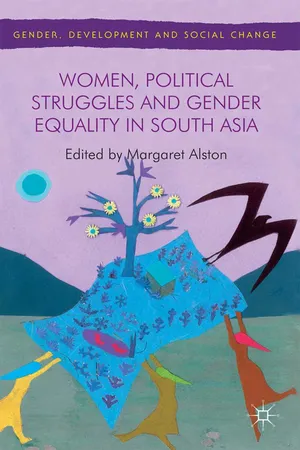
Women, Political Struggles and Gender Equality in South Asia
About this book
A brutal gang-rape of a young woman in India in 2012 caused a global outcry against rising brutal violence against women. In response to the young woman's death and the protests that followed, the contributors analyze the position of women in South Asia, the issue of violence, women's political activism and gender inequalities.
Information
Print ISBN
9781137390561
Subtopic
Politics1
Introduction: Women, Political Struggles and Activism – Exploring the Lives of Women in South Asia
Margaret Alston
On 16th of December 2012, in the late evening of a balmy Delhi night, a young physiotherapy student boarded a bus with her male companion after an evening out at the movies. She had her whole life and a long professional career ahead of her – a career made possible by the efforts of her family, who had sold their rural farm land to move to the city to enable her to pursue her education.
What followed was a crime so horrific that the whole world recoiled. For several hours she was repeatedly raped, beaten, bitten and brutalized, and her friend bashed to unconsciousness. When the ordeal was finally over she and her companion were thrown naked off the bus where they lay until a passer-by called for assistance. Her injuries were so extreme that despite her courage, determination and will to live and despite her family seeking medical assistance in another country, she died some thirteen days later – her passing mourned by people across the globe, overwhelmed by the brutality and senselessness of this appalling act.
Protests erupted across India; mass rallies called for an end to the constant and shameful harassment and violence against women. Tear gas and water cannons were used against the protesters, marches were banned in Delhi and government ministers called for calm. Although the young woman’s name was suppressed, she became known as ‘Damini’ meaning ‘lightning’ – a reference to an early Bollywood film and also, one suspects, as recognition of her case becoming a lightning rod for activism and protest. On the occasion of her death the Indian Prime Minister, Mr Manmohan Singh, referring to the widespread anger and protests stated
It would be a true homage to her memory if we are able to channel … these emotions and energies into a constructive course of action. (Aljazeera News 2012)
This book emerges in honour of Damini as a constructive avenue to discuss violence against women and girls across South Asia, to alert the world to this challenge, to analyse and critique the political struggles in which women in the region are engaged and to celebrate their activism. We call on the global community to support the women of South Asia in their quest for equality, dignity and justice.
South Asia
South Asia is a large contained landmass that is home to one-fifth of the world’s population – approximately 1.6 billion people, forming the most densely populated region of the world. The extent of the area known as South Asia is disputed but arguably comprises the countries of Afghanistan, Bangladesh, Bhutan, India, Iran, Maldives, Myanmar, Nepal, Pakistan, Sri Lanka and the Maldives (see Figure 1). The population is not homogenous across the countries that make up the region nor even within these countries’ borders. It is an area that encompasses a complex diversity of geography, population, religions, customs, dress and circumstances.
Archaeological records suggest it was one of the first regions to be inhabited by modern humans, some 400,000 years ago and acted as a trade route to other parts of Asia and Europe (Majumder 2010; Mines & Lamb 2010). Its rich cultural history is evident from artefacts dating from approximately 2500 BC, and its vibrant trade routes are well-documented from 300 BC and beyond. Sanskrit – considered the oldest language in the world – evolved in this region at least 6,000 years ago, giving some sense of its rich cultural heritage. The key to understanding the area is the historical centrality of the trade routes through the region, both in ancient and more modern times, a phenomenon that has facilitated the transfer of ideas, language, culture, traditions and religion.
Religious diversity
Modern day South Asia is a mix of religions that either developed on the subcontinent or found their way to the region through the land and sea trade routes. Ancient Hindu texts written in Sanskrit confirm that the Hindu religion was prominent in the South Asia region from at least 2000 BC, and from the 5th to approximately the 14th centuries AD, Hinduism was the official religion in much of South Asia. Buddhism developed in the 1st millennium BC and coexisted with Hinduism for much of this period, becoming more dominant across South Asia from around the 14th century AD.

Figure 1 South Asia
The religion of Islam spread across the area from the Middle East around the same period, again facilitated by the trade routes and possibly with a Turkish influence – a factor that has led to a more moderate form of Islam practiced in much of contemporary South Asia. This is evident in aspects of gender roles such as women’s dress and the extent of their freedom of movement. Afghanistan provides a stark contrast, perhaps demonstrating a more direct influence on Islamic development via the Middle East.
In the 16th century, the arrival of the British colonial powers and the East India Company in South Asia led to the spread of Christianity. Apart from the introduction of a new form of religion – it had a further curious impact. Because of the greater resistance of Islamists to British rule and the greater accommodation from Hindus, increased opportunities were provided to Hindus through their appointments to government positions and exposure to the British education system. Over time this led to distinct differences in wealth, or the lack thereof, demonstrated through religious orientation. The systematic advancement of Hindus led to widespread poverty and destabilization among the Islamic people. This had a significant impact on the divisions within the region, perhaps most notable once the British withdrew after the Second World War.
The establishment of ‘India’ as a predominantly Hindu country and the carving off of the Punjab to the west of India and Bengal to the east as the new Islamic states of ‘Pakistan’ were artefacts of this religious divide. Despite Punjab and Bengal being 1,000 miles apart, they were expected to form a stable government. Inevitably political destabilization followed. Politicians from Punjab dominated the government of Pakistan until 1970 when Bengal won a majority of seats at the national election. Punjab refused to concede and a gruesome battle ensued that saw widespread genocide in Bengal and the rape and torture of hundreds of thousands of women. The entry of India to the battle against Punjab not only put an end to the war but also resulted in the separation of Punjab as ‘Pakistan’ and the establishment of the new country of ‘Bangladesh’ in the east, formerly known as Bengal. This is one of the most extreme evidences of simmering political tensions across the region, perhaps matched by ongoing tensions in Sri Lanka where a bitter civil contest between the Rajapaksa regime and the Tamils continues. These contestations demonstrate the ongoing intersection of politics, religion and race in the affairs of the state.
Historical religious traditions, and their links to state power, are critical to understanding the position of women in South Asia. It is arguable that Hinduism, Buddhism and the moderate Islamic religion give more significant – though certainly not equal – status to women than more fundamentalist religions that allocate very few rights to women, and in fact treat women as a form of property. Nonetheless few countries in South Asia support full freedom of women – the right to own property, to make autonomous decisions about who they will marry, to be free from violence and to have equal representation under state laws.
A further complicating factor in Indian society is the caste system. This has historically stratified people in one of four castes or positions in society. These castes are strictly enforced and are critically determinant of opportunity and life chances.
Demographics
The socio-demographic profile of South Asia varies across countries and by the levels of wealth disparity. It also varies by population size – India is the largest, with 1.2 billion people and the Maldives the smallest, with an approximate population of 300,000. Bloom and Rosenberg (2011), drawing on UN statistics, note that:
• Infant mortality rate is highest in Afghanistan – approximately 152 per thousand children under the age of 1 year die, compared with Sri Lanka where the rate is 15
• The average number of births varies from 6.5 births per child-bearing age woman in Afghanistan to 2 in the Maldives
• Life expectancy varies from 75.5 in Sri Lanka to 44 in Afghanistan.
Changes in population size, life expectancy and health are evident where safe water, sanitation and family planning programs have been introduced; where women have access to education; where there are lower numbers of child marriages; and where health care is accessible.
Nonetheless there is widespread poverty in South Asia, with most countries registering among the lowest population income per head – the dire ones being Bangladesh, Nepal and Afghanistan and the most advanced being India.
Governance
The split of countries along religious lines – which occurred either violently (as in Pakistan and Bangladesh) or through the weight of numbers (as in India) – led to diverse forms of government and varying degrees of success with democratic rule. Despite the spread of democracy, some countries remained under monarchical rule – Nepal until as late as 2008. Arguably, India and Sri Lanka have had the most success with democracy, while Pakistan and Bangladesh are good examples of countries that have experienced long periods of military rule replacing elected but insecure governments subject to internal, and sometimes violent, clashes between rival factions (Shastri & Wilson 2006). These battles are often centred on the degree of religious conservatism within the governing parties, rather than on contentious issues. Countries that have adopted democratic rule are not necessarily fully functioning democracies, and the intervention of military rule during various periods of recent history in these countries demonstrates the precariousness of democracy in these regions.
In some South Asian countries, religious fundamentalism is growing. Increasingly visible fundamentalist religious groups are evident in the rise of the Taliban in Afghanistan and others in Islamic countries such as Pakistan and Bangladesh. This fundamentalist activism is often shaped and demonstrated around calls for reduced status of women and their rights. This was most recently evident in the shooting of Malala Yousafzai, a young 16-year-old Pakistani woman shot by the Taliban on 9 October 2012, for voicing her views on the right to education for girls. Malala survived and was nominated for the 2013 Nobel Peace Prize for her fight for justice for girls. She now lives in Britain and is afraid to go back to her own country where the increasing power of the Taliban has resulted in girls being under constant threat of similar violence.
The links between religion and the state are perhaps closest in Pakistan. At the other end of the spectrum is India that purports to have a secular government. It is in the critical interweaving of religion and state that the murky waters of equality and self-determination unravel for many women of South Asia. The state in its many forms creates gendered subjects. While constitutions and state laws may offer protection and equal citizenship in theory, in practice religious laws and customs, such as Sharia law, often prevail. Gender has become politicized as women are viewed as the keepers of the virtuous community – the standard bearers of culture. To a greater or lesser extent, through laws and customs, the states that form the region known as South Asia claim control over women through laws and sanctions, through violence against women and through a failure to recognise their rights. In Afghanistan, women can be beaten in the streets for not covering their faces or for revealing their ankles. In Bangladesh, Pakistan and India, women who report rape crimes to local police may be raped in police custody. In Pakistan, young women can be shot for publicly claiming the right to education for girls. In the late 1980s, General Ershad, the head of the then military government in Bangladesh, ordered the tarring of women’s midriffs if women’s saris did not cover them adequately (Basu 2005). Through benign neglect and increasingly violent actions, the paternalistic state ratifies and endorses a particular view of women.
The regulation of women’s sexuality also falls under the control of the state. Access to family planning and reproductive health advice is limited in many countries of South Asia. Where it is evident and has had a visible impact on population control and on the health of women and children, such as in Bangladesh, it has usually been introduced first by non-government organizations. Women’s access to reproductive health may be facilitated by the state and undermined by fundamental religious beliefs, leaving women highly vulnerable to a lack of control over their bodies. This lack of reproductive freedom is compounded in many cases by religious practices such as early, or even child, marriages. Although outlawed by the state, instances of child marriages can be found, resulting in exposure of young women to early pregnancies, insecure health, loss of access to education and a lifetime of poverty.
In some countries of South Asia there are a small number of dedicated women’s seats in parliaments. While on the one hand the co-option of women into the state political infrastructure through the dedication of women-only seats attempts to improve the representation of women, on the other it also controls the women. In countries such as Bangladesh, selection of the women candidates is done not by direct election but by a process whereby the parties allocate these seats to women who are arguably compliant with party policy and who will not threaten gender inequalities.
Women have been strong participants in fights for nationalism in India, Pakistan and Bangladesh – perhaps the most recent being the establishment of the new Bangladesh in 1970, where women played a large and critical role in achieving the new state. Basu (2005) argues that democracy is essential for women’s movements to establish a strong political force. She cites the case of Sri Lanka under military rule being responsible for the increased rape and violence against women.
Ironically several South Asian countries have been led by women – most notably Sirimavo Bandaranaike in Sri Lanka (the modern world’s first female Prime Minister elected for the first of her three terms in 1960), Benazir Bhuto in Pakistan (the first woman to lead a Muslim state), Indira Ghandi in India and Sheikh Hasina in Bangladesh. These female leaders have had some influence on the conditions of women in their countries. Sheikh Hasina for example introduced a revised women’s policy to Bangladesh in 2011, giving women the right to own property in their own right– a policy that led to widespread national strikes and violence led by religious fundamentalists.
Trends
Critical processes of modernization are underway in South Asia, with societies moving slowly from their agricultural or rural base to more complex, industrialized and modern communities. Although a large majority of people are still based in rural areas and dependent on agriculture, growing urbanization is evident across the regions typified by burgeoning, rapidly expanding modern cities surrounded by ever-expanding slum areas populated by the growing influx of rural villagers looking for a new life. These expanding areas are providing new employment in the construction of roads, buildings and infrastructure and a growing service industry of food stallholders and domestic workers. In Bangladesh millions of young rural women are finding employm...
Table of contents
- Cover
- Title
- Copyright
- Contents
- Series Editor’s Preface
- Notes on Contributors
- 1 Introduction: Women, Political Struggles and Activism — Exploring the Lives of Women in South AsiaMargaret Alston
- Section I Gender-based Violence in South Asia
- Section II Activism, Resistance and Empowerment
- Section III Politics, Leadership and Representation
- Index
Trusted by 375,005 students
Access to over 1.5 million titles for a fair monthly price.
Study more efficiently using our study tools.
Frequently asked questions
Yes, you can cancel anytime from the Subscription tab in your account settings on the Perlego website. Your subscription will stay active until the end of your current billing period. Learn how to cancel your subscription
No, books cannot be downloaded as external files, such as PDFs, for use outside of Perlego. However, you can download books within the Perlego app for offline reading on mobile or tablet. Learn how to download books offline
Perlego offers two plans: Essential and Complete
- Essential is ideal for learners and professionals who enjoy exploring a wide range of subjects. Access the Essential Library with 800,000+ trusted titles and best-sellers across business, personal growth, and the humanities. Includes unlimited reading time and Standard Read Aloud voice.
- Complete: Perfect for advanced learners and researchers needing full, unrestricted access. Unlock 1.5M+ books across hundreds of subjects, including academic and specialized titles. The Complete Plan also includes advanced features like Premium Read Aloud and Research Assistant.
We are an online textbook subscription service, where you can get access to an entire online library for less than the price of a single book per month. With over 1.5 million books across 990+ topics, we’ve got you covered! Learn about our mission
Look out for the read-aloud symbol on your next book to see if you can listen to it. The read-aloud tool reads text aloud for you, highlighting the text as it is being read. You can pause it, speed it up and slow it down. Learn more about Read Aloud
Yes! You can use the Perlego app on both iOS and Android devices to read anytime, anywhere — even offline. Perfect for commutes or when you’re on the go.
Please note we cannot support devices running on iOS 13 and Android 7 or earlier. Learn more about using the app
Please note we cannot support devices running on iOS 13 and Android 7 or earlier. Learn more about using the app
Yes, you can access Women, Political Struggles and Gender Equality in South Asia by M. Alston in PDF and/or ePUB format. We have over 1.5 million books available in our catalogue for you to explore.