- English
- ePUB (mobile friendly)
- Available on iOS & Android
eBook - ePub
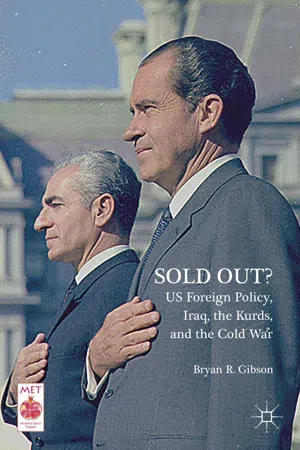
Sold Out? US Foreign Policy, Iraq, the Kurds, and the Cold War
About this book
Information
1
Eisenhower and the Qasim Regime: July 1958–January 1961
Iraq’s revolution on July 14, 1958, upended America’s regional containment strategy and opened a dramatic new chapter in the superpowers’ Cold War rivalry in the Middle East. This chapter will provide a brief overview of America’s Middle Eastern strategy following the Second World War, and then analyze the Dwight D. Eisenhower administration’s response to Iraq’s revolution and the chaos that ensued. Moreover, it will review the American decision-making process, assess the effectiveness of the Eisenhower administration’s approach, and identify any missed opportunities, where, had the United States acted differently, it might have been able to salvage a working relationship with the new Iraqi regime. Finally, it is important to understand how US officials in Washington and Baghdad perceived these events, how these perceptions compared or contrasted with those of its allies, and how they translated into the implementation of the US policy. In doing so, it will become clear that following Iraq’s revolution, the Eisenhower administration’s policy ran against the approaches of its regional allies due to concerns about the new Iraqi regime’s flirtation with the Iraqi Communist Party (ICP) and its perceived Soviet patron. Consequently, rash decisions were made, opportunities to ensure Iraq’s nonalignment in the Cold War were missed, and America’s actions helped push the Iraqi regime closer to the Soviet Union.
A Chaotic Region
Before examining the Eisenhower administration’s response to Iraq’s revolution, an understanding of America’s policies toward Iraq and the region needs to be established. Israel’s defeat of the Arab armies in 1948 led to profound changes throughout the region, as Arab nationalism emerged as a dominant ideology. Egypt’s revolution in 1952 was the first instance in which Arab nationalist, military officers overthrew the corrupt, Western-backed monarchy of King Farouk, and eventually brought to power Egypt’s longtime, charismatic president, Gamal Abd al-Nasser, who soon adopted a fierce anti-British attitude. The loss of Egypt from the Western camp was a cause for concern for the Eisenhower administration, leading Secretary of State John Foster Dulles to ponder bringing together the “Northern Tier” states of Turkey, Iran, Iraq, and Pakistan into a collective security alliance aimed at containing a potential Soviet thrust southward toward the oil-rich Gulf.1 With Iraqi premier Nuri as-Said taking the initiative, the Baghdad Pact—as the alliance was commonly known—was formed in 1955, sparking a fierce debate among the Arab states—Jordan, Saudi Arabia, and Syria—about whether to join. However, when Britain joined the pact in April 1955, Nasser used this as a rallying point and formed a mutual security alliance with Saudi Arabia and Syria.2 The debate over the pact underscored just how fractious Arab politics was in the aftermath of the 1948 war. It also showed that Iraq stood out from the rest, joining a non-Arab, pro-Western alliance.
The United States and Britain differed greatly in their understandings of and approaches toward Arab nationalism. As Fain observed, the United States was predisposed toward sympathizing with anticolonialist attitudes and was able to view British imperialism in the region as “both morally wrong and politically destabilizing.”3 By the mid-1950s, US officials had begun to recognize that Arab nationalism could be used to America’s advantage by channeling its ideological adherents in directions consistent with its containment policies.4 This, of course, put the United States at direct odds with the British, who viewed Nasser’s brand of Arab nationalism as a direct threat to their national interests, particularly the Suez Canal, through which nearly two-thirds of Britain’s oil supply sailed. The threat was deemed so serious that Britain devised a plot to attack Egypt—along with France and Israel—in October 1956, with the objective of removing Nasser from power and regaining control over the strategic country. However, because Britain and its allies failed to consult the United States in advance, the Eisenhower administration was forced to issue threats to bring about their reluctant withdrawal. The war left Nasser relatively unscathed, allowing him to emerge as a hero and a champion of a new anti-imperialist, pan-Arab, and nationalistic ideology known as Nasserism. Buoyed by his success, Nasser commenced a subversive effort throughout the region aimed at overthrowing Western-backed, “reactionary” monarchies and replacing them with Arab nationalist regimes. This state of belligerency was what Malcolm Kerr called the “Arab Cold War.”5
Responding to the deteriorating situation in the Middle East, during his State of the Union address in January 1957, President Eisenhower issued a war cry, announcing his eponymous doctrine that offered economic or military assistance “to secure and protect the territorial integrity and political independence of such nations . . . against overt armed aggression from any nation controlled by international communism.” The Eisenhower doctrine was aimed not just at containing the Soviet Union but at Nasser’s radical brand of Arab nationalism.6 The doctrine would prove important in the coming months, as people in the Arab street began to question if Arab unity was the solution to the region’s problems, especially Israel. Meanwhile, the situation in Syria deteriorated rapidly, with communist elements maneuvering to seize power, leading to an unexpected union with Egypt in February 1958 to prevent this from happening. This union brought about the formation of the United Arab Republic (UAR).7
The UAR’s creation alarmed Iraq’s premier Nuri as-Said, who sought to establish Iraq as a counterbalance by forging a union with Jordan, known as the Arab Union (AU), two weeks later. As tensions escalated, in early July 1958, King Hussein of Jordan requested Iraqi assistance to quell internal disturbances. Unknown to Nuri, the military units he had dispatched had been infiltrated by self-styled Iraqi Free Officers, who paid homage to Nasser’s own Free Officer movement in Egypt. The unit had to pass close to Baghdad on its way to Jordan and upon receiving his movement orders, Abd al-Salim Arif led it into Baghdad, seized the radio station, occupied all strategic buildings, and announced the formation of an Iraqi Republic. After a prolonged battle, the rebels killed King Faisal II, Crown Prince Abd al-Ilah, and eventually Nuri as-Said, who had initially escaped but was soon discovered dressed as a woman and executed.8
By mid-1958, British and American policies toward Arab nationalism were already at odds with each other. With its colonial empire in decline, Britain appeared to be clinging haplessly to its Middle Eastern assets, which were considered crucial to its postwar economic survival. This was evident in the British-inspired—though Central Intelligence Agency (CIA)-led—coup in Iran in 1953.9 Consequently, Britain viewed Nasser’s brand of Arab nationalism as a threat to its national interests and could not allow him—or anyone else for that matter—to dominate the Gulf region and its vital oil supplies. For the Americans, the region was viewed in terms of its Cold War rivalry with the Soviet Union, and its policy was geared toward preventing Soviet control of the region’s oil resources, even if this meant aggravating the British or accommodating Nasser. America’s Middle Eastern policy was based entirely on Cold War considerations. As one American analyst put it, “By the late 1950s we had to recognize that the Soviet Union had leapfrogged the northern-tier barrier, using basically political and economic methods, and had become a Middle East power in fact.”10 However, to the United States, the only precondition for working with Nasser was that he kept communist forces on the fringes of power, which his union with Syria suggested he was willing to oblige. In short, by the time of Iraq’s revolution in 1958 the stage had already been set for further disagreements between Washington and London over not just how to assess the revolution but also how to respond.
The July Coup
It took almost 11 hours for officials in Washington to determine that a coup had taken place in Baghdad on July 14, 1958. At 8 a.m. (Eastern Standard Time [EST]), Foster Dulles informed Eisenhower that elements of the Iraqi army “had moved upon the royal palace and had murdered Crown Prince Emir Abdul Illah.” He was uncertain about the king’s fate and that of his premier, but feared the worst. This led Eisenhower to call in his national security team to review the situation and “make sure that no facet of the situation was overlooked.” When the group gathered in the Oval Office, Allen Dulles, who was the Secretary of State’s brother and the Director of Central Intelligence (DCI), explained that “pro-Nasser elements of the Iraqi army” executed the coup, King Faisal and Nuri as-Said were presumed dead, and a republican government had been established. However, the CIA director was uncertain whether Nasser was behind the coup, noting that while the conspirators were pro-Nasser, the CIA “lacked hard evidence implicating [him].” This conclusion dispelled the notion that the United States thought that Nasser had played a direct role in the plot.11 Eisenhower agreed that little could be done in the short term and adopted a “wait-and-see” approach.12
The Iraqi coup had a profound impact on America’s strategy to contain the Soviet Union. As a vital member in the Baghdad Pact, Iraq was pro-Western, and held considerable oil wealth. US companies also had a 23.75 percent stake in the Iraqi Petroleum Company (IPC).13 Given the zero-sum nature of the Cold War, whereby a loss by one side was viewed as a gain by the other and vice versa, US policymakers feared that the Soviets could leapfrog past the Northern Tier containment shield, establish a satellite in the Gulf, control Iraq’s vast oil reserves, and transform the regional Cold War balance of power. While this was a worst-case scenario, it was not beyond the realm of possibility. The problem was that on the question of intervention in Iraq, the British and Americans departed. Whereas the British wanted the United States to intervene militarily in Iraq, the Eisenhower administration was more inclined to “wait-and-see” how the new Iraqi government behaved before it would react. This did not, however, mean that the United States and Britain would not take action to shore up the West’s now-tenuous regional position.
The coup prompted the United States and Britain to intervene in Lebanon and Jordan to protect Western interests. A civil crisis had broken out in Lebanon in May and June 1958, as the newfound UAR proved to be an attractive alternative to Christian rule for the country’s large Sunni and Shi’a minorities.14 Just a few hours after the coup in Iraq, Lebanon’s embattled president, Camille Chamoun, informed the Eisenhower administration that he “wanted US military intervention in Lebanon within 48 hours.” This meant that the United States could use military force to shore up Lebanon under the basis of the Eisenhower doctrine. After rapid consultations with Congress, on July 14, Eisenhower ordered the Commander of the Sixth Fleet to land US Marines in Beirut the next day.15 As the marines arrived on the sunny beaches of Beirut, they were surprised to be greeted not by hostile forces but by friendly crowds of beautiful women in bikinis and street peddlers hawking everything from Coca Cola to hummus.16
Throughout the same period, a political and economic crisis had engulfed Jordan. Since the formation of the AU, King Hussein had struggled with the practicalities of the union and was concerned that the political turmoil in Lebanon would soon spread to Jordan.17 Of course, his concerns were only further exacerbated by the Iraqi coup, which not only wiped out a branch of his family but also meant the loss of subsidized petroleum and led to massive shortages inside Jordan. On July 17, the Jordanian foreign ministry informed the US Embassy that it wished for military assistance to “crush [the] insurrection [in] Baghdad, [and] restore peace in accordance with AU constitution.”18 While King Hussein was the rightful heir to Iraq’s throne—as stipulated in the AU constitution—he believed he could call on the US to intervene on Iraq’s behalf, but the Eisenhower administration proved hesitant.19 There were several reasons for this: (1) there was no guarantee a US intervention in Iraq would work; (2) it could spark a regional war; and (3) it ran the risk of pushing the new Iraqi regime, which had already shown some signs of moderation, right into the arms of the Soviets. Given this, the United States refused to endorse such a move, advising King Hussein:
[The] US believes [the] primary concern at [the] moment . . . should be preservation [of the] independence and integrity of Jordan. [The] New request for assistance to destroy [the] insurrection in Iraq goes far beyond scope of purpose for which [the] US and UK were requested and agreed to help Jordan.20
However, according to Ashton, Britain soon unco...
Table of contents
- Cover
- Title
- 1 Eisenhower and the Qasim Regime: July 1958–January 1961
- 2 Kennedy and the Qasim Regime: January 1961–February 1963
- 3 Kennedy and the First Ba’thist Regime: February–November 1963
- 4 Johnson and the Arab Nationalists: November 1963–June 1967
- 5 Johnson and the British Withdrawal from the Gulf: June 1967–January 1969
- 6 Nixon and the Second Ba’thist Regime: January 1969–July 1972
- 7 Nixon and the Kurdish Intervention: August 1972–October 1973
- 8 Kissinger and the Kurdish War: October 1973–March 1975
- Conclusion
- Notes
- Select Bibliography
- Index
Trusted by 375,005 students
Access to over 1.5 million titles for a fair monthly price.
Study more efficiently using our study tools.
Frequently asked questions
Yes, you can cancel anytime from the Subscription tab in your account settings on the Perlego website. Your subscription will stay active until the end of your current billing period. Learn how to cancel your subscription
No, books cannot be downloaded as external files, such as PDFs, for use outside of Perlego. However, you can download books within the Perlego app for offline reading on mobile or tablet. Learn how to download books offline
Perlego offers two plans: Essential and Complete
- Essential is ideal for learners and professionals who enjoy exploring a wide range of subjects. Access the Essential Library with 800,000+ trusted titles and best-sellers across business, personal growth, and the humanities. Includes unlimited reading time and Standard Read Aloud voice.
- Complete: Perfect for advanced learners and researchers needing full, unrestricted access. Unlock 1.5M+ books across hundreds of subjects, including academic and specialized titles. The Complete Plan also includes advanced features like Premium Read Aloud and Research Assistant.
We are an online textbook subscription service, where you can get access to an entire online library for less than the price of a single book per month. With over 1.5 million books across 990+ topics, we’ve got you covered! Learn about our mission
Look out for the read-aloud symbol on your next book to see if you can listen to it. The read-aloud tool reads text aloud for you, highlighting the text as it is being read. You can pause it, speed it up and slow it down. Learn more about Read Aloud
Yes! You can use the Perlego app on both iOS and Android devices to read anytime, anywhere — even offline. Perfect for commutes or when you’re on the go.
Please note we cannot support devices running on iOS 13 and Android 7 or earlier. Learn more about using the app
Please note we cannot support devices running on iOS 13 and Android 7 or earlier. Learn more about using the app
Yes, you can access Sold Out? US Foreign Policy, Iraq, the Kurds, and the Cold War by Bryan R. Gibson in PDF and/or ePUB format, as well as other popular books in Politics & International Relations & Diplomacy & Treaties. We have over 1.5 million books available in our catalogue for you to explore.