- English
- ePUB (mobile friendly)
- Available on iOS & Android
eBook - ePub
About this book
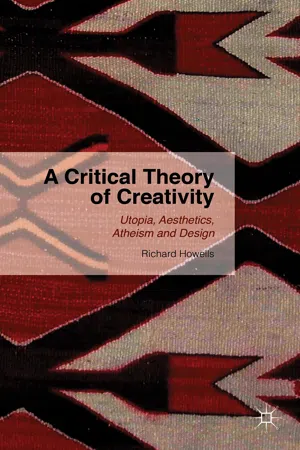
A Critical Theory of Creativity argues that a Utopian drive is aesthetically encoded within the language of form. But coupled with this opportunity comes a very human obligation which cannot be delegated to God, to nature or to market forces. As Ernst Bloch declared: 'Life has been put into our hands.'
Information
1
Visions and Derisions of Utopia
Utopia is a word famously first used by Sir Thomas More as the name of his ideal, imaginary island in his seminal Utopia of 1516. Here, Utopians enjoyed a comprehensive welfare state in which the concept of private property did not exist. Everyone enjoyed a six-hour working day and had so little concern for gold that they used it for making chamber pots. There was religious toleration, and it all amounted, declared More, to ‘the most civilized nation in the world’.1 Since More published Utopia, the word ‘Utopia’ has come to stand for all ideal places and not just this one particular imaginary island. The fact that Utopia translates literally as ‘no place’ is generally overlooked in its application to ideal communities both actual and imaginary.2 So although it was he who gave it its name, the Utopian genre stretches well beyond More – both to his past and to his future.
The Garden of Eden, as described in both the Old Testament and the Torah, could well be the original Utopia. Here, it is widely supposed, Adam, the first man, and his partner Eve enjoyed paradise before earthly temptation got in the way. God, according to Genesis, had built a garden east of Eden: ‘And out of the ground made the Lord God to grow every tree that is pleasant to the sight, and good for food’.3 Adam and Eve were invited to take naked pleasure in the garden and all it offered – except for a certain ‘forbidden fruit.’ They ended up eating it, of course, and God expelled them, in their shame, from Eden: ‘Cursed is the ground for thy sake; in sorrow shalt though eat of it all the days of thy life’.4 So, paradise was lost, and all mankind suffered forevermore. This is, of course, a somewhat partial and negative interpretation of the text – a matter to which we shall return. For the time being, though, this popular interpretation does at least serve to underline the deep-rooted significance of the Utopian myth to Abrahamic culture.
As Darren Webb observed in an article for Politics, Utopian literature today exists ‘in abundance’.5 Much of this literature is, of course, political: analytical rather than fictional or imaginative. But even within the political genre, there is much difference to be observed. Webb therefore proposes a ‘taxonomy of modes of hoping’,6 in which he suggests ‘estimative’, ‘resolute’, ‘patient’, ‘critical’ and ‘transformative’ as distinct categories of hope.7 He avers that hope still has a necessary place in our ‘collective emotional orientation’, but concludes that what we need is not more or better Utopias being written, nor even a revisiting or reevaluation of the Utopias of the past. What we require, he argues, is a reconstitution of the very institutions of social life, ‘so that they once again foster critical and transformative hope’.8
As Webb reminds us, there has been no shortage of Utopian writing and even experimentation in Western culture. Imagined Utopias, mostly of the literary sort, have been written, read and anthologised ever since. They range from the authoritarian to the libertarian, from the politically earnest to the distinctly off-the-wall. Sex and sexuality – for example – have certainly exercised Utopian imaginations from at least the 17th century, typically in narrative form. A brief overview is informative.
In the first century, Plutarch’s account of the life of the lawgiver Lycurgus, maidens were ordered to ‘exercise their bodies’ in sports ‘in order that the fruit of their womb might have vigorous root in vigorous bodies’.9 They were ‘freed from…all effeminacy’ and required to wear only tunics in processions. At ‘certain festivals’ they were required to dance and sing in front of the young men.10 ‘Scant clothing’ in their presence was considered an incentive to marriage, while ‘confirmed bachelors’ were stigmatised. When they were ‘in full bloom and wholly ripe’ for marriage, the women were ‘carried off by force.’ Then, their hair was cut, and they were laid down ‘alone in the dark’. Then the groom entered, and after a ‘short time’ with his bride, he returned to sleep as usual with the other men.11
Tommaso Campanella, a 17th-century Italian monk serving nearly 30 years in prison, imagined City of the Sun. In his ideal city, young people are judged ready for sex after having been watched wrestling together in the nude. They are matched for compatibility by the priests – who take a keen interest in all this – and sent off to procreate at the astrologically appropriate time. ‘Those who commit sodomy,’ writes Campanella, ‘are disgraced and made to walk about for two days with a shoe tied to their necks as a sign that they perverted the natural order, putting their feet where their head belongs.’12 On the other hand, ‘Those who abstain from every form of sexual intercourse until they reach twenty-one are honoured, and odes written in their praise.’13
In Yevegny Zamyatin’s We (1924), people are called ‘numbers’, and ‘The Lex Sexualis’ states, ‘Every number has the right of availability, as a sexual product, to any other number.’ Each number is issued a book of pink tickets: These entitle numbers to have sex with any other number, as long as it is on a prescribed ‘Sexual Day’. On these occasions, they are allowed to lower the blinds for fifteen minutes.14 Zamyatin’s dystopian vision was banned in the Soviet Union.15
In Marge Piercy’s Woman on the Edge of Time (1979), both homo- and heterosexual sex are encouraged; promiscuity and sex between children are openly tolerated. As far as possible, gender has been eliminated altogether.16 On the other hand, in Charlotte Perkins Gilman’s Herland (1915), the idea of sex for pleasure is simply not understood. ‘It seems so against nature,’ muses one of the women.17 Conversely, for the Marquis de Sade, nature gives unbridled license to his every desire. ‘Were Nature offended by these proclivities she would not have inspired them in us,’ he declares.18 Indeed, de Sade writes, ‘We are persuaded that lust, being a product of those penchants, is not to be stifled or legislated against, but it is, rather, a matter of arranging the means whereby passion may be satisfied in peace.’19
His 120 Days of Sodomy is, according to John Carey, one ‘huge programmatic pornotopia’20 – de Sade’s active interest in which earned him a death sentence (from which he was able dramatically to escape).
This great diversity of Utopian views on sex and sexuality represented in this short case study serves to make a central and recurring point: one person’s Utopia is another’s dystopia. It would be impossible, for example, to coalesce the ideal worlds of both the Marquis de Sade and Charlotte Perkins Gilman. This is something investigated by Catriona Ní Dhúill in her work on the sometimes difficult relationship between Utopian philosophy and gender theory. On the one hand, Ní Dhúill acknowledges gender theory’s ‘utopian core’: the underlying conviction that there are alternatives to the present situation and that things can be changed.21 On the other, she admits the difficulty of isolating any ‘shared vision’ of Utopia in writing on gender and sexuality.22 The consequence of this is extreme difficulty in formatting or agreeing upon a definitive collective goal, underscored by that perennial and fundamental question in (it seems to me) so much of sociology: ‘Who is covered by “we”?’23 This is precisely illustrated with my examples of the sexual and gendered Utopias of imaginative fiction, and Ní Dhúill notes the same. She finds Gillman’s Utopian Herland problematic, for example, because it depends on what she sees as the dubious concept of ‘true’ femininity.24 Such, she argues, are the dangers of prescriptivity, which can be found in all manner of writing on gender and sexuality, both factual and fictional.25 Indeed, she detects a ‘hermeneutic of suspicion’ that surrounds all discussions of gender and identity.26 As Gayatri Spivak has also argued, there is nothing in the question of identity than cannot be contested.27
While all of this may be true, it does not mean (as Ní Dhúill agrees) that there is nothing to be gained by asking questions and proposing alternatives. It seems to me that a thought experiment is never wasted. As Ní Dhúill says of gender and sexuality, there are always ‘open horizons of possibility’,28 and there are special possibilities for transformation in the ‘fault lines’ between generations and historical moments.29 Herein lies the importance of discussing the contested Utopian ‘truth of gender’ trope and its associated idea that gender is a constructed and therefore disputed concept. And if these identities are constructed, says Ní Dhúill, then surely we can ‘remake them to our liking’.30 To pursue a non-prescriptive remaking of gendered and sexual identities, Ní Dhúill argues for the usefulness of the Utopian critical theory of Ernst Bloch, and especially his The Principle of Hope. Although Ní Dhúill says that Bloch did not overly concern himself with gender issues (to be contextually fair, he was writing from 1918 and before the advent of gender studies), she argues that his way of thinking can still be applied to such issues today. This, surely, demonstrates the potency of any critical theory: that it can be applied fruitfully to circumstances beyond those within which it was conceived. Such is the case with Bloch, to whom we shall return in the next chapter.
Three significant features unite each of the seemingly incompatible forms of Utopia so far described. First, all of them are literary/imaginary. Second, and fundamentally for the purposes of this book, none is self-reflexively concerned with the theory, the idea or the ontology of Utopian thought. Third, not one of them was put into practice or ‘lived’.
The issue of lived Utopias can usef...
Table of contents
- Cover
- Title
- Introduction
- 1 Visions and Derisions of Utopia
- 2 Ernst Bloch and Utopian Critical Theory
- 3 Homo Aestheticus
- 4 Case Study: Navajo Design, Culture and Theology
- 5 Archetypes, the Unconscious, and Psychoanalysis
- 6 Roger Fry and the Language of Form
- 7 From Genesis to Job
- 8 Homo Absconditus
- 9 Conclusion: The Republic of Heaven
- Notes
- Bibliography
- Index
Trusted by 375,005 students
Access to over 1.5 million titles for a fair monthly price.
Study more efficiently using our study tools.
Frequently asked questions
Yes, you can cancel anytime from the Subscription tab in your account settings on the Perlego website. Your subscription will stay active until the end of your current billing period. Learn how to cancel your subscription
No, books cannot be downloaded as external files, such as PDFs, for use outside of Perlego. However, you can download books within the Perlego app for offline reading on mobile or tablet. Learn how to download books offline
Perlego offers two plans: Essential and Complete
- Essential is ideal for learners and professionals who enjoy exploring a wide range of subjects. Access the Essential Library with 800,000+ trusted titles and best-sellers across business, personal growth, and the humanities. Includes unlimited reading time and Standard Read Aloud voice.
- Complete: Perfect for advanced learners and researchers needing full, unrestricted access. Unlock 1.5M+ books across hundreds of subjects, including academic and specialized titles. The Complete Plan also includes advanced features like Premium Read Aloud and Research Assistant.
We are an online textbook subscription service, where you can get access to an entire online library for less than the price of a single book per month. With over 1.5 million books across 990+ topics, we’ve got you covered! Learn about our mission
Look out for the read-aloud symbol on your next book to see if you can listen to it. The read-aloud tool reads text aloud for you, highlighting the text as it is being read. You can pause it, speed it up and slow it down. Learn more about Read Aloud
Yes! You can use the Perlego app on both iOS and Android devices to read anytime, anywhere — even offline. Perfect for commutes or when you’re on the go.
Please note we cannot support devices running on iOS 13 and Android 7 or earlier. Learn more about using the app
Please note we cannot support devices running on iOS 13 and Android 7 or earlier. Learn more about using the app
Yes, you can access A Critical Theory of Creativity by R. Howells in PDF and/or ePUB format, as well as other popular books in Social Sciences & Art General. We have over 1.5 million books available in our catalogue for you to explore.