- English
- ePUB (mobile friendly)
- Available on iOS & Android
eBook - ePub
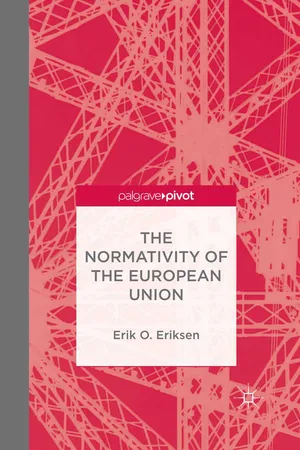
The Normativity of the European Union
About this book
The Normativity of the European Union provides an account of what has made European integration possible. Reconstructing the integration process up to the Eurozone crisis, Eriksen provides novel insight into the conditions for integration and the nature of the EU as well as highlighting why European solidarity has become a moral duty.
Information
1
The Musts of European Integration
Abstract: The European Union has ended up as a polity in its own right and one with democratic credentials. What made such an integrationist move possible? Moreover, why do the member states find themselves entangled in a situation of pooled sovereignty and collectivised risks? This chapter reconstructs the integration process from a distinct theoretical perspective premised on the assumed force of reasons. Some reasons take the form of musts and are inescapable in order to give a full account of the integration process. Values like peace, democracy, impartiality and dignity are among the musts of the European integration process. Despite their indeterminate character, they have obtained a quasi-empirical status as requirements on actors and institutions. The normativity of the EU underscores non-domination and a post-humiliating Europe, which is threatened by todays’ Eurozone crisis.
Eriksen, Erik O. The Normativity of the European Union. Basingstoke: Palgrave Macmillan, 2014. DOI: 10.1057/9781137391452.0004.
The European Union (EU)1 is unprecedented and testifies to a large-scale experiment searching for binding constitutional principles and institutional arrangements beyond the mode of rule entrenched in the nation state. It is, according to Jan Werner Müller (2011: 238), the ‘most successful institutional innovation since the emergence of the democratic welfare state’. The EU testifies to the fact that a historical reconciliation between states has taken place and that learning processes have been institutionalised. The ‘state of nature’ between the states has been domesticated in Europe. Hostility and harsh competition has been replaced by peaceful cooperation. In light of this the current lamentations about the EU are somewhat puzzling.
Why are we witnessing such anger over the financial crisis of the Eurozone, when so much has been achieved in spite of the obvious limitations of the EU’s resources and power instruments?2 Why are intellectuals like Jürgen Habermas, Amartya Sen, Ulrich Beck, Salman Rushdie, Julia Kristeva and Anthony Giddens so critical? Europe’s political leaders are accused of incompetence and inept action. In its struggle with global financial markets the EU is accused of having lapsed into old-fashioned power politics and dictated conditions for the debt countries, the insolvent members of the zone. According to critics there is a slavish devotion to economic solutions – to the dictates of the financial markets, and the mantra of neoliberalism – with no attention to political and social outcomes. This, it is claimed, ends up in post-democratic executive federalism based on intergovernmental structures (Habermas 2012a; cp. 2013).
Also elder statesmen like Helmut Kohl, Helmut Schmidt, Jacques Delors, Giscard d’Estaing, as well as the former German Minister of Foreign Affairs Joschka Fischer, Member of the European Parliament Daniel Cohn-Bendit and former prime ministers like Guy Verhofstadt, all lament the present state of affairs and fume over the actions of the day.3 They warn against the return of protectionism, of nationalism and even of military conflict. According to them there is a betrayal of the European idea; there is no vision, no progressive proposal at the table – only technocratic rule dictated by economic calculus. The vision of the present German chancellor Angela Merkel is held to be simply crisis management and damage control. By this the whole integration project is put at risk. The acute Eurozone crisis has been met with a ‘wall of words’, and a fiscal compact to toughen budget rules bound to end in austerity and social misery.4 The sovereign debt crises have been allowed to unfold for a long time; uncertainty, gridlock and paralysis prevail because of narrow-minded political leaders.5
Why such rage, why such harsh language?6 Why the many disillusioned expectations towards the EU? After all, the competencies of the EU in social and economic matters are miniscule. It has no competence in fiscal matters; it cannot redistribute resources, issue state bonds, print money, and it has no sovereign tax basis. The European Central Bank (ECB) cannot act as a lender of last resort. All this belongs to the competency of member states. There is a structural imbalance in the internal market. A monetary union without a fiscal union is unsustainable. However the will and the resources needed to make a common fiscal policy with redistributive measures are lacking at the European level today. A true political union is lacking. This is all well-known and a result of member states’ unwillingness to grant more powers and resources to the Union. Collective action is constrained by the politics of European states (Scharpf 2010).
Moreover, why denounce the EU when the European Monetary Union (EMU) was established in the heyday of the neoliberal zeitgeist disposed to labour market liberalisation, privatisation and removal of subsidises.7 A neoliberal economic regime in which state intervention was to be abolished has been in place since the late 1970s initiated by Ronald Reagan and Margaret Thatcher. Monetarist supply-side programmes propagated by the Chicago school replaced Keynesian demand-side programmes. The European Monetary System was established to counter the destabilising effects of the collapse of the Bretton Woods order,8 when fixed exchange rates disintegrated amid the first deep post-war recession. In this new system regulation is mostly negative; it is about abolishing barriers for an effective internal market (Scharpf 1999). But already the Rome Treaty (1957) elevated the fundamental market freedoms and competition law. For many the EU came to be seen as being about establishing unrestricted competition and a levelled playing field: the unfettered circulation of goods and labour. It is the member state which is supposed to provide for socio-economic justice and social welfare. The EU’s positive competences to ensure reregulation and redistribution at the European level are close to non-existent. Price stability, not redistribution, is a constitutional norm of the EU. The EU itself is not merely an instrument for catching up politically with economic globalisation (cp. Habermas 2001), it has contributed to it as well, given the structural neoliberal bias in its set up. The EMU was not complemented with a political union equipped with the necessary fiscal means to handle crisis, to ‘mutualise’ debts and stimulate growth. So, why lambast the EU for inaction and desolation?
Part of the answer is found in the fact that the structural deficiency of the EMU has today deprived several states of their right to democratic self-rule. Thus there is an immediate and comprehensible background for the reactions against the manner in which the Eurozone crisis has been tackled. Heads of governments who lack a European mandate in these matters have agreed upon a series of financial, economic, social and wage policies that affect the well-being of many Europeans. Such issues belong, according to the Lisbon Treaty,9 to the remit of the member states. Moreover, it is not democratically accountable, elected politicians who are deciding on future living conditions for European citizens, but rather the self-appointed troika – the International Monetary Fund (IMF), the European Commission and the European Central Bank (ECB). The EMU, which is the product of the Treaty on European Union (TEU), has produced new treaties of its own establishing the European Stability Mechanism (ESM) and the Fiscal Pact.10 They are established outside of the Lisbon Treaty and the Stability and Growth Pact. These trample on national law11 and are in breach with EU law.
Stability mechanisms, such as the EFSF and the ESM, operate as separate financial institutions outside the Treaty framework, with their own intergovernmental decision-making bodies and behind the shield of far-going immunity and confidentiality. Intergovernmental stability mechanisms remain outside the scope of application of both Treaty provisions on the principle of transparency and complementary secondary legislation. Such an institutional development makes any control by the European parliament or national parliaments, not to mention civil society and the citizenry, extremely difficult. (Tuori 2012: 47)12
Amartya Sen may thus be correct in claiming that ‘it isn’t Just the Euro: Europe’s Democracy Itself is at Stake’.13
A better Europe without a blueprint
But there is more to it. Had the EU been an ordinary international organisation – solely in the hands of the contracting parties – defying democratic procedures and neglecting social concerns and third parties’ interests would not have caused such hullabaloo. If Europe still were a continent of sovereign nation states, and the EU only an international organisation, then pursuing the national interests with the help of any viable instrument would not have been unexpected. If the EU had been a compartment of international relations – an organisation with a special purpose in solving member states’ problems – democracy, solidarity and common obligations for the well-being of all would not have been on the agenda. But in fact the EU is more, and this ‘more’ must be accounted for in order to understand the frustration over the present state of affairs.
Part of the problem is, however, that there is no agreement of what the EU is or should be. For many scholars and decision-makers the EU is in fact merely an instrument for satisfying member states’ interests. For them the crisis could not have been handled otherwise. But the genuine European vision is different, according to cosmopolitans and federalists. It is the idea of a better Europe: a vision of a European bonum commune, of a humanitarian, united and democratic Europe. European integration came with a promise of peace and democracy; of protecting European democracies from dictatorship and war, from crisis and misery. In Francis Fukuyama’s words:
The European view is that Europe seeks to create a genuine rule-based international order suitable to the circumstances of the post-cold war world. That world, free of sharp ideological conflicts and large scale military competition, is one that gives substantially more room for consensus, dialogue and negotiation as ways of settling disputes.14
Intrinsic to the vision was the promise that power transfer would be accompanied by democratic upgrade. The citizens should themselves be able to influence their destiny. Even if European democracy initially was not an issue, the process itself was conducted through multilateralism and legal proceedings with democratic credentials. The integration of European states and citizens was not to be conducted through blood and iron, but in a peaceful and civilised way, through the medium of law.15
In the beginning, [the European Union] was more of an economic and technical collaboration. ... At long last, Europe is on its way to becoming one big family, without bloodshed, a real transformation clearly calling for a different approach from fifty years ago, when six countries first took the lead.16
The European integration process has been driven by law, which is a reflexive medium for solving problems and conflicts in modern societies. Law is a conscious and self-referential medium, which cannot be fully auto-poetic for a long time without ‘irritating’ (pace Niklas Luhmann) other social forces. Modern law is intrinsically connected to democracy, as only an open and inclusive process of decision-making can legitimately furnish the legal system with the rules it applies. On this background one can understand the angry reactions and accusations on the EU’s and the main states’ handling of the Eurozone crisis. It has been conducted without much popular authorisation.17 Transgressing competencies and defying legal procedures are undermining the very legitimacy of Europe’s political order. Moreover, the reactions from intellectuals as well as from the affected parties to crisis management and the politics of austerity testify to the fact that risks have become collecti...
Table of contents
- Cover
- Title
- 1 The Musts of European Integration
- 2 Voluntary Supranationalism
- 3 European Democracy
- 4 Democratic Alternatives or Dead Ends?
- 5 A Cosmopolitan European Future
- 6 Fraternit The Missing Must of Integration
- References
- Index
Trusted by 375,005 students
Access to over 1.5 million titles for a fair monthly price.
Study more efficiently using our study tools.
Frequently asked questions
Yes, you can cancel anytime from the Subscription tab in your account settings on the Perlego website. Your subscription will stay active until the end of your current billing period. Learn how to cancel your subscription
No, books cannot be downloaded as external files, such as PDFs, for use outside of Perlego. However, you can download books within the Perlego app for offline reading on mobile or tablet. Learn how to download books offline
Perlego offers two plans: Essential and Complete
- Essential is ideal for learners and professionals who enjoy exploring a wide range of subjects. Access the Essential Library with 800,000+ trusted titles and best-sellers across business, personal growth, and the humanities. Includes unlimited reading time and Standard Read Aloud voice.
- Complete: Perfect for advanced learners and researchers needing full, unrestricted access. Unlock 1.5M+ books across hundreds of subjects, including academic and specialized titles. The Complete Plan also includes advanced features like Premium Read Aloud and Research Assistant.
We are an online textbook subscription service, where you can get access to an entire online library for less than the price of a single book per month. With over 1.5 million books across 990+ topics, we’ve got you covered! Learn about our mission
Look out for the read-aloud symbol on your next book to see if you can listen to it. The read-aloud tool reads text aloud for you, highlighting the text as it is being read. You can pause it, speed it up and slow it down. Learn more about Read Aloud
Yes! You can use the Perlego app on both iOS and Android devices to read anytime, anywhere — even offline. Perfect for commutes or when you’re on the go.
Please note we cannot support devices running on iOS 13 and Android 7 or earlier. Learn more about using the app
Please note we cannot support devices running on iOS 13 and Android 7 or earlier. Learn more about using the app
Yes, you can access The Normativity of the European Union by E. Eriksen in PDF and/or ePUB format, as well as other popular books in Politics & International Relations & European Politics. We have over 1.5 million books available in our catalogue for you to explore.