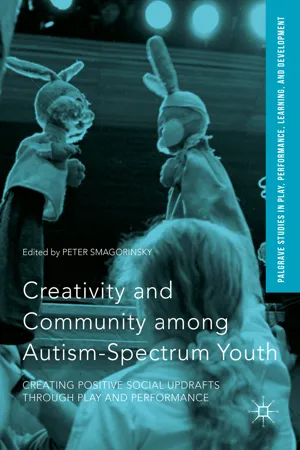
eBook - ePub
Creativity and Community among Autism-Spectrum Youth
Creating Positive Social Updrafts through Play and Performance
- English
- ePUB (mobile friendly)
- Available on iOS & Android
eBook - ePub
Creativity and Community among Autism-Spectrum Youth
Creating Positive Social Updrafts through Play and Performance
About this book
This edited volume explores the roles of socially-channeled play and performance in the developmental trajectories of young people who fall on the autism spectrum. The contributors offer possibilities for channels of activity through which youth on the autism spectrum may find acceptance, affirmation, and kinship with others. "Positive social updraft" characterizes the social channels through which people of difference might be swept up into broader cultural currents such that they feel valued, appreciated, and empowered. A social updraft provides cultural meditational means that include people in a current headed "upward," allowing people of atypical makeups to become fully involved in significant cultural activity that brings them a feeling of social belonging.
Information
© The Author(s) 2016
P. Smagorinsky (ed.)Creativity and Community among Autism-Spectrum YouthPalgrave Studies In Play, Performance, Learning, and Developmenthttps://doi.org/10.1057/978-1-137-54797-2_11. Introduction
Peter Smagorinsky1
(1)
Department of Language and Literacy Education, The University of Georgia, Georgia, USA
As a person with autism I want to emphasize the importance of developing the child’s talents. Skills are often uneven in autism, and a child may be good at one thing and poor at another. I had talents in drawing, and these talents later developed into a career in designing cattle handling systems for major beef companies. Too often there is too much emphasis on the deficits and not enough emphasis on the talents. Abilities in children with autism will vary greatly, and many individuals will function at a lower level than me. However, developing talents and improving skills will benefit all. If a child becomes fixated on trains, then use the great motivation of that fixation to motivate learning other skills. For example use a book about trains to teaching reading, use calculating the speed of a train to teach math, and encourage an interest in history by studying the history of the railroads. ~Temple Grandin (Adams et al. 2012)
In forests and tide pools, the value of biological diversity is resilience: the ability to withstand shifting conditions and resist attacks from predators. In a world changing faster than ever, honoring and nurturing neurodiversity is civilization’s best chance to thrive in an uncertain future. ~Steve Silberman (2013)
Both of the quotes with which I open this chapter speak about the potential of autistic 1 people to live lives that are personally fulfilling and that contribute to the well-being of society. Unfortunately, however, those on the spectrum tend to be viewed negatively as weird, sick, disabled, disordered, abnormal, and laden with deficits. This book is an effort both to shift the public conception of autistic people toward an understanding of assets and possibility, and to illustrate how the people who surround those on the spectrum may adapt their beliefs and conduct to enable autistic people lead lives that are satisfying and fulfilling.
In this book we take a perspective grounded in Vygotsky’s (1987) notion of culturally mediated human development, one that is focused on potential and concerned with fostering it through social processes. In considering questions of development, I always summon a question I heard James Wertsch pose at a conference: Development toward what? Given my agreement with Wertsch’s (1985) summation of L.S. Vygotsky’s historical-cultural-social perspective on psychology, I extend that question to include attention to critical related factors: Development through what mediational channels, development through which mediational tools, development in light of whose priorities and value systems, and development toward what social and cultural endpoints?
The contributors to this volume assert that autism is less a static condition than a set of traits that provide the basis for the development of personality through participation in significant cultural activities. This perspective on human difference is available through Vygotsky’s (1993) writing in the field known as defectology, a term whose unfortunate name I unpack in Chap. 2. This field falls within the general purview of Vygotsky’s individual, social, cultural, and historical developmental psychology and is concerned with people of physical and cognitive difference—primarily the deaf, blind, and cognitively impaired children of the early Soviet Union (see Chap. 2). We have adapted a Vygotskian perspective to consider twenty-first-century treatment of those who are classified with what are commonly known as autism spectrum disorders (ASD) (see Smagorinsky 2011a, 2012a, b, 2014a, b; Cook and Smagorinsky 2014), a pathology-oriented characterization that we contest in this volume.
According to the Centers for Disease Control and Prevention (2015), “Autism spectrum disorder (ASD) is a group of developmental disabilities that can cause significant social, communication and behavioral challenges” (n. p.; emphasis added). This statement reveals the pathological way in which autism is defined, even by those who consider themselves sympathetic to the autistic population. The National Institute of Neurological Disorders and Stroke (2016) further states, “The severity of ASD can vary greatly and is based on the degree to which social communication, insistence of sameness of activities and surroundings, and repetitive patterns of behavior affect the daily functioning of the individual” (n. p.). Greater symptomatic degrees of this “neurological disorder” are treated as indications of “severity,” again suggesting that the greater the presence of traits, the more diseased one is considered. Autism, in the view of the general public and the services through which they are informed, is thus widely viewed as an abnormality and disablement of severe consequences.
The authors of this volume take a very different perspective not only in their rejection of this pathological perspective but also in their focus of attention in promoting greater well-being. They are especially attentive to the need for adaptations in the social environment of human development (see Chap. 3), rather than solely focusing on individuals who are considered anomalous; and the role of play and performance within these social channels to allow groups to construct boundaries and means of self-regulation sensitive to the needs of the whole group.
This emphasis on participation in cultural activity runs counter to the asocial manner in which autism is often conceived. The authors of the chapters in the book demonstrate how autism-spectrum children and youth may be taken up in a positive social updraft through which their actions may be channeled in ways that affirm their worth and status within social groups. As the Silberman (2013) quote that begins this chapter suggests, the point is twofold: to address the developmental needs of those on the spectrum, and to enrich the whole of society with the qualities available from those who have long been considered pathetic and abnormal and are best treated with isolation and neglect.
The authors in this volume document the poverty of the perspective that views the human race as hierarchical and human development as measurable through prescriptive notions of normality, a scale that inevitably finds autism-spectrum children and youth (and adults) to be defective. Rather, the contributors work from the premise that human life, although socially channeled toward a common motive within broad societies, includes unlimited endpoints and accompanying pathways for individuals and their social groups to travel. Throughout history, society has provided general value systems and outcomes through which both personal and collective actions are mediated. Individuals within societies are typically socially pressured to take on the identity afforded by those cultural streams, from the leverage of national policies for general populations such as youth in school to more micro-level forces such that left-handed people must adapt to living a right-handed life. 2
People in the USA and other competitive Western societies are raised within a set of tensions that value conformity to rules on the one hand, and individualism on the other. Human development within such tensions can be subject to a great deal of dissonance, especially for those whose individualism provides a poor fit with societal convention. Such people tend to be treated as oddballs and weirdos, scorned as deficient for their different orientations and ways of engaging with the world.
In this volume, the authors attend especially to autistic people, particularly children and adolescents, whose differences typically lead to their rejection and dismissal by the general population as being of lesser social value. Their differences might be rooted in neurological makeup that produces classifications of deficiency and disorder, might follow practices of a nondominant culture, may be a consequence of external trauma, may have origins in physical or cognitive points of difference that impinge on what are considered typical ways of being, or might proceed from other circumstances. In contrast, the contributors describe how social contexts may be found, constructed, or adapted so that children and youth on the autism spectrum may be treated as contributing members to the greater social order, even as they do so through different means of engagement.
An Alternative to the Standard, Individualistic View of Human Development
The contributors to this volume are particularly concerned about the ways in which social groups, especially those that are dominant, tend to construct environments that limit the types of people who may participate in their activities with confidence and positive reinforcement. We share Vygotsky’s (1993) assumption that if problems follow from a person developing in a manner contrary to what is anticipated by others, these problems are social rather than deficiencies of the individual.
There is a tendency to locate the individualistic perspective on what is called “mental health”—a term I trouble later in this chapter—as the special province of Western societies. Yet societies from outside the Western purview share this perspective as well. Lee (1997) states that
Most Asian Americans attempt to deal with their psychological problems without seeking professional services. Many tend to rely on the family in dealing with their problems. Traditional families often treat mental disorders by urging the disturbed family members to change their behavior. They believe that self-control, will power, avoidance of unpleasant thoughts, keeping busy, and trying not to think too much about problems can help individuals to deal with their troubles. Each family member, including the extended family members, may offer his or her recommended treatment. When the troubled person and his or her family are not able to resolve the problem, they often turn to resources available in their community, such as elders, spiritual healers, ministers, monks, herbalists, fortune tellers, or physicians. Many come to mental health professionals as the last resort, while others are forced to receive counseling by the courts, hospitals, schools, and other social services agencies. (n.p.)
Although there is attention to changes within the family, the onus, as in Western approaches, is on individual self-control, or perhaps on individualized treatments such as acupuncture. Within this perspective, the individual is disturbed, disordered, or troubled—a view that fits well within the Western view—and in need of repair. This perspective is common among diagnosticians and is pervasive among the general public, becoming near axiomatic in the ways in which people who exhibit anomalous tendencies are socially and medically constructed in U S society and beyond.
In this volume the authors question this emphasis on the individual as the locus of responsibility for difference, shifting attention instead to the environment. Paradoxically perhaps, we assume that although all human conduct and development are socially mediated so that cultures have definable contours and processes, those outcomes and processes are not deterministic, and a dominant culture’s ideal destinations or means of arriving at them do not suit all. Further, especially in large nations composed of people of many cultural orientations, multiple pathways and outcomes must be available such that the notion of standardization to a norm becomes too preposterous a condition to impose on multifarious people and subgroups. In our conception, cultural variation includes the cultures that involve people who carry classifications regarding their “mental health” in that their goals, practices, and social standards typically have a particular character that requires adaptive thinking and action on the part of its participants and, from our perspective, on the part of those who surround them.
Typically, however, societies develop beliefs about propriety that lead the majority to view neurodivergent people as having deficiencies that should be corrected. The solution to deafness is to repair the problem with a cochlear implant; the solution for people considered to be mentally ill is to provide the individual with therapy and medication; the solution to being left-handed is to require right-handed performance; and so on. As I know from my own experiences with systemic anxiety, Asperger’s traits, and obsessive-compulsiveness, medication can provide relief from anxiety and other conditions that make social life a challenge. Yet such interventions are designed to change the individual’s neurological functioning and thus address only a part of what makes life difficult. Similarly, therapy tends to address the individual’s feelings of distress. What it does not contribute to is a change in the social setting in which the individual is considered to be abnormal, or sick, or disordered, or any number of other pejorative deficit conceptions.
In contrast, many on the autism spectrum don’t want to be normal. One person on the Asperger’s spectrum has characterized th...
Table of contents
- Cover
- Front Matter
- Part I. Theoretical Framework
- Part II. Deliberately Crafted Activity Settings
- Part III. Mainstream Activity Niches
- Back Matter
Trusted by 375,005 students
Access to over 1.5 million titles for a fair monthly price.
Study more efficiently using our study tools.
Frequently asked questions
Yes, you can cancel anytime from the Subscription tab in your account settings on the Perlego website. Your subscription will stay active until the end of your current billing period. Learn how to cancel your subscription
No, books cannot be downloaded as external files, such as PDFs, for use outside of Perlego. However, you can download books within the Perlego app for offline reading on mobile or tablet. Learn how to download books offline
Perlego offers two plans: Essential and Complete
- Essential is ideal for learners and professionals who enjoy exploring a wide range of subjects. Access the Essential Library with 800,000+ trusted titles and best-sellers across business, personal growth, and the humanities. Includes unlimited reading time and Standard Read Aloud voice.
- Complete: Perfect for advanced learners and researchers needing full, unrestricted access. Unlock 1.5M+ books across hundreds of subjects, including academic and specialized titles. The Complete Plan also includes advanced features like Premium Read Aloud and Research Assistant.
We are an online textbook subscription service, where you can get access to an entire online library for less than the price of a single book per month. With over 1.5 million books across 990+ topics, we’ve got you covered! Learn about our mission
Look out for the read-aloud symbol on your next book to see if you can listen to it. The read-aloud tool reads text aloud for you, highlighting the text as it is being read. You can pause it, speed it up and slow it down. Learn more about Read Aloud
Yes! You can use the Perlego app on both iOS and Android devices to read anytime, anywhere — even offline. Perfect for commutes or when you’re on the go.
Please note we cannot support devices running on iOS 13 and Android 7 or earlier. Learn more about using the app
Please note we cannot support devices running on iOS 13 and Android 7 or earlier. Learn more about using the app
Yes, you can access Creativity and Community among Autism-Spectrum Youth by Peter Smagorinsky in PDF and/or ePUB format, as well as other popular books in Psychology & Teaching Arts & Humanities. We have over 1.5 million books available in our catalogue for you to explore.