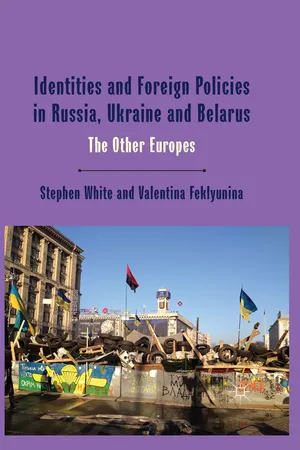
eBook - ePub
Identities and Foreign Policies in Russia, Ukraine and Belarus
The Other Europes
- English
- ePUB (mobile friendly)
- Available on iOS & Android
eBook - ePub
Identities and Foreign Policies in Russia, Ukraine and Belarus
The Other Europes
About this book
This book maps changing definitions of statehood in Russia, Ukraine and Belarus as a result of their exclusion from an expanding Europe. The authors examine the perceptions of the place of each state in the international political system and its foreign policy choices, and draw comparisons across the region.
Information
1
Other ‘Europes’
The Russian Federation is the largest state in Europe, indeed anywhere. Ukraine is the second largest. The other Slavic republic that became independent in 1991, Belarus, is also entirely European in its geographical location. And yet all three have often interpreted their ‘Europeanness’ in ways that have been different from interpretations elsewhere on the continent. In particular, the ‘Europes’ they have sought to confront, cooperate with or even join have often been different from the ‘Europe’ of the European Union and its full-time officials in Brussels. In the chapters that follow we will seek to identify these various perspectives by investigating Russian, Ukrainian and Belarusian identities and the ways in which they shaped their countries’ perceptions of ‘Europe’ in the post-Soviet period and underpinned their respective foreign policies. An understanding of these factors is fundamental in its turn if we are to explain the apparent stalemate that has developed in state-to-state relations, and perhaps help to overcome it. We start with an examination of the highly contested notion of ‘Europe’ in the post-Soviet context, and then move on to consider the various ways in which it has engaged policymakers as well as the wider society over long periods of time. The last part of the chapter presents our conceptual framework, explains our methodological choices, and sets out the structure of the book as a whole.
Defining ‘Europe’
‘Europe’ has always been a contested concept. In conventional usage it embraced the territory between the Atlantic and the Ural mountains. But the Urals were not an obvious break, and they had not been thought to mark the outer limits of the continent until the early 18th century when two scholars, a Swedish military officer, Philip-Johann von Strahlenberg, and the Russian geographer, Vasilii Tatishchev, began to challenge the traditional river boundaries and to press the claims of a mountain range further to the east that – in Tatishchev’s words – was ‘much more appropriate and true to the natural configuration’.1 Not all were immediately persuaded, and there was still less agreement about the boundary that was supposed to run from the southern extremity of the Urals to the Caspian and the Black Sea, a boundary that had been drawn in different places at different times by different authorities. In strictly geological terms, Europe and Asia were actually better understood as a single continent. ‘Europe’, in this sense, was more like a ‘western peninsula of Asia’, as the German traveller Alexander von Humboldt described it in the mid-19th century;2 the Indian subcontinent, which rested on a different tectonic plate, had arguably a better claim to a wholly independent status.
The geographical boundaries, as they were generally understood in the early 21st century, raised further issues. For a start, there were countries that straddled the divide. Was Turkey, for instance, a ‘European’ country, or at least the part of it that lay on the ‘European’ side of the Straits? It had, after all, been a part of the Roman Empire, which lay at the foundations of Western civilisation, and Constantinople had been the capital of the Eastern Empire for a thousand years after the fall of Rome. A substantial part of southeastern Europe, including most of Hungary and the Balkans, had come under Ottoman rule by the 16th century, leaving an agreeable legacy of coffee houses and open-air bathing. Turkey, the successor state, had been a member of the Council of Europe from the year of its foundation and applied for associate membership of the European Economic Community (the later Union) in 1959, soon after it had been established. An association agreement was concluded in 1963 that was understood as the start of a process that would lead to full membership; a formal application was lodged in 1987, and negotiations began in 2005. There was clearly no question, as far as the EU itself was concerned, that Turkey was formally eligible.3 Yet only three per cent of its territory lay on the European side of the Eurasian boundary, which hardly made it a ‘European country’.
Kazakhstan was another partly ‘European’ country, with at least two regions that spanned the same boundary. The Ural river, which meandered down from the southern end of the mountain range, had traditionally been regarded as the dividing line between the two continents. The capital of West Kazakhstan region, Ural’sk, stood on the western bank, technically in ‘Europe’, but with a statue of Genghis Khan in one of its public places that made clear it had enjoyed a more exotic history. The Lesser Horde, one of the administrative divisions of the Mongol empire, had been established here; yet the town had actually been founded by the Ural Cossacks, and not far from the statue of the Mongol warlord was the historic building in which two of Russia’s greatest writers, Pushkin and Tolstoy, had taken residence when they were visiting the region. Crossing westwards over the river bridge, the sign said ‘Europe’; going eastwards, it said ‘Asia’. There was otherwise very little to suggest it was a boundary between two different civilisations.4 Kazakhstan itself was a member of the Organisation for Security and Cooperation in Europe (OSCE; indeed it chaired the entire organisation in 2010), but it was not a member of the Council of Europe even though a larger proportion of its national territory lay inside the continental boundary than in the case of Turkey.
Matters were still more complicated further south, where the mountains of the Urals dwindled into the desert lands around the Caspian. Soviet geographers had originally regarded the Ural river as the Europe-Asia frontier; but at the end of the 1950s it was concluded that there was in fact no ‘objectively existing physical-geographical boundary’ between the two continents and that a better case could be made for the river Emba, some distance to the southeast, a boundary that had been proposed by von Strahlenberg in the 18th century.5 The Emba, in fact, was hardly a more obvious dividing line in terms of its physical characteristics, and Russian geographers have argued more recently that the entire Caspian Lowland might be a better choice, given that its natural features have remained unchanged for millions of years; the effect would be to extend ‘Europe’ further to the south, taking in more of Kazakhstan.6 Indeed the argument could be made that ‘Europe’ should have different boundaries for different purposes – for instance, political or administrative, as well as boundaries that were based on the enduring attributes of physical geography;7 and that in any case the outer limits of what were ultimately cultural and historical communities were better conceived as a transition zone than as a single line on a map.8
Matters were no clearer on the other side of the Caspian, where Azerbaijan and Georgia had traditionally been regarded as having part of their territory in ‘Europe’. Armenia, by contrast, was held to belong in Asia, as it lay entirely to the south of the watershed of the Caucasus mountains. But there were Greater and Lesser Caucasus ranges, and a case could be made for a watershed that ran along either of them; apart from this, the mountain watersheds themselves migrated from time to time. A case could also be made for a border that ran along the Rioni and Kura rivers between the Greater and Lesser Caucasus, a border that had originally been defined by Herodotus.9 This provided a basis for the conventional boundary that placed most of Georgia and Azerbaijan in ‘Europe’ and the Georgian capital, Tbilisi, in both continents at the same time. Other definitions placed some northern parts of Armenia, and even parts of Iran, inside the continental boundary; and it had been a long-established Soviet practice to include the three Caucasian republics in their entirety, right up to the Turkish frontier.10 All three were members of the Council of Europe as well as the OSCE, and the EU formally acknowledged their ‘European aspirations’, which appeared to suggest that they were regarded, at least in principle, as eligible for membership.11
Perhaps, then, ‘Europe’ was less a set of boundaries, and rather more a sphere of values? ‘Not so much a place as an idea’, in one formulation;12 ‘not a continent [but a] concept’, in another?13 But if so, which concept, and which ideas? Was it, for instance, essentially ‘Christendom’, the term that had been preferred throughout the Middle Ages? Arguably, it was the virtual identification of Europe with an earlier Christendom that had been the ‘most influential single factor’ in its emergence as an expanse of territory with which its various peoples could share a common sense of belonging.14 But ‘Christendom’ extended more broadly, at various times including the domains of the Coptic Church in North Africa, the Byzantine Christians in Anatolia, and the Crusader State in the Middle East. And with the failure of the attempts to unite the Eastern and Western churches in the 15th century, the association became even more problematic; still more so when Western Christians began to divide among themselves in the Thirty Years’ War, and the Treaty of Westphalia of 1648 established the principle that states should be able to resolve these matters individually.15 Apart from this, there were many elements of ‘European’ culture that could scarcely be seen as Christian at all: ‘the Roman, the Hellenic, arguably the Persian, and (in modern centuries) the Jewish’; perhaps there was ‘also a Muslim strand’.16
The same was true of languages. ‘Europeans’, for the most part, spoke an Indo-European language; normally, however, it was a different one. At least 104 languages from six different families were spoken by its 87 ‘peoples’,17 and the European Union alone had 23 official languages in three different alphabets, which even so excluded the official languages of some of its member states.18 The Indo-European languages themselves extended much more broadly than the boundaries of a conventional ‘Europe’, to the Indian subcontinent as well as the countries overseas that had been settled by European colonisers. Indeed in some cases there were many more who spoke a European language who lived entirely outside the continental boundaries than who lived within them. There were more French speakers in France than in other countries and more Dutch speakers in the Netherlands than anywhere else. But fewer than five per cent of Portuguese speakers lived in Portugal (there were much larger numbers in Brazil and parts of Africa); no more than 10 per cent of Spanish speakers lived in Spain or another European country (there were far more in Latin America); and only 16 per cent of English speakers lived in ‘Europe’, with much larger numbers in other countries (particularly in North America).19
Language was pre-eminently a means of communication, and it was through the communication it facilitated that identities themselves were established and extended. In this sense, ‘Europe’ could be understood as a ‘web of communication and interaction’20 or as a ‘narrative network’,21 with no a priori commitment to a particular set of territorial boundaries. ‘Europe’, in these terms, could be seen as a shared meaning, or what Benedict Anderson had defined as an ‘imagined community’;22 it was simply a space that those who lived within it had agreed to designate accordingly. There was a foundation for a negotiated ‘European’ identity of this kind in contiguity, in the way in which families and friendships were distributed across a common territory, and in the way in which ‘European’ activities brought together a particular group of states while simultaneously excluding others. ‘Europe’ was certainly a matter of territory and boundaries. But it was also a function of the interaction of its various peoples as they took part in a variety of ‘European’ activities: for instance, in competitions such as Eurovision (Russia began to take part in 1994 after it had joined the European Broadcasting Union and won for the first time in 2008) or the contests among the leading European football clubs that began to take place in the mid-1950s (see Table 1.1).23
But there were countries well beyond the continental territory that also ‘felt European’, as Commission President Romano Prodi had remarked, such as New Zealand; ‘that is the problem.’24 Nor did the countries that were geographically ‘European’ associate exclusively, or even primarily, with each other. There were Dutch, French, Portuguese and Spanish settlements abroad that were regarded as an integral part of the national territory, even though they were located as far away as the Caribbean or the Indian Ocean. Conversely, there were other possessions and dependencies that were not a part of their state of origin even though they were clearly within the boundaries of a geographical ‘Europe’, such as the Channel Islands (which were formally outside the European Union as well as the direct jurisdiction of the United Kingdom). There were further associations of a looser kind, often ba...
Table of contents
- Cover Page
- Half Title Page
- Title Page
- Copyright
- Contents
- List of Tables and Figures
- Preface and Acknowledgements
- 1 Other ‘Europes’
- 2 Negotiating a Relationship
- 3 ‘Europe’ and the Post-Soviet Republics Since 1991
- 4 Russia and ‘Europe’: Elite Discourses
- 5 Ukraine and ‘Europe’: Elite Discourses
- 6 Belarus and ‘Europe’: Elite Discourses
- 7 Mass Publics and Foreign Policy Preferences
- 8 Conclusion: Identities and Foreign Policies in the Other Europes
- Notes
- A Note on Sources
- Index
Trusted by 375,005 students
Access to over 1.5 million titles for a fair monthly price.
Study more efficiently using our study tools.
Frequently asked questions
Yes, you can cancel anytime from the Subscription tab in your account settings on the Perlego website. Your subscription will stay active until the end of your current billing period. Learn how to cancel your subscription
No, books cannot be downloaded as external files, such as PDFs, for use outside of Perlego. However, you can download books within the Perlego app for offline reading on mobile or tablet. Learn how to download books offline
Perlego offers two plans: Essential and Complete
- Essential is ideal for learners and professionals who enjoy exploring a wide range of subjects. Access the Essential Library with 800,000+ trusted titles and best-sellers across business, personal growth, and the humanities. Includes unlimited reading time and Standard Read Aloud voice.
- Complete: Perfect for advanced learners and researchers needing full, unrestricted access. Unlock 1.5M+ books across hundreds of subjects, including academic and specialized titles. The Complete Plan also includes advanced features like Premium Read Aloud and Research Assistant.
We are an online textbook subscription service, where you can get access to an entire online library for less than the price of a single book per month. With over 1.5 million books across 990+ topics, we’ve got you covered! Learn about our mission
Look out for the read-aloud symbol on your next book to see if you can listen to it. The read-aloud tool reads text aloud for you, highlighting the text as it is being read. You can pause it, speed it up and slow it down. Learn more about Read Aloud
Yes! You can use the Perlego app on both iOS and Android devices to read anytime, anywhere — even offline. Perfect for commutes or when you’re on the go.
Please note we cannot support devices running on iOS 13 and Android 7 or earlier. Learn more about using the app
Please note we cannot support devices running on iOS 13 and Android 7 or earlier. Learn more about using the app
Yes, you can access Identities and Foreign Policies in Russia, Ukraine and Belarus by Stephen White,Valentina Feklyunina in PDF and/or ePUB format, as well as other popular books in Politics & International Relations & European Politics. We have over 1.5 million books available in our catalogue for you to explore.