- English
- ePUB (mobile friendly)
- Available on iOS & Android
eBook - ePub
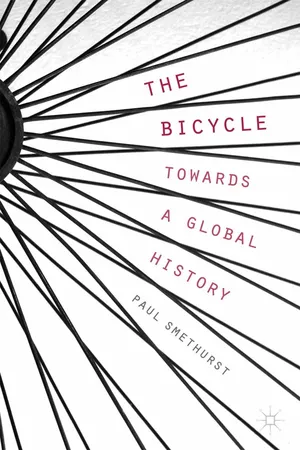
The Bicycle — Towards a Global History
About this book
This is the first history of the bicycle to trace not only the technical background to its invention, but also to contrast its social and cultural impact in different parts of the world, and assess its future as a continuing global phenomenon.
Information
Topic
GeschichteSubtopic
SozialgeschichteONE
INVENTION: THE TECHNICAL EVOLUTION OF THE MODERN BICYCLE
OVERVIEW
The history of the invention of the bicycle was a microcosm of the history of all inventions. It showed how true it was that there was really nothing new. Everything that was invented had been invented before by somebody who was either in advance of his time, and therefore found no immediate demand for his invention, or, possibly, had not the mechanical means for putting his invention into practice.1
Henry Wood made the above comments at the Royal Society of Arts in London in 1897 in response to an address by George Lacy Hillier on ‘Cycling: Historical and Practical’, one of a series of technical papers on the history of the bicycle presented at the Society in the 1890s.2 The speakers were major figures in the industry, and they had a particular vantage in looking back at the history of the bicycle’s invention from the point where its modern form had become stable, its popularity unquestioned and the future of the industry seemingly assured. As they addressed members of this august body, founded in the mid-18th century to encourage the arts, manufacturing and commerce, there might well have been an air of triumphalism. The bicycle industry and its many contingent enterprises were prospering, and here was an object lesson in how to bring innovative modern technology to the market with resounding success (at least until the slump of the 1900s, the result of overproduction).
It is clear both in this paper and John Kemp Starley’s ‘The Evolution of the Cycle’, presented the following year (discussed below), that the most instructive aspect of this lesson was the collaborative nature of the enterprise. The bicycle industry could not have succeeded to the extent that it did without the contribution of venture capitalists or the modern factories that assembled mass-produced components from multiple sources, and the specialised skills of engineers and workers on production lines. This system of production also relied on the development of particular materials, including high-grade steel for wheels, frames, chains and ball bearings, and rubber for tyres. Beyond the factory gate, commercial success would then depend on promotion and marketing by distributors and advertisers, as well as sponsorship and endorsement by patrons and celebrities. It is not often realised that all of the above factors in the development of the modern bicycle arrived within a brief span (1870–1890), and coincided with the rise of modernity in the West. Primitive forms of the bicycle built by blacksmiths, coachmakers and amateur mechanics before this time were soon outmoded. The bicycle had now arrived as a definitive modern object, heralding and sometimes instigating the emergence of modern infrastructures that would radically alter social life. This chapter charts the technical development of the modern bicycle, but more importantly it sets its emergence within the social, economic and cultural contexts that shaped western modernity, and which in turn established the bicycle as a talisman of that modernity.
As a general concept, invention presupposes an original idea – it implies a ‘first’. As with other modern inventions – and for some of the same reasons – there have been many competing claims for the inventor of the first bicycle. While some of these claims stretch the definition of what actually constitutes a bicycle, others refer to concepts or machines that never progressed beyond designs and prototypes, and a few should be dismissed as hoaxes. Serious contenders for the first bicycle date back to the early 19th century, when the wooden hobby-horse, or ‘Draisine’ was introduced by Karl von Drais of Germany. As this was propelled by pushing the machine along with the feet in contact with the ground – in effect, a running-machine – it lacked several key features of the modern bicycle, and offered a very different riding experience. The first successful patent for a machine calling itself a bicycle was lodged in the US in 1866 by Pierre Lallement, who had, two or three years earlier, brought a pedal-driven ‘velocipede’ with him from France, where he claimed to have invented it. Paradoxically, rather than helping to establish a lead in the US, Lallement’s patent hampered the bicycle industry there for several decades.3 Much of the technical development of the modern bicycle as we know it today would take place in France and England between 1865 and 1885.
There are to this day many question marks over the history of bicycle development, and establishing provenance through the thousands of patents registered, press cuttings, letters and so on prior to 1900 continues to exercise historians.4 Catalogues and exhibitions during the 1870s and 1880s boasted hundreds of manufacturers selling dozens of different types of bicycle and tricycle, making it very difficult to trace a clear line of development. Although most of the major hoaxes have now been thoroughly debunked, some have become so ingrained in bicycle folklore that they continue to gain legitimacy in new bicycle histories and museum exhibitions. Such is the case with the Kirkpatrick Macmillan bicycle, supposedly built around 1840 in Scotland and later claimed to be the world’s first rear-driven bicycle.5 On the other hand, many unsung and amateur mechanics must have experimented with primitive bicycles prior to the arrival of the French pedal-driven velocipede in the 1860s. There were certainly self-taught engineers in the period working on tricycles and four-wheeled velocipedes in Britain and elsewhere.6 These kept alive the promise of human-powered transport, even if most of their inventions did not travel very far.7
Priority claims for the bicycle are relevant to its cultural history because they can reveal socio-cultural factors governing its use, or lack of it. While establishing genuine claims is important – not least to ensure credit goes where it is due – genuine mistakes, hoaxes and infelicities form a significant part of the bicycle’s wider history. While some hoaxes have been motivated by nationalist fervour and jingoism, the bicycle industry was not immune from making exaggerated claims of its own. Some might suggest that the phenomenal safety bicycle boom of the 1890s was itself based on something of a misrepresentation, fuelled by myths associated with bicycling, and later exploited in advertising posters. This is nicely illustrated in a passage in Jerome K. Jerome’s Three Men on the Bummel (1900), where the painfully uncomfortable realities of bicycling are contrasted with the effortless flight of ethereal nymphs adorning bicycle poster art (see Chapter 2). False promises and the failure of bicycling to meet consumers’ expectations have led to a number of boom and bust cycles over the years.
In exploring a wider range of invention and micro-invention, bicycle historians have recently been challenging linear approaches to its technical development. In particular, greater emphasis is now being given to technical developments and bicycle use around the world in an attempt to widen bicycle history.8 Nevertheless, in dealing with the bicycle’s technical development in the 19th century, historians have tended to focus mainly on the development paths forged by western inventors. In this chapter, I have for the most part deferred to leading international bicycle historians past and present, rather than introduce further primary research to challenge their findings. My aim is to provide a balanced and critical perspective based on the consensus of bicycle historians today. This chapter should not therefore be read as a definitive history of the technical development of the bicycle, but rather as a summary and explanation of received histories within the technological, social and cultural contexts of the late 19th century.
The contextual approach followed here puts greater emphasis on microinventions, including the essential components on which the modern bicycle depended, and the industrial processes necessary to their production. Crucially, most of these were not available until after 1870, and it is important to realise that the technical development of the modern bicycle could hardly have begun earlier than this date. Among the non-technical factors that spurred the development of the bicycle were the disruptive social changes of the late 19th century that created the need for new forms of mobility. From a materialist perspective, innovative technologies such as the bicycle might then be considered products of socio-historical conditions, rather than sudden inventions driving social change. Whatever the emphasis, the milieu produced by industrial modernity in the West in the late 19th century was crucial both to the technical development of the modern bicycle and the emergence of bicycling as an everyday cultural practice.
History tends to be on the side of the winners, and in the case of bicycle history, certain individuals will stand out because their inventions happily coincided, in Henry Wood’s words, with ‘immediate demand’ and ‘the mechanical means for putting [their] invention into practice’. Notwithstanding the efforts of leading inventors, it was the progressive and collaborative practices of specialised frame, wheel and component manufacturers that ultimately provided the mechanical means for the production of an affordable modern bicycle.9 Equally important to the bicycle’s commercial success were the social and cultural life of the burgeoning urban centres of Europe and North America and the whole complex of industrial capitalism.
Taking a longer view, the technical evolution of the bicycle – from its rudimentary beginnings in the wooden hobby-horse at the beginning of the 19th century to the instantly recognisable embodiment of late 19th century precision engineering known as the safety bicycle – was faltering and sometimes wayward. It was anything but a smooth linear development. For much of the 19th century the bicycle’s primitive ancestors (hobby-horses and pedal-driven velocipedes) lacked mass appeal, either as practical forms of transport or recreational vehicles. Social and cultural factors, as well as technical shortcomings, meant that demand – although very enthusiastic for a year or two in both instances – would quickly dissipate.
With this in mind, the recent elevation of Drais to ‘inventor of the bicycle’ may have been overstated.10 The role of his Draisine (hobby-horse) did not open the way to the modern bicycle. Indeed, the hobby-horse had such a bad press by 1820 that it remained difficult to persuade the public back to the bicycle 50 years later (see below, ‘Flogging a Dead Draisine’). The hobby-horse was not a bicycle in the modern sense because this presupposes a machine that involves some form of pedalling or cycling. Although it boasted two in-line wheels of equal size, and a rudimentary steering mechanism, it lacked a mechanical means of propulsion. It was a running machine (as its inventor called it) or a ‘bipedal scooter’, propelled by ‘footing’ rather than ‘bicycling’. Continual contact with the ground negated that suggestion of flight which the modern bicycle is often said to evoke. Where the modern bicyclist might have had the sensation of severing ties with the ground, consistent with a modernist ideal of embracing the future, the rider of the hobby-horse metaphorically and literally dragged his heels in the mud. There were both aesthetic and experiential factors distinguishing the modern bicycle from the hobby-horse, in addition to all the technological advances that made the bicycle a functional and affordable reality, and the social conditions that created a need for personal mobility. We could also say that the rise of bicycling in the modern era was subject to culturally fashioned desires. Indeed the invention, reinvention and practice of bicycling have usually been driven by prevailing fashion as much as practical utility. This becomes especially apparent in parts of the developing world, where bicycling as a popular activity often lagged several decades behind the transfer of the bicycle as a technology (see Chapter 3).
The invention of bicycling as anything other than a fringe activity could be said to have begun with the pedal-driven velocipedes, which resembled the bicycle patented by Lallement. Although these were popular in France in the late 1860s, they were superseded in the 1870s and 1880s by high-wheelers or ‘Penny-farthings’. Elegant constructions, with their large ‘spider’ drive wheels and diminutive rear wheels, these demonstrated that fast human-powered transport was feasible. With mass production they were also becoming increasingly affordable. Hundreds of bicycle manufacturers were soon taking advantage of late 19th century advances in metallurgy and engineering to produce machines which converted muscle power to speed across level ground more efficiently than any other means. Perhaps more importantly, the ‘Ordinary’, as the high-wheeler became known (in France, Le Grand Bi), opened up the first worldwide bicycle culture, vastly extending the earlier inchoate and short-lived fashions for the French velocipede (1865–1870) and hobby-horse (1817–1820). Although the Ordinary only commanded the streets and racetracks for a couple of decades (1870–1890), its iconic form impressed itself indelibly on the western cultural imaginary as a symbol of speed in the modern era.
With the Ordinary came the formation of bicycle clubs and cyclists’ lobby groups across Europe, North America and many European colonies overseas (especially Australia and India, which would become key export markets). Long-distance touring was now possible, with Thomas Stevens completing a much-publicised round-the-world tour in 1884–1886 (see Chapter 2). Bicycle races first became popular as public spectacles and entertainment when the French velocipede appeared in the 1860s. With the Ordinary came yet more serious competition, involving professional racers and sponsors, and this at a time when sport and recreation were beginning to establish themselves as key elements of modern cultur...
Table of contents
- Cover
- Title
- Copyright
- Contents
- List of Figures
- Acknowledgements
- Introduction
- 1 Invention: The Technical Evolution of the Modern Bicycle
- 2 Mobility: The Practical and Cultural Impact of Bicycling in the West
- 3 Crossings: The Diffusion of Bicycle Culture across Asia and Africa
- 4 Trends and Trajectories: The Global Future of the Bicycle
- Notes
- Bibliography
- Index
Trusted by 375,005 students
Access to over 1.5 million titles for a fair monthly price.
Study more efficiently using our study tools.
Frequently asked questions
Yes, you can cancel anytime from the Subscription tab in your account settings on the Perlego website. Your subscription will stay active until the end of your current billing period. Learn how to cancel your subscription
No, books cannot be downloaded as external files, such as PDFs, for use outside of Perlego. However, you can download books within the Perlego app for offline reading on mobile or tablet. Learn how to download books offline
We are an online textbook subscription service, where you can get access to an entire online library for less than the price of a single book per month. With over 1.5 million books across 990+ topics, we’ve got you covered! Learn about our mission
Look out for the read-aloud symbol on your next book to see if you can listen to it. The read-aloud tool reads text aloud for you, highlighting the text as it is being read. You can pause it, speed it up and slow it down. Learn more about Read Aloud
Yes! You can use the Perlego app on both iOS and Android devices to read anytime, anywhere — even offline. Perfect for commutes or when you’re on the go.
Please note we cannot support devices running on iOS 13 and Android 7 or earlier. Learn more about using the app
Please note we cannot support devices running on iOS 13 and Android 7 or earlier. Learn more about using the app
Yes, you can access The Bicycle — Towards a Global History by P. Smethurst in PDF and/or ePUB format, as well as other popular books in Geschichte & Sozialgeschichte. We have over 1.5 million books available in our catalogue for you to explore.