eBook - ePub
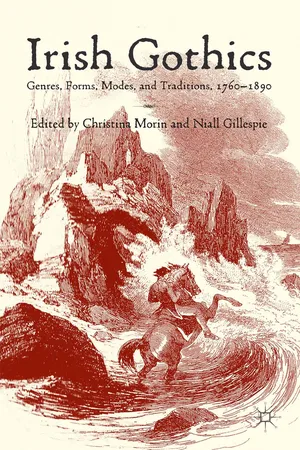
Irish Gothics
Genres, Forms, Modes, and Traditions, 1760-1890
- English
- ePUB (mobile friendly)
- Available on iOS & Android
eBook - ePub
About this book
Scholarly interest in 'the Irish Gothic' has grown at a rapid pace in recent years, but the debate over exactly what constitutes this body of literature remains far from settled. This collection of essays explores the rich complexities of the literary gothic in eighteenth- and nineteenth-century Ireland.
Information
1
Theorizing ‘Gothic’ in Eighteenth-Century Ireland
Christina Morin
I perceive you have no idea what Gothic is.1
Irish gothic literature has inspired widespread interest and heated debate in recent years. Much of the scholarly work devoted to the subject has focused primarily on two questions: is there such a thing as an Irish gothic ‘tradition’, and, if so, what are its fundamental characteristics? The conventional answer has been that, if a unique Irish gothic literary tradition does, in fact, exist, it was produced by Anglo-Irish writers concerned with confronting the anxieties induced by their minority position in Ireland. What ties such disparate authors as Regina Maria Roche (c. 1764–1845), Maria Edgeworth (1768–1849), Charles Maturin (1780–1824), Sydney Owenson (c. 1783–1859), Joseph Sheridan Le Fanu (1814–73), Bram Stoker (1847–1912), and Oscar Wilde (1854–1900) together, it is argued, is their shared Protestant confessionalism and an attendant interest in ‘the burden of colonial history’, which expresses itself in their works via gothic themes, settings, and motifs.2 As Roy Foster has influentially argued, Irish gothic writers of the eighteenth and nineteenth centuries were motivated by fears surrounding their privileged position as members of the Anglo-Irish Ascendency. Their ‘occult preoccupations’, Foster contends, ‘mirror a sense of displacement, a loss of social and psychological integration, and an escapism motivated by the threat of a takeover by the Catholic middle classes’.3 Vera Kreilkamp similarly maintains that nineteenth-century Anglo-Irish writers harnessed the conventions of the gothic novel that had developed across Britain and Europe in the latter half of the eighteenth and the beginning of the nineteenth centuries in order to express ‘the reality of Anglo-Irish conditions’ in the period following Anglo-Irish Union (1801), when the Ascendancy was increasingly under threat by a growing Catholic middle class and an ongoing campaign for Catholic Emancipation.4
Recent scholarship, however, has begun to question the prevailing assumptions that have shaped our understanding of Irish gothic literature. Is it, in other words, an exclusively Protestant form that emerged in an atmosphere of continued angst over a process of marginalization inaugurated by the political disenfranchisement of Ireland’s Protestant parliament and exacerbated by a new Catholic social mobility? Answering resoundingly in the negative, Claire Connolly persuasively images the use of the gothic mode in Ireland in the 1820s as essentially cross-sectarian in nature. Rather than emblematize the anxious expression of Anglo-Irish fears, the gothic is, instead, in Connolly’s construction, the domain of Protestants and Catholics alike interested in portraying Ireland as ‘a place of densely textured and interlocking communities characterised by richly realised belief systems’.5 Connolly’s contentions extend, in a sense, the skepticism presented by Jarlath Killeen when he urges caution in the understanding of Irish gothic literature as a nineteenth-century Protestant response to the loss of power and status associated with Union and impending Catholic Emancipation. Instead, Killeen observes, ‘Irish Gothic has a longer history than the nineteenth century, longer, in other words, than the actual marginalization of Protestant interest in Ireland’.6 For Killeen, the roots of Irish gothic literature may be traced as far back as the mid-seventeenth century and be seen to encompass a wide variety of prose works by Sir John Temple (1600–77), William Molyneux (1656–98), Jonathan Swift (1667–1745), Edmund Burke (1729/30–97), Roche, and Edgeworth, amongst many others.7
Although Killeen’s focus remains on Anglo-Irish writers, his location of what he terms ‘a pre-Gothic aesthetic’ in Ireland in the long eighteenth century prompts us to rethink the ideological basis of later Irish gothic literature.8 Moreover, his attention to an extensive array of fiction and non-fiction invites a reconsideration of current understandings of the novel as the gothic literary form par excellence, though Killeen himself does not tease out the multi-generic nature of Irish gothic literary production. Instead, he suggests that seventeenth- and eighteenth-century works such as Temple’s The Irish Rebellion (1646), Swift’s A Modest Proposal (1729), and Burke’s A Philosophical Enquiry into the Origins of our Ideas of the Sublime and Beautiful (1757), simply laid the groundwork for ‘a discernible “Irish gothic” canon’ in the later nineteenth century. That this ‘canon’ is comprised, in Killeen’s arguments, solely by novels, including Maturin’s Melmoth the Wanderer (1820), Le Fanu’s Uncle Silas (1864), Wilde’s The Picture of Dorian Gray (1891), and Stoker’s Dracula (1897), lends apparent credence to the current critical tendency to define the literary gothic as almost wholly novelistic in nature. As Anne Williams rightly observes, ‘Out of long habit, the word “Gothic” seems most appropriately followed by the word “novel” ’. Robert Miles, for instance, defines ‘Gothic’ as ‘[a] strain of the novel’, and both David Punter and Jerrold Hogle describe the literary gothic as specifically fictional in nature.9 Working against this mono-generic notion of the so-called ‘Gothic novel’, this essay explores the emergence of gothic tropes in a cross-generic selection of often overlooked Irish texts, including Mary Delany’s unpublished 1759 short story, ‘Marianna’, Thomas Leland’s only novel, Longsword, Earl of Salisbury (1762), and Elizabeth Griffith’s Amana. A Dramatic Poem (1764). As it does so, it seeks to problematize the notable transition from, in Killeen’s formulation, a cross-generic ‘aesthetic’ to a mono-generic ‘tradition’ or ‘canon’ over the course of the eighteenth century, proposing instead an understanding of gothic literary production in Ireland, Britain, and Europe akin to that suggested by Timothy G. Jones when he writes, ‘Perhaps the Gothic is something which is done rather than something that simply is [ . . . ] My suggestion is that the Gothic is a cultural practice that is almost as institutionalised yet adaptable as activities such as “playing a game of football” or “going to church” ’.10
Jones’s notion of the gothic encourages us to view gothic literary production ‘not as a set form, nor as a static accumulation of texts and tropes, but as a historicized practice which is durable yet transposable: a habitus that orchestrates the generation of various texts and variant readings over the course of time’.11 Such a perception constructs gothic literary production as a specific kind of cultural activity, one that was inherently influenced by changing and evolving temporal and cultural conditions over the course of the eighteenth and nineteenth centuries. Moreover, it enforces the fact that gothic literary production is not now nor ever was restricted to a specific genre, an understanding that is, in any case, misleading, given the intrinsic generic instability of the late eighteenth and early nineteenth centuries.12 The texts analyzed here highlight the importance of thinking across generic boundaries when considering gothic literary production, showing eighteenth-century Irish gothic practice to be, above all else, the product of a particular mode of thinking about the past that filtered into all aspects of cultural production in eighteenth-century Britain and Ireland. In so doing, these works show the folly of thinking about ‘Irish Gothic’ as a specific ‘tradition’ or ‘canon’ precisely because they point to the ways in which Irish authors shared their cultural perception and, therefore, their practice of the gothic not only with each other, regardless of religious and ideological affinities, but also with their contemporaries in Britain, Europe, and further afield. These works, in other words, gesture towards a cosmopolitan conception of gothic literary production wherein questions of religious background, political affinity, geographical location, and literary genre become subsumed within an overarching cultural practice that fundamentally transcends the normative boundaries usually ascribed to ‘Gothic’ and ‘Irish Gothic’ literature.
Gothic, gothic, or Gothick? Exploring eighteenth-century conceptions
Current literary criticism more often than not adheres to the belief that ‘the gothic novel’ as a unique literary genre came into being in 1764 with the publication of Horace Walpole’s The Castle of Otranto. It is with this premise that most twentieth- and twenty-first-century discussions of gothic literature begin, with particular attention frequently paid to the apparently pioneering subtitle added to Otranto’s second edition – ‘A Gothic Story’. Yet, it is worth remembering that this putatively genre-founding subtitle was self-consciously chosen by Walpole not necessarily to underline the generic innovativeness of his text but playfully to engage with several oftentimes competing notions of the term ‘gothic’ then in dominance in the British popular imagination. That very few writers in Walpole’s wake adopted the terminology ‘gothic’ to describe their works is indicative of the manner in which contemporary perceptions of the term ‘gothic’ signified not generic novelty or specificity but a particular manner of viewing and relating to the past. Indeed, for eighteenth-century readers and writers the word ‘gothic’ was suggestive of the chronological and social evolution that had helped produce the modern British nation. Accordingly, throughout the eighteenth century, ‘Gothic’ – generally with a capital ‘G’ – was defined as ‘uncouth’ or ‘barbaric’ and was applied to the past as a way of indicating ‘a distant, non-specific, period of ignorance and superstition from which an increasingly civilized nation had triumphantly emerged’.13 At the same time, however, ‘Gothic’ also assumed a particular, and apparently contradictory, significance in the emergence of modern Britain.14 As Clare O’Halloran observes, recourse to the Gothic past provided one means by which British society could imagine an august political inheritance derived from a rather vague set of Germanic and Teutonic tribes, including the Anglo-Saxons, who, despite their barbarity, were seen as having given birth to modern British liberty.15 Reference to Britain’s Gothic political origins throughout the eighteenth century thus functioned as a method of critiquing current governmental policies and political trends. The so-called ‘noble Gothick Constitution’ thereby became a far-removed ‘fount of constitutional purity and political virtue from which the nation had become dangerously alienated’.16
In a related use of the term, architectural treatises propounded upon the link between architecture and Gothic liberty, endowing the Gothic, or broadly if only vaguely medieval, style with roots in the innate political nobility and virtue of the Gothic past. An instructive example of such symbolism occurs in Henry Fielding’s The History of Tom Jones (1749), as Barrett Kalter points out. In that novel, Squire Allworthy’s estate and, accordingly, the gentleman himself, are described in terms of their positively valued ‘Gothick’ character: ‘The Gothick stile of building could produce nothing nobler than Mr Allworthy’s house. There was an air of grandeur in it, that struck you with awe, and rival’d the beauties of the best Grecian architecture; and it was as commodious within, as venerable without’.17 As with other contemporary uses of the term ‘gothic’, however, Gothic architecture could also be contrastingly understood as inferior, especially in comparison to the classical style, against which it was linked to ‘lawlessness’ and ‘disorder’.18 In this schema, the Gothic architectural style was seen to suffer from the innate barbarity of its original, medieval setting in contrast to the civilization that produced its opposite, the classical style. Gothic architecture was therefore condemned in the early eighteenth century as ‘Dark, Melancholy and Monkish Piles . . . Mountains of Stone, Vast and Gygantic . . . but not Worthy the Name of Architecture’.19
At issue in these complementary but also internally contradictory understandings of the term ‘gothic’ – historical, political, and architectural – was a primal disconnect between past and present. In its signification of barbarity and pre-modernity, ‘gothic’ pointed to an Enlightenment distancing of the past that was key to eighteenth-century British modernity. Similarly if contradistinctively, in its connotation of the past as the ancient if dangerously far removed seedbed of political virtue and liberty, ‘gothic’ condemned the present as fatally devolved from its noble roots. These equally temporally minded contemporary understandings of the term ‘gothic’ poignantly highlight cultural concerns over historical transition in the period, anxieties that feed directly into eighteenth-century literature and tend to corroborate the view of gothic literary practice as, in Siobhá...
Table of contents
- Cover
- Title Page
- Copyright
- Contents
- List of Illustrations
- Acknowledgments
- Notes on the Contributors
- Introduction: De-Limiting the Irish Gothic
- 1. Theorizing ‘Gothic’ in Eighteenth-Century Ireland
- 2. The Irish Protestant Imaginary: the Cultural Contexts for the Gothic Chapbooks Published by Bennett Dugdale, 1800–5
- 3. Irish Jacobin Gothic, c. 1796–1825
- 4. Suffering Rebellion: Irish Gothic Fiction, 1799–1830
- 5. The Gothicization of Irish Folklore
- 6. Maturin’s Catholic Heirs: Expanding the Limits of Irish Gothic
- 7. J. S. Le Fanu, Gothic, and the Irish Periodical
- 8. ‘Whom We Name Not’: The House by the Churchyard and its Annotation
- 9. Muscling Up: Bram Stoker and Irish Masculinity in The Snake’s Pass
- 10. ‘The Old Far West and the New’: Bram Stoker, Race, and Manifest Destiny
- Index
Trusted by 375,005 students
Access to over 1.5 million titles for a fair monthly price.
Study more efficiently using our study tools.
Frequently asked questions
Yes, you can cancel anytime from the Subscription tab in your account settings on the Perlego website. Your subscription will stay active until the end of your current billing period. Learn how to cancel your subscription
No, books cannot be downloaded as external files, such as PDFs, for use outside of Perlego. However, you can download books within the Perlego app for offline reading on mobile or tablet. Learn how to download books offline
Perlego offers two plans: Essential and Complete
- Essential is ideal for learners and professionals who enjoy exploring a wide range of subjects. Access the Essential Library with 800,000+ trusted titles and best-sellers across business, personal growth, and the humanities. Includes unlimited reading time and Standard Read Aloud voice.
- Complete: Perfect for advanced learners and researchers needing full, unrestricted access. Unlock 1.5M+ books across hundreds of subjects, including academic and specialized titles. The Complete Plan also includes advanced features like Premium Read Aloud and Research Assistant.
We are an online textbook subscription service, where you can get access to an entire online library for less than the price of a single book per month. With over 1.5 million books across 990+ topics, we’ve got you covered! Learn about our mission
Look out for the read-aloud symbol on your next book to see if you can listen to it. The read-aloud tool reads text aloud for you, highlighting the text as it is being read. You can pause it, speed it up and slow it down. Learn more about Read Aloud
Yes! You can use the Perlego app on both iOS and Android devices to read anytime, anywhere — even offline. Perfect for commutes or when you’re on the go.
Please note we cannot support devices running on iOS 13 and Android 7 or earlier. Learn more about using the app
Please note we cannot support devices running on iOS 13 and Android 7 or earlier. Learn more about using the app
Yes, you can access Irish Gothics by Christina Morin,Niall Gillespie in PDF and/or ePUB format, as well as other popular books in Literature & Literature General. We have over 1.5 million books available in our catalogue for you to explore.