eBook - ePub
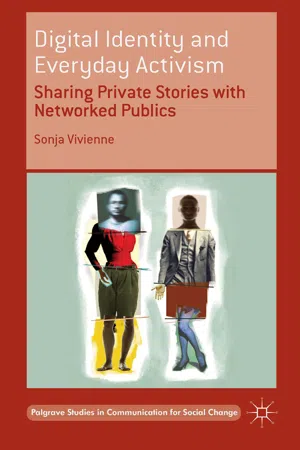
Digital Identity and Everyday Activism
Sharing Private Stories with Networked Publics
- English
- ePUB (mobile friendly)
- Available on iOS & Android
eBook - ePub
About this book
This book reinvigorates the space between scholarly texts on self-representation, voice and agency and practical field-guides to community media and digital storytelling. It offers reflection on the ethical praxis of co-creative media, and an indispensable suite of digitally savvy representation strategies, pertinent to modern people everywhere.
Information
1
Introduction
Access to and capacity for public self-representation have become markers of civic engagement and social wellbeing in Western democratic societies. Digital tools and platforms have extended opportunity for self-representation to many marginalised groups. Nevertheless, inequities persist. Barriers to social participation and adequate self-expression are similar to, but also different from, those experienced prior to widespread digitally mediated communication.
Digital storytelling is a workshop-based participatory media practice focussed on self-representation. In a variety of forms and over the last 25 years, it has come to play a substantial role in many development, empowerment and educative contexts. Meanwhile, everyday activists, including those campaigning for recognition of alternate family structures, same-sex marriage and non-normative gender representation, have seized upon the potential for digitally disseminated personal stories to catalyse various kinds of social change. This book uses the term ‘everyday activism’ – the sharing of personal stories in public spaces with the aim of challenging the status quo – as an expansion on existing definitions of organised, strategic and intentional activism. I contend that this domestic iteration of activism contributes to ‘erosive social change’: changes in attitude that take place slowly over extended time frames, profoundly reshaping social norms as they diffuse among networked publics. This kind of change can manifest in multiple forms and is therefore difficult to quantify or correlate with a specific cause.
Whereas previous scholarly work has focussed on digital storytelling as an institutionally mediated practice with limited distribution, I extend this research to consider individually motivated activist-oriented storytelling that actively engages with online distribution. Between 2009 and 2013, I worked with GLBTQIS storytellers and their advocates in three interwoven case studies that took place in Adelaide, Australia. What’s Your Story? and Positive Stories were digital storytelling initiatives that were supported by social service institutions SHine SA1 and ACSA,2 respectively. The third case study, Rainbow Family Tree, was and remains an independent online community of queer activist-oriented digital storytellers and their friends and family members. My engagement in all three case studies was as queer digital storyteller, workshop facilitator, web curator and researcher. All three case studies experimented with different forms of online and face-to-face practice over extended time frames. Over a three-and-a-half-year period, I adopted the role of ‘observant participant’ of storyteller practice and online participation. I conducted in-depth semi-structured interviews, questionnaires and a focus group with a small group of 25 participants. I analysed a total of 33 digital stories and scrutinise 24 in this book.
I describe case studies by privileging the experiences of storytellers and the stories they produce. As a means of allowing the research story to unfold I start first with a micro examination of individual experiences of co-creating queer identity, pulling out to a meso analysis of both personal and institutional processes of mediating voice, before considering the macro landscape of imagined networked publics. This might be regarded as a movement from considerations of ‘me’, on to ‘us’, and finally through to ‘me, us and the world’. I interweave descriptions of story content and/or process with theory throughout and use sub-headings to highlight thematic concerns.
Queer3 identity stories are of particular research interest because they are shared in potentially hostile environments and invoke a need for privacy. Further, the very definitions of these collective identities are in flux. Despite fears of homophobic or transphobic ramifications (for themselves, their friends and their family members), queer digital storytellers co-create new, increasingly complex identities with a variety of networked publics that they consider themselves to be a part of and/or apart from. In the hope of generating empathy and eventually greater social acceptance, storytellers speak and listen across differences between face-to-face and online publics, both real and imagined. My participants engaged in specific pre-production, production and distribution practices as a means of maintaining a degree of control over privacy and publicness. I identify three textual approaches (visible, bounded and pseudonymous) and three modes of sharing (targeted, ad hoc and proxy) and characterise these in a typology of outness and otherness.
In this book, I argue that this attenuated approach to privacy and publicness constitutes a sophisticated form of digitally mediated civic engagement. On a broader social canvas, these strategies for self-representation can also be mapped back to identity management practices undertaken by a broader population across a range of social and networked media. In the final chapters of the book I consider how what I have come to call Intimate Citizenship 3.0 stakes out new territory in participatory culture for everyone, including the most socially at-risk identities.
While it is difficult to evaluate the extent to which the everyday activism of the storytellers I work with achieves the social change they hope for, the capacity for Intimate Citizenship 3.0 to generate ripples in the pond of cultural renewal nevertheless emerges with clarity. In conclusion, this book offers support for the notion that, despite numerous obstacles, the cumulative influence of diverse voices dispersed among networked publics can provoke subtle and profound shifts in values, thereby constituting new cultural norms.
What is a digital story?
Digital stories are short (3–5 min) rich media autobiographical videos, combining personal photographs and/or artworks, narration and music. They are traditionally created in a workshop context that takes place over 3–4 days and includes a story circle, technical instruction and celebratory screening for fellow storytellers and invited guests. ‘Digital’ refers to the digital tools used by storytellers for production (computers, digital cameras, editing software, etc.) and in some cases the digital distribution mediums (ranging from DVD to the internet).
In colloquial usage, ‘digital storytelling’ can refer to blogs, vlogs, digital special effects, hypertext fiction and so on, but these are not my focus. In this book, I examine three stages of digital storytelling that I categorise as pre-production, production and distribution. ‘Pre-production’ refers to the frequently under-examined prerequisites to becoming a digital storyteller including the cultural capital and agency necessary to engage in storytelling. There must also be some affinity with workshop criteria that affords resonance between individual and group identity. ‘Production’ refers to all aspects of the production process, from assessing which story to tell and how to tell it, to, mastering digital tools and negotiating with the numerous friends and family who are implicitly part of the story as to how they will be represented. ‘Distribution’ refers to the processes storytellers undertake to distribute their stories to an audience, whether in a face-to-face theatrical screening or viral circulation via a variety of online platforms. Digital storytelling has been lauded as an exemplar of digital emancipation (Lambert, 2002; Meadows & Kidd, 2009). As a cultural form of self-expression, it parallels other forms of personal storytelling undertaken for social change including certain forms of public speaking (witnessing), life writing, blogging and autobiographical filmmaking.
Everyday activism and social change
Digital storytellers typically regard themselves as ‘ordinary people’,4 and apprentices in formal media production. Sometimes they are motivated to share their personal stories in public spaces in order to catalyse social change. I call the people in my case studies ‘everyday activists’ because they are not strategic or organised but are called upon in everyday life to use their personal stories in mundane environments to challenge social norms. They have varied political viewpoints, ideological beliefs and values. Like the ‘grassroots, non-party political activists’ in a case study by Chatterton and Pickerill, my research cohort ‘articulate(d) their engagement in political projects through messy, complex and multiple identities – always in the process of becoming and moving forward through experimentation and negotiation’ (Chatterton & Pickerill, 2010). Mansbridge and Flaster define everyday activists as individuals who ‘may not interact with the formal world of politics, but they take actions in their own lives to redress injustices’ (Mansbridge & Flaster, 2007, p. 627).
An anecdote helps illustrate everyday activism. A friend of mine was at the checkout at a major hardware chain buying sacks of heavy potting mix with her twin eight-year-old boys. The shop assistant exclaimed, ‘I hope Dad’s going to help you with these when you get home!’, to which one of the boys responded, ‘We don’t have a dad!’. The shop assistant looked embarrassed and the other boy announced proudly, ‘We’ve got two mums!’. The shop assistant squirmed and my friend said reassuringly, ‘It’s OK; we’re both quite strong’.
The social context in Australia in 2012 was one in which politicians, the religious right and general public hotly debated gay marriage and legal recognition of same-sex parents and partnerships. In the years in which I gathered data, I read many weekend newspaper editorials that debated whether being gay is a moral blight or something to tolerate. Online polls and ‘have your say’ spaces were filled with comments ranging from hateful and inflammatory to ‘what’s the problem, they’re normal, just like us!’. The GLBTQIS community is also riven by debates over who can be included among the ranks of ‘other’ and whether wanting to be ‘equal’ equates to wanting to be the ‘same’ as witnessed on mailing lists and newsgroups like ‘ausqueer’ (‘ausqueer: yahoo group’, 2012).
My aforementioned friend doesn’t have much interest in politics but is passionate about her kids’ right to attend school free of homophobic harassment and bullying. At times this brings her into conflict with the school and school community. She wants her kids to be proud of their family circumstances when other people may prefer that they be discreet. She feels duty-bound to model openness and pride despite the awkward social moments it sometimes generates. The family marches with the ‘Pink Parents’5 group in the annual pride march although, as her kids have gotten older, my friend has become increasingly concerned that they may be upset and shamed by the religious protests and homophobic commentators that often frequent the parade. She experiences conflict between wanting to protect her children while helping them be proud, engaged citizens of the world.
Foucault draws on ancient Greek and Roman literature to explore the concept of truth telling as ‘parrhesia’. He characterises parrhesia as ‘a verbal activity in which a speaker expresses his personal relationship to truth, and risks his life because he recognises truth telling as a duty to improve or help other people (as well as himself)’ (Foucault, 2001, p. 19). He outlines several critical qualities in the parrhesiastes. The message must constitute the speaker’s own opinion and be expressed in a fashion that makes no rhetorical effort to veil what he thinks. There must be an alignment between ‘belief’ and ‘truth’. While Foucault does not dwell upon ‘what is truth?’ (in the Cartesian sense) he imputes that the parrhesiastes, in speaking his personal truth in order to criticise someone or something more powerful than himself, takes a considerable personal risk and does so voluntarily, out of a sense of duty:
when a philosopher addresses himself to a sovereign, to a tyrant, and tells him that his tyranny is disturbing and unpleasant because tyranny is incompatible with justice, then the philosopher speaks the truth, believes he is speaking the truth and, more than that, also takes a risk … In parrhesia, the speaker uses his freedom and chooses frankness instead of persuasion, truth instead of falsehood or silence, the risk of death instead of life and security, criticism instead of flattery, and moral duty instead of self-interest and moral apathy.
(Foucault, 2001, pp. 16–20)
A substantial qualifier is present in Foucault’s description of parrhesia and follows in my definition of everyday activism. Foucault says: ‘the speaker uses his freedom and chooses’, thereby highlighting the prerequisite social agency that is central to activist-oriented self-expression.
The question of choice is also implicit in the previous anecdote when my friend, the lesbian mum, makes a choice as to whether she’ll correct the presumptions of the shop assistant. Like the parrhesiastes she elects ‘frankness instead of persuasion, truth instead of falsehood or silence’. While it is a choice it is nevertheless a limited one – as a parent she wishes her children to grow up proud of their family so she is impelled to model this behaviour in the face of powerful normative values that depict ‘family’ as heterosexual and nuclear. She responds to a social ‘injunction’ – defined by Riggs and Willing in research with lesbian mothers, as an ‘unreasonable’ expectation, ‘not of their making’, to live with and manage heteronormativity (Riggs & Willing, 2013, p. 7). In this way lesbian mums, like other everyday activists, are summoned by social norms that simultaneously limit their choices and freedom. In my case studies, while participants were often ‘called upon’ (sometimes by an institutional recruitment drive), their civic engagement was not diminished. Storytellers have many reasons for becoming involved in digital storytelling; however, they invariably describe a desire to ‘contribute in some way’ or ‘make a difference’.
Everyday activists speak their personal truths to socially legitimised power despite risk of significant ramifications. For digital storytellers the consequences of truth telling can include falling out with family members who don’t share their representation of family history. For socially maligned identities, consequences may be even more severe. An HIV-positive storyteller fears losing his job in a small rural community should his health status become public knowledge. Another storyteller fears that his nephews and nieces will be hassled at school. Transgender storytellers may not choose to share their biological history with everyone they meet. Parents of transgender children face tough choices between wanting to change the world their children are growing up in and needing to protect their privacy. Storytellers who are very concerned about privacy may simply choose to withhold personal information or share it only with people they know and can see (Hogan, 2010). However, the more personal the story, and the more revealing of unique idiosyncratic identity, the more vulnerable storytellers are to judgment. Despite this, many of my research participants speak of ‘becoming empowered’, or acquiring agency through digital storytelling that in turn facilitates further active civic engagement. The question of how storytellers maintain safety (ostensibly via carefully managed privacy) while harnessing the potentials of online communication (and a degree of publicness) is a central concern of this book.
While, for various reasons, my aforementioned friend has not made a digital story herself, the lesbian parents in this study (alongside other queer identities with divergent preferred nominalisations) seized the opportunity to amplify their everyday activism in digital story form. Unlike face-to-face everyday activism (that requires being ‘out’ or identifiable), the digitally mediated equivalent affords an opportunity to strike a balance between privacy and publicness; often perceived as safety and risk. For those who wish to preserve a level of pseudonymity, their digital stories stand in for them as proxies. Their archived and distributed stories have potential to reach many more people, and for a greater length of time, than their face-to-face exertions.
Nevertheless, the obstacles to adequate, congruent digitally mediated self-expression are many. These include: (1) social convergence of familiar and unknown publics, (2) insufficient social capital or technical aptitude and (3) everyday difficulties like time, money and emotional energy (Livingstone, 2005). When a storyteller is co-present with their audience, they can tweak their performance according to audience response, but mediating technologies – (from telephones to television to social media) – cause storytellers to imagine the audience’s responses. They consider ‘what will they think of me?’ and shape their stories in anticipation. They manipulate tone and pacing and emphasise turning points where underlying themes are overt or implicit. Online distribution also renders stories persistent and searchable (boyd, 2008a) to unintended audiences and publics that may simultaneously include family and strangers, friends and enemies.
Everyday activism is not a term that my participants typically used to describe themselves and few research participants thought of themselves as activists in the traditional sense:
I thought to be radical you had to [be] standing on the barricades or hanging huge screaming signs off the top of the Sydney opera house [sic].
(Sarah, private correspondence, 2011)
However, as we discussed daily social behaviour and motivations during workshops and interviews, some central themes emerged – many people calculated risks before engaging with social presumptions. They nevertheless favoured truthful, utilitarian and opportunistic responses, and simply managed th...
Table of contents
- Cover
- Title Page
- Copyright
- Contents
- List of Figures
- Foreword
- Preface and Acknowledgements
- 1. Introduction
- 2. The ‘Social’ in Storytelling
- 3. Identity: Nominalisation, Authenticity and Incoherence
- 4. Case Studies in Voice
- 5. The Private in Networked Publics
- 6. Provocations: Digital Storytelling ≠ Social Change
- 7. What Lessons to Bear Forth?
- Notes
- Bibliography
- Index
Trusted by 375,005 students
Access to over 1.5 million titles for a fair monthly price.
Study more efficiently using our study tools.
Frequently asked questions
Yes, you can cancel anytime from the Subscription tab in your account settings on the Perlego website. Your subscription will stay active until the end of your current billing period. Learn how to cancel your subscription
No, books cannot be downloaded as external files, such as PDFs, for use outside of Perlego. However, you can download books within the Perlego app for offline reading on mobile or tablet. Learn how to download books offline
Perlego offers two plans: Essential and Complete
- Essential is ideal for learners and professionals who enjoy exploring a wide range of subjects. Access the Essential Library with 800,000+ trusted titles and best-sellers across business, personal growth, and the humanities. Includes unlimited reading time and Standard Read Aloud voice.
- Complete: Perfect for advanced learners and researchers needing full, unrestricted access. Unlock 1.5M+ books across hundreds of subjects, including academic and specialized titles. The Complete Plan also includes advanced features like Premium Read Aloud and Research Assistant.
We are an online textbook subscription service, where you can get access to an entire online library for less than the price of a single book per month. With over 1.5 million books across 990+ topics, we’ve got you covered! Learn about our mission
Look out for the read-aloud symbol on your next book to see if you can listen to it. The read-aloud tool reads text aloud for you, highlighting the text as it is being read. You can pause it, speed it up and slow it down. Learn more about Read Aloud
Yes! You can use the Perlego app on both iOS and Android devices to read anytime, anywhere — even offline. Perfect for commutes or when you’re on the go.
Please note we cannot support devices running on iOS 13 and Android 7 or earlier. Learn more about using the app
Please note we cannot support devices running on iOS 13 and Android 7 or earlier. Learn more about using the app
Yes, you can access Digital Identity and Everyday Activism by Sonja Vivienne in PDF and/or ePUB format, as well as other popular books in Social Sciences & Literary Criticism. We have over 1.5 million books available in our catalogue for you to explore.