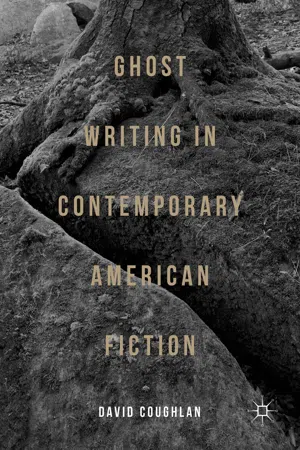
This book examines representations of the specter in American twentieth and twenty-first-century fiction. David Coughlan's innovative structure has chapters on Paul Auster, Don DeLillo, Toni Morrison, Marilynne Robinson, and Philip Roth alternating with shorter sections detailing the significance of the ghost in the philosophy of Jacques Derrida, particularly within the context of his 1993 text, Specters of Marx. Together, these accounts of phantoms, shadows, haunts, spirit, the death sentence, and hospitality provide a compelling theoretical context in which to read contemporary US literature. Ghost Writing in Contemporary American Fiction argues at every stage that there is no self, no relation to the other, no love, no home, no mourning, no future, no trace of life without the return of the specter—that is, without ghost writing.
- English
- ePUB (mobile friendly)
- Available on iOS & Android
eBook - ePub
Ghost Writing in Contemporary American Fiction
About this book
Information
© The Author(s) 2016
David CoughlanGhost Writing in Contemporary American Fiction10.1057/978-1-137-41024-5_11. Introduction: Of Spectrality
David Coughlan1
(1)
School of Culture and Communication, University of Limerick, Limerick, Ireland
“a specter is haunting the world—the specter of capitalism” (96): in Don DeLillo’s Cosmopolis (2003), these words appear on the electronic display of the stock and currency tickers fronting a Times Square tower normally occupied by an investment bank but here temporarily controlled by masked protestors who bomb the bank, release rats into the surrounding buildings, smash the windows of nearby stores, spray graffiti across advertisements, drop from the towers, struggle with riot police, get punched and gassed and arrested, set fire to cars and barricades, and mass violently around the limousine in which Eric Packer, DeLillo’s multibillionaire protagonist, rides untouched. The “head of Packer Capital” (92), he is one man in a sea of masked individuals who, like the crowds of DeLillo’s Mao II (1991), are “one body now, an undifferentiated mass” (3), and are all “the same, young people from fifty countries, immunized against the language of self” (8). He’s the other one, the different one, the named head to their faceless body, and yet “he’d like to be out there, mangling and smashing” (Cosmopolis 92), and then, somehow, he is. As he looks on, the words “a rat became the unit of currency” (96) appear on the ticker and Eric realizes that he and the protestors have been reading the same oppositional poetry, and can quote each other. 1 Suddenly, he’s a part of them, and feeling exhilarated, invulnerable, immortal even, he borrows yen in amounts that will ruin him. He sacrifices himself to the total life of the crowd because, as DeLillo famously writes in White Noise (1984), “To become a crowd is to keep out death. To break off from the crowd is to risk death as an individual, to face dying alone” (73). And then there is death, something “happening. […] There was a man on fire” (Cosmopolis 97). Everything is brought into question, and Eric wonders if any “culture is total” (90), any context total, when a thing so unassimilable, so “outside its reach” (100) can occur. His “chief of theory” (77) tells him that it’s not truly outside, “not original […]. It’s an appropriation” (100); Eric would argue against this, and yet his counterargument also rests on the reproducibility of the dead man’s experience: “Imagine him in bed, this morning, staring sideways at a wall, thinking his way toward the moment” (98–99), and “[i]magine the pain. Sit there and feel it” (100), rehearse it, and remember it, this other’s unthinkable death, there outside and yet in you. This scene, therefore, presents an inside and outside, same and different, self and other, life and death, but the specter of each is haunting each. “There is no outside” (90) that isn’t already inside, nothing present that isn’t already unsettled by absence, no life without death, and therefore no life, in the sense of a total living, a fully lived and present life. This is what this book, Ghost Writing in Contemporary American Fiction, addresses—a world in which there is only posthumous life, life after death, life following death, a living on, as the dead living, as ghosts.
A Specter Is Haunting
“A specter is haunting […]”: DeLillo’s revision of the first line from Friedrich Engels and Karl Marx’s The Manifesto of the Communist Party (1848) connects his novel to the key theoretical text in Ghost Writing in Contemporary American Fiction—namely, Jacques Derrida’s Specters of Marx (1994; Spectres de Marx [1993]). Derrida’s text is widely acknowledged to be the harbinger of, even “the catalyst for” (Blanco and Peeren, “Introduction” 2), what very quickly came to be referred to as the “spectral turn” in critical theory (Luckhurst, “Contemporary London Gothic” 527; Weinstock 4). Yet, though very many works have since been published on ghosts, and very few of them fail to touch on Derrida, I would argue that fewer still look to embrace him. 2 He is widely quoted (Specters of Marx is a very quotable book), but selectively so, as if he might be invoked without consequence, and thus kept at a distance from the real business of ghost studies. The first aim of this book, therefore, is to attempt to grasp what the ghost is for Derrida and to follow where it leads. But this is not easily done; it soon becomes apparent that, for Derrida, the question of the ghost is wide-ranging. 3
Illustrating this is the brief story that Derrida includes near the start of Specters of Marx (originally given as a two-part lecture), telling of how he arrived at its title. He says:
In this instance, Derrida is already staging something of the ghost for us. First, when he identifies the title that comes to him as something coming to him again, he recounts how the (word) “specter” always “begins by coming back” (11). This means it is difficult to speak of a true beginning or certain source, of the original title “Specters of Marx” (4), for example. There is no simple origin, therefore the name for the “specter” is always “specters.”More than a year ago, I had chosen to name the “specters” by their name starting with the title […] when, very recently, I reread The Manifesto of the Communist Party. I confess it to my shame: I had not done so for decades […]. Now, of course, I have just discovered, in truth I have just remembered what must have been haunting my memory: the first noun of the Manifesto, and this time in the singular, is “specter”: “A specter is haunting Europe—the specter of communism.” (4)
Second, in the projected name that turns out to be an unrecalled citation, he shows that, where specters are concerned, time is not straightforward: “What seems to be […] the future, comes back […] from the past” (10). This actually follows from the observation that the specter begins by coming back, and from the realization that the specter therefore, as revenant, always “comes by coming back” (10), so that every future appearance is a reappearance, and every arrival is a return. For the ghost, the future will have been the past, and “[w]hat has not yet taken place therefore must have happened already” (Derrida, “Pa ce Not(s)” 59). 4 This remarkable statement is something to which we will come back.
Third, in this account, Derrida’s “Specter’s of Marx” is already the “specter” of Marx, and he is just repeating Marx’s word, or rewriting Marx or writing in his place, in his stead. In a sense, he is ghostwriting, doing the creative work of naming the “specters,” but then having to credit Marx as if the name were his. 5 Derrida tells what appears to be Marx’s story. Or, alternatively, Marx is the ghostwriter, the one who secretly (because forgotten) does the work that the other would present as his own. Again, it is hard to identify the source of the “specter” that joins these two men separated by time and memory. But what this means is that my words are never mine alone but are always haunted by the other and open to being reworked by the other. This is why Derrida concludes Specters of Marx with a reference to “when one speaks there in a foreign language” (176) and why he says “[o]ne never writes either in one’s own language or in a foreign language” (“Border Lines” 127). I can never write my own story but nor can I write the other’s story, the foreigner’s story. 6 This is the problem that faces all the writers, all the ghostwriters discussed in this book because the words they use to tell others’ stories are never simply the other’s words.
Fourth, and related to the consideration just raised, there is the question of one’s responsibility to the other, and of doing justice to the other. Derrida’s small admission that he has neglected his Marx—that to his shame, he has not been rereading him—may be about what he sees as a critical or intellectual lapse, but it also gestures to the larger issue of his duty to the person of Marx. What is forgotten along with the “specter”? To forget a word might mean to forget an individual, an idea, a culture, a politics, an ideology, an environment, a civilization, or communism, for example. But, as Derrida tells, these things haunt and can be remembered, recalled, mourned, or even revived. They can survive and live on. Later in Specters of Marx, therefore, he speaks of “a justice which, beyond right or law, rises up in the very respect owed to whoever is not, no longer or not yet, living, presently living” (97), a justice owed yet to the dead and the unborn.
But, fifth, when Derrida mentions that he has just remembered what must have been haunting his memory, he presents himself as someone not entirely present to himself. Until he has just remembered, he is haunted by something he remembers no longer or not yet, so that not present thing is somehow unsettling his comfortably inhabited present moment, his here and now which he realizes, too late, was a haunted home all along. This is the lesson that is least palatable to scholars, and especially scholars of ghosts: when Derrida speaks of “whoever is not,” he does not speak only of the dead and unborn, he means you and me, and when he speaks of “whoever is not […] presently living,” he means you and me because we are, none of us, simply present, simply living. I am a “ghost whose expected return repeats itself, again and again” (Specters of Marx 10), and so are you. We are (all of us) ghosts. 7
What Is a Ghost?
To speak to the ghost, therefore, is to speak to origins, time, others, justice, and the self. We have obviously moved away from what the Oxford English Dictionary identifies as the “prevailing sense” of the word ghost as the “soul of a deceased person, spoken of as appearing in a visible form, or otherwise manifesting its presence, to the living.” In fact, this is one definition of ghosts that we should absolutely disregard, if we take it to mean the ghost is crossing from death to life, or returning from beyond this living world. There is no life after death that is not of this world. Nothing reaches the dead, or comes from the dead, and there is nowhere outside of this world, no other world where the dead can be. There is no other world but the world of the other that is lost, and lost utterly, when someone dies. His painful awareness of this is apparent in much of the work of Derrida who, as Nicholas Royle states, “doesn’t believe in an afterlife: ‘I do not believe that one lives on post-mortem’,” he says (Jacques Derrida 7), and therefore he does not believe in ghosts as the literal return of the dead. Except, he does believe in ghosts as the literal return of the dead, if by that, we mean he believes in ghosts as the inscription or reinscription of the dead in the world, as a tracing of the remains of the dead in the world, or as a ghost writing (he believes in the return of spirit as “spirit”). And, in fact, he believes in another of the OED’s definitions of the ghost, “or spirit, as the principle of life,” or of living.
To think of the ghost as the principle of life seems a strange definition of both life and the ghost. But perhaps what is becoming apparent is that the ghost is difficult to define because it has so much to do with definition, with identifying the limits of what something or someone is and is not, of when and where they are, of who they are. The ghost appears as something at odds with limits, this thing that is both living and dead, that is neither living nor dead, that is past and is not past but to come, that looks like a dead father, or husband, or daughter, and therefore the question of definition appears with it: “What art thou […]?” (Shakespeare, Hamlet 1.1.45) asks the scholar Horatio of the ghost that he does not want to be a ghost. Because, a definition is also a conjuration, meaning that, as Derrida describes, it both brings “forth with the voice, […] makes come, by definition, what is not there at the present moment” (Specters of Marx 41) and “means also to exorcise” (48), “to conjure (away) the ghosts” (47). In other words, the definition works exactly to unghost the ghost, to call forth the life from this living thing, to erase death from this not dead thing; or, from what is too easily considered the other side, to embrace the death of this dead thing, and smother the life of this not living thing. Calling to the ghost to identify it(self), we want only to exorcise its ghostliness, to name it in relation to a certain life and a certain death. We want only to admit it as something that has crossed the line dividing death to life, crossed from outside to inside, when in truth, the ghost remains between. And, moreover, it is not settling in between the defined limits of life and death, not hunkering down between the absolute presence of life and the absolute absence of death; no, rather, it is the stubborn between-ness of the ghost which even gives us to speak of life as such, of death as such. Such things derive from the ghost, which is “[n]either in life nor in death alone. What happens between two, and between all the ‘two’s’ one likes, such as between life and death, can only maintain itself with some ghost, can only talk with or about some ghost” (xviii). 8
Conjuration, therefore, works to fix “all the ‘two’s’,” like original and copy, or presence and absence, or life and death, or immediate and delayed, or speech and writing, or to fix what is and is not, so that speech is of the original, presence, life, the immediate, while “‘writing’ implies repetition, absence, risk of loss, death” (Bennington 49) and so must be cast out. But Derrida would like not to abide by this conjuration, this swearing together, but to attend to the “contradictory injunction” from “the one who orders ‘swear’,” the one who enjoins us to speak on what is to be or not to be, the ghost (Derrida, Specters of Marx 7). Derrida, therefore, is not an exorcist but a medium, letting the ghost speak of the medium, of the between which means the original is haunted by the copy, and the immediate haunted by the delay. After Derrida, for example, we cannot refer to the opposition of speech and writing outside the logic of supplementarity, within which we “are prey to the ghostly power of the supplement; it is the unlocatable site that gives rise to the specter” (Derrida, Work of Mourning 41). 9 We understand that “binary thought depends more or less secretly on the terms it subordinates in its foundational oppositions. […] What one tries to keep outside inhabits the inside and there would be no...
Table of contents
- Cover
- Frontmatter
- 1. Introduction: Of Spectrality
- Ghost Writing
- 2. Mimes and Phantoms: Don DeLillo
- Shadows
- 3. One Pace After the Other: Paul Auster
- Haunts
- 4. Exit Ghost Writer: Philip Roth
- Of “Spirit”
- 5. Passing Through: Marilynne Robinson
- Death Sentence
- 6. Gone Sometime. Home to Stay: Marilynne Robinson
- Ghostpitality
- 7. Haunted Homes: Toni Morrison
- Backmatter
Trusted by 375,005 students
Access to over 1.5 million titles for a fair monthly price.
Study more efficiently using our study tools.
Frequently asked questions
Yes, you can cancel anytime from the Subscription tab in your account settings on the Perlego website. Your subscription will stay active until the end of your current billing period. Learn how to cancel your subscription
No, books cannot be downloaded as external files, such as PDFs, for use outside of Perlego. However, you can download books within the Perlego app for offline reading on mobile or tablet. Learn how to download books offline
Perlego offers two plans: Essential and Complete
- Essential is ideal for learners and professionals who enjoy exploring a wide range of subjects. Access the Essential Library with 800,000+ trusted titles and best-sellers across business, personal growth, and the humanities. Includes unlimited reading time and Standard Read Aloud voice.
- Complete: Perfect for advanced learners and researchers needing full, unrestricted access. Unlock 1.5M+ books across hundreds of subjects, including academic and specialized titles. The Complete Plan also includes advanced features like Premium Read Aloud and Research Assistant.
We are an online textbook subscription service, where you can get access to an entire online library for less than the price of a single book per month. With over 1.5 million books across 990+ topics, we’ve got you covered! Learn about our mission
Look out for the read-aloud symbol on your next book to see if you can listen to it. The read-aloud tool reads text aloud for you, highlighting the text as it is being read. You can pause it, speed it up and slow it down. Learn more about Read Aloud
Yes! You can use the Perlego app on both iOS and Android devices to read anytime, anywhere — even offline. Perfect for commutes or when you’re on the go.
Please note we cannot support devices running on iOS 13 and Android 7 or earlier. Learn more about using the app
Please note we cannot support devices running on iOS 13 and Android 7 or earlier. Learn more about using the app
Yes, you can access Ghost Writing in Contemporary American Fiction by David Coughlan in PDF and/or ePUB format, as well as other popular books in Literature & Literature General. We have over 1.5 million books available in our catalogue for you to explore.