eBook - ePub
Global Perspectives on Women in Combat Sports
Women Warriors around the World
- English
- ePUB (mobile friendly)
- Available on iOS & Android
eBook - ePub
Global Perspectives on Women in Combat Sports
Women Warriors around the World
About this book
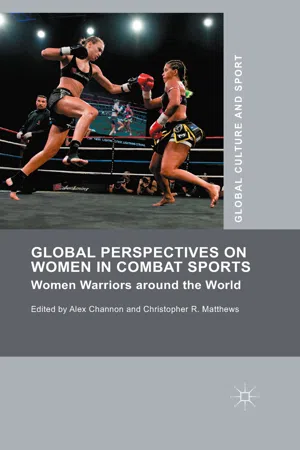
This volume offers a wide-reaching overview of current academic research on women's participation in combat sports within a range of different national and trans-national contexts, detailing many of the struggles and opportunities experienced by women at various levels of engagement within sports such as boxing, wrestling, and mixed martial arts.
Information
Topic
Sciences socialesSubtopic
Féminisme et théorie féministe1
Approaching the Gendered Phenomenon of ‘Women Warriors’
Alex Channon and Christopher R. Matthews
Introduction: Why write of ‘women warriors’?
Our initial motivation for producing Global Perspectives on Women in Combat Sports: Women Warriors around the World began several years ago when, as PhD candidates studying together at Loughborough University, UK, we developed a shared interest in combat sports through our separate but related research projects. Christopher’s work, involving an ethnographic study of a working class, predominantly male boxing club, and Alex’s, which explored the phenomenon of mixed-sex training in a range of martial arts schools, fuelled many discussions between us on the sociological richness of these activities. Topics such as the contentious definition of ‘violence’, the emotional landscape of training to fight, the social class characteristics of participants in different clubs and schools and the complex relationship between ethnicity and authenticity in the martial arts occupied many of our debates. However, the most salient issue for both of us, and that which we returned to with the greatest regularity, was the manner in which gender was constructed, portrayed and lived out within these activities. Indeed, both our doctoral theses and subsequent publications were eventually based on analyses of the gendered behaviour of practitioners within such settings, and these marked the beginning of our academic careers as scholars in this particular field (e.g. Channon, 2012a, 2012b, 2013a; Matthews, 2012, 2014).
We were fortunate enough to be doing such research at a time when what might reasonably be described as the traditional association between combat sports and male exclusivity would be challenged in some fairly important and highly visible ways, beyond the immediate confines of our studies’ empirical foci. Firstly, in 2009, the International Olympic Committee approved the inclusion of women’s boxing for the Olympic programme; the following Summer Games, in London in 2012, saw the 116-year history of women’s exclusion from the Summer Olympic sports programme finally end, with female pugilists entering the boxing ring as competitors for the first time. The first gold medal to be awarded to a female boxer went to the United Kingdom’s Nicola Adams – a previously unheard-of athlete who would instantly become one of the most celebrated stars of the Games in her home nation and who continues to be a recognisable figure in mainstream British media today. Also in 2012, the Ultimate Fighting Championship (UFC) – the world’s premier mixed martial arts (MMA) promotion – signed its first female competitor: the former Olympic judo bronze medallist and undefeated Strikeforce MMA champion, Ronda Rousey. Rousey’s victory in the first ever women’s fight in the UFC, in February 2013 against former US marine Liz Carmouche (which headlined that night’s pay-per-view event) – along with her subsequent feud with arch-rival Meisha Tate – saw Rousey’s star rise significantly in the MMA world and beyond, drawing much attention to the fact that women were now competing at the highest level in a sport often seen as synonymous with male exclusivity and orthodox narrations of manhood.
In the light of these high-profile accomplishments, it is arguably the case that the 2012–13 period will be seen in years to come as something of a watershed moment in the development of women’s combat sports. While women have been actively training and competing in boxing and MMA for many years prior to this time (not to mention a vast range of other fighting disciplines – see Jennings, 2015), the events of 2012–13 represented a significant step towards the mainstreaming of their involvement in some of the highest profile combat sport competitions in the world. As Woodward (2014) describes, these developments effectively brought women’s combat sports ‘into discourse’, seeing them legitimated and validated as part of the cultural landscape of contemporary sport through their overt construction as something serious, exciting and worthy of wide public attention and mediated consumption.
Within such a context, it is perhaps unsurprising that scholarly interest in this phenomenon has expanded significantly over recent years. Indeed, within the United Kingdom alone, we are joined in our interest in the sociological study of women’s combat sports by several others, including doctoral students, early career researchers and senior academics presently or recently engaged in researching this topic (e.g. Allen-Collinson and Owton, 2014; Dunn, 2013; Lindner, 2012; Maclean, 2013; Mierzwinski et al., 2014; Phipps, 2013; Vaittinen, 2013; Velija et al., 2013; Woodward, 2014) – some of whom we have had the good fortune of collaborating with in both this and other recent efforts. In addition, and as this volume reveals, there are many others currently or recently having worked on similar projects around the world (e.g. Boddy, 2014; Heiskanen, 2012; Jennings, 2015; Kavoura et al., 2014; McNaughton, 2012; Paradis, 2012; Smith, 2014; Trimbur, 2013; van Ingen and Kovacs, 2012), such that this relatively small area of the wider sporting landscape has become something of a hot topic for, in particular, contemporary social and historical research on sport.
Building on an already strong foundation of work conducted throughout the past three decades, mostly by feminist researchers (see reviews by Channon and Jennings, 2014; Follo, 2012), this recent explosion of interest led to the decision to produce this present volume, intended to engage with the broad attention that women’s participation in combat sports has generated both within and outside of academia. It is our hope that this book will become a useful resource for students and scholars who share an enthusiasm for the subject area, and will also help generate future interest in furthering our collective understanding of this phenomenon. In this respect, when trying to grasp the contemporary significance of women’s increasingly visible presence in these cultural spaces, many scholars have, like us, grounded their analyses as explicit studies of gender. While not all of the chapters in this present volume centralise gender as such, this remains a vital thematic concern for the text as a whole, and it arguably constitutes the primary entry point for social scientific (and other) approaches to making sense of the phenomena surrounding contemporary ‘women warriors’. It is to this theoretical concern that we now turn.
Gender, women and combat sports: Some theoretical considerations
Broadly defining what is meant by the term ‘gender’, in its academic sense rather than how it may typically be used in everyday parlance, requires significantly more space than we are able to afford within the confines of this introductory chapter. Indeed, comprehensive discussions of what gender is, how and where it exists and how it shapes our social lives tend to require entire textbooks of their own – for some excellent, recent examples, see Bradley (2013), Connell (2009) and Ryle (2015). For the purposes of our present effort though, a brief outline of how we define and use this vitally important sociological concept remains necessary. For readers interested in exploring further the issues that follow, we locate our position within a pro-feminist, social constructionist approach to gender, well-articulated in the texts mentioned above as well as other works from, in particular, Connell (1987, 1995), Hearn and Morgan (1990), Lorber (1993, 2000), West and Fenstermaker (1995) and West and Zimmerman (1987, 2009).
Two fundamental points concern, firstly, the largely constructed nature of sex differences, and secondly, the implications which these differences have for individuals’ power chances. In the first regard, social constructionist theories tend to suggest that while ‘sex’ refers to biological differences between people’s bodies as they pertain to sexual reproduction (e.g. ‘male’ and ‘female’), ‘gender’ refers to the varied sets of social norms and practices which people with differently sexed bodies are typically expected to engage in within any given culture (e.g. ‘masculinities’ and ‘femininities’). Added to this, a third layer of differentiation, described by West and Zimmerman (1987) as ‘sex category’ (e.g. ‘men’ and ‘women’), refers to the social groups typically constituted by people based on their (assumed) sex – but importantly, made socially visible and meaningful by their gendered behaviour. That is, we tend to recognise and classify people as men or women based on their presentation of more-or-less masculine or feminine selves within a culturally accepted, gendered system of signification, rather than actual knowledge of their biological reproductive capacities.
In this respect, socially learned and culturally specific performances of gender enable social ‘men’ and ‘women’ to exist as such, meaning that the basis of sex categorisation as a social phenomenon is fundamentally dependent upon cultural practices for its generation and maintenance. While discourses surrounding essential ‘biological differences’ between men and women play an important role in making sense of sex, these effects are often largely overstated – a phenomenon which is also an effect of culture (Lorber, 1993; Matthews, 2014). In other words, from what Ryle (2015) describes as a ‘strong social constructionist’ position, cultural norms have a greater part to play in constituting social sex groups than do the absolute limitations of male or female biology, and this has important consequences regarding gendered individuals’ agency and destiny within hierarchically organised societies.
Indeed, this reasoning takes on great relevance when a second important aspect of this phenomenon is considered: the power relations which arise out of sex category differences. It is widely recognised that social constructions of masculinity and femininity, and by extension the normative expectations surrounding men’s and women’s lives, are very often arranged in binary – that is, two-sided and oppositional – relationships (e.g. Bourdieu, 2001; Connell, 1987; Lorber, 1996; Weedon, 1999). Further, and more often than not, the binaries constitutive of sex and gender difference are hierarchal in nature, wherein qualities associated with men and masculinity are almost always more socially valued than their counterparts associated with women and femininity. At a theoretical level, this pertains to the general association of qualities such as physical strength, rationality, autonomy, leadership and similar characteristics with masculinity; and physical frailty, emotionality, dependence, subservience and other such qualities with femininity. Indeed, the binaries which often constitute sex and gender difference tend to be reducible to the broad construction of men and masculinity as being relatively more important and powerful than women and femininity, such that ‘doing’ gender in these ways generates social hierarchies which broadly privilege men at the expense of women (Bourdieu, 2001; Bradley, 2013; Connell, 1987, 1995).
Such hierarchal formations of gender are evident in many aspects of culture – such as gender-typing occupations, pay differences, the division of household responsibilities, political representation and so on – but for the purposes of this chapter, their relation to the body is perhaps most significant. For instance, it can be seen at play in the fashions which men and women are expected to wear. Heteronormative exemplars of mainstream Western women’s clothing and body adornments typically restrict the body’s motion (e.g. high heels) while revealing or accentuating its (hetero)sexual attractiveness (e.g. ‘fitted’ clothing, makeup) and suggesting sexual access (e.g. miniskirts). Meanwhile, men’s fashions in the same context (e.g. suits) rarely display or sexualise the body to the same extent, nor are they nearly as restrictive of movement, leaving the ‘masculine’ dresser less likely to be the object of others’ sexualising gaze, while being freer and more comfortable to move around and take possession of space.
This gender hierarchy becomes more explicitly embodied when men and women work upon and use their bodies in ways which are structured by codes of masculinity and femininity, respectively. Here, men (and boys) are expected and encouraged to practise activities, such as various sports or types of weight training, which lead to the development of their bodies’ strength, speed and various motor skill competences, while generally favouring a lean and muscular appearance. This helps partly explain the long-term cultural association between various athletic disciplines and certain forms of masculinity, along with the concurrent over-representation of, and disproportionate cultural rewards provided to, men within most professional sports. Meanwhile, women (and girls) are generally expected to work on their bodies in ways which limit the development of physical strength – especially its outward appearance through excessive musculature, a potent cultural signifier of both power and manhood. This phenomenon, in turn, partly explains the widespread tendency for girls to ‘drop out’ of sporting activities during their teenage years (e.g. Evans, 2006; Women’s Sports Foundation, 2011). The differential socialisation of boys and girls surrounding the culturally ‘appropriate’ use of the body then works to produce sexual disparity in physical appearances, attributes and skills. Thus, insults such as ‘you throw like a girl’ make sense as derogatory statements thanks to prevailing cultural formations which amount to the physical downsizing and de-skilling of girls and women relative to boys and men (cf. Roth and Basow, 2004; Young, 1980).
Combining such reasoning with the assertion that sex category differences are constituted and maintained by gender rather than being the ‘natural’ consequence of sex is to recognise that such arrangements, although they may have the appearance of naturalness given their social commonality and close association with the biological bodies of women and men, are not fixed or inevitable (Lorber, 1993; Matthews, 2014). Indeed, if they have been created and maintained by the gender arrangements of society, then they can be altered by arranging society and its gender norms differently. It is with this important principle in mind that analyses of gender within Sport Studies typically begin, as scholars recognise the crucial role that various sporting activities can play in the construction or, indeed, reconstruction of gender at the symbolically important level of the body.1
Gender subversion in women’s combat sports
With respect to this possibility of subverting sexual inequality, the notion that women’s participation in so-called masculine sports and related activities can challenge traditional sexual hierarchies, at both individual and broader cultural levels, has been forwarded by many scholars (e.g. Cahn, 1994; Hargreaves, 1994; McCaughey, 1997; Roth and Basow, 2004; Theberge, 2000; Thing, 2001). This position draws on the typically ‘gender-transgressive’ nature of participation, which is arguably the most immediately salient issue in analysing the phenomenon of women’s sport within contemporary cultural milieu in many countries around the world. In its most concise and simplified form, this argument centres on women’s development of athletic skills and cultivation of strong, tough, performance-ready bodies as an appropriation of what are assumed to be naturally and exclusively ‘male’ competencies. As women develop such embodied abilities and qualities, they not only depart from normative, subordinating constructions of femininity and the female body, but also trouble the exclusive and naturalised association between men, the male body and those qualities culturally recognised as constituting masculinity. Revealing by example the socio-cultural roots of sex differentiation as established through gender performance, they problematise the hierarchal power relations at least partially built on such bases.
While these arguments have long been made with respect to women in sport more broadly, their impact is amplified when the subject of discussion becomes those activities which most closely approximate the ability to exert physical domination over others – a key component of what might be considered to symbolically constitute ‘hegemonic’2 forms of masculinity (Connell, 1995; Messner, 1990, 2002), and something which we argue is a vital element of many (if not most) combat-based sports. In this respect, not only do the bodily capacities of women fighters trouble enduring myths of ‘natural’ female frailty and passivity (cf. Dowling, 2000), nor simply do they depart from the normative construction of women as vulnerable to and thus dependent upon men for protection (McCaughey, 1997), they also signify women’s occupation of one of the few remaining social enclaves largely reserved for men (at least, in Western countries), for the purposes of reifying male power, in societies where ‘dramatic symbolic proof’ of male superiority (Messner, 1988, p. 200) has become increasingly difficult to come by. With these possibilities in mind, the social significance of women in combat sports is difficult to deny, and the study of how this phenomenon may instigate or facilitate challenges to sexual hierarchy becomes paramount.
However, to suggest that any iteration of women’s engagement in combat sports stands to transform or subvert inequitable gender relations is to oversimplify this phenomenon in a number of respects. Firstly, the manner in which sex constitutes an axis of power difference in contemporary societies is known to intersect with a variety of other phenomena in multiple ways – various formations of gender and sexuality work to mediate the power chances of men and women as men and women, while social class stratification, ethnicity, physical ability and other socio-demographic variables complicate any discussion of power differences across diverse populations. Such an ‘intersectional’ approach to understanding power, privilege and social hierarchy has become common practice within many academic approaches to understanding gender (e.g. Ryle, 2015; Weedon, 1999; West and Fenstermaker, 1995), and in the wider discussion of sport as a form of ‘empowerment’ for women, it is acknowledged that the women most likely to experience this are those who already occupy relatively privileged social positions (e.g. Hargreaves, 2000).
Addressing the gendered significance of women’s combat sports therefore requires that scholars consider more than the traditional sexual inequities constitutive of ‘patriarchy’; as important as these are, they alone cannot account for the full spectrum of power relations impinging upon (or potentially transformed through) the experiences or symbolic meaning of ‘women warriors’ (cf. Heiskanen, 2012; Mitra, 2009). For instance, a black woman boxer within a white-dominated, patriarchal society may confound normative conceptions of femininity through her fighting ability and toughness, but racialising discourses connecting ‘blackness’ with violence, and defining femininity around exclusively white-centred norms, may be used to reposition such a boxer in ways which reduce the subversive impact she might otherwise have had on wider structures of sexism, while also shoring up racist symbolism in the process.
Secondly, and extending from this first point, the specific cultural contexts within which women participate in combat sports complicate universalising claims as to the transformative value of their experience or involvement. While the collected studies represented within this volume illustrate a number of compelling similarities across varied national settings, the importance of cultural sensitivity in addressing questions of gender performance, sexual hierarchy and social change cannot be overstated. For instance, in an ostensibly liberal Western society such as the United Kingdom, where the legacy of successful feminist activism can be seen through women’s broad enfranchisement in public life along with the legal and political valorisation of sex equality, female boxers, such as Olympic champion Nicola Adams, may constitute important symbolic challenges to enduring forms of sexism. In other words, the cultural and political context of gender in the United Kingdom today generally makes for fertile ground for figures such as Adams to enter the public consciousness in potentially transformative/progressive ways (notwithstanding, of course, the possibility for racist/heterosexist interpretation – Adams is both black and openly bisexual, inviting varied responses to what she personally signifies vis-à-vis normative constructions of femininity).
However, the same cannot be easily inferred of women in nations where it is in fact sex inequality and segregation which are formalised, both within law and in orthodox visions of public morality. For instance, the 2012 Olympic judoka Wojdan Shaherkani, from Saudi Arabia, cannot be thought to bear the same meaning for Saudis as female judokas or other athletes might for Britons, despite the broadly celebratory tone struck in the Western press over her inclusion in London 2012 as one of the first ever female Saudi Olympians (e.g. Addley, 2012). For women from such divergent backgrounds, the experience of participating in combat sports is likely to be contoured by vastly different cultural forces, both within t...
Table of contents
- Cover
- Title Page
- Copyright
- Contents
- List of Figures and Tables
- Acknowledgements
- Notes on Contributors
- 1. Approaching the Gendered Phenomenon of ‘Women Warriors’
- Part I: Discursive Constructions and Mediated Representations of Women in Combat Sports
- Part II: Institutional Structures and Actors in Women’s Combat Sports
- Part III: Recreational Practice and Self-Defence
- Part IV: Competitive and Performative ‘Women Warriors’
- References
- Index
Trusted by 375,005 students
Access to over 1.5 million titles for a fair monthly price.
Study more efficiently using our study tools.
Frequently asked questions
Yes, you can cancel anytime from the Subscription tab in your account settings on the Perlego website. Your subscription will stay active until the end of your current billing period. Learn how to cancel your subscription
No, books cannot be downloaded as external files, such as PDFs, for use outside of Perlego. However, you can download books within the Perlego app for offline reading on mobile or tablet. Learn how to download books offline
Perlego offers two plans: Essential and Complete
- Essential is ideal for learners and professionals who enjoy exploring a wide range of subjects. Access the Essential Library with 800,000+ trusted titles and best-sellers across business, personal growth, and the humanities. Includes unlimited reading time and Standard Read Aloud voice.
- Complete: Perfect for advanced learners and researchers needing full, unrestricted access. Unlock 1.5M+ books across hundreds of subjects, including academic and specialized titles. The Complete Plan also includes advanced features like Premium Read Aloud and Research Assistant.
We are an online textbook subscription service, where you can get access to an entire online library for less than the price of a single book per month. With over 1.5 million books across 990+ topics, we’ve got you covered! Learn about our mission
Look out for the read-aloud symbol on your next book to see if you can listen to it. The read-aloud tool reads text aloud for you, highlighting the text as it is being read. You can pause it, speed it up and slow it down. Learn more about Read Aloud
Yes! You can use the Perlego app on both iOS and Android devices to read anytime, anywhere — even offline. Perfect for commutes or when you’re on the go.
Please note we cannot support devices running on iOS 13 and Android 7 or earlier. Learn more about using the app
Please note we cannot support devices running on iOS 13 and Android 7 or earlier. Learn more about using the app
Yes, you can access Global Perspectives on Women in Combat Sports by Christopher R. Matthews, Alex Channon, Christopher R. Matthews,Alex Channon in PDF and/or ePUB format, as well as other popular books in Sciences sociales & Féminisme et théorie féministe. We have over 1.5 million books available in our catalogue for you to explore.