- English
- ePUB (mobile friendly)
- Available on iOS & Android
eBook - ePub
About this book
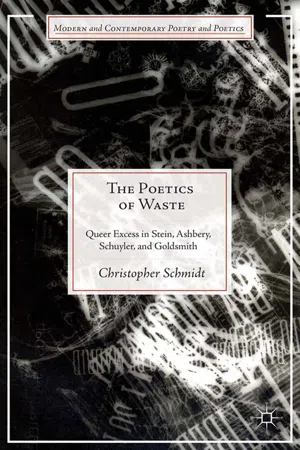
Modernist debates about waste - both aesthetic and economic - often express biases against gender and sexual errancy. The Poetics of Waste looks at writers and artists who resist this ideology and respond by developing an excessive poetics.
Information
CHAPTER 1
Industry and Excess in Gertrude Stein
“You are so full of a cow factory”
—Gertrude Stein, “A Sonatina
Followed by Another” (307)
Followed by Another” (307)
To understand the many conflicts circulating in and around Gertrude Stein’s waste management poetics, it may be useful to consider the testimony of an outside reporter. In 1927 William Carlos Williams visited Stein’s salon at 27 rue de Fleurus. Although his visit merits little more than a mention by Stein in The Autobiography of Alice B. Toklas (1933), Williams’s own account helps us see more clearly the affiliations and disaffiliations that would characterize modernism and its critical reception. It also makes legible the importance of waste for Stein’s writing economy and its defining role in schisms between Stein and other modernist writers. In The Autobiography of William Carlos Williams (1951), the writer recalls:
We looked at the paintings. Who could not have done so? It was one of the sights of Paris. Tea was served, after or during which Miss Stein went to the small cabinet, opened it and began to take out her manuscripts, one at a time, telling us the titles and saying that she hoped some day to see them printed. I can’t remember the exact sequence of what followed, but one way or another she asked me what I would do were the unpublished books mine and I were faced with the difficulty she was experiencing.
It must have been that I was in one of my more candid moods or that the cynical opinion of Pound and other of my friends about Miss Stein’s work was uppermost in my mind, for my reply was, “If they were mine, having so many, I should probably select what I thought were the best and throw the rest into the fire.”
The result of my remark was instantaneous. There was a shocked silence out of which I heard Miss Stein say, “No doubt. But then writing is not, of course, your métier.”
That closed the subject and we left soon after. (254)
Bracketing his unsympathetic reaction, Williams’s reportage allows us to see some instructive things about the “bewildering volume” of Stein’s literary output (“The Work” 57). Stein’s accumulated archive of unpublished manuscripts, her hope to make each and every production marketable, and her industry in producing yet more unpublishable works highlight important conflicts within Stein’s writing economy. Like the other writers I consider in this study, Stein occupies both the poles of conserver and waster. She is a regularly productive worker and manager—a proper Taylorist subject of the technological age—whose accumulated writings nevertheless embrace and at times occupy the status of waste. The excesses of Stein’s writing practice, which Williams suggested she burn, were ones that Stein wished to market, reflecting her investment in commodification, which many of her modernist contemporaries at least pretended to disdain.
This tense encounter between Stein and Williams also exemplifies their divergent aesthetic responses to economic pressures within the modernist period. While Stein and Williams possessed much in common,1 it was Williams’s work that would more easily fit with ascendant Taylorist principles of efficiency and waste reduction (as well as the needs of later anthologists for tidy lyric poems). Williams, like Pound, embraced a machinic model of efficiency for his poems, and in a more charitable treatment of Stein published elsewhere, even projects it onto her, noting that she uses “words as objects out of which you manufacture a little mechanism you call a poem” (In 69). This is not a complete mischaracterization, for Williams captures the material, object-like quality of Stein’s language. Yet Stein’s writing was rarely “little” in its mechanics, and she did not eliminate words to achieve a state of purity and efficiency (although she did employ a reduced vocabulary). Stein’s excessive, repetitive, and resolutely nonmetaphoric writings flout Pound’s Imagist directive to “include no words that do not contribute to the presentation.” The extraneous is Stein’s paradise.
By contrast, Williams’s own poetry of the period was often quite responsive to the tenets of the Efficiency Movement, as Cecelia Tichi argues in Shifting Gears: Technology, Literature, Culture in Modernist America (1996).2 Williams himself espouses aspects of modernist reductionism in his Spring and All (1923), arguing against “excrementa” and inefficiency, opining that an “essential vitality” will be “laid waste” by the use of “demoded words and shapes”—even as the book’s loose hybrid form, like that of Kora in Hell (1920), undermines his polemical disdain for waste (19).3 Stein meanwhile voices what might be termed the Poundian objection to her work in a passage from “American Biography and Why Waste It” (1928), composed around the time of Williams’s visit: “They murmured about excess not about excess not about exceeding their limit. They murmured about success. Be brief” (265).4 While a “brief” lyric might have received a more welcoming reception on the market, the often excessive length of Stein’s works, replete with repetitions and indeterminacies, make evident her stubborn, paradoxical investment in producing waste—not least the waste of language itself, in the slippage of signifier and signified to create a remainder.5
Williams isn’t the only reader to suppose a technological impulse in Stein’s poetry. Tichi also suggests that critics attend to the machinic orientation of Stein’s writing, as it has guided discussion of Williams (284). Various critics have addressed the influence of specific technologies on Stein’s work, a list that includes Susan McCabe and Sarah Bay-Cheng on Stein’s use of the cinema; Barrett Watten on the automobile; and Joan Retallack and Steven Meyer on Stein’s involvement as a student at Harvard Annex with “Cultivated Motor Automatism,” which would lead B. F. Skinner to dismiss Stein’s writing as automatic in his Atlantic Monthly article, “Has Gertrude Stein a Secret?” (1934). Stein however emphatically rebuts Skinner’s charge of automatism, and the terms of her rebuttal are telling. In a letter to Ellery Sedgwick, the editor of The Atlantic Monthly, Stein replies, “No it is not so automatic as he thinks . . . If there is anything secret it is the other way . . . I think I achieve by xtra consciousness, excess” (qtd. in Meyer 227, emphasis added). While Stein did indeed respond to the machinic influence of Taylorism, she did so in a signally excessive manner, veering from the program of reduction and efficiency that Pound and Williams absorbed from Taylorist scientific management principles.
Instead, Stein’s radical response to Taylorist ideologies is to imagine the body itself as the ground for the era’s technological machinism, and to eroticize that body as mechanically productive. The following passage from a lesser known Stein work, “A Sonatina Followed by Another” (1921) exemplifies this tack:
You are so full of a cow factory. You manufacture cows by vows. The cows produce reduce reduce they reduce the produce. Cows are necessary after feeding. We are needing what we have after feeding. After feeding we find cows out. How are cows multiplied. By proper treatment. Thank you so much for being so explicit. (307)
In imagining the addressee of this passage as a “cow factory,” Stein conflates organic and machinic metaphors, as she does in the tender yet machinic buttons she presses in the poem of that name, Tender Buttons. While the title of the latter work is often interpreted as referring to the erogenous zones of Toklas’s body (les boutons tendres is slang for nipples in French), it may simultaneously refer to the buttons of a machine, as Kathryn Kent suggests (150–51). It is illuminating to envision this machine, like the factory figured above, as Toklas’s body, the buttons of which Stein pushes to produce pleasure, excrement, writing; the machine may also be the typewriter that enabled Toklas to become the manager of Stein’s own writing factory. This “cow factory” helps us visualize how the material conditions of Stein’s writing practice—her regular productivity, her installation of a kind of factory system in her home to produce and market her work, and her annexation of Toklas’s body as an extension of her own—reflect the imprint of dominant Taylorist ideologies on her writing practice.
Tracking the development of the “cow” across Stein’s writing opens up a window into the queer dimensions of Stein’s obsession with Toklas’s digestive regularity, itself a remainder of the Taylorist diet regime called “Fletcherism.” Although Stein herself rejected restrictive diets, her work and life can be usefully understood through the prism of this digestive regime, a “time- and body-discipline” for “domestic management” that was highly prevalent in the culture of the time, as Sarah Blair argues (423). Stein’s “cow” reflects the imprint of Taylorist—and in particular, Fletcherist—regimes on household and bodily economies of waste management in 27 rue de Fleurus, functioning both as a symbol of a queer care for Toklas’s regularity, and as a psycho-sexual remainder of Stein’s detachment from patriarchal systems of order and regulation, embodied in the figure of her brother, Leo, who levied criticism and invective against Gertrude’s early writing.
“You Are So Full of a Cow Factory”
What is a “cow” and why its emergence so important to Stein’s literary project? There is no single answer to what Stein’s “cow” represents; such one-to-one decoding would betray Stein’s multiplicative poetics of excess. But the passage quoted above, from Stein’s “A Sonatina Followed by Another,” provides some context for understanding this particular textual riddle, as will later excursions into other Stein writing, including the love notes she wrote to Toklas (often ignored by Stein’s most serious critics), which are full of references to the “cow.”
It is not surprising that most critics have interpreted “cow,” which appears with remarkable frequency not just in Stein’s love notes but across her literary corpus, as a synonym for orgasm. The word often appears contiguous to celebrations of the female body and is at times incanted in a frenzy of clotted repetitions—“cow come out cow come out”—which poststructuralist critics like Marianne DeKoven have likened to a kind of textual, antipatriarchal jouissance.6 Dolores Klaich advances a more precise representational interpretation of the cow, suggesting that it and “Caesar,” which frequently appears in tandem with the cow, “clearly . . . make the most sense as symbols of parts of the particular parts of the body involved in the act of cunnilingus” before claiming that in “A Sonatina Followed by Another” the cow “would also seem to mean orgasm” (206). Similar readings have been advanced by Linda Simon, one of Stein and Toklas’s earliest critical biographers, and Ulla Dydo, Stein’s most scrupulous textual critic. Simon argues, “The cow makes sense best as the end product of their lovemaking” (316). Dydo writes, “Always it is Stein, the husband, who makes love to Toklas, the wife, which culminates in her having a cow, or orgasm (the verb to cow) also appears” (Language 28). McCabe likens the repetitive invocations of “cow come out” in “Emp Lace” to a “spasm” of “hyper-femininity,” one that mimics both “childbirth” and “orgasm” (92).
While Stein’s invocations of the cow express an erotic exuberance that makes orgasm a plausible reading in many pieces of writing, a closer look at the passage above reveals that many other contexts beyond the sexual are involved in this production of cows. A striking digestive motif (“After feeding we find cows out”) is intermingled with logics of production and efficiency (“You are so full of a cow factory”). The passage describes a literal incorporation of the scientific management system of Frederick Winslow Taylor that sought to “increase . . . productivity” and reduce “wastefulness” not just in the factory but, as Martha Banta argues, in “every phase of diurnal experience,” including domestic management (ix, 9). Stein’s Taylorist interest in productivity and, in this instance, waste reduction is evident in her suggestion that cows “produce reduce reduce they reduce the produce,” a line that employs formal excess (“reduce reduce they reduce”) even as it evinces, on the semantic level, a conflict between production and reduction (“reduce the produce”). In this scenario, the “cow” is both a valued product to be manufactured and perhaps as well a waste product to be reduced.
These tensions between excess and reduction animate Stein’s writing, as does a thoroughgoing interest in “feeding” and digestion. But a related question emerges about the passage above, one that demands a more immediate response. In what context does it makes sense to equate a beloved queer body with the logic and operations of the factory system? Despite the old-world excesses of her own body, Stein in her writing eroticizes the lean productive body of Toklas, who was not only Stein’s lover, but also the domestic manager of 27 rue de Fleurus. This shared abode functioned not just as a home but also as a kind of avant-garde experiment that similarly reflects the influence of Taylorist ideology, as Sarah Blair argues. The space was a “sanctum sanctorum of the professional-managerial classes, laboratory for progressivist theories of domestic management, display arena for the exercise of taste, and material workplace for an expanding market of domestic laborers” (423). It was also, occasionally, a publishing house. In addition to the demands of running a Parisian home and salon, Toklas was also Stein’s amanuensis, publicist, and often her publisher, roles that demanded an efficiency and productivity that Stein valued and encouraged in Toklas. Stein’s concern with domestic management is not merely biographical speculation; it is evident as a theme across her writing, albeit often by negative example. As Martha Banta argues, Three Lives “examines what happens to three women when their very personal relations with the culture of management go awry” (10). If “Good Anna,” “Melanctha,” and “Gentle Lena” are early cautionary tales about an inability to manage efficiently, Stein’s later writings are embroidered with injunctions for Toklas to more effectively maintain domestic health and regularity—not just of the household, but also of her own body. In works like “A Sonatina Followed By Another,” “A Book Concluding with As a Wife Has a Cow a Love Story,” and, most revealingly, in the posthumously published love notes, Stein figures Toklas’s body as a kind of excremental machine engineered for the manufacture of queer love and a number of domestic products represented by the “cow,” including Stein’s writing.
Fletcherism and Stein’s Corpoautomobile
Before we look at these texts and the ways that they manage Toklas’s body (and by proxy, its production of Stein’s writing), it may be useful to examine some of the social history that would lead Stein to imagine Toklas’s body as a machine-like “cow factory.” Marc Seltzer has argued that in the modernist period “intimations of machine-likeness of persons and the personation of machines” were rampant not just in literary and filmic texts (in Fritz Lang’s Metropolis, for example) but also in the period’s health rhetoric (32). Such human-machine intimations indeed dominate the work of Horace Fletcher, the inventor of the diet regime Fletcherism. This extremely popular fin de siècle diet regime sought to regularize consumption in order to increase energy and reduce the production of “offensive” waste (144). Following Taylorist principles, Fletcher suggested that adherents chew each mouthful of food until the digestion’s automatic swallowing mechanism was induced—approximately “thirty two” chews, although often exceeding this number (127). In The New Glutton or Epicure (1903), Fletcher explicitly transposes industrial models onto the digestive system, turning the alimentary canal into a scientifically monitored assembly line:
All of the functions of the body are operated by something very much akin to electricity—mental energy—so that aside from the fermentation which gluttony makes possible, the mere drag of handling of dead material in the body, that the body cannot use, for two or three days, is a wasteful draught on the available mental capacity.
Using an electric power-plant as analogous to the Mind Power-Plant of the brain, and a trolley railroad as analogous to the machinery of the body—analogies which are very close by consistent similarity—the loading of the stomach with unprepared food, as in gluttony, is like loading flat cars with pig iron and running them around the line of the road in place of passenger cars, thereby using up valuable energy and wear...
Table of contents
- Cover
- Title
- Introduction The Poetics of Waste Management
- 1 Industry and Excess in Gertrude Stein
- 2 The Queer Nature of Waste in John Ashbery’s The Vermont Notebook
- 3 “Baby, I Am the Garbage”: Camp Recuperation in James Schuyler
- 4 Kenneth Goldsmith’s Queer Appropriations
- Afterword Poetry, Waste, and the Body Politic
- Notes
- Bibliography
- Index
Trusted by 375,005 students
Access to over 1.5 million titles for a fair monthly price.
Study more efficiently using our study tools.
Frequently asked questions
Yes, you can cancel anytime from the Subscription tab in your account settings on the Perlego website. Your subscription will stay active until the end of your current billing period. Learn how to cancel your subscription
No, books cannot be downloaded as external files, such as PDFs, for use outside of Perlego. However, you can download books within the Perlego app for offline reading on mobile or tablet. Learn how to download books offline
Perlego offers two plans: Essential and Complete
- Essential is ideal for learners and professionals who enjoy exploring a wide range of subjects. Access the Essential Library with 800,000+ trusted titles and best-sellers across business, personal growth, and the humanities. Includes unlimited reading time and Standard Read Aloud voice.
- Complete: Perfect for advanced learners and researchers needing full, unrestricted access. Unlock 1.5M+ books across hundreds of subjects, including academic and specialized titles. The Complete Plan also includes advanced features like Premium Read Aloud and Research Assistant.
We are an online textbook subscription service, where you can get access to an entire online library for less than the price of a single book per month. With over 1.5 million books across 990+ topics, we’ve got you covered! Learn about our mission
Look out for the read-aloud symbol on your next book to see if you can listen to it. The read-aloud tool reads text aloud for you, highlighting the text as it is being read. You can pause it, speed it up and slow it down. Learn more about Read Aloud
Yes! You can use the Perlego app on both iOS and Android devices to read anytime, anywhere — even offline. Perfect for commutes or when you’re on the go.
Please note we cannot support devices running on iOS 13 and Android 7 or earlier. Learn more about using the app
Please note we cannot support devices running on iOS 13 and Android 7 or earlier. Learn more about using the app
Yes, you can access The Poetics of Waste by C. Schmidt in PDF and/or ePUB format, as well as other popular books in Literature & Art General. We have over 1.5 million books available in our catalogue for you to explore.