- English
- ePUB (mobile friendly)
- Available on iOS & Android
eBook - ePub
About this book
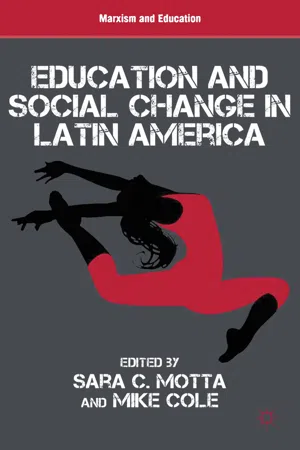
This book examines the multiple relationships between education, pedagogy, and social change in Latin America and beyond through a discussion of critical theory in education and its uses in Latin American society today. An international group of contributors discuss both individual countries and the region as a whole.
Information
Print ISBN
9781349479337
9781137380678
Subtopic
Comparative EducationPart I
On the Philosophies, Theories and Histories of Emancipatory Education in Latin America
Chapter 1
Naming the World: Situating Freirean Pedagogics in the Philosophical Problematic of Nuestra América
Jon L. Mansell
Since the first publication of his Pedagogy of the Oppressed in Brazil in 1968, the work of Paulo Freire has come to be a source of inspiration to political militants, socially engaged educators and critical scholars throughout the world. In particular many theorists and practitioners working across both the global north and south have seen in Freire’s work rich resources for a renovation of the praxis of emancipatory politics. An important contribution in this volume to this renovation is offered by Sara Motta, developed in dialogue with theorists of Open Marxism, to challenge the monological representative politics of twentieth-century socialism. Instead, according to Motta, the Freirian approach to pedagogy is suggestive of a form of politics that is lived through “the transformation of subjectivity into non-alienated social flows of being, doing, living and loving” (chapter 3, in this volume). Here politics becomes a process of everyday life, of the construction of self that inherently contests the separation between politics and life implied within twentieth-century social democratic and socialist theories of the state.
Also in this volume, Liam Kane has assessed the resonances between Freirean pedagogy and the broad Marxist tradition, considering ten particular points of contact. In particular it is suggested that popular education diverges from Marxism in certain points, notably in the conceptualization of agency, focusing on the “oppressed” or the people, rather than the more narrowly defined proletariat of Marxian political economy. In addition, popular education offers a more open approach to knowledge, based upon the recognition that people develop “knowledge acquired from their own particular lived experiences” (chapter 2, in this volume) rather than the more limited, abstract productivist conception of knowledge found in orthodox historical materialism. Finally, Kane suggests the importance of an ethical concept of “humanization” influenced by Christian thought that distinguishes Freire from the secular rationality of Marxism, which has been dominant in Europe for much of the twentieth century. These dialogues and engagements suggest that the relationship between Freirean pedagogy and emancipatory thought developed in Europe is then highly productive, but also complex and often composed of both resonances and divergences.
In seeking to contextualize some of these productive dialogues, in this chapter I will offer a reading of Freirean pedagogy that situates his unique contribution as a particular moment in the development of Latin America thought. I suggest this approach is useful as questions of literacy, grammar and education have always been central to philosophical thought in Latin America, in the development of a sense of identity, geography and history. I therefore discuss three historical periods: (1) the role of literacy in the development of scholastic humanism during the sixteenth-century colonial period, (2) nineteenth-century post-Independence positivism and (3) concluding in what I suggest as a distinctive philosophy of Nuestra América in the latter half of the twentieth century of which Freirean pedagogy is a part.
These discussions draw heavily on the Latin American modernity/coloniality school, in particular Walter Mignolo and Enrique Dussel whose work is paradigmatic of the critical renovation of a distinctively Latin American philosophy in the twentieth century. I conclude by suggesting what I see as three of the fundamental theoretical implications of reading Freire through this tradition: (1) the primacy of the ethical to the rational, (2) an epistemological privileging of the margins and (3) a commitment to the body against abstract, disembodied knowledge.
Naming and Philosophizing América
The Colonial Naming of América
At the center of Freire’s understanding of critical pedagogy and adult literacy is the idea that the power of the word is the power to name the world (1996, p. 69); to name however does not imply capturing the exteriority of the world (rendering the world static as a fixed word) but instead expresses only a certain partial fixing of meaning within a totality of knowledge (language, discourse, representation). It is in this sense that language constitutes something of a (para-)reality that is inherent to the American experience, from the moment that Christopher Columbus set foot on the island of Guanahani and renamed that island through the vocabularies of Latin Christendom as San Salvador. Moreover, drawing on the flawed cartographic assumptions of Latin Christendom Columbus subsequently names the natives of this island as Indios, an initial misrecognition that continues to denote the indigenous inhabitants of the continent until the present day. Two decades after Columbus discovered India, the Portuguese navigator Amerigo Vespucci re-cognizes these territories as different from the previous assumptions. This difference is thus named as a derivation of his own name: America. For Eduardo O’Gorman (1961, p. 42) this process of de-naming and re-naming suggests that the American was not discovered by Europeans, but instead from the very first moment of encounter, invented through European words and discourses. In this view the original encounter between European and Amerindian is fundamentally non-dialogical, it is literally monological, that is, purely articulated through the logic of the conqueror’s performance of speech. As such Enrique Dussel has suggested Columbus’ discovery actually amounts to an original act of covering over of America, as knowable: “As a result the Other, The American Indian disappeared, The Indian was not discovered (des-cubierto) as Other, but subsumed under categories of the Same . . . denied as Other, covered over (en-cubierto)” (1995, p. 32). It is this process of naming and the loss that it involves which it might be argued constitutes the original American philosophical problematic.
It is striking that the complicity between the word and territorial power is already explicitly understood by the Spaniards at the onset of the colonial period. As Walter Mignolo has discussed (1995, pp. 37–58), the year of conquest was also the year of the conquest of language, the publication of the first systematic Castilian grammar by Antonio de Nebrija. In presenting this document to Queen Isabella, Nebrija affirms the profound implications of his achievement with reference to the role of Latin in the expansion of the Roman Empire, thus drawing a timely parallel: Nebrija asserts, “always language was the companion of empire . . . together they begin, grow and flower and together they fall” (2007). Within this rhetorical construction, Castile is presented as the new bearer of Christian civilization and while force of arms may secure conquest, it is only through the closely related disciplines of law and language that civilization may establish itself upon solid ground. For Mignolo, this original connection between grammar and statecraft is of real importance, imposing discipline on the popular impurities inflicted upon the spoken word, characterized by the anarchical impulses of dialect, distortion and innovation “speakers would pronounce in one way and write in another . . . [Nebija thus perceived the] need for a remedy which will prevent the deterioration and subsequent disintegration of the language (e.g., the control of the voice by means of letters)” (Mignolo, 1992, p. 189). The construction of an approved standardized grammar was thus an effort at the disciplining of language as a fixed, complete system; establishing the rules of both what can and cannot be correctly said, but also firmly connecting this discipline to social hierarchies through epistemological constructions that were essential to the ideological legitimacy of emerging national and colonial projects.
As Mignolo (1995) demonstrates, in parallel to the conquest of language, the conquest of the American territory was explicitly linked to the standardization of literacy. Indeed, according to the scholastic humanism of the sixteenth century (e.g., the Jesuit theologican Jose de Acosta) the Amerindian is considered more or less human to the extent that her knowledge approximates European models of literacy. The power relations of the colonial difference thus takes on an apparently objective, rational form precisely because Greco-Roman reason involves an essential disembodiment of knowledge: “Spaniards stressed reading the word rather than reading the world and thus made the letter the anchor of language and knowledge” (Mignolo, 1995, p. 105). There is then a divergence between individualized European knowledge codified through alphabetic systems and the collectively constructed oral narratives and pictoideographic representational systems of the Amerindians. This Amerindian heritage could not exist in a meaningfully different way, but must be situated in a subordinate position to European literacy, translated, and thus transformed into the totality of European knowledge. The disciplinality of grammar in the context of colonial conquest thus necessitated that knowledge become detached from place, hierarchically organized and legitimized, universalistic, quasi-autonomous from its referents and as such in the American context became complicit with conquest. In the words of Boaventura de Sousa Santos—epistemocidal (2007). The Amerindian in relation to this totalizing form of knowledge could be legitimately disavowed of the right to speak knowledge as Other—oral tradition, Nahuatl grammar, Mayan myth, Guarani body art, etc. were denied to be forms of knowledge, and deemed irrational, idolatrous, satanic. As such “the traditions embedded in Amerindian languages were overruled by alphabetic writing (the letter) which ended up by controlling the territory . . . colonising the imaginary” (Mignolo, 1992, p. 199).
The idea of literacy in the sixteenth century is then deeply monological, tied to an imperial project of authoritatively naming and writing over Others’ knowledge. The authority of written knowledge could thus be deployed, with an appearance of intellectual neutrality, as a tool of naming and knowing the world in order to dominate the world, producing a para-real system of documentations and discourses, which as Annibal Quijano has suggested ensures that
the conquered and dominated peoples were situated in a natural position of inferiority and, as a result, their phenotypic traits as well as their cultural features were considered inferior. In this way race became the fundamental criterion for the distribution of the world population into ranks, places, and roles in the new society’s structure of power. (2008, p. 183)
The disembodiment and de-placement of early modern European universalistic knowledge represents then the ideological appearance of what Quijano (2008) has called the coloniality of power, whereby the totality of written knowledge becomes for Guardiola-Rivera “an order, a form of sovereignty or rule; a self-legitimated (global) state-form . . . trade relations only become hegemonic, achieving the form of the state, when they appear as culture” (2002, p. 27). The implications of this complicity between the coloniality of power and the apparent autonomy of literacy embedded in a Eurocentric knowledge world are clearly significant, as America is named, Amerindia is gradually covered over: Nahuatl is translated to Spanish, orality is disciplined by grammar, bodies are subjectivated by bureaucratic record-keeping—the local becomes subjugated to the national/imperial, the lived particular to the written universal. As Guardiola-Rivera affirms, in America “there is a relationship between literacy as a global design (the secular religion of the civilizing mission) and the process of colonial spatial differentiation initiated in the sixteenth century” (2002, p. 16). The scholastic philosophical tradition that dominates the early colonial period thus constructs literacy as a key dimension of the colonial project, the construction of European knowledge as global and universal, but this can only be achieved through the covering over of the knowledge of Europe’s Others—these parallel processes are inseparable and co-constitutive.
The Post-Independence Thinking of America
The end of Spanish and Portuguese colonial rule in the Americas signaled the decline of Iberian scholasticism as the dominant mode of thought in the newly independent republics. The independence movements had been shaped ideologically by a powerful sense of the struggle for reason (associated with the French and North American revolutions) against the dogmas of the Catholic tradition; as such, the new generation of thinkers was keen to proclaim an intellectual renovation that repudiated the Spanish intellectual heritage (Zea, 1963, p. 41). Against the conservatism of Spanish scholasticism the philosophy of the new world was to be a positivistic liberalism associated primarily with French and British thought, a philosophy of liberty and reason, order and progress. The interpretation of Positivism differed from country to country: Brazil and Mexico drew primarily from the French tradition of Comte; Uruguay, Argentina and Chile turning toward the English thinkers Spencer and Mill. What united these diverse national traditions however was the recognition of a specifically American point of departure, a rejection of scholasticism, a passion for science, a suspicion of the clergy and a fascination with the possibilities of education.
The origin of nineteenth-century Latin American thought was then an affirmation of the American as a distinct moment of universal history. In this view the challenge for the thinkers of the “land of the future” was to enter into universal history, by acting as a vanguard in the struggle of European rationalized culture over and against wild American nature. This particular positionality set out by the Venezuelan Andrés Bello affirms that a “philosophy of history, the science of humanity, is the same in every place and in every time . . . but the general philosophy of history cannot lead to the particular philosophy of history of a people” (Bello, 1997, p. 176). This challenge of constructing a philosophical voice of the American as part of the universal philosophy of history thus constitutes a distinctive process throughout the nineteenth century. A key text in this context is Esteban Echeverría’s seminal novella El Matadero (1993), which according to Roberto Echevarría serves to inaugurate “a new Latin American master-story mediated by the most authoritative European discourse produced by the West since the sixteenth century: modern science” (1995, p. 221). Within this meta-narrative we find the construction of a powerful new Creole imaginary, whose subject is able to come into existence through a radical break with the past (the decadent Catholicism of the colonial period) and through the struggle for the future against the barbarism of American nature. The importance of this text according to Echevarría is that it establishes a new self-consciousness in Latin American thought, that of the rational, detached observer, surrounded everywhere by the savagery of nature—“From now on the Latin American narrative will deal obsessively with that ‘other within’ who may be the source of all, that is the violent origin of the difference which makes Latin America distinct and consequentially original” (Echevarría, 1995, p. 223).
An important theorist of this new imaginary in the nineteenth century was another Argentine dissident Domingo Faustino Sarmiento (1811–1888) forced into exile by the dictatorship of Juan Manuel de Rosas (1829–1852). Sarmiento’s autobiography of the provincial Caudillo Juan Facundo Quiroga captures the spirit of the age: the struggle between “civilisation and barbarism.” This binary opposition is for Sarmiento the basis of the Argentine tragedy, by which the capital Buenos Aires “the only city in the vast Argentine territory which is in contact with European nations” (Sarmiento, 1998, p. 12) is surrounded on all sides by barbarian menace “on the north and the south are savages ever on the watch . . . to fall like packs of hyenas . . . upon the defenceless settlements” (p. 10). The ascendency of the Caudillo Facundo (who is a substitute for Rosas himself) marks for Sarmiento the apogee of this tragedy, the domination of the barbarian Gaucho over the educated gentleman, the domination of the wild Pampas over the cultivated City of Letters. The racial undertones of this analysis are quite explicit, the Gaucho being the product of several centuries of mi...
Table of contents
- Cover
- Title
- Introduction: Exploring the Role of Education and the Pedagogical in Pathways to Twenty-First-Century Socialism in Latin America1
- Part I On the Philosophies, Theories and Histories of Emancipatory Education in Latin America
- Part II Education Struggles and/in Left Governments
- Part III Education and Pedagogy from Below
- Conclusion: The Current Crisis in Capitalism and the Role of Education
- List of Contributors
- Index
Trusted by 375,005 students
Access to over 1.5 million titles for a fair monthly price.
Study more efficiently using our study tools.
Frequently asked questions
Yes, you can cancel anytime from the Subscription tab in your account settings on the Perlego website. Your subscription will stay active until the end of your current billing period. Learn how to cancel your subscription
No, books cannot be downloaded as external files, such as PDFs, for use outside of Perlego. However, you can download books within the Perlego app for offline reading on mobile or tablet. Learn how to download books offline
Perlego offers two plans: Essential and Complete
- Essential is ideal for learners and professionals who enjoy exploring a wide range of subjects. Access the Essential Library with 800,000+ trusted titles and best-sellers across business, personal growth, and the humanities. Includes unlimited reading time and Standard Read Aloud voice.
- Complete: Perfect for advanced learners and researchers needing full, unrestricted access. Unlock 1.5M+ books across hundreds of subjects, including academic and specialized titles. The Complete Plan also includes advanced features like Premium Read Aloud and Research Assistant.
We are an online textbook subscription service, where you can get access to an entire online library for less than the price of a single book per month. With over 1.5 million books across 990+ topics, we’ve got you covered! Learn about our mission
Look out for the read-aloud symbol on your next book to see if you can listen to it. The read-aloud tool reads text aloud for you, highlighting the text as it is being read. You can pause it, speed it up and slow it down. Learn more about Read Aloud
Yes! You can use the Perlego app on both iOS and Android devices to read anytime, anywhere — even offline. Perfect for commutes or when you’re on the go.
Please note we cannot support devices running on iOS 13 and Android 7 or earlier. Learn more about using the app
Please note we cannot support devices running on iOS 13 and Android 7 or earlier. Learn more about using the app
Yes, you can access Education and Social Change in Latin America by S. Motta, M. Cole, S. Motta,M. Cole in PDF and/or ePUB format. We have over 1.5 million books available in our catalogue for you to explore.