This book examines the ways in which studies of science intertwined with Cold War politics, in both familiar and less familiar "battlefields" of the Cold War. Taken together, the essays highlight two primary roles for science studies as a new field of expertise institutionalized during the Cold War in different political regimes. Firstly, science studies played a political role in cultural Cold War in sustaining as well as destabilizing political ideologies in different political and national contexts. Secondly, it was an instrument of science policies in the early Cold War: the studies of science were promoted as the underpinning for the national policies framed with regard to both global geopolitics and local national priorities. As this book demonstrates, however, the wider we cast our net, extending our histories beyond the more researched developments in the Anglophone West, the more complex and ambivalent both the "science studies" and "the Cold War" become outside these more familiar spaces. The national stories collected in this book may appear incommensurable with what we know as science studies today, but these stories present a vantage point from which to pluralize some of the visions that were constitutive to the construction of "Cold War" as a juxtaposition of the liberal democracies in the "West" and the communist "East."
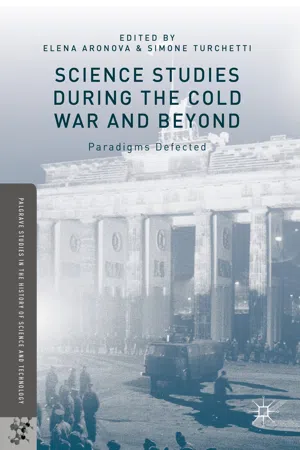
eBook - ePub
Science Studies during the Cold War and Beyond
Paradigms Defected
- English
- ePUB (mobile friendly)
- Available on iOS & Android
eBook - ePub
Science Studies during the Cold War and Beyond
Paradigms Defected
About this book
Information
© The Editors and Authors 2016
Elena Aronova and Simone Turchetti (eds.)Science Studies during the Cold War and BeyondPalgrave Studies in the History of Science and Technology10.1057/978-1-137-55943-2_11. Introduction: Science Studies in East and West—Incommensurable Paradigms?
Elena Aronova1 and Simone Turchetti2
(1)
University of California at Santa Barbara, Santa Barbara, USA
(2)
University of Manchester, Manchester, UK
No less than three generations of scholars have been introduced to science studies through the work of the American science historian Thomas Samuel Kuhn. His work, especially The Structure of Scientific Revolution (1962)—the book that fomented the field of science studies—continues to be a key reference, especially for university teachers. Few, however, would be prepared to lecture on the theories of vědecko-technickárevoluce (scientific-technical revolution) of the Czech communist scholar Radovan Richta. Today his name, in contrast to Kuhn’s, means something only to a few connoisseurs, and his Civilizacenarozcestí (Civilization at the Crossroads) is more likely to be found in second-hand markets selling Cold War antiques than on a syllabus of a class introducing students to the field of science studies. The perils of Richta’s production matter not only to the Cold War nostalgic. They show the remarkable gap in our knowledge of the origins and development of science studies in the Cold War period. Despite the fact that science studies scholars have urged to embrace symmetry in portraying key episodes in the history of science, they suddenly become linear and unidirectional when asked to discuss the history of their own discipline. 1
As a form of reflexivity and expertise on science’s present, past, and future, “science studies” and the neighboring fields of history and philosophy of science may appear to an observer as merely arcane lines of enquiry about the nature of scientific knowledge and its methodology. It is telling, however, that comparatively recent debates on the seemingly abstract issue of whether scientific theories are socially constructed, which were dubbed the “science wars,” were accompanied by the kind of bitterness and deep politicization that suggests a larger significance of the studies of science beyond the relatively small community of students of science. 2 One indication of larger political ramifications of the field is the fact that in different forms, “science studies” surfaced during the Cold War in a variety of political regimes and nation-states: from Western liberal democracies to communist China, and from Soviet bloc regimes to new nations of the so-called “Third world.” In the decades following the end of World War 2 (WW2), marked by the shock of Hiroshima and Nagasaki, scientists and politicians alike emphasized that science, which made the atomic bomb possible, had transformed the world. The centrality of scientific and technological prowess for the Cold War itself, and the high currency the technocratic social engineering arguments had acquired as a result, moved the study of science, now refashioned as science of science, from an academic periphery to a prominence it had never enjoyed before.
As several scholars have pointed out, the Cold War was as much about knowledge as about knowledge about knowledge—who had it and who hadn’t, but also how to put knowledge by those who had it to use as a critical component of soft diplomacy. 3 The intellectuals’ quest for the new ways to analyze science’s growth and predict its development may well not have been directly enlisted in the service of the state. Yet, the repercussions of the new form of expertise were clear to technocratic managers who sought to cultivate new experts on science for various national and geopolitical needs. The proliferation of new terms—науковедение (naukovedenie) in the Soviet Union, naukoznawstwo in Poland, 自然辩证法 (dialectics of nature) in China, and science studies in English-speaking countries—manifested the emergence of a new disciplinary identity.
What role did these meta-studies of science play in the Cold War? How did different national varieties of “science studies” meet the political demands of the Cold War? How did the studies of science, as intellectual projects, participate in defining the relationships between science, society, and the state? Was the conceptual core of the new field affected, and how? And how did Cold War politics shape, or fail to shape, the field of science studies as we now know it?
This collection brings together historians and philosophers of science, Europeanists, and science studies scholars from many different national traditions to address these and other questions. The chapters in this volume do not offer a synthetic narrative, but they do present a reader with the subject’s wide parameters, considering various ways in which the studies of science as a new field of expertise broadly conceived intertwined with Cold War politics, in both familiar and less familiar “battlefields”.
Recent years have seen the resurgence of interest in Cold War and its scientific spaces. 4 In the words of Naomi Oreskes, despite a long-sustained attention of historians to the subject, the scholarship had suffered from a “miasma problem”: few historians who examined the cultural and political contexts of a given science made stronger claims about how exactly that context affected the content of scientific knowledge. 5 The recent new wave of scholarship on natural and social sciences in America during the Cold War had moved past “miasmas,” elucidating the ways in which the conceptual foundations, frames of analyses, and the tools of such new sciences as cognitive sciences, area studies, and Soviet studies, as well as an array of well-established disciplines, were interwoven with a particular set of cultural norms, imperatives, and rationalities that underpinned American culture during the Cold War. 6 While these new studies have demonstrated how various situations were created by the Cold War, some scholars have called into question the usefulness of “Cold War” as an analytical category. 7 Questioning the novelty and the perceived ruptures in, for instance, American human and social sciences during the Cold War, these scholars highlighted the important continuities whose erasure in itself contributed into constructing the notion of “Cold War.”
Indeed, even the term “Cold War,” far from being a neutral periodization, embedded contestation and produced deep animosity. 8 The phrase, which was coined by George Orwell in 1945 to describe the undeclared state of war between the USA and the USSR made “cold” by the atomic bomb, was used in the first postwar decade by American analysts as a synonym of Joseph Stalin’s confrontational politics. 9 Cold War, as the argument behind the phrase went, was imposed on the rest of the world by the Soviet tyrannical leader, who waged the war against the West (meaning mostly the USA and Britain). Not surprisingly, throughout the Cold War the term was used mostly in North America and Western Europe (albeit more in West Germany and Switzerland than in France or Austria), but not within the Soviet bloc. The Soviet Union was never a true competitor to the other superpower and was striving to keep the precarious legitimacy of its post-WW2 territorial gains, rather than to seek a confrontation with its more powerful and secure Western former wartime allies. 10 Scholars in the Soviet Union and East European countries described the tensions in other terms until the “Cold War” itself was over.
Yet, the Cold War is, for better or worse, an impossible issue to avoid, however we may wish to get rid of it. It has been, and remains, the frame of reference for much of what has been written about the role of science in the political and cultural diplomacy in the second half of the twentieth century. With only few exceptions, however, the historical reflection on Cold War science has been largely concerned with the North American, and, to a smaller extent, Western European side of the conflict. It is important therefore to de-link our understanding of the Cold War and its scientific spaces from the trajectory that remains focused on American–Western–European narratives.
The histories of various national intellectual projects under the umbrella of the studies of science that we summarily render “science studies,” on the other hand, present a vantage point from which to pluralize some of the visions that were constitutive to the construction of “Cold War” as a juxtaposition of the liberal democracies in the “West” and communism in the “East.” Lorraine Daston has pointed out that until very recently the history of science has been largely a “European self-portraiture.” 11 Meta-reflection on science’s past, present, and future was a brainchild of the Enlightenment. 12 As part of the Enlightenment project, historiography of science linked science to liberal notions of freedom, progress, and individual creativity, on the one hand, and with modernity, “civilization,” “Europe,” and the “West,” on the other. 13 The institutionalization of history of science in the Anglophone West in the post-WW2 years consolidated this view. The new historiography of science has centered on “the Scientific Revolution”—the organizing master narrative of the new discipline—that posited the theoretical transformations of the sixteenth and seventeenth centuries as a pivotal moment in the history of modern science, and modernity itself. 14 As Herbert Butterfield, the doyen of the history of science in Britain in the first postwar decade, has put it, “The scientific revolution we must regard […] as a creative product of the West—depending on a complicated set of conditions which existed only in Western Europe.” 15
Many scholars have pointed out that the view of science as a uniquely Western product was encouraged by the political climate and, indeed, the notion of “the Cold War.” This view posited “the East,” which had not produced modern science, as “underdeveloped” vis-à-vis “the West” and, in the worst-case scenario, threatening to spread out coercion and totalitarianism. 16 With the Scientific Revolution conceptualized as a key defining moment of new intellectual history of science, the contribution of Islamic scholars during the Middle Ages, as well as the developments in modern Russia, China, and Japan, fell out of focus and was marginalized. As Geert Somsen pointed out in a recent essay, the narrative of “the Scientific Revolution” entailed conceptual, chronological, as well as geographical priorities. 17
The consolidation of a Eurocentric conception of science in the first post-WW2 decades marked a decisive reversal of the earlier, interwar agenda of the field. As Anna Mayer has argued, the notions of science as global endeavor and of history of science as an international enterprise were crucial for the unprecedented growth and expansion of history of science as a discipline in the first half of the twentieth century in Europe and North America. 18 In the 1920s and 1930s, the kinds of academic forums, networks, professional associations, and specialized journals for the history of science that conventionally characterize academic professions have been established in the USA, Britain, and the Soviet Union. 19 Such institutional innovations as the journal Isis (founded in 1913 by a Belgian chemist-turned-historian George Sarton, who almost single-handedly launched the discipline of history of science in the USA), the History of Science Society (established in 1924), the Académie Internationale d’Histoire des Sciences (founded in 1927), and, in the same year, the Institute for the History of Science and Technology in the Soviet Union headed by Nikolai Bukharin, all emphasized that history of science must be pursued collaboratively by international practitioners. 20 In 1931, the surprise appearance of a Soviet delegation at the Second International Congress of the History of Science and Technology in London made a lasting impression on Western science historians, from John Desmond Bernal to Sarton’s student Robert Merton, catalyzing the spread of Marxist history of science in Anglo-American literature. 21 Marxist approaches, which rooted scientific discoveries in socioeconomic forces and dialectical materialism, appealed to British left-wing scientists. In his influential book The Social Function of Science (1939), Bernal sought to provide the basis for the new scientific discipline, “the science of science,” grounding it in Marxist historical materialism, Engels’s dialectics of nature, and socialist planning. 22 However diverse the approaches to history of science were in these three settings, stretching from Marxism to classical liberalism, they embedded the idea that science is global and international, a means to unify the world at a time of social crises and political upheavals in Europe be...
Table of contents
- Cover
- Frontmatter
- 1. Introduction: Science Studies in East and West—Incommensurable Paradigms?
- 1. Science Studies in the “West”
- 2. Studies of Science Behind the “Curtain”
- 3. National Agendas of the Studies of Science Beyond the “Two Blocs”
- Backmatter
Trusted by 375,005 students
Access to over 1.5 million titles for a fair monthly price.
Study more efficiently using our study tools.
Frequently asked questions
Yes, you can cancel anytime from the Subscription tab in your account settings on the Perlego website. Your subscription will stay active until the end of your current billing period. Learn how to cancel your subscription
No, books cannot be downloaded as external files, such as PDFs, for use outside of Perlego. However, you can download books within the Perlego app for offline reading on mobile or tablet. Learn how to download books offline
Perlego offers two plans: Essential and Complete
- Essential is ideal for learners and professionals who enjoy exploring a wide range of subjects. Access the Essential Library with 800,000+ trusted titles and best-sellers across business, personal growth, and the humanities. Includes unlimited reading time and Standard Read Aloud voice.
- Complete: Perfect for advanced learners and researchers needing full, unrestricted access. Unlock 1.5M+ books across hundreds of subjects, including academic and specialized titles. The Complete Plan also includes advanced features like Premium Read Aloud and Research Assistant.
We are an online textbook subscription service, where you can get access to an entire online library for less than the price of a single book per month. With over 1.5 million books across 990+ topics, we’ve got you covered! Learn about our mission
Look out for the read-aloud symbol on your next book to see if you can listen to it. The read-aloud tool reads text aloud for you, highlighting the text as it is being read. You can pause it, speed it up and slow it down. Learn more about Read Aloud
Yes! You can use the Perlego app on both iOS and Android devices to read anytime, anywhere — even offline. Perfect for commutes or when you’re on the go.
Please note we cannot support devices running on iOS 13 and Android 7 or earlier. Learn more about using the app
Please note we cannot support devices running on iOS 13 and Android 7 or earlier. Learn more about using the app
Yes, you can access Science Studies during the Cold War and Beyond by Elena Aronova, Simone Turchetti, Elena Aronova,Simone Turchetti in PDF and/or ePUB format, as well as other popular books in History & Eastern European History. We have over 1.5 million books available in our catalogue for you to explore.