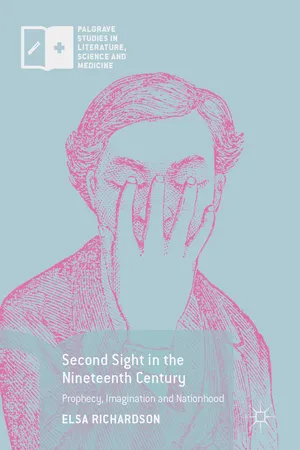
This book explores the phenomenon of second sight in nineteenth-century literature and culture. Second sight is a form of prophetic vision associated with the folklore of the Scottish Highlands and Islands. Described in Gaelic as the An-da-shealladh or 'the two sights', those in possession of this extraordinary power are said to foresee future events like the death of neighbour, the arrival of strangers into the community, the success or failure of a fishing trip. From the late seventeenth century onwards, rumours of this strange faculty attracted the attention of numerous scientists, travel writers, antiquarians, poets and artists. Focusing on the nineteenth century, this book examines second sight in relation to mesmerism and phrenology, modern spiritualism and anthropology, romance literature and folklorism and finally, psychical research and Celtic mysticism. Tracing the migration of a supposedly 'Scottish' tradition through various sites of nineteenth-century popular culture, it explores questions of nationhood and identity alongside those posed by supernatural phenomena.
eBook - ePub
Second Sight in the Nineteenth Century
Prophecy, Imagination and Nationhood
- English
- ePUB (mobile friendly)
- Available on iOS & Android
eBook - ePub
About this book
Information
© The Author(s) 2017
E. RichardsonSecond Sight in the Nineteenth CenturyPalgrave Studies in Literature, Science and Medicinehttps://doi.org/10.1057/978-1-137-51970-2_11. Introduction
Elsa Richardson1
(1)
Strathclyde University, Glasgow, United Kingdom
On 23 August 1894, the Dundee Courier printed a short report that detailed a tour being taken through the West Highlands and Islands by several members of a London-based organisation called the Society for Psychical Research (SPR). The purpose of their trip, we are told, concerned ‘that peculiar faculty said to be possessed by many people, especially in the Highlands, and popularly known as “second sight”’. Accompanied by a small white terrier, two of the organisation’s ‘lady members’ were making their way through the small fishing villages and farming communities of Tiree, Iona, Eriskay, Barra and Portree in search of people in possession of this special ocular capacity.1 Writing in Cock Lane and Common Sense (1894), Andrew Lang, a Scottish writer and prominent member of the SPR, described the hallmarks of the phenomenon under investigation:
In second sight the percipient beholds events occurring at a distance, sees people whom he never saw with the bodily eye, and who afterwards arrive in his neighbourhood; or foresees events approaching but still remote in time. The chief peculiarity of second sight is, that the visions often, though not always, are of symbolical character. A shroud is observed around the living man who is doomed; boding animals, mostly black dogs, vex the seer; funerals are witnessed before they occur, and ‘corpse-candles’ (some sort of light) are watched flitting above the road whereby a burial procession is to take its way.2
Described in Gaelic as the An-da-shealladh or the ‘two sights’, this intuitive vision was said to thrive among the Scottish Highlanders. Unlike the doctrinal revelations of the religious prophet or the nation-forming proclamations of the oracle, the premonitions associated with second sight trafficked in quotidian experience. To give an example, in one account recorded by the SPR an island woman delays packing for a trip to England because of a vision in which a ‘messenger came on horseback with a letter’ telling of a death in the family; two days later, just as she is confessing this ‘foolishness’ to her husband, the letter arrives exactly as forecast.3 Arriving unsought, such predictions detailed everyday events in the lives of people living in remote communities: the death of a neighbour, the unexpected arrival of a relative, the wrecking of a fishing boat or the success of a harvest. From the late seventeenth century onwards, these mundane prophecies began to attract the attention of scientists, antiquarians, travel writers, artists, novelists, folklorists and eventually, psychical researchers. This book is, in part, an examination of these varied enquiries and an attempt to understand how the odd portents of a remote people came to occupy a prominent position in the British imagination.
Second sight was an object of fascination for many English-speaking observers, drawn north in search of symbolical visions and eerie prophecies. Writing in A Journey to the Western Islands of Scotland (1775), the lexicographer and essayist Samuel Johnson avowed that his travel narrative would really have ‘little claim to the praise of curiosity’ if it failed to address the question of second sight among the Highlanders. Describing it as an ‘impression made either on the eye, or by the eye upon the mind’, Johnson finds that the premonitions associated with second sight feature set narratives: such as, a man ‘on a journey far from home falls from his horse’ and is seen ‘bleeding on the ground’ by a relative working miles away from the accident, or a seer ‘driving home his cattle’ is surprised by the sudden appearance of a spectral ‘bridal ceremony or a funeral procession’ blocking his way.4 These visions are, the writer explains, the spectral imprints of distant or future events seen as ‘if they were present’, that are brought about by a ‘superadded’ power of sight.5 Having encountered ‘many tales of these airy shows’ and carefully weighed their evidentiary value, Johnson departed from Scotland unconvinced but ‘willing to believe’ in the possibility of supernatural foresight.6 The measured tone of this conclusion, grounded in empirical observation and probabilistic reasoning, is typical of the investigative cultures examined by this book. In his history of ghost-seeing from the Reformation to the twentieth century, Shane McCorristine uses the term ‘Enlightenment-agnosticism’ to describe the peculiar approach to the supernatural that emerged as an ‘uncanny reflection of positivistic scientific practice’.7 When, in 1882, a group of Cambridge University scientists and philosophers came together to found a society dedicated to the ‘organised and systematic’ study of anomalous phenomena, they did so as part of an established intellectual tradition.8 Though over a century separates Johnson’s tour through the Highlands from the expedition undertaken by the SPR, the two share in a desire to expose the extraordinary visionary capacities rumoured to proliferate among the Gaelic people to the scrutiny of empiricist observation. With the financial backing of a sympathetic laird and the practical assistance of a local priest, through the closing decade of the nineteenth century psychical researchers worked to gather a corpus of individual testimony pertaining to the nature and prevalence of second sight. This data then formed the basis of several formal reports made to the SPR in London and reprinted in the organisation’s proceedings, the Journal of Psychical Research: an alchemical transformation that, like Johnson’s erudite rationalism, worked to convert uncanny foresight into a form of scientific knowledge.
The principal focus of this book lies in the nineteenth century with the enquiries made by several nascent investigative cultures, including spiritualism, anthropology and psychical research, into the subject of second sight. The Victorian supernatural has been described as having a ‘protean quality of being a cause, a place, a kind of being, a realm, a possibility, a new form of nature and a hope for the future’; an amorphous multiplicity that has long attracted scholars working in the humanities.9 There has been, however, a shift in the focus of this attention away from literary treatments of the ghost story or social histories of superstition, towards the interdisciplinary study of spiritualism, mesmerism, mysticism and the occult. Scholars such as Jill Galvan, Christine Ferguson, Roger Luckhurst, Pamela Thurschwell and Sarah Wilburn have explored the complex patterns of information sharing that took place between orthodox and heterodox practices, technology and the occult, science and popular literature.10 In doing so they have unearthed metaphoric interstices capable of upending any easy division of natural and supernatural, science and religion, rational and irrational. Methodological and disciplinary differences aside, these treatments all share in a desire to challenge a disenchanted reading of modernity, first made famous by the sociologist and political economist Max Weber, in which rationalisation and intellectualisation are credited with forcing magic, religion and spirituality from the public realm.11 Historians have chipped away at the idea of disenchantment to reveal the magical imagination at work in the operations of capitalism and the structures of modernity itself.12 Prominent in this area of study, the work of Michael Saler and Joshua Landy have disassembled Weber’s thesis by exposing the close relation of secularisation to multifarious forms of modern enchantment.13 The examples that Saler and Landy use to illustrate the concept of re-enchantment come, almost exclusively, from elite culture; modern magic lies, for these authors, in the discourses of literature, philosophy and aesthetics. Along similar lines, historiographical treatments of the Victorian supernatural have, with a few notable exceptions, tended to formulate their arguments in relation to the experiences and written reflections of the highly educated.14 They have done so with good reason, as studies into the magical beliefs of educated elites have permitted historians to map out important interconnections between the cultural modalities of the supernatural and developments in science, medicine and so on. What this approach necessitates, however, is the jettisoning of beliefs, stories and customs associated with the illiterate, the poor and the marginalised.
The history of second sight demands a different approach. Strongly associated with the Highlands of Scotland, a region that remained economically, politically and linguistically peripheral through the nineteenth century, second sight existed as part of a culture situated on the fringes of British society. Since the seventeenth century, English-speaking observers have tried to make sense of this peculiar power by gathering first-hand accounts, conducting surveys and translating oral testimony into written evidence. In the process, they have transformed customary and peripheral knowledge into data to be processed, instrumentalised and eventually assimilated by discourses operating at the imperial centre. The SPR’s inquiry was, for instance, undertaken with the aim of amassing data in support of a new theoretical framework for understanding the supernatural, based on the idea of thought transference or telepathy. This is clear in an early report on the progress of the investigation, in which stories of second sight are described as running along lines ‘with which we are all familiar’ and as constituting clear examples of ‘thought transference—information subconsciously acquired’. No matt...
Table of contents
- Cover
- Front Matter
- 1. Introduction
- 2. Second Sight and the Creation of the Highlands
- 3. Mesmerism, Phrenology and Supernatural History
- 4. Primitive Spiritualism and Origin Stories
- 5. Psychical Research, Folklore and Romance
- 6. Research in the Field: Ada Goodrich Freer and Fiona Macleod
- 7. Conclusion
- Back Matter
Trusted by 375,005 students
Access to over 1.5 million titles for a fair monthly price.
Study more efficiently using our study tools.
Frequently asked questions
Yes, you can cancel anytime from the Subscription tab in your account settings on the Perlego website. Your subscription will stay active until the end of your current billing period. Learn how to cancel your subscription
No, books cannot be downloaded as external files, such as PDFs, for use outside of Perlego. However, you can download books within the Perlego app for offline reading on mobile or tablet. Learn how to download books offline
Perlego offers two plans: Essential and Complete
- Essential is ideal for learners and professionals who enjoy exploring a wide range of subjects. Access the Essential Library with 800,000+ trusted titles and best-sellers across business, personal growth, and the humanities. Includes unlimited reading time and Standard Read Aloud voice.
- Complete: Perfect for advanced learners and researchers needing full, unrestricted access. Unlock 1.5M+ books across hundreds of subjects, including academic and specialized titles. The Complete Plan also includes advanced features like Premium Read Aloud and Research Assistant.
We are an online textbook subscription service, where you can get access to an entire online library for less than the price of a single book per month. With over 1.5 million books across 990+ topics, we’ve got you covered! Learn about our mission
Look out for the read-aloud symbol on your next book to see if you can listen to it. The read-aloud tool reads text aloud for you, highlighting the text as it is being read. You can pause it, speed it up and slow it down. Learn more about Read Aloud
Yes! You can use the Perlego app on both iOS and Android devices to read anytime, anywhere — even offline. Perfect for commutes or when you’re on the go.
Please note we cannot support devices running on iOS 13 and Android 7 or earlier. Learn more about using the app
Please note we cannot support devices running on iOS 13 and Android 7 or earlier. Learn more about using the app
Yes, you can access Second Sight in the Nineteenth Century by Elsa Richardson in PDF and/or ePUB format, as well as other popular books in Literature & Literature General. We have over 1.5 million books available in our catalogue for you to explore.