The experiences of African women in the era before independence remain a woefully understudied facet of African history. This innovative and carefully argued study thus adds tremendously to our understanding of colonial history by focusing on women's education, professionalization, and political mobilization in the East African islands of Zanzibar.
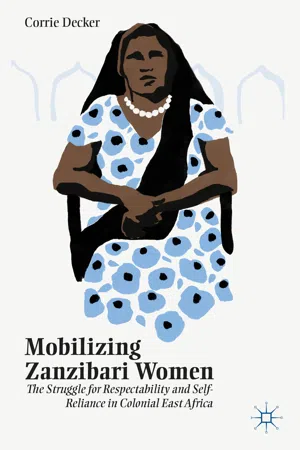
eBook - ePub
Mobilizing Zanzibari Women
The Struggle for Respectability and Self-Reliance in Colonial East Africa
- English
- ePUB (mobile friendly)
- Available on iOS & Android
eBook - ePub
Mobilizing Zanzibari Women
The Struggle for Respectability and Self-Reliance in Colonial East Africa
About this book
Information
Chapter 1
Inducting Girls into the Regime of Respectability
The Arab Girls’ School, the first government school for girls in Zanzibar, opened its doors on June 1, 1927. An immediate positive reaction from local elites set the tone for the school; subsequently, girls’ education became one of the most promising features of the colonial administration. The school hosted siku kuu (“special days”), such as Prize Giving Day, when the sultan, his wife, and top-ranking British officials came to celebrate the achievements of students. Bi Salama, who attended the school at the time, insisted that schoolgirls were on their best behavior on these occasions. Students and teachers sat “properly dressed,” wearing their headscarves, buibuis (long, dark pieces of cloth that fully covered women’s bodies), and clean shoes. Sitting quietly, properly dressed, both teachers and students demonstrated to public audiences that they were “very respectable” Muslim women and girls.1 These scenes reassured parents that their daughters would grow up to become “good Muhammadan wives and mothers.”2 Support from the sultan and the Arab elites who collaborated with British officials to open the school won over skeptical parents. The early success o f the school, in terms of gradually increasing both enrollments and public accolades, surprised officials who assumed that Muslims would oppose educating their daughters.
The Arab Girls’ School was the embodiment of elite Arab male discourses on heshima (“respectability”). Everything about the school—the building, location, curriculum, and culture—upheld the ruling family’s regime of respectability. This heshima was put on display at public events like the Prize Giving ceremony as a way to convince naysayers that girls could acquire a “modern” education without damaging their reputations or those of their families. The first girls at the school were the daughters of men who had themselves graduated from government schools, many of whom went on to become government teachers or officials. They sent their daughters to school as a statement that they embraced modern Islamic reforms and elite traditions of heshima.
Behind the scenes, however, fathers, mothers, grandmothers, and daughters often butted heads. Women and men in Stone Town families sometimes disagreed about what it took to ensure a girl’s heshima. Grandmothers were especially worried that schooling would “spoil” the girls, that they would initiate affairs with boys and lose their virginity before marriage. Bi Salama’s claim that the students and teachers demonstrated their respectability may have been a defense against her own grandmother who expressed these fears. The regime of respectability instilled at the school was a powerful message to all Zanzibari women and a tool for Arab men to perpetuate their discourse on women’s heshima. This form of girlhood respectability bolstered the reputation of fathers, but schooling threatened other pedagogical traditions, such as female initiation, which were under the control of mothers and grandmothers. Women retaliated by removing girls from school at the age of puberty. Family disputes over the decision to send girls to school and allow them to continue their studies after reaching puberty arose out of this dynamic between men’s discourses and women’s actions. These gendered and generational cleavages also provide a window into the aspirations of schoolgirls themselves.
Twentieth-Century Women’s Education in the International Context
The Arab Girls’ School opened amid substantial developments in the history of education and women globally. The “New Woman,” a predominantly European and North American figure, gave way to the internationally recognizable “Modern Girl” who embraced a cosmopolitan aesthetic and followed her own desires, often to the chagrin of parents and state officials.3 At the same time, modernists in Egypt and other areas of the Muslim world pushed for the widespread education and social advancement of women.4 The first generations of educated elite men in colonial Africa also demanded more government-funded schools, control over the curriculum, and education for their daughters and wives.5
The globalization of the school, Kathryn M. Anderson-Levitt argues, occurred in three distinct phases.6 During the first period, from the early eighteenth century to the 1870s, the global North introduced standardized national schooling systems and strove for universal education. Britain’s Elementary Education Act of 1870 is one example of this shift.7 The second phase of the globalization of the school, which began in the 1870s and continued through World War II, introduced the notion of a standardized educational institution to other countries and colonies around the world. This was the era of the “civilizing mission” and “New Imperialism,” during which the majority of the African continent fell under European colonial rule. Anderson-Levitt stresses that schooling populations in the global South remained miniscule during this second phase. It was not until after the mid-twentieth century, the postcolonial period in Africa, that mass education became a global objective.8
Rapid expansion of women’s education occurred on an international scale during the second phase in the late nineteenth and early twentieth centuries. Given that democracy and industrialization drove the call for mass schooling in Europe and North America, Merry Wiesner-Hanks explains, the first targets of these programs were men, mainly soldiers and voters.9 In fact, Europe was not the global leader when it came to women’s education. By 1910, 90 percent of Japanese boys and girls attended schools, a figure much higher than in any European country.10 By the following decade, the Soviet Union had also surpassed Europe in this area. Five times as many women attended university in the Soviet Union as in Germany, France, and England combined, and more Soviet women than European women attended secondary school as well.11 American schools were also successful at achieving early gender equity. In 1890, girls outpaced boys in high school graduation rates, and by 1920, more than 47 percent of undergraduate students were female.12 In many Islamic territories, too, the late nineteenth century brought about advancements in women’s education.13 Egypt’s “modernizer,” Muhammad Ali, set a precedent for state interventions in the 1830s when he established a school to train women as health practitioners. Widespread support for girls’ education emerged in progressive Muslim communities by the early twentieth century when educated women began to actively participate in public debates about gender equality.14
Quite often the stated purpose of women’s education was to produce “good wives and wise mothers.”15 American psychologist G. Stanley Hall urged educationalists to segregate girls and boys at adolescence in order to ensure that women embraced their domestic destiny. He pointed to studies proving “that the more scholastic the education of women, the fewer children and the harder, more dangerous, and more dreaded is parturition, and the less the ability to nurse children.”16 Despite attempts to mold girls into housewives, some women used their skills to obtain work outside the home. In Britain, working-class women were trained in domestic subjects to prepare them for jobs as servants in middle-class households.17 By the 1920s, women across the world who were trained in domestic “science” embraced their expertise as an avenue toward professionalization.18 Other options were teaching and nursing, careers also thought to be extensions of motherhood.19 In the United States, for example, women made up more than 90 percent of primary schoolteachers by 1920.20 The rhetoric comparing teaching to motherhood later provided justification for women’s teacher-training programs in Zanzibar as well.
Most African colonial girls’ schools maintained a strict focus on domesticity.21 The Phelps-Stokes Commissions to Africa in 1922 and 1925 recommended more attention be paid to girls’ education with an emphasis on domestic subjects as part of an “adapted education” program.22 Across the continent, many parents feared sending their girls to Western schools because they did not believe school authorities would properly supervise their daughters, who were otherwise under the control of elders at home. Not surprisingly, these parents associated Western education with increased promiscuity and the loss of moral and religious beliefs.23 In Kenya, conflict between missionaries and Kikuyu elders over the issue of female circumcision in the late 1920s led to the establishment of the Kikuyu Independent Schools Association.24 The competition and collaboration between colonial officials and local elders or elites over the control of women informed interventions into the lives of girls and women. Colonial obsession with “wicked women,” “runaway wives,” prostitutes, and “mine marriages” in Africa, though most immediately about the fear of elders’ loss of control over young men and women, also pointed to concerns about the loss of women’s economic contributions to the community amid the growth of rural poverty that came with the establishment of colonial economies.25 As much as colonial education threatened the authority of elders and directed girls into domestic roles in monogamous households, it also at times empowered girls and women to think of themselves as “modern” individuals with more social and economic options than their mothers and grandmothers.26
British colonial officials relied heavily on missionaries to establish, fund, and manage schools in most African territories. East Africa (Kenya, Uganda, and Tanganyika) was no exception. However, this tactic did not work in predominantly Muslim areas such as Northern Nigeria, Sudan, and the Swahili Coast. Parents worried that, even at nondenominational government schools, teachers would try to convert their sons and daughters to Christianity. In Northern Nigeria, British officials worked with Islamic sultans to establish girls’ schools, but they failed to convince elite families to enroll their daughters.27 The British had more luck in Sudan where local initiatives set t...
Table of contents
- Cover
- Title
- Copyright
- Contents
- List of Figures and Tables
- Acknowledgments
- List of Abbreviations
- Introduction
- 1 Inducting Girls into the Regime of Respectability
- 2 Training Girls for Colonial Development
- 3 Writing Self-Reliance into Respectability
- 4 Developing Agents of Mobility
- 5 Mobilizing Women During the Time of Politics
- Conclusion
- Notes
- Selected Bibliography
- Index
Trusted by 375,005 students
Access to over 1.5 million titles for a fair monthly price.
Study more efficiently using our study tools.
Frequently asked questions
Yes, you can cancel anytime from the Subscription tab in your account settings on the Perlego website. Your subscription will stay active until the end of your current billing period. Learn how to cancel your subscription
No, books cannot be downloaded as external files, such as PDFs, for use outside of Perlego. However, you can download books within the Perlego app for offline reading on mobile or tablet. Learn how to download books offline
Perlego offers two plans: Essential and Complete
- Essential is ideal for learners and professionals who enjoy exploring a wide range of subjects. Access the Essential Library with 800,000+ trusted titles and best-sellers across business, personal growth, and the humanities. Includes unlimited reading time and Standard Read Aloud voice.
- Complete: Perfect for advanced learners and researchers needing full, unrestricted access. Unlock 1.5M+ books across hundreds of subjects, including academic and specialized titles. The Complete Plan also includes advanced features like Premium Read Aloud and Research Assistant.
We are an online textbook subscription service, where you can get access to an entire online library for less than the price of a single book per month. With over 1.5 million books across 990+ topics, we’ve got you covered! Learn about our mission
Look out for the read-aloud symbol on your next book to see if you can listen to it. The read-aloud tool reads text aloud for you, highlighting the text as it is being read. You can pause it, speed it up and slow it down. Learn more about Read Aloud
Yes! You can use the Perlego app on both iOS and Android devices to read anytime, anywhere — even offline. Perfect for commutes or when you’re on the go.
Please note we cannot support devices running on iOS 13 and Android 7 or earlier. Learn more about using the app
Please note we cannot support devices running on iOS 13 and Android 7 or earlier. Learn more about using the app
Yes, you can access Mobilizing Zanzibari Women by C. Decker in PDF and/or ePUB format, as well as other popular books in Social Sciences & Education Theory & Practice. We have over 1.5 million books available in our catalogue for you to explore.