- English
- ePUB (mobile friendly)
- Available on iOS & Android
eBook - ePub
About this book
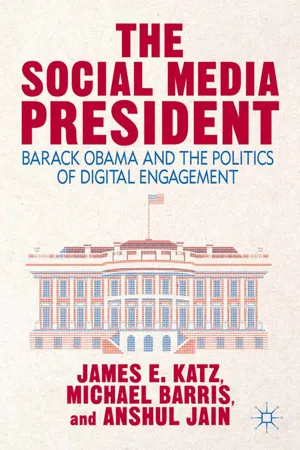
The proliferation of social media has altered the way that people interact with each other - leveling the channels of communication to allow an individual to be "friends" with a sitting president. In a world where a citizen can message Barack Obama directly, this book addresses the new channels of communication in politics, and what they offer.
Information
P A R T I
FRAMING THE ISSUE
C H A P T E R 1
INTRODUCTION AND OVERVIEW
“LET THEM DETERMINE ITS COURSE”
On July 8, 2013, President Barack Obama entered the White House State Dining Room to address a packed chamber of reporters and dignitaries and lay out his new management agenda. He spoke forcefully on behalf of his vision: harnessing communication technology, so effectively deployed in his campaign, for empowering citizen participation in government. His remarks compactly frame the theme of this book. He declaimed:
Back in 2007, when I was first running for this office, I had the opportunity to visit Google headquarters in Mountain View, in Silicon Valley, to discuss ways we could use technology to allow more citizens to participate in their democracy, and bring a government built largely in the 20th century into the 21st century.
After all, we had already set out to build a new type of campaign—one that used technology to bring people together, and then trusted them with that technology to organize on their own. And the idea was simple: instead of bringing more people to the campaign, we wanted to bring the campaign to more people, and let them determine its course and its nature. If you wanted to make phone calls or knock on doors, you didn’t have to come into a field office first, you could just get the information you needed right on your phone and go out there and do it. If you wanted to get your friends involved, then we had the tools to help you connect.
And I very much felt that some of the things that we were doing to help us get elected could also be used once we were elected. . . . Now, once we got to Washington, instead of an operation humming with the latest technology, I had to fight really hard just to keep my BlackBerry.1
THE PROMISE AND ITS APPEAL
President Obama’s oft-repeated assertion is that he wants to draw on the power of digital engagement to tap into the wishes and talents of the American people. He believes that the remarkable results of the computer revolution include the possibility of public participation in national policy—that is, that widespread computer-mediated communication could give individual citizens a hand in affecting the destiny of their country. This idea has stirred not only the imagination of Barack Obama, but of some of the activists and thinkers across academia, industry, and advocacy groupings with whom he has interacted over the years.2 The vision of direct public participation is embraced with particular warmth by those who long to use communication technology to effect dramatic social change.3 Yet the idea also has tremendous resonance with many among the general public who would wish to have their views taken into account, and perhaps even gain widespread adoption. Surely this must be one of the more alluring prospects offered by the dramatic advances in social media technology. To the technology’s most enthusiastic proponents, a new era of equity, democracy, personal empowerment, and interpersonal understanding is about to be realized.
In contrast to these enthusiastic visions, we offer not just a corrective that these dreams are a bit too sanguine, or that progress will be slow. Rather we go further to argue that, in fact, this social media-enabled future is exceedingly difficult to implement with foreseeable technology; its pursuit has real costs, and it may be counterproductive, even if it were to succeed.
Recent scholarship offers valuable insights along both theoretical and empirical axes that shed light on how social media impact the dynamics of elite cues, public opinion, and opinion transmission more generally. What is lacking, however, and what our study attempts, is to push toward a deeper understanding of how presidential social media engagement interacts with the public. We want to provide a sense of what drives policy formulation and implementation in the social media arena at the White House level. We want to survey the reactions and changes that have arisen from high-level social media engagements. Finally, we want to explore the implications for future governance in terms of high-level social media interactions.
MODELS OF AMERICAN GOVERNMENT
In this section, we sketch the evolution of social media and their role as seen by two competing visions of citizen engagement in government. We do this to provide a sense of the kind of citizen engagement endorsed by two Founders of the United States. Drawing on the contrasting models of US government favored, respectively, by Alexander Hamilton and Thomas Jefferson, and placing them in today’s context, it can be said that the underlying tension in the debate over citizen participation in policy-making is between a desire for expertise, on the one hand, and democratic participation, on the other. Hamilton believed that a strong centralized government was needed for business and industry to grow, and for the rights of individuals and minorities to be protected. Jefferson, on the other hand, distrusted professional expertise: he wanted power dispersed among the people both on a philosophical level and as a way to prevent them from being exploited by elites. Hamilton wanted governmental officials to be insulated from the passions of the crowd; Jefferson wanted them exquisitely responsive to the will of the people.4
The US Constitution is designed to maintain a balance of power within the government, implicit in its establishment of checks and balances that induce cooperation and pressures across the three branches of government. The implication is that the Constitution not only favors deliberation but also promotes the blending of expertise with intermittent democratic participation. In fact, fear of “mobocracy” weighed heavily on many of the Founders of the United States. Hamilton in particular sought to have a Constitution capable of serving as a bulwark against the abuses of enraged crowds that he had witnessed at the outbreak of the American Revolution and intermittently in its aftermath.5
With the Constitution as a backdrop, and aware of the cross-pressures elaborated by Hamilton and Jefferson, we reason that relying on “the wisdom of the crowd” to set policy is a far less vital dimension of the political process than opposition and confrontation at the leadership level. Conflicts over broad national policy cannot, and should not, be avoided or short-circuited through reliance on ever-more-powerful social media tools. In the final analysis, social media-based town halls and aggregations of “likes” and tweets do not a representative democracy make.
On the other hand, engaged citizens do make a democracy. Drawing on the competing visions of Hamilton and Jefferson, we can conceptualize a continuum of citizen engagement. For illustrative purposes we can describe several points along the continuum. Starting at the lowest form of engagement, which we could say is close to nonengagement, the citizen takes no active part in governmental affairs but is merely law abiding. The citizen pays taxes and obeys laws but is otherwise inert in terms of governmental activity. The very-low engaged citizen does nothing to learn or express an opinion about politics or policy. A somewhat higher form of engagement is to vote but not learn about issues. The next highest form is to vote and learn about politics but give no meaningful expression to a viewpoint. Still higher engagement is to not only vote and learn about policy but also to take actions that reflect or propagate a viewpoint. This would include discussing politics with neighbors, contributing to a campaign, or taking other steps to make one’s views known outside the voting booth (such as commenting or arguing on blogs or contacting elected officials concerning a policy). The highly engaged citizen is active in suggesting, evaluating, and formulating policy. The highest form of citizen engagement is to decide directly on issues.
The emergence of advanced communication technologies has both deepened and complicated the meaning of engagement. Philip N. Howard explains that “thin citizenship,” where citizens impulsively respond to transient political urges without pondering deeper issues, is promoted by the growing aggregation of detailed personal profiles ready for manipulation. These “data shadows” and “silhouettes” command the sharp interest of political actors.6 The implications of readily available silhouettes are profound. Elected officials, campaigns, or other political advocacy groups can use hypermedia technology to engage not only with individual citizens, but with their data “silhouettes” as well.7 Along the spectrum from total disengagement to full engagement, social media platforms have engendered a number of additional possibilities—both with and without the full knowledge and consent of the individual citizen.
We might say that Jefferson favored the highest form, direct decision-making,8 while Hamilton feared the excessive passions and poor judgments of people if brought together as crowds, and had little patience for ill-informed people participating in political free-for-alls.9
PLATO’S PUZZLE
Social media enthusiasts often embrace the notion that the wisdom of the people should dictate the actions of leaders. Generally, democracy is traced to ancient Athens, but that “cradle of democracy,” of course, never allowed full participation of all its residents (i.e., only male adult citizens were allowed to participate); nor did those it empowered vote on all decisions. Rather, Athens practiced a republican form of government. Nonetheless, the idea of full participation by citizens was at least considered by ancient Greek political philosophers, though some such as Plato did not think it was a good idea. If we are to live together, the Greek philosophers asked, how are the rules for this shared existence to be determined? How are the goals of the society to be established? Who should have say over the direction?
Plato, for one, examined, and then rejected, the idea of society being steered by the will of the people. In an analogy from The Republic, Plato described how a ship’s navigator must rely on his expert training and greater wisdom to guide the ship of state, rather than be guided by its brawling, ignorant crew. Moreover, Plato warned in his ship analogy that the crew (the mob) was not only incompetent to make proper judgments, but also would too easily be suborned by manipulators. Plato strongly rejected the idea that democracy should be used as the arbiter of governmental policy, and argued instead that sophisticated and wise experts should be relied upon. Although he never used the term “lobbyist” or “special interest,” he certainly alluded to their ancient equivalents and warned of their corrosive influence. Plato’s criticisms were based on his experience with early democracy as he witnessed it in Athens. Yet he was arguing not only against an early form of “wisdom of the crowds” but also against the philosophical tradition of shared power and responsibility. Like it or not, Plato was enough of a realist to recognize that democracy had taken deep root in Athens, and a degree of crowd wisdom was already being practiced. For the many philosophers and political leaders arrayed against him, an important question remained as to how the will of the people should be transformed into the actions of the leaders. Plato’s objection to democracy notwithstanding, that question continues to bedevil all who want to see the noble impulse of democracy put into action. The problem is an enduring one, and the energy and excitement that go into addressing it not only continue unabated but have even intensified with the prospect of “crowdsourcing” the overthrow of old regimes, as witnessed by a series of ballyhooed social media revolutions arcing from Tunisia and Egypt to the Ukraine and Moldova, and whose reverberations trouble Iran and China.
LINES OF INQUIRY
DEMOCRACY THROUGH TECHNOLOGY
In essence, one goal of this book is to explore a well-intentioned program in pursuit of democratic ideals through technological dreams. To foreshadow our findings, despite initially vigorous pursuit of a program of participation via social media, and valuable steps toward transparency in some governmental operations, the possibility of democratic participation via social media remains hovering, mirage-like, on the horizon. While social media tools serve as useful devices for information dissemination and democratic mobilization, among large groups they are largely ineffective—if not undesirable—as tools of democratic deliberation and decision-making on major policy issues. (We make this judgment not on the basis of sentiment, since our own values lead us to favor democratic deliberation and decision-making, but rather on the hard realities of discursive practices, information processing, and human cognition.) Beyond the technical and bureaucratic reasons, we see that what is required are political leaders who struggle to persuade publics, no less than the opposition figures who challenge them. Leaders need these skills to fulfill their visions. Relying on technocrats armed with ever-better opinion aggregation tools, for example, would not lead to a system that would be “too big to fail” but rather to a system that is bound to fail.
DIGITAL MEDIA’S EVOLVING ROLE IN PRESIDENTIAL POLITICS
An important background topic of this book is the way digital media technologies have evolved over the past two decades to play a generally important role in presidential politics. We attend to this in terms of campaigns for the White House from 1992–2012, as well the ways the White House has historically used digital media to inform, guide, engage, an...
Table of contents
- Cover
- Title
- Part I Framing the Issue
- Part II The Obama Presidency
- Part III Perspectives and Outlook on the Social Media President
- Appendix: Scholarship of Digital Media and the American Political Landscape
- Notes
- Index
Trusted by 375,005 students
Access to over 1.5 million titles for a fair monthly price.
Study more efficiently using our study tools.
Frequently asked questions
Yes, you can cancel anytime from the Subscription tab in your account settings on the Perlego website. Your subscription will stay active until the end of your current billing period. Learn how to cancel your subscription
No, books cannot be downloaded as external files, such as PDFs, for use outside of Perlego. However, you can download books within the Perlego app for offline reading on mobile or tablet. Learn how to download books offline
Perlego offers two plans: Essential and Complete
- Essential is ideal for learners and professionals who enjoy exploring a wide range of subjects. Access the Essential Library with 800,000+ trusted titles and best-sellers across business, personal growth, and the humanities. Includes unlimited reading time and Standard Read Aloud voice.
- Complete: Perfect for advanced learners and researchers needing full, unrestricted access. Unlock 1.5M+ books across hundreds of subjects, including academic and specialized titles. The Complete Plan also includes advanced features like Premium Read Aloud and Research Assistant.
We are an online textbook subscription service, where you can get access to an entire online library for less than the price of a single book per month. With over 1.5 million books across 990+ topics, we’ve got you covered! Learn about our mission
Look out for the read-aloud symbol on your next book to see if you can listen to it. The read-aloud tool reads text aloud for you, highlighting the text as it is being read. You can pause it, speed it up and slow it down. Learn more about Read Aloud
Yes! You can use the Perlego app on both iOS and Android devices to read anytime, anywhere — even offline. Perfect for commutes or when you’re on the go.
Please note we cannot support devices running on iOS 13 and Android 7 or earlier. Learn more about using the app
Please note we cannot support devices running on iOS 13 and Android 7 or earlier. Learn more about using the app
Yes, you can access The Social Media President by J. Katz,M. Barris,A. Jain in PDF and/or ePUB format, as well as other popular books in Politics & International Relations & Digital Marketing. We have over 1.5 million books available in our catalogue for you to explore.