- English
- ePUB (mobile friendly)
- Available on iOS & Android
eBook - ePub
About this book
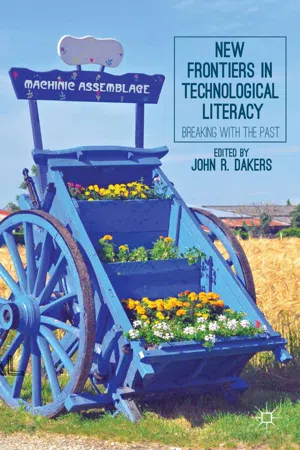
This book attempts to rethink the concept of technological literacy in a modern context, not only in terms of a subject area taught in schools, but also as an important general concept that all citizens should engage with. As this book will illustrate, the concept of technological literacy has no universally agreed definition.
Information
Topic
EducationSubtopic
Computer Science GeneralConceptualizing Technological Literacy
Chapter 1
Technological Literacy as a Creative Process of Becoming Other
John R. Dakers
Introduction
Samuel Butler offers a somewhat dystopic view of Victorian society in his now famous satire, Erewhon, published in 1872. In it, he tells the story of a fictitious country where the strange inhabitants have formed a society that forbids the use of modern technology (only old, established, and nonthreatening technology is allowed). This society actively suppresses any expression of originality, experimentation, or creativity. It further contends that individual scholarship can only ever be made manifest in a curriculum that develops proficiency in the study of what is referred to as “unreason and hypothetics.” Indeed, a venerable Erewhonian professor of worldly wisdom states that “it is not our business to help students to think for themselves. Surely that is the very last thing which one who wishes them well should encourage them to do. Our duty is to ensure that they shall think as we do, or at any rate, as we hold” (189).
Despite the superb efforts of many of my colleagues from around the world to challenge this perspective, I believe that technology education, in its present incarnation, for the most part, fits rather neatly into Erewhonian culture. In this chapter, I want to explore a completely new alternative for the delivery of technology education; an alternative that will focus exclusively on the development of technological literacy. In so doing, I hope to promote (provoke) some discussion about alternative pathways, as well as alternative potentialities that we might consider, or indeed discover.
Drawing primarily on the work of Gilles Deleuze, a French poststructuralist philosopher who incidentally was influenced by Butler’s Erewhon, I shall explore the concept of “becoming technologically literate.” This reflection differs from the many other important questions frequently asked about technology education. Rather than explore technology education as something homogeneous, I will instead approach the subject from a heterogeneous perspective. In so doing, I will deconstruct the notion of technology education as a distinct and objective subject domain that studies the given technologies and techniques that apply to the known world that we, as human beings, have constructed for ourselves. Instead, I will reconstruct the world as one made up of multiple dimensions and perspectives, one distinct from static objective realities. This will represent a progressive and radical departure from the world of education as elucidated in cultures similar to Erewhon.
Essentialism and Classification
The world that we occupy today continues to be shaped by the philosophy of Plato and Aristotle. Despite being teacher and student, both philosophers had significantly different perspectives on the way that we humans perceive the world. However, they have both had an enduring impact on the world of philosophy and on the way that we human beings continue to make sense of the world.
Plato developed the concept of ideal forms. These ideal forms represent the intrinsic nature or indispensable quality of something that determines its character: a property of something without which it would simply not exist; a thing’s essence. Significantly, for Plato, these forms were not subject to alteration; they were already given, already established perfect manifestations of all things hidden somewhere in the dark recesses of the mind. In order to know something or do something, one has to have a conception of its ideal form, its ultimate state of perfection, its essence: “Plato believed that the essence of a thing is the form in which it participates” (Korsgaard, 1996, p. 2). In other words, it is the ideal form that constitutes perfection. This applies equally to organic things, nonorganic things, and metaphysical things like a poem. Human beings, for example, tend to be inclined, depending on circumstances and motivational factors, to strive toward perfection. We continue to be, alas, perennially disappointed in this endeavor. However, this continual striving toward perfection constituted the ethical question that was, for Plato, of primary importance: “how should one live?” or “what constitutes a good life?” At the summit of this order is the form of the good to which all human beings must strive toward (June, 2011, p. 91). For Plato, these ideal forms can never actually be achieved or sensorially experienced by human beings. They can only be known, and human beings know these ideal forms intrinsically: they are genetic forms of knowledge that have been predetermined for us (Korsgaard, 1996; June, 2011). By way of illustration, consider a potter or a carpenter turning a bowl. They want to produce a bowl that is perfectly cylindrical in form, but clearly, no human being is capable of creating the ideal form of a perfect circle, so the bowl produced will constitute a copy of the ideal cylindrical form, an ideal circle. The closer the potter or carpenter is able to get to creating a perfect circular form, the closer to perfection he or she is able to get. This Platonic form of the good is a process or an activity that has orientated human beings toward leading their lives such that their endeavors would ultimately manifest in arete—that is, to strive toward excellence, toward being good at what they are, to become virtuous. However, virtue expressed in terms of arete can only ever be judged in terms of its relation to the general ideal form of the good, just as the potter’s cylindrical form can only ever be judged in terms of how close it resembles an ideal circle; we are never likely to achieve it, but it serves as a guiding principle. Examinations follow this line of reasoning to some extent: the closer to (re)presenting the preestablished ideal form, the higher the grade achieved; the further away, the lower the grade achieved. Examinations, particularly technology education examinations, leave no room for alternative perspectives.
Plato’s ontological arrangement in the form of the good is, however, trenchantly rejected by his student Aristotle, who asserts “the fundamental existence of sensible particulars against that of general entities. The species and genera that classify individuals exist, but they are only secondary in the ontological scheme” (Lawson-Tancred, 1995, pp. 406–407). In other words, Aristotle rejects the idea that particular definitions must ultimately originate from or be determined by some general, superior, and hierarchical ideal form: “If one asks what something is, which is to ask for its definition, then the only sort of informative answer that can be given [for Aristotle] is one that refers to its species. And if one asks what that is, then one must refer to the subgenus in which it is most immediately included, and so on up to the highest genus to which it can belong, which is that general category of substance” (Lawson-Tancred, 1995, p. 407).
Aristotle’s categories, then, are phenomenal and realized, not in the Platonic ideal sense, but as something substantial. The Aristotelian categories, writ large, are genus, species, and individual. This system of classification has formed the bedrock for the way we have come to identify and understand the world to this day. Significantly, it is not confined to biological systems, but it informs a system of classification that covers the entire spectrum of categorization that prevails in all disciplines, including those associated with technoscientific studies and technology education. Typical forms of assessment in technology education include questions that relate to categories: name different types of wood (hardwood, softwood, and human-made boards), for example.
“Aristotle’s Categories is a singularly important work of philosophy . . . [that has] engaged the attention of such diverse philosophers as Plotinus, Porphyry, Aquinas, Descartes, Spinoza, Leibniz, Locke, Berkeley, Hume, Kant, Hegel, Brentano and Heidegger (to mention just a few), who have variously embraced, defended, modified or rejected its central contentions. All, in their different ways, have thought it necessary to come to terms with features of Aristotle’s categorical scheme” (Studtmann, 2007). Aristotle, in his treatise, attempts to enumerate the most general kinds of categories (genera), subdivide them into workable entities (species), and then finally reduce them to their essential qualities (individuals). These categories enable us to differentiate between objects given in the world and so make sense of the world. A cat is not a dog, nor is a tree a mountain, for example. A cat has an essential quality that is categorically different from the essential qualities representing a dog.
Both Plato and Aristotle rely on essential qualities in order for their theses to make sense. As such, their worlds can only ever be perceived of from an anthropocentric perspective. It is human beings, as subjects, who discover and (re)present the world from their own perspective along the lines explicated by Plato and Aristotle.
Conventional Thought on the Concept of a Whole
I have previously asserted that there is no such thing as a car (Dakers, 2014). In conventional thinking, a car is thought of as an objective whole entity, one that has some essential enduring quality expressed in terms of the parts that combine to give it or them an enduring identifiable trait: “The essence of a thing is that which explains its identity, that is, those fundamental traits without which an object would not be what it is. If such an essence is shared by many objects, then possession of a common essence would also explain the fact that these objects resemble each other and, indeed that they form a distinct natural kind of things” (Delanda, 2002, p. 9; italics in original).
In other words, there are defining characteristics that explain an object and so differentiate it from other objects. In so doing, these characteristics combine to form part of a classifiable, identifiable species, or “wholes,” that will all resemble each other (trees, humans, cows, or cars, for example). Thus, in conventional thinking, a whole is generally considered to be something that is logically deducible from general principles. For example, it is universally accepted that the general principle of combining a variety of specific entities—wheels, windscreens, seats, engines, and so on—in a specific way will form a quantitative whole that we have come to know as being a car. Moreover, a whole—in this case a car—will also have certain essential qualities that are expressed in terms of its parts. A car is essentially the combination of a number of recognizable and established components that, when combined, are identifiable as belonging to our conception of what constitutes a car. If, for example, only two wheels were to form part of the ensemble, we would reconceptualize the whole as being a bicycle or a motorbike. A less complex example of a whole is water. The combination of two specific atoms in a specific way, one of oxygen and two of hydrogen, will form a quantitative whole that we have come to understand as being water, or H2O. A whole in conventional terms, then, is an entity—whether material or immaterial (a car, water, a human, or thoughts expressed in the form of a poem, for example)—that comprises the sum of its parts, is identifiable (or at least has the capacity to be identified), and is, significantly, subject to dissolution or complete loss of identity should a component part be removed. If we remove a component from a car—its engine, for example, which is in itself a whole—we would completely change the constitution of the car. It would no longer be recognized as being a car, given that a car, thought in conventional terms, requires an engine as part of its established identity. In this respect, a whole can only be considered as being a whole, providing it is capable of being given a definitive classification. An entity that cannot be fully classified (a car without an engine, for example), can never be fully known and so cannot be considered to be whole in the terms discussed. A human being who does not fit the ideal form (Plato), or does not conform to the essential classification that constitutes a human being (Aristotle), cannot be considered to be definable as a human being. While they may resemble human beings, they need extended forms of classification in order to differentiate them from the essential form to which they are related (e.g., handicapped, schizophrenic, slow, hyperactive).
Given, then, that conventional thinking considers that a whole can only be understood in terms of it having a specific and definitive identity, that identity must imply a boundary of some sort, one that serves to distinguish one whole from another. A “normal” human being having two legs, for example, is distinguished from a human being who has only one leg. A classificatory boundary is established in order to differentiate the two. Another obvious example is a map. A map of Europe defines the boundaries that distinguish one country from another. The whole of Germany is identified as something distinct from the whole of Italy. Each country is, in turn, made up of identifiable areas that are also distinguished by towns and cities and so forth. The distinguishing areas or parts that together constitute the whole of Germany distinguish it from Italy, which forms another whole country made up of different parts. Moreover, other distinct parts help formulate the essential quality that constitutes Germany and make it distinct: language, architecture, gastronomy, and culture, to name but a few. Germany was, however, in the past, two distinct wholes: East Germany and West Germany. They were considered to be two separate entities then: two identifiable, enduring, and bounded countries each having different political and cultural identities. However, by redefining the boundaries in all respects, they have come together to form a new whole known as Germany. Change has occurred. The enduring properties of two formerly distinct and identifiable wholes have altered, and boundaries have been redefined. This puts into question the enduring properties of wholes as predicated in conventional thought. The boundaries defining two identifiable entities have become porous, enabling the formation of a novel entity, one having new identifiable characteristics.
Nevertheless, no matter what whole it is that we are dealing with as human beings, we continue to define wholes, or entities, as separate, identifiable wholes that can only ever be analyzed in terms of their parts. Thus we define wholes, ultimately, in terms of their essential properties. Our entire world is classified in this way especially as a result of scientific classification predicated on an Aristotelian system of classification. There are, thus, very clear scientific identities, and so boundaries, imposed on the concept of wholes that tend to externalize, objectify, and separate things into clearly identifiable, enduring, stable components ranging from atomic structure to the properties of the universe. This is how we human beings continue to make sense of the world.
Wholes can be technological, metaphysical, or naturally occurring entities. A car or a computer may be considered to be a technological whole, the complete works of Shakespeare as a metaphysical whole (presented in some actual form like a book or a play), while a tree or a human being may be considered as a natural whole. Whether technological, metaphysical, or natural conventional thinking requires that wholes are able to be reduced to their essential qualities. However, Deleuze (1988) and later Deleuze and Guattari (1987) offered an alternative way to consider the world by introducing and developing the concept of assemblages.
The Concept of Assemblages
The philosophy of Deleuze is complex, and any full explanation of his oeuvre and associated terminology are considerably beyond the scope of this chapter. One very important concept in Deleuzian thought, however, is that of the assemblage. Some of the explanations offered for an assemblage in this book may be considered as overlapping with another important Deleuzian concept known as multiplicity. While the two concepts differ in degree, they can be interpreted as having some common attributes depending on the context in which they are set. In order to simplify my interpretation of an assemblage, I have elected to use only the term assemblage throughout this chapter.
Following the mathematics developed originally by Gauss and later expanded by Riemann, a new form of mathematics was developed that completely changed aspects of the mathematics developed by Descartes. This is in combination with the philosophy developed by Bergson, Deleuze, and Guattari offer a calculus of change: nonenduring wholes that exist without having been given some external set of coordinates, as determined by some external hierarchy, such as to render an established universally accepted identity for any gi...
Table of contents
- Cover
- Title Page
- Copyright Page
- Dedication
- Contents
- Foreword: Advancing and Questioning Literacy
- Acknowledgments
- Introduction: Breaking with the Past
- Conceptualizing Technological Literacy
- The Hidden Voice of Youth
- Gender and Technology
- Sustainability
- Technological Literacy in China
- Education and the Concept of Technological Literacy
- Technological Literacy in the Workplace
- About the Contributors
Trusted by 375,005 students
Access to over 1.5 million titles for a fair monthly price.
Study more efficiently using our study tools.
Frequently asked questions
Yes, you can cancel anytime from the Subscription tab in your account settings on the Perlego website. Your subscription will stay active until the end of your current billing period. Learn how to cancel your subscription
No, books cannot be downloaded as external files, such as PDFs, for use outside of Perlego. However, you can download books within the Perlego app for offline reading on mobile or tablet. Learn how to download books offline
Perlego offers two plans: Essential and Complete
- Essential is ideal for learners and professionals who enjoy exploring a wide range of subjects. Access the Essential Library with 800,000+ trusted titles and best-sellers across business, personal growth, and the humanities. Includes unlimited reading time and Standard Read Aloud voice.
- Complete: Perfect for advanced learners and researchers needing full, unrestricted access. Unlock 1.5M+ books across hundreds of subjects, including academic and specialized titles. The Complete Plan also includes advanced features like Premium Read Aloud and Research Assistant.
We are an online textbook subscription service, where you can get access to an entire online library for less than the price of a single book per month. With over 1.5 million books across 990+ topics, we’ve got you covered! Learn about our mission
Look out for the read-aloud symbol on your next book to see if you can listen to it. The read-aloud tool reads text aloud for you, highlighting the text as it is being read. You can pause it, speed it up and slow it down. Learn more about Read Aloud
Yes! You can use the Perlego app on both iOS and Android devices to read anytime, anywhere — even offline. Perfect for commutes or when you’re on the go.
Please note we cannot support devices running on iOS 13 and Android 7 or earlier. Learn more about using the app
Please note we cannot support devices running on iOS 13 and Android 7 or earlier. Learn more about using the app
Yes, you can access New Frontiers in Technological Literacy by J. Dakers in PDF and/or ePUB format, as well as other popular books in Education & Computer Science General. We have over 1.5 million books available in our catalogue for you to explore.