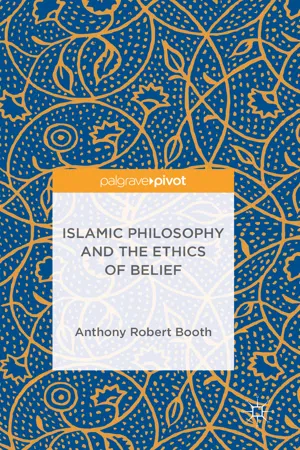
In this book the author argues that the Falasifa, the Philosophers of the Islamic Golden Age, are usefully interpreted through the prism of the contemporary, western ethics of belief. He contends that their position amounts to what he calls 'Moderate Evidentialism' – that only for the epistemic elite what one ought to believe is determined by one's evidence. The author makes the case that the Falasifa's position is well argued, ingeniously circumvents issues in the epistemology of testimony, and is well worth taking seriously in the contemporary debate. He reasons that this is especially the case since the position has salutary consequences for how to respond to the sceptic, and for how we are to conceive of extremist belief.
- English
- ePUB (mobile friendly)
- Available on iOS & Android
eBook - ePub
Islamic Philosophy and the Ethics of Belief
About this book
Information
Topic
PhilosophieSubtopic
Épistémologie en philosophie© The Author(s) 2016
Anthony Robert BoothIslamic Philosophy and the Ethics of Belief10.1057/978-1-137-55700-1_11. Falsafa as Ethics of Belief
Anthony Robert Booth1
(1)
University of Sussex, Brighton, UK
Abstract
In this chapter, I begin to make the case for considering the great, medieval Islamic philosophers—the falasifa—through the prism of contemporary, Western scholarship on the ethics of belief. Within the Islamic intellectual movement, I identify three types of thought that can be classified as Evidentialist, non-Evidentialist and anti-Evidentialist. I argue that the falasifa are best described as endorsing a kind of Moderate Evidentialism, and that this view deserves consideration in the modern debate on the ethics of belief. I contrast this view with what I take to be its unique rival in the Islamic context, a view I call Moderate anti-Evidentialism.
Keywords
IslamEvidentialismFideismPragmatismFalsafaBeliefal-GhazaliWilliam JamesW.K. CliffordA Note on Translation, Transliteration, Dates, and References
Throughout this manuscript, I have transliterated Arabic words into English, with the use of diacritical marks, and have put the words in italics. However, I used Anglicised versions of certain well-known Arabic words and names. For instance, I used ‘Koran’ instead of ‘Qur’ān’ or ‘hadith’ instead of ‘hādīth’, and the names ‘al-Kindi’, ‘al-Farabi’, ‘al-Ghazali’ instead of ‘al-Kindī’, ‘al-Farābī’, ‘al-Gḥazālī’. I used the Latinate names ‘Averroes’ for ‘Ibn Rushd’ and Avicenna for ‘Ibn Sīnā’. I used diacritical marks for the transliteration of the names of the lesser-known Islamic philosophers, but did not use them for the word falasifa and its cognates, since I used it so often. When quoting and referencing works in medieval Islamic philosophy, I used the full name of the work in English translation in italics, followed by page numbers; for those referred to in the original Arabic, I have used the Arabic name of the work, also in italics, with a endnote on the translation. All works, in translation or in the original, are referenced at the end of the book, before my list of secondary sources (by which I mean all non-medieval works). All dates used refer to the Common Era calendar.
1.1 Knowledge in Islam
In Knowledge Triumphant, Franz Rosenthal argues that the central leitmotif of all Islamic civilization is the concept of knowledge. 1 Understanding the Islamic notion of knowledge, according to Rosenthal, is necessary if one is to understand Islam, the civilisation to which it gave birth, and the particular historical course it has taken. Indeed, according to Rosenthal, “Islam means Knowledge”. The position is prima facie defensible, as Rosenthal suggests, when one considers that the Koranic term for the time preceding the Koranic revelation is jāhilīyah, a term usually translated as ‘ignorance.’ 2 The term suggests that the key difference between the time preceding the revelation and the time following it is that the latter was a time when people in this world came to have knowledge: specifically, knowledge given unto them by the instruments of revelation. 3 To the modern epistemologist, this claim will raise several questions: are we here talking about the claim that people living in pre-Islamic times merely had true beliefs about the world, or that they had only justified, true beliefs (falling short of knowledge) about the world? And if the latter, what does Islam tell us is the crucial difference between justified, true belief and knowledge? Are we to think that those who were alive in the jāhilīyah period lived in complete ignorance of any proposition? Or were they merely ignorant of certain, important propositions? If so, which ones? Did they lack merely propositional knowledge, or also practical? Were they living in ‘deep’ ignorance (where there was no way they could have acquired relevant evidence) or living in culpable ignorance?
Rosenthal’s work, although presented as a work of epistemology, does not answer these questions. What we get, instead, is a historical study on how the Arabic concept ʿilm, ‘knowledge’, was taken by the various intellectual movements of medieval Islam, as well as how centrally this concept figured in all of these movements. As he puts it, “there is no other concept that has been operative as a determinant of Muslim civilization in all its aspects to the same extent as ʿilm” (Rosenthal 2007, p. 2). Rosenthal even advances the bold thesis that understanding the centrality of the concept of knowledge in Islam is crucial to understanding the turn the Islamic world has taken in recent times, and how that concept has indeed underwritten a species of Islamic fundamentalism. 4 Contrary to Rosenthal, however, I contend that the epistemology of the medieval Islamic philosophers in fact gives us the resources for not only understanding extremist belief, but further grasping what is uniquely wrong with it. As far as the medieval Islamic philosophers (falasifa) were concerned, the core philosophical issue was not about knowledge in particular, but about what constitutes justified belief. This is of course also a traditional concern in epistemology, but unless one makes the substantive assumption that nothing but evidence (or epistemic reason) can justify belief, then we can consider that the topic outruns epistemology. As such, I consider the falasifa’s intellectual project as one primarily engaged in the ethics of belief. That is, they were concerned with understanding the epistemic (and in many cases the non-epistemic) conditions of justified belief; in particular, they sought to understand when belief is blameworthy, and, as in the case of apostasy, when it is punishable by death. I will frame the views of the falasifa in terms of the contemporary debate in Western philosophy on the ethics of belief. Then, I will show how falsafa occupies a unique and defensible position-one that ought to be of considerable interest to those working on the issues sans phrase (that is, in a way that ignores whether the issues belong to a particular tradition).
Rosenthal notes that the Arabic concept ʿilm differs from the English concept of knowledge. For instance, in modern English ‘knowledge’ does not admit of a plural formation, whereas ʿilm in Arabic does, as per ‘ulum. More significantly, ʿilm can admit of degrees and can be graded, whereas ‘knowledge’ in modern English cannot, at least not if used about propositional knowledge. Indeed, some contemporary epistemologists have taken as data the fact that ‘knowledge-how’ is gradable, where propositional knowledge is not. The former but not the latter locution seems felicitous here:
- I sort of know how to play the guitar.
- I sort of know that Brighton is in England.
And this bit of data is then taken to be part of a broader set of evidence for the claim that practical knowledge cannot be reduced to propositional, theoretical knowledge. In English the notion of justification (as applied to beliefs) does seem to be gradable, however. The following locutions seem perfectly felicitous, for instance:
- James is more justified than Andrew in believing that he is good at rugby.
- I have better justification for the belief that there is a Higgs Boson particle than I had ten years ago.
- James is sort of justified in believing that his date will arrive on time.
As we may infer from the above examples, the English notion of justification (but not knowledge) is gradable; yet, the Arabic notion of ʿilm is gradable. This distinction gives us prima facie reason to think that when the falasifa wrote about ʿilm, they had in mind a concept closer to epistemic justification than knowledge. Again, the fact that we can felicitously speak of ‘justifications’ and ‘reasons’ in English (where talk on ‘knowledges’ sounds odd) gives us reason to prefer (or at least consider as a plausible alternative) an interpretation where the Islamic medieval philosophers were primarily interested in the conditions for justified belief, rather than the concept of knowledge. The primacy of the issue of apostasy, as we shall see, further vindicates this last claim, for according to even the most notoriously strict accounts of apostasy in medieval Islam (for instance those of al-Ghazali) one can fail to be an apostate when one fails to know the claims of Islam. Most importantly, however, the falasifa themselves mirror the gradability of the Muslim concept of ʿilm in their epistemology, where, in Aristotelian fashion, they painstakingly enumerate the various differentiae to which knowledge-as-such is subject, and, in neo-Platonic fashion, the hierarchy that dominates that taxonomy. 5 This countenanced gradability concerning the subject of ‘knowledge’, when better considered as ‘justified belief’, may provide the keys to understanding a unified view of the falasifa’s take on the relationship between faith and reason, with respect to well-known problems regarding interpreting both their individual views and their political philosophy.
1.2 The Ethics of Belief in the West
Let us grant the claim that it is initially plausible that the falasifa were at least somewhat concerned with the ethics of belief. Next, let us consider the modern, Western debate on this issue. The debate has become a complex one, and as with any topic in contemporary Western philosophy, replete with hyper-specialised jargon and hair-splitting distinctions. The way I conceive the debate here will necessarily look blunt-edged to the specialist, but I hope it will be both detailed to be useful, yet general enough to serve the broad ends of this particular book.
Traditionally, the ‘ethics of belief’ has been taken in the Western philosophical world of the last two or three centuries to denote a debate between two groups of philosophers considering the question regarding what is justified belief. The first—Evidentialists—think that nothing but evidence, or more broadly, epistemic reason (reason to think that a proposition ‘p’ is true), can justify a subject S’s believing that p. Not only do Evidentialists think that evidence that p is necessary for S’s belief that p to be justified, they also think that no consideration other than evidence is relevant to whether S is justified in believing that p. They adhere to:
Evidentialism
S’s belief that p is justified iff S has epistemic reason to believe that p.
The second group I term non-Evidentialists. This group of philosophers simply deny the truth of Evidentialism, and think the following:
Non-Evidentialism
S’s belief that p is justified iff S has, for reasons of sort α, β, γ, δ, either one or a combination of α, β, γ, δ reason to believe that p.
Non-Evidentialists may admit that S’s having epistemic reason to believe that p is necessary for S to be justified in believing that p, but they never admit that it is sufficient. That is, they deny that having epistemic reason to believe that p always entails that S is justified in believing that p.
The archetypal Evidentialist is usually considered to be W.K. Clifford, a late nineteenth century British mathematician 6 and philosopher, who wrote the following in The Ethics of Belief:
At first glance, Clifford’s view follows Locke and the British empiricists 7 ; however:It is wrong, always, everywhere, and for anyone, to believe anything upon insufficient evidence. (Clifford 1877)
Faith is nothing but a firm assent of the mind: which if it be regulated, as is our duty, cannot be afforded to anything, but upon good reason; and so cannot be opposite to it. He that believes, without having any reason for believing, may be in love with his own fancies; but neither does he seek truth as he ought, nor pays the obedience due to his maker, who would have him use those discerning faculties as he has given him, to keep him out of mistake and...
Table of contents
- Cover
- Frontmatter
- 1. Falsafa as Ethics of Belief
- 2. Certainty and Prophecy
- 3. Prophecy and Politics
- Backmatter
Trusted by 375,005 students
Access to over 1.5 million titles for a fair monthly price.
Study more efficiently using our study tools.
Frequently asked questions
Yes, you can cancel anytime from the Subscription tab in your account settings on the Perlego website. Your subscription will stay active until the end of your current billing period. Learn how to cancel your subscription
No, books cannot be downloaded as external files, such as PDFs, for use outside of Perlego. However, you can download books within the Perlego app for offline reading on mobile or tablet. Learn how to download books offline
Perlego offers two plans: Essential and Complete
- Essential is ideal for learners and professionals who enjoy exploring a wide range of subjects. Access the Essential Library with 800,000+ trusted titles and best-sellers across business, personal growth, and the humanities. Includes unlimited reading time and Standard Read Aloud voice.
- Complete: Perfect for advanced learners and researchers needing full, unrestricted access. Unlock 1.5M+ books across hundreds of subjects, including academic and specialized titles. The Complete Plan also includes advanced features like Premium Read Aloud and Research Assistant.
We are an online textbook subscription service, where you can get access to an entire online library for less than the price of a single book per month. With over 1.5 million books across 990+ topics, we’ve got you covered! Learn about our mission
Look out for the read-aloud symbol on your next book to see if you can listen to it. The read-aloud tool reads text aloud for you, highlighting the text as it is being read. You can pause it, speed it up and slow it down. Learn more about Read Aloud
Yes! You can use the Perlego app on both iOS and Android devices to read anytime, anywhere — even offline. Perfect for commutes or when you’re on the go.
Please note we cannot support devices running on iOS 13 and Android 7 or earlier. Learn more about using the app
Please note we cannot support devices running on iOS 13 and Android 7 or earlier. Learn more about using the app
Yes, you can access Islamic Philosophy and the Ethics of Belief by Anthony Robert Booth in PDF and/or ePUB format, as well as other popular books in Philosophie & Épistémologie en philosophie. We have over 1.5 million books available in our catalogue for you to explore.