eBook - ePub
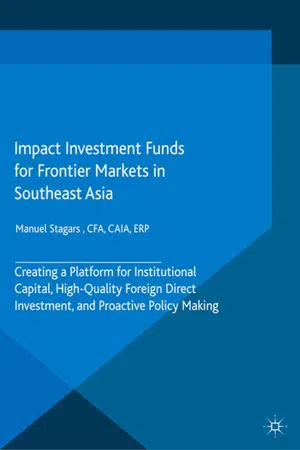
Impact Investment Funds for Frontier Markets in Southeast Asia
Creating a Platform for Institutional Capital, High-Quality Foreign Direct Investment, and Proactive Policy Making
- English
- ePUB (mobile friendly)
- Available on iOS & Android
eBook - ePub
Impact Investment Funds for Frontier Markets in Southeast Asia
Creating a Platform for Institutional Capital, High-Quality Foreign Direct Investment, and Proactive Policy Making
About this book
Until now, most socially responsible and impact investments have centred on developed markets, with growth potential and investment opportunities in the frontier economies of countries such as Cambodia, Laos, Myanmar, and Vietnam being mostly overlooked. While some individuals and organizations have begun to develop responsible investment opportunities with these countries in mind, large new sources of capital for development could still emerge.
This book explores the greater potential for global investment in Southeast Asia, and the ways in which socially responsible investment styles can be used in their developing economies. It demonstrates how the benefits of investment could create a robust platform for separate stakeholders, including governments, non-governmental organizations, development banks, the financial sector, and small and medium sized enterprises. The author explores how shaping collaborative sustainable investment policies could speed up inclusive development, address the needs of those at the bottom of the pyramid, and ensure sustainable future growth.
Information
1
Impact Investment: Where Are We Now?
Investors increasingly look beyond the prospects of simply collecting financial returns. They want to do something worthwhile with their investments, and are even willing to forgo a small portion of profits to make sure this is the case. To meet this growing demand, investment banks are beginning to set up socially responsible investments (SRI) and impact investment funds for their clients. Projects satisfy impact criteria when they involve positive social or environmental change, regardless of their economic or political environment. Because they also require a return on investment, they inhabit a different paradigm from donations or aid programs. To clarify what exactly impact investment entails, we will establish a definition of the investment strategy as most academics and practitioners understand it.
Even though this book focuses on the frontier economies in Southeast Asia, impact investment makes sense in developed countries as well. In fact, most funds of this investment strategy currently concentrate on developed countries. A joint study of impact investment by UNCTAD and the United States Department of State noted that over 90 percent of impact investment funds focus on the developed world. In North America and Europe, capital flows mostly in social impact and renewable energy projects. Estimated impact investments presently range from US$30 billion to US$100 billion, depending on which sectors and activities are defined as impact investing. According to JPMorgan, the impact investment market has the potential to reach US$1 trillion of assets under management (AUM) by 2020, with profits up to US$667 billion.1 Among developing economies, Latin America and the Caribbean receive most impact investment, followed by Africa and South Asia.2 A key objective in promoting the impact investment strategy should focus on more impact investment to developing countries, and especially least-developed countries (LDCs). We will examine the geographical focus of impact investment in more detail when we explore the currently available impact funds in this chapter.
The concept of impact investment seems straightforward, but some of its investment instruments are rather complex and therefore largely misunderstood by policy makers, potential investees, and investors. As an investment strategy, impact investment spans different asset classes, namely impact equity, impact fixed income, and impact alternatives (private equity, venture capital, real estate, absolute return). Several investment funds focus on fostering social entrepreneurship that spans all three asset classes. Even though these funds have a broader focus than the frontier countries in the ASEAN, this chapter introduces some of the funds with a social impact mandate and the social enterprises they invest in. This chapter will also explain social impact bonds (SIBs) and development impact bonds (DIBs), which hold much promise as impact investment instruments, and other ways for the public sector to mobilize private finance. It also introduces the logic behind blending different impact asset classes in dedicated investment funds. Next to a sound financial structure of investment vehicles, sourcing and managing impact investment is highly important for funds to build a track record. This chapter also gives an introduction to the roles of an impact fund manager or other investment intermediary who sources investments and selects them for a portfolio. The manager must then watch the portfolio investments and makes sure that investees use capital for productive uses. We will look into positive and negative screens that allow a first assessment of potential investee companies and projects and discuss other strategies such as mission lock to achieve alignment between assets in an impact portfolio and the mandate of impact investors.
What is impact investment?
Monitor Institute defines impact investment as “making investments that create social and environmental value as well as financial return.”3 Kellogg Professor Jamie Jones defines impact investment as “the use of for-profit investment to address social and environmental problems.”4 Impact investing comprises all forms of financing from seed and early-stage risk capital all the way through to debt and growth capital.5 In any event, the investment strategy is outcomes-driven and centers around a positive result in society or the environment through profitable capital investments. Any impact-driven organization can be a recipient of impact investment, provided it can deliver measurable social or environmental impact and financial return.
When investors and entrepreneurs hear about granting capital to social and environmental causes, especially in developing countries, many of them think first of charity and development aid instead of investment. Most of them believe they perfectly understand what the term impact investment seeks to describe, but more often than not, they confuse it with non-profit donations and philanthropy. It is correct that the frontier markets of Southeast Asia absorb much funding of this kind: Cambodia alone receives grants of about US$1 billion per year from various donors.6 In contrast to aid, impact investment involves an investment thesis with a financial return alongside a measurable improvement of societal or environmental challenges. It ties social motivations to economic incentives, which can sometimes more effectively do good.7 Aid capital has a positive effect, but impact investments have to hold up in comparison with other more conventional investments in terms of accountability and performance.
Impact investment is an investment strategy, not an asset class. The strategy spans several assets classes, namely impact equities, impact fixed income, and impact alternative assets (private equity, venture capital, real estate, absolute return). Impact investments must fulfill criteria for profitability and social or environmental impact. As soon as they do, the choice of a particular investment depends on the situation and the preference of investors. Many investors treat impact investment as an asset class, allocating it within alternative investments. Under a portfolio approach to impact investment, investors need to define the societal or environmental outcomes they aim to accomplish, their desired financial return, volatility and liquidity, and the allocation percentage of their portfolio to impact investments. Under that viewpoint, if they already have a strong weight toward developed markets, then the impact investments in their portfolio may center on emerging and frontier markets in Asia to diversify risk. If they have a preference for a specific impact asset class, then they should choose accordingly. Impact investments need to make sense in the overall portfolio of clients, and selecting and allocating these assets needs portfolio theory know-how. Impact investing is more complex than selecting donations or planning gifts and philanthropy.
Mandates of impact investment
One of the noteworthy aspects of impact investing is that it unites three important mandates: the first is the avoidance of investments that induce harm for society or the environment by focusing on sustainable portfolio investments. A garment factory that employs child labor illustrates this point: Even if it donates to a school, the charitable component defeats the purpose. The second mandate consists of creating a new channel for investment capital for social enterprises, sustainable entrepreneurs, and other SMEs. Unlike a grant or aid, economic investment motives promote the effective use of capital. Investor education and the potential to attract additional investment into a social enterprise will be spillover effects, which may kick-start a sustainable business ecosystem. The third mandate is active change that makes a difference in society or the environment. This will potentiate the other positive effects and create synergies. Figure 1.1 shows these three mandates, with impact investment in the overlapping center of the circles.

Figure 1.1 Mandates of impact investment
When all three mandates come together, the impact of capital can be substantial. We have seen that impact investment is distinctly different from a grant, aid, or subsidy. Perpetuating dependency on subsidies will never accomplish this. The UK’s Social Impact Investment Taskforce, established under the UK’s presidency of the G8, points out that the emergence of impact investing is happening at least partly as a result of the increasing efforts of social-sector organizations to generate revenues, rather than depend solely on grants. Where they have been allowed to do so, they have been growing more rapidly, driven in part by government contracting, which has been rising.8 When entrepreneurs and SMEs in frontier economies have the capital and the skills to participate and compete in the market, this may set a developing country on the path of better economic growth in the future.
Impact investment and conventional investment
To distinguish impact investment from conventional investment, let’s look at Figure 1.2. Most conventional investments in the global investment universe are in the quadrants C and D. Their social and environmental impact is either neutral or negative. Impact investments, on the other hand, live in quadrants A and B. They should achieve profitability, just as conventional investments do, but their impact should be greater than zero.

Figure 1.2 Impact vs profitability matrix
Impact investment and SRI
Various nonconventional investment strategies exists, and most investors and their advisors use the terms impact investment, sustainable investment, and SRI (socially responsible investment or sustainable and responsible investment) interchangeably. There are further variants, such as ethical investment and social investment, and discussing them all can quickly end in confusion.
As Krosinsky and Robins point out, responsible investing describes an approach adopted by institutional investors to take environmental, social, and governance (ESG) factors into account. Some of these investments avoid businesses involved in alcohol, tobacco, gambling, or weapons. Social investing seeks to produce social as well as financial returns. It examines outcomes in light of the impact on society, often in a pro-poor context. Sustainable investing considers the long-term economic, environmental, and social risks and opportunities facing the global economy. What distinguishes sustainable investing from the other approaches is the conviction to systematically integrate environmental, social, and economic factors within the valuation and choice of assets and the exercise of ownership rights and duties. To unify the different investment approaches across the spectrum, the acronym SRI emerged. It started out standing for “socially responsible investment,” but more recently, it has begun to stand for “sustainable and responsible investment.”
Where does impact investment fit into this definition? Krosinsky and Robins see SRI as a catch-all term that covers the different investment strategies along the spectrum between nonprofit finance and conventional finance.9 It encourages corporate practices that promote ...
Table of contents
- Cover
- Title
- Introduction
- 1 Impact Investment: Where Are We Now?
- 2 Emerging and Frontier Markets in Southeast Asia
- 3 Currently Available Conventional Investment Options in Frontier Markets
- 4 Areas of Potential Impact Investment Intervention in the ASEAN Frontier Markets
- 5 Concerns and Countermeasures
- 6 High Potential of Impact Investment to Catalyze Sustainable and Resilient Development in Frontier Markets in the ASEAN
- 7 A Look into the Future: Building a Platform for Sustainability and Impact Investment
- Conclusion
- Notes
- Selected Bibliography
- Index
Trusted by 375,005 students
Access to over 1.5 million titles for a fair monthly price.
Study more efficiently using our study tools.
Frequently asked questions
Yes, you can cancel anytime from the Subscription tab in your account settings on the Perlego website. Your subscription will stay active until the end of your current billing period. Learn how to cancel your subscription
No, books cannot be downloaded as external files, such as PDFs, for use outside of Perlego. However, you can download books within the Perlego app for offline reading on mobile or tablet. Learn how to download books offline
Perlego offers two plans: Essential and Complete
- Essential is ideal for learners and professionals who enjoy exploring a wide range of subjects. Access the Essential Library with 800,000+ trusted titles and best-sellers across business, personal growth, and the humanities. Includes unlimited reading time and Standard Read Aloud voice.
- Complete: Perfect for advanced learners and researchers needing full, unrestricted access. Unlock 1.5M+ books across hundreds of subjects, including academic and specialized titles. The Complete Plan also includes advanced features like Premium Read Aloud and Research Assistant.
We are an online textbook subscription service, where you can get access to an entire online library for less than the price of a single book per month. With over 1.5 million books across 990+ topics, we’ve got you covered! Learn about our mission
Look out for the read-aloud symbol on your next book to see if you can listen to it. The read-aloud tool reads text aloud for you, highlighting the text as it is being read. You can pause it, speed it up and slow it down. Learn more about Read Aloud
Yes! You can use the Perlego app on both iOS and Android devices to read anytime, anywhere — even offline. Perfect for commutes or when you’re on the go.
Please note we cannot support devices running on iOS 13 and Android 7 or earlier. Learn more about using the app
Please note we cannot support devices running on iOS 13 and Android 7 or earlier. Learn more about using the app
Yes, you can access Impact Investment Funds for Frontier Markets in Southeast Asia by Manuel Stagars in PDF and/or ePUB format, as well as other popular books in Business & Financial Services. We have over 1.5 million books available in our catalogue for you to explore.