eBook - ePub
Sport, Protest and Globalisation
Stopping Play
- English
- ePUB (mobile friendly)
- Available on iOS & Android
eBook - ePub
About this book
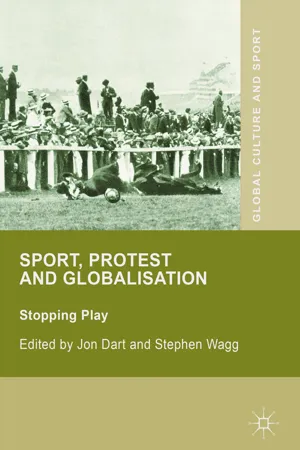
This volume is built around three assumptions - first, that for huge numbers people around the world, including many sport lovers, there are more important things in life than sport; second, that the governance of sport is in many ways problematic and needs to be confronted; and, third, that contrary to the still-popular belief that sport and politics don't mix, sport often provides an ideal theatre for the enacting of political protest. The book contains studies of a range of protests, stretching back to the death of suffragist Emily Davison at the Derby of 1913 and encompassing subsequent protests against the exclusion of women from the sporting arena; the Berlin Olympics of 1936; Western imperialism; the Mexico Olympics, 1968; the state racism of apartheid in South Africa; the effect of the global golf industry on ecosystems; Israeli government policy; resistance to the various attempts to bring the Olympic Games to Canadian and American cities; the cutting of welfare benefits fordisabled British citizens; class privilege in the UK; Russian anti-gay laws; and high public spending on sport mega-events in Brazil. The collection will be of interest to scholars and students with an interest in Sports Studies, History, Politics, Geography, Cultural Studies and Sociology.
Information
Print ISBN
9781137464910
Subtopic
Politics© The Author(s) 2016
Jon Dart and Stephen Wagg (eds.)Sport, Protest and GlobalisationGlobal Culture and Sport Series10.1057/978-1-137-46492-7_11“The Olympics Do Not Understand Canada”: Canada and the Rise of Olympic Protests
Christine M. O’Bonsawin1
(1)
Department of History, University of Victoria, P.O. Box 1700 STN CSC, Victoria, BC, V8W 3P4, Canada
The selection of Montreal as host of the 1976 Olympic Summer Games appeared to be a straightforward decision for the International Olympic Committee (IOC). After all, Montreal had previously hosted a highly successful 1967 International and Universal Exposition—Expo ’67—and Canada had showed a remarkable aptitude for staging international and domestic multi-sport events. Moreover, the city of Montreal has long been heralded as “the cradle of Canadian sport.” 1 Nonetheless, in the lead-up to the 1976 Olympic Games, amidst gloomy headlines about soaring deficits, extreme security measures, construction delays, and deaths, and in the midst of a national unity crisis, many Canadians seemingly lost interest, or quite simply opposed the arrival of the Olympic Games on national soil. An East German editor went so far as to question “[w]hy did Canada want the Games? Why did your federal government agree to them if it didn’t want to help pay?” 2 In responding to the East German’s query, Canadian sportswriter Doug Gilbert suggested that “[t]he Olympics do not understand Canada and Canada does not understand the Olympics. As a result, 22 million of us have been going around for five years with the vague feeling something is wrong with the 1976 Games.” 3 Something was certainly wrong with Montreal, and perhaps something was seriously wrong with Olympic hosting in Canada, more generally.
The primary focus of this chapter, then, is on Olympic protest associated with Canadian-hosted Olympic Games, including the 1976 Montreal Olympic Summer Games, the 1988 Calgary Olympic Winter Games, and the 2010 Vancouver Olympic Winter Games. This study further highlights Canadian Olympic bids that were unsuccessful mainly because there existed considerable opposition within Canada to the respective bid groups. Accordingly, the chapter is organized around three trends of Olympic protest, as manifested in the evolution of Olympic protest behaviour over the last half-century, and then applied to the Canadian context. First, the array of international political clashes that occurred in the lead-up to the 1976 Montreal Olympics is examined in a discussion of state-centric Olympic protest, as these Games represent one of the most significant episodes of political protest in the history of the Olympic movement. Second, protest events in the lead-up to the 1976 Montreal and 1988 Calgary Olympic Games as well as the 1996 Toronto Olympic bid are analysed in a discussion on domestic-orientated protest. Lastly, the chapter examines Canada in the era of transnational Olympic protest. In this latter discussion, Olympic protest related to the 1988 Calgary and 2010 Vancouver Games, as well as to the 2008 Toronto bid are contextualized within the broader scope of transnational Olympic protest. Over the last half-century, Canada and its domestic actors have played an exceedingly important role in the evolution of Olympic protest behaviour. As such, widespread occurrences of Olympic-related protest activities throughout Canada have significantly persuaded state-centric, domestic-orientated, and transnational Olympic protest trends.
State-Centric Olympic Protest in Canada
Throughout the Cold War era, the Olympic Games provided a viable opportunity to propagate state-centric political contention and nationalistic agendas. 4 Olympic protest during this time primarily existed at the state level. According to Donald Macintosh and Michael Hawes, the bans and boycotts of the Cold War era
In positioning sovereign states in constant competition, this theory of political realism assumes that states are dominant actors (state-centric); states will use force to improve their position in the international system; a hierarchy exists in world politics whereby military interests dominate economic, social, and technical concerns (albeit they are all important to the international system). 6 Consequently, throughout the Cold War era, political contention with regard to the Olympic Games was primarily expressed through the enactment of political bans and boycotts.emerged in the pragmatic and nationalistic period that followed World War II. This perspective characterizes the international system as an anarchic environment in which independent sovereign states are in constant competition for power and influence. In this formulation, the central goal of every state is the pursuit of its national interest and the maximization of its power “relative” to the other states in the system. 5
On August 16, 1976, IOC President Lord Killanin circulated a letter to all members of the IOC stating, “[e]ver since 1896 there have been politics in the Olympic Games, but never on the scale of Montreal.” 7 The IOC’s clash with the Canadian government in the lead-up to the 1976 Montreal Olympic Games was, arguably, the result of Canada’s desire to use the Games to enhance its political and economic standing in the international system. The IOC had awarded the Games to Montreal on the premise that all IOC accredited National Olympic Committees (NOCs) and International Federations (IFs) be granted entry into Canada to compete in the Olympic Games. 8 At this time, the IOC recognized Taiwan, also known as the Republic of China (ROC), as the sole NOC representative of China. There was significant disagreement within the IOC concerning which China to recognize, and there appeared to be support for the (re)admission of the People’s Republic of China (PRC) into the Olympic family. 9 Matters were further complicated in October 1970, merely five months after the Games had been awarded to Montreal, when the Canadian government adopted its one-China policy, thereby recognizing the PRC in its new foreign policy design. According to Dongguang Pei, in an official parliamentary debate, the Government of Canada acknowledged that the question of which China to admit to the 1976 Olympics would be left in the hands of the IOC, as “these decisions have to be made by the International Olympic Committee. We are the host for the games but we do not decide who participates.” 10
Tensions quickly escalated in May 1976 when the Government of Canada revealed that “we recognize the PRC and we are not under the guise proposing to import into our foreign policy a two-China policy.” 11 In the following days, the US Olympic Committee, with the support of American President Gerald Ford, threatened to boycott the Games if Taiwan was not permitted to participate, and the IOC held a secret vote to determine whether it should cancel the Games altogether. Much to the dismay of Montreal Olympic organizers, negotiations between the IOC and the government of Canada resumed even as athletes from both Taiwan and the PRC travelled to Canada to compete in the Olympic Games. Two days before the Games were scheduled to open, the Canadian government agreed that ROC athletes could participate in the Olympics as representatives of Taiwan and not China. The IOC decided to change the name of this NOC from ROC to the Olympic Committee of Taiwan for the two-week duration of the Games. With this compromise in place, the USA abandoned its boycott threat. Taiwan and the PRC, on the other hand, proved dissatisfied with the proposed resolution. The Montreal Olympic Games opened on July 17, 1976, in the complete absence of Chinese representation. 12
Another difficulty was posed by the white-minority governments of southern Africa. With the expulsion of South Africa and Rhodesia from the Olympic movement, it appeared the IOC and thus Montreal organizers had sidestepped the possibility of an African boycott of the 1976 Olympic Games. However, the Supreme Council for Sport in Africa (SCSA) took the matter a step further and requested that the IOC impose additional sanctions on any nation that had competed against South Africa or Rhodesia, even if such competitions remained outside the realm of Olympic sport. The New Zealand All-Blacks national rugby union team had drawn significant attention to itself following a tour of South Africa in April 1976. Consequently, the SCSA called on the IOC and the Government of Canada to bar New Zealand from the Montreal Olympics. While the IOC claimed that matters regarding rugby remained outside IOC jurisdiction, 13 Canada insisted that the issue needed to be resolved by those parties directly involved, including the IOC, SCSA, and New Zealand. The Government of Canada had long held a position that it unreservedly opposed the apartheid policies of South Africa and Rhodesia; however, in the lead-up to the Montreal Olympics, the Canadian government remained impervious to anti-apartheid initiatives and SCSA appeals. For example, in January 1976, the SCSA openly criticized Canada for sending a team to the World Softball Championships in New Zealand despite the fact that the SCSA had called for a worldwide boycott of the event because of South Africa’s participation. 14
Canada’s failure to take or support action against apartheid was arguably bound by understandings of political realism. As Macintosh and Hawes explain, “the c...
Table of contents
- Cover
- Frontmatter
- Introduction: Sport and Protest
- ‘Deeds, Not Words’: Emily Wilding Davison and the Epsom Derby 1913 Revisited
- Women’s Olympics: Protest, Strategy or Both?
- A Most Contentious Contest: Politics and Protests at the 1936 Berlin Olympics
- Splitting the World of International Sport: The 1963 Games of the New Emerging Forces and the Politics of Challenging the Global Sport Order
- “Memorias del ’68: Media, Massacre, and the Construction of Collective Memories”
- Race, Rugby and Political Protest in New Zealand: A Personal Account
- Fighting Toxic Greens: The Global Anti-Golf Movement (GAG’M) Revisited
- ‘Human Rights or Cheap Code Words for Antisemitism?’ The Debate over Israel, Palestine and Sport Sanctions
- Chicago 2016 Versus Rio 2016: Olympic ‘Winners’ and ‘Losers’
- “The Olympics Do Not Understand Canada”: Canada and the Rise of Olympic Protests
- ‘The Atos Games’: Protest, the Paralympics of 2012 and the New Politics of Disablement
- ‘Messing About on the River.’ Trenton Oldfield and the Possibilities of Sports Protest
- Sochi 2014 Olympics: Accommodation and Resistance
- An Anatomy of Resistance: The Popular Committees of the FIFA World Cup in Brazil
- Backmatter
Trusted by 375,005 students
Access to over 1.5 million titles for a fair monthly price.
Study more efficiently using our study tools.
Frequently asked questions
Yes, you can cancel anytime from the Subscription tab in your account settings on the Perlego website. Your subscription will stay active until the end of your current billing period. Learn how to cancel your subscription
No, books cannot be downloaded as external files, such as PDFs, for use outside of Perlego. However, you can download books within the Perlego app for offline reading on mobile or tablet. Learn how to download books offline
Perlego offers two plans: Essential and Complete
- Essential is ideal for learners and professionals who enjoy exploring a wide range of subjects. Access the Essential Library with 800,000+ trusted titles and best-sellers across business, personal growth, and the humanities. Includes unlimited reading time and Standard Read Aloud voice.
- Complete: Perfect for advanced learners and researchers needing full, unrestricted access. Unlock 1.5M+ books across hundreds of subjects, including academic and specialized titles. The Complete Plan also includes advanced features like Premium Read Aloud and Research Assistant.
We are an online textbook subscription service, where you can get access to an entire online library for less than the price of a single book per month. With over 1.5 million books across 990+ topics, we’ve got you covered! Learn about our mission
Look out for the read-aloud symbol on your next book to see if you can listen to it. The read-aloud tool reads text aloud for you, highlighting the text as it is being read. You can pause it, speed it up and slow it down. Learn more about Read Aloud
Yes! You can use the Perlego app on both iOS and Android devices to read anytime, anywhere — even offline. Perfect for commutes or when you’re on the go.
Please note we cannot support devices running on iOS 13 and Android 7 or earlier. Learn more about using the app
Please note we cannot support devices running on iOS 13 and Android 7 or earlier. Learn more about using the app
Yes, you can access Sport, Protest and Globalisation by Jon Dart, Stephen Wagg, Jon Dart,Stephen Wagg in PDF and/or ePUB format. We have over 1.5 million books available in our catalogue for you to explore.