- English
- ePUB (mobile friendly)
- Available on iOS & Android
eBook - ePub
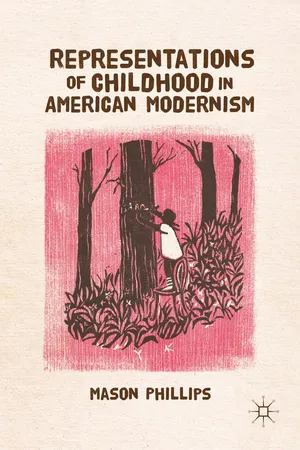
Representations of Childhood in American Modernism
About this book
This book documents American modernism's efforts to disenchant adult and child readers alike of the essentialist view of childhood as redemptive, originary, and universal. For James, Barnes, Du Bois, and Stein, the twentieth century's move to position the child at the center of the self and society raised concerns about the shrinking value of maturity and prompted a critical response that imagined childhood and children's narratives in ways virtually antagonistic to both. In this original study, Mason Phillips argues that American modernism's widespread critique of childhood led to some of the period's most meaningful and most misunderstood experiments with interiority, narration, and children's literature.
Information
© The Author(s) 2016
M. PhillipsRepresentations of Childhood in American Modernismhttps://doi.org/10.1057/978-1-137-50807-2_11. Introduction
Mason Phillips1
(1)
Fairfax, Virginia, USA
By the turn of the twentieth century, childhood was in vogue. The idyllic child at the heart of poetic, Romantic discourse resurfaced in the work of twentieth-century reformers and scientists who dedicated themselves to understanding and bettering the lives of actual children. As Sally Shuttleworth observes, the child-study movement, which thrived in the early years of the twentieth century, had its roots in the core values of post-Romantic discourse (2). In promoting the belief that the entire history of human evolution recapitulates itself in the lifespan of each individual, child-study scientists validated the importance of childhood as the origin of both personal and social progress.1 By 1930, Herbert Hoover spoke for many reformers when he argued that interventions in the problems of poverty, health, and education for just “one generation” of children would cause those problems and “a thousand other[s]” to “vanish” (qtd. in Smuts 140). Even Freud, whose theories of infantile sexuality seemed to threaten Romantic ideals of childhood innocence, underscored the essentialist line on childhood as the epicenter of the self.
Childhood played a foundational role in modern visions of individual and human history, but in many of these narratives childhood itself had no history. In the mind, childhood became a permanent fixture, a place solidified by Freud into what Carolyn Steedman calls the “timeless interiority of the unconscious” (93). For Freud and other child-study theorists, the child also served as an accessible agent of man’s otherwise inaccessible, primitive past. And for reformers, childhood was the impressionable point at which and through which future history would be made.
In her 1900 treatise, The Century of the Child, feminist and socialist Ellen Key railed against the use of corporal punishment, factory work for both women and children, and the “idiotic” model of public school education, which, in her view, churned out (like a factory itself) identically-minded, unquestioning, and (above all) obedient children. The book became an international bestseller. Through it, Key sought to make the cultivation of the child along with its mother the centerpiece of social and political reform efforts across Europe and America (330). And, in so many respects, the early years of the twentieth-century were already en route to making Key’s vision of a child-centered society a reality. Anxious parents, eager to incorporate the spirit of reform at home, enjoyed a robust body of child-rearing literature, including Parents’ Magazine which made its debut in 1926. The psychological study of children boomed. Alice Boardman Smuts tells us that in 1918 there were only five psychologists and psychiatrists who studied childhood full time, but by 1930 there were more than 600 (1–2). 1912 saw the creation of “The Children’s Bureau,” which devoted its first years almost entirely to the problem of childhood mortality. In the 1890s children accounted for 40 % of all deaths; by the 1920s that number had fallen dramatically to 21.7 % (Zelizer 29). To help move children out of danger zones, such as the streets and the factories, public spaces were created for the child’s cultivation and protection. Kindergartens grew alongside a more progressive educational model that emphasized children as active rather than passive learners. Playgrounds were beginning to become regular features of urban centers like Chicago, which built its first in 1893 (Kinchin and O’Connor 43). In the key area of child labor, however, Hugh Cunningham observes that progress in the United States was slow. Nearly all countries had passed laws regulating child labor by the end of the nineteenth century, except for the U.S. (180–181). Nonetheless, the number of child laborers in America was on the decline, from nearly 2 million in 1910 to around 667,000 in 1938 (the year the first federal regulations finally took effect) (Zelizer 65; 56).
The turn of the twentieth century was also the time of the so-called golden age of children’s literature in which such classics as J.M. Barrie’s Peter Pan (1902), L.M. Montgomery’s Anne of Green Gables (1908), Frances Hodgson Burnett’s The Secret Garden (1911), Kenneth Grahame’s The Wind in the Willows (1908), Margery Williams’s The Velveteen Rabbit (1922), and A.A. Milne’s Winnie the Pooh (1926) appeared to work alongside Anglo-American progressives to sentimentalize childhood as a beloved space set apart from the disenchanted adult world of labor, materialism, and managed time. Anne Scott MacLeod cites an American review of Peter Pan, praising Barrie for having “truly kept the heart and mind of a child,” as part of a larger wish on the part of turn-of-the-century adults to be themselves “as spontaneous and as innocently joyful as children” (120). Where, in times past, Anglo-American societies had concentrated on saving the child’s place in heaven or its future place in the establishment, Cunningham observes that the Victorians and the moderns were also determined “to save children for the enjoyment of childhood” (137).
Representations of Childhood in American Modernism thus tells an unpopular story. It is the story of American modernism’s literary efforts to disenchant adult and child readers alike of the essentialist view of childhood as redemptive, virtuous, originary, and universal. These efforts were unpopular because, as happened with Henry James, readers were frustrated by their defiant refusal to meet expectations about what children and narratives about children ought to be. One reviewer for The New York Times referred to James’s Maisie as a “small monster,” ironically echoing Maisie’s depraved parents, who regularly insult their daughter in almost the same way (“Henry James’s New Work” BR9). Another reviewer was more appalled by the coldness of James’s approach to his subject, charging that the “author exhibits not one ray of pity or dismay at this spectacle of a child with the pure current of its life thus poisoned at its source” (“What Maisie Knew” 454). They were unpopular because, as happened with Stein, publishers and agents read modernist children’s literature as “hardly being for les enfants” (Stein and Vechten 679). Like James, Stein was also guilty of failing to arouse the feelings that readers expected and desired from representations of childhood. Bennett Cerf, at Random House, rejected Stein’s manuscript for To Do: A Book of Alphabets and Birthdays because he felt “as cold as a slab of alabaster” about the book (Stein and Vechten 697N). They were unpopular because, as happened with The Brownies’ Book, their readership was limited in numbers and in purchasing power. The final issue of The Brownies’ Book laments, “there are two million Brownies in the United States, and unless we got at least one in every hundred to read our pages and help pay printing, we knew we must at last cease to be” (qtd. in Johnson-Feelings 347). And they were all unpopular for reimagining the child that lay at the center of nineteenth- and twentieth-century identity, feeling, education, and reform as the source of what ails us, not the cure.
Some scholars have asserted the view that the reason there appears to be so little modernist children’s literature is because modernists themselves chose not to enter the field. David Rudd, for example, has argued that the reason for modernism’s minimal presence in the world of children’s literature is not because children’s literature denied its entry but because “modernism deliberately distanced itself from what it saw as the restrictive world of children’s writing” (300). Similarly, William Gray contrasts modernist literature as an “acquired taste” most often encountered in college coursework with the populist and pleasing impulses of children’s literature (28). But the image of modernists holding children’s literature at arm’s length mistakes an important truth: a number of modernists actively sought to widen the ways that adults think about childhood, to change the way childhood is presented to children, and to open the fields of both modernist and children’s literature to make room for some of their most experimental and most unconventional contributions to twentieth-century literature.
Students and scholars of modernism routinely study the works of W.E.B. Du Bois, Gertrude Stein, Langston Hughes, J.M. Barrie, Djuna Barnes, and Henry James. But it remains the case that neither students nor experts of modernism routinely study the culture of childhood that influences a great many of their writings. Though questions about gender, race, class, and sexuality are prevalent in the field, social constructions of childhood have largely remained off-radar. Though Stein, Hughes, and Du Bois regularly wrote for children, their children’s literature is not regularly included in modernist considerations of their work. W.E.B. Du Bois and Jessie Fauset were at the forefront of African-American children’s literature in the teens and twenties through their combined editorial and aesthetic contributions to The Crisis Children’s Numbers and The Brownies’ Book, the premier children’s periodical created for and by African Americans. Langston Hughes, who began his career publishing in The Brownies’ Book, went on to write numerous books for children throughout the entirety of his career. Black Misery, his final book for children, was also the last book he worked on before he died in 1967. Gertrude Stein wrote a series of children’s books in the late thirties and early forties, including an alphabet book and a first reader. And many other American modernists, not included in the present study, produced one or two books for children in their lifetime.2 When we observe the dearth of modernist fiction about and for children, the question is not why modernists shunned childhood but why we as readers have neglected or denied their interest in this field.
Thankfully, this neglect has not been absolute. Scholars like Juliet Dusinberre and Douglas Mao have produced book-length studies of the child figure in modernism’s adult literature.3 And Kimberly Reynolds has taken important steps in opening up the study of modernist children’s literature by showing that, although children’s literature can serve conservative, mainstream interests, it has also historically served as “a breeding ground and an incubator for innovation.” “Many textual experiments,” she argues, “are given their first expression in writing for children” (15). Still, there have been few attempts to bridge modernism’s writings for adults with its writings for children, even when both are about childhood and even when both are conceived in the same minds and flow from the ink of the same pens. What would it mean to regularly read Langston Hughes’s Dream Keeper or First Book of Rhythms or his First Book of Jazz alongside his blues and jazz poems? How might that pairing affect our interpretations of Hughes’s poetics? How might Hughes’s modernist aesthetic affect our readings of his children’s texts? What would it mean to insert readings from The Brownies’ Book into the sequential study of Du Bois’s writings from this period? How would our understanding of Gertrude Stein’s late modernism change if The World is Round or To Do: A Book of Alphabets and Birthdays were required reading? These are among the questions that the current project hopes to answer.
Most importantly, this is a book that seeks to read the figure of the child across the history of American modernism, across authors, across decades, across genres, and across intended audiences. And in so doing, it shows that American modernism’s challenge to Edenic depictions of childhood is both widespread across the movement and integral to the development of the movement itself. Henry James’s child-centered works, What Maisie Knew (1897) and The Turn of the Screw (1898), are watershed texts for modernist fiction whose unconventional child characters inspire equally unconventional experiments in narrative form. After 1934 nearly every (child or adult) text Gertrude Stein produced until her death in 1946 works to deconstruct children’s narratives in some form or other. Even her children’s books are deconstructions of children’s books. There are crucial continuities as well between Du Bois’s concerns about childhood which surface in The Souls of Black Folk and those that remanifest in his later works for children and which contribute in meaningful ways to Du Bois’s evolving thought on double consciousness and the problem of the color line. And Djuna Barnes adds an important critique not just of Romantic childhood but also of modernism itself in her late modernist novel, Nightwood.
Throughout, I argue that there is a child in the midst of modernism, but it is neither the child nor the modernism we are accustomed to seeing. When in 1939, Edmund Wilson, a prominent and influential scholar of modernism, was approached about reviewing Eliot’s and Stein’s recent children’s books, he proclaimed that he “found himself baffled by the assignment.” Unable to review either book, Wilson turned the task over to another reviewer but not before printing, in the place of a review, an explanation of his trouble. After confessing that he “had difficulty in getting through the Stein book” and that he was “disappointed in Old Possum,” Wilson offers a scathing commentary on the state of modernism:
It is perhaps worth pointing out that there seems to be something like a general tendency on the part of the more “difficult” writers to go in for children’s books. Kay Boyle has done a book about a camel; and E. E. Cummings is rumored to be engaged on a book of fairy-tales. I don’t know what this means—except that they evidently do not feel at the moment that they have anything better to do. (qtd. in Curnutt 115)
After pretending to pass on the job of reviewing the two books in question, Wilson presents his assessment anyway. And he does much more, reading Eliot’s Old Possum’s Book of Practical Cats and Stein’s The World is Round as indications of a larger modernist trend. Though Wilson also feigns “bafflement” about “what this [tendency] means,” he is nonetheless certain that it is both not worth the modernist scholar’s or the modernist writer’s time.
Unfortunately, Wilson’s dismissal of modernist children’s literature is just one example of the lackluster history of this literature’s collective reception. Histories of childhood and children’s literature have routinely skipped modernism. Jacqueline Rose brought attention to this problem as early as 1984 when, in The Case of Peter Pan, she argued that the conservative conventions of children’s literature writing and publishing had excluded the possibility of a modernist children’s literature (142). Rose may not have been aware at that time of the number of modernist children’s books in and out of print, but her lack of awareness supports the observation. The vast majority of these children’s books were published (when they were published) in limited numbers. But Rose is also susceptible to her own charge. Published in 1911, J.M. Barrie’s Peter and Wendy could be read as an emergently modernist children’s book, but instead Rose reads it as representative of the kind of childhood idolatry common to the field. Still, most scholars cannot be said to even struggle with the issue in the way that Rose does. For instance, James Holt McGavran’s collection, Literature and the Child: Romantic Continuations, Postmodern Contestations, makes the decision to skip modernism self-evident.
Other studies that include early twentieth-century movements and trends skip modernism’s subversive discourses in favor of the more dominant, popular discourses of the era. Hugh Cunningham describes the first half of the twentieth century, in light of new labor laws, the playground movement, and education reform, as even more committed to fulfilling the nineteenth-century promise “to save children for the enjoyment of childhood” (137). When the focus is literary, rather than social, history, the master-narrative remains the same. Focusing on widely popular golden age children’s literature, A Critical History of Children’s Literature describes the period from 1890 to 1920 (the period of modernist emergence and experimentation) as a time of “rightful heritage,” when the nineteenth-century idea that children’s literature “could exist for the purpose of giving pleasure and delight” was inherited and brought to “maturity.”4 Even when the focus is psychology, the early twentieth century often becomes part of a long nineteenth-century narrative of childhood. Carolyn Steedman’s otherwise exceptional study of how childhood becomes central to modern i...
Table of contents
- Cover
- Front Matter
- 1. Introduction
- 2. American Modernism, Childhood, and the Inward Turn
- 3. The “Partagé Child” and the Emergence of the Modernist Novel in Henry James’s What Maisie Knew
- 4. An Innocence Worse than Evil in The Turn of the Screw
- 5. Nightwood: A Bedtime Story
- 6. The Children of Double Consciousness: From The Souls of Black Folk to The Brownies’ Book
- 7. Drowning in Childhood: Gertrude Stein’s Late Modernism
- Back Matter
Trusted by 375,005 students
Access to over 1.5 million titles for a fair monthly price.
Study more efficiently using our study tools.
Frequently asked questions
Yes, you can cancel anytime from the Subscription tab in your account settings on the Perlego website. Your subscription will stay active until the end of your current billing period. Learn how to cancel your subscription
No, books cannot be downloaded as external files, such as PDFs, for use outside of Perlego. However, you can download books within the Perlego app for offline reading on mobile or tablet. Learn how to download books offline
Perlego offers two plans: Essential and Complete
- Essential is ideal for learners and professionals who enjoy exploring a wide range of subjects. Access the Essential Library with 800,000+ trusted titles and best-sellers across business, personal growth, and the humanities. Includes unlimited reading time and Standard Read Aloud voice.
- Complete: Perfect for advanced learners and researchers needing full, unrestricted access. Unlock 1.5M+ books across hundreds of subjects, including academic and specialized titles. The Complete Plan also includes advanced features like Premium Read Aloud and Research Assistant.
We are an online textbook subscription service, where you can get access to an entire online library for less than the price of a single book per month. With over 1.5 million books across 990+ topics, we’ve got you covered! Learn about our mission
Look out for the read-aloud symbol on your next book to see if you can listen to it. The read-aloud tool reads text aloud for you, highlighting the text as it is being read. You can pause it, speed it up and slow it down. Learn more about Read Aloud
Yes! You can use the Perlego app on both iOS and Android devices to read anytime, anywhere — even offline. Perfect for commutes or when you’re on the go.
Please note we cannot support devices running on iOS 13 and Android 7 or earlier. Learn more about using the app
Please note we cannot support devices running on iOS 13 and Android 7 or earlier. Learn more about using the app
Yes, you can access Representations of Childhood in American Modernism by Mason Phillips in PDF and/or ePUB format, as well as other popular books in Literature & North American History. We have over 1.5 million books available in our catalogue for you to explore.