eBook - ePub
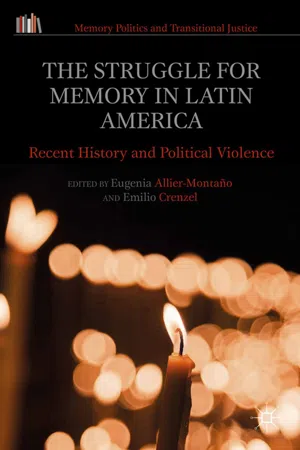
The Struggle for Memory in Latin America
Recent History and Political Violence
- English
- ePUB (mobile friendly)
- Available on iOS & Android
eBook - ePub
The Struggle for Memory in Latin America
Recent History and Political Violence
About this book
This book examines the struggles that unfolded in Latin America over the memory of the pasts of political violence experienced by the countries of the continent in the second half of the twentieth century: Argentina, Brazil, Chile, Colombia, the United States, Guatemala, El Salvador, Mexico, Paraguay, Peru, and Uruguay.
Information
Part I

Dictatorships and Authoritarian Regimes
Chapter 1
Toward a History of the Memory of Political Violence and the Disappeared in Argentina
Emilio Crenzel
Introduction
The political violence that Argentina suffered in the 1970s and early 1980s was rooted in the country’s institutional history and the new international context following the end of the Second World War. A dozen military coups were staged in Argentina from 1930 to 1983. The intervention of the armed forces in institutional life came to be seen as natural by broad sectors of civil society and the political community. This together with the influence of nationalist, conservative, and Catholic fundamentalist ideas formed a culture characterized by contempt for the law and rejection of the other and in which resorting to violence acquired a privileged status.1 In the mid-1940s, the emergence of Peronism—a political movement with an industrialist project led by Colonel Juan Perón, which incorporated the labor movement into political life, even if it was in a subordinate role through an alliance between classes—launched a process of polarization that was aggravated in 1955 after Perón was ousted from power and banned from politics. This gave way to a cycle of social unrest and political radicalization fueled by the Cold War and the victory of the Cuban Revolution that included the emergence of Marxist and Peronist guerrilla groups. In that context, the armed forces adopted the counterinsurgency methods employed by the French army in the Algeria and Indochina wars and the National Security Doctrine of the United States, both of which included torture as a key component of military intelligence and the belief that a full-scale war had to be waged against an enemy that could be lurking anywhere in society.2
Perón’s return to the presidency in 1973 did not put an end to political violence. Guerrilla groups took up arms again and under Peron’s government a death squad known as the Triple A (Argentine Anticommunist Alliance) began operating with official backing from the government, murdering hundreds of political activists. At the same time, a number of repressive measures were legally implemented, targeting left-wing opposition and even radicalized sectors within the Peronist movement.
Following his death in 1974, Perón was succeeded by his widow, María Estela Martínez, who declared a state of siege on November 6, 1974, by Decree 1368. In February 1975, she issued Decree 265 authorizing the armed forces to wipe out subversive activities in the province of Tucumán, and in October 1975, she expanded the scope of this authorization to the rest of the country (Decree 2772). Political violence became a part of everyday life. From 1973 to 1976, 1,543 political assassinations were committed; 5,148 people were imprisoned for political reasons; and another 900 were forcefully disappeared (CONADEP 1984).
In that climate of violence, a coup d’état was staged on March 24, 1976, and the practice of forcefully disappearing dissidents became systematic. The disappearances consisted of the detention or abduction of individuals by military or police officers who took them to illegal holding sites or camps, where they were tortured and for the most part murdered. Their bodies were then buried in unmarked graves, incinerated, or thrown into the sea; their property was looted; and their children snatched by members of the repressive forces who changed their identities. As of October 2014, Abuelas de Plaza de Mayo had recovered 115 of these missing children and restored their identities. As these crimes were being committed, the state simultaneously denied any responsibility in them.3
Human rights organizations maintain that as many as 30,000 people were disappeared. As of 2009, the National Human Rights Secretariat had recorded 7,140 cases of forced disappearance and 2,793 survivors of clandestine detention centers and was processing an additional 1,000 reports. No new official figures have been made public since 2009.4 Obtaining a precise figure for the number of disappeared persons is made difficult by the very nature of the crime, the perpetrators’ refusal to hand over the records they have in their power, the role certain actors play by publicly denouncing their own figures, and the political contexts that frame the disputes over these figures (Brisk 1994, 676–692). Eighty percent of all disappearances were perpetrated in major cities (Buenos Aires and its metropolitan area, Córdoba, La Plata, Rosario, and Tucumán); 81 percent of the victims were aged 16–35 at the time of their disappearance, and 70 percent were men. Thirty percent of the disappeared were blue-collar workers, 21 percent were students, 18 percent were white-collar workers, and 11 percent were professionals. Most were members of Peronist, Marxist, guerrilla, or class-based organizations. Another 10,000 people were imprisoned for political reasons; 1,360 were murdered; and an estimated 250,000—in a population of 25 million—were forced into exile.5
The Dictatorship and Human Rights Abuses (1976–1983)
The disappearances entailed a rupture with respect to the conception of death traditionally held in Argentina, typical of Western culture. The in-between state into which the disappeared were thrown—neither living nor dead—fractured the basic social frameworks for evoking. The natural end of life, which comes with death, was suspended, thus generating constantly renewed cycles of despair and hope among the relatives and friends of the disappeared. Even if they believed their loved ones were being held captive, the relatives of the disappeared did not know where they were or how long their captivity would last. In most cases, the absence of a body or a grave completely blurred the line between the world of the living and the world of the dead that is represented by cemeteries and prevented the bereaved from practicing rites—such as holding wakes and funerals—that help process loss (Da Silva Catela 2001, 114–119 and 122–123). The disappearances marked a turning point in the history of political violence in Argentina. Prior to the coup, political assassinations were acknowledged by their perpetrators, the corpses were disposed of in public spaces, and these acts were reported in the press.
After almost two years of refusing to admit the existence of disappeared persons or denying any interest by the state in the fate of these missing people through the dismissal of the thousands of habeas corpus petitions filed by relatives, in a press conference held in December 1977, de facto president Jorge Videla publicly described the disappeared as guerrillas and explained their disappearance as resulting from the country’s state of war (La Prensa, September 15, 1977, 2 and 3).
Videla’s statement was voiced to counter growing demands from numerous human rights organizations, including: the Liga Argentina por los Derechos Humanos, founded in 1937; the Servicio de Paz y Justicia, formed in 1974 with a nonviolent approach; the Asamblea Permanente por los Derechos Humanos (APDH), created in 1975 in the face of growing political violence; the Ecumenical Movement for Human Rights, established in 1976 by religious groups of different faiths; the Centro de Estudios Legales y Sociales (CELS), a group that broke away from APDH in 1979; Familiares de Detenidos y Desaparecidos por Razones Políticas, formed in 1976; and the Madres de Plaza de Mayo and Abuelas de Plaza de Mayo created in April and October 1977, respectively, by mothers and grandmothers of disappearance victims. This diverse movement gathered reports and published them in the form of paid ads in various press media in the country and abroad and promoted mobilizations, such as the unique form of demonstration introduced by the Mothers of Plaza de Mayo, who would protest by marching continuously around the Plaza de Mayo monument, located across the street from the Casa Rosada, the seat of the Argentine government, demanding to know the fate of the disappeared. These demands were also raised outside the country by organizations of political exiles, such as the Comisión Argentina de Derechos Humanos (CADHU) and the Centro Argentino de Información y Solidaridad (CAIS), by transnational human rights organizations such as Amnesty International, which even conducted a country mission to investigate the reports in 1976, and by foreign governments, in particular, the United States, France, Italy, and Sweden.
In a context marked by widespread terror and the stigmatization of the persecuted, and with the armed forces simultaneously assuming the self-appointed role of defenders of morality and patriotic values, which were understood as natural elements of “Western Christian” civilization, the relatives of the victims and the human rights organizations chose to portray the disappeared as individuals, as opposed to political subjects, highlighting their basic identifying particulars, such as their gender and age, placing them in comprehensive categories, such as their nationality, religious beliefs, and occupations, and stressing their moral values. These categories restored the humanity that the disappeared had been denied and underlined the indiscriminate nature of the violence unleashed by the “terrorist state” and the “innocence” of its victims, devoid of any political connections, but in particular any relation with guerrilla elements. These denunciations did not historicize state violence, exposing only a confrontation between victims and victimizers, displacing both the Marxist class-struggle approach and the people-oligarchy antinomy of the populist tradition, which had prevailed among radical activists prior to the coup. The legitimation of political violence was replaced with human rights demands: the right not to be tortured and the right not to be subjected to forced disappearance or arbitrary arrest. Thus, in denouncing the disappearances and other human rights abuses, they presented a truth that was essentially factual and rested heavily on the account of the physical harm suffered by the victims.
As Markarian has shown for the Uruguayan case, this form of denunciation was shaped through the new relationships that its protagonists established with transnational human rights networks (Markarian 2005, 104–105). Through those ties they incorporated the human rights culture that was spreading globally in the mid-1970s (Sikkink 1996, 59–84).
In September 1979, the Inter-American Commission on Human Rights (IACHR) sent a mission to Argentina after receiving hundreds of disappearance complaints. Even as it was rejected by the dictatorship and questioned by countless social and political organizations who objected its “interference in internal affairs,” the IACHR received reports, interviewed government authorities, political leaders, and heads of human rights organizations, and inspected military facilities, such as the Escuela de Mecánica de la Armada (ESMA) and “La Rivera” in the province of Cordoba, which had been denounced as clandestine detention centers where disappeared persons were held captive and cemeteries where victims had allegedly been buried in unmarked graves.
The IACHR report, issued in April 1980, contained 5,580 disappearance reports (most of them gathered by APDH), attributed the responsibility of the disappearances to the military juntas, expressed concern for the “thousands of detainees who have disappeared” and who “may be presumed dead,” and recommended, among other measures, that the perpetrators be brought to trial and punished. A few days before the arrival of the mission, the dictatorship passed Law No. 22,068, which stipulated that any person whose disappearance had been reported would be presumed dead, a provision that was rejected by human rights organizations and the IACHR (Comisión Interamericana de Derechos Humanos 1980, 13–18 and 147–152). Unwilling to accept the death of their sons and daughters without knowing how they had died and who was responsible, the Mothers of Plaza de Mayo countered by raising the demand “Aparición con vida” (Bring them back alive), which would become a major slogan of the organization.
These and other denunciations were to some extent neutralized by the dictatorship, who only after the defeat of Argentina in the Malvinas/Falklands War with the United Kingdom in June 1982 became increasingly isolated both domestically and internationally. As a result of this defeat, in contrast to the other countries of the Southern Cone of Latin America, the Argentine dictatorship was unable to impose negotiated conditions for the transition to democracy. Thus, despite having 70 percent of the population against it, on September 22, 1983, a month before the elections, the Junta passed the National Pacification Act (Law No. 22,924), known as the “self-amnesty law,” which declared that all causes of criminal action arising from crimes committed during the “war against subversion” were extinguished. While the Peronist presidential candidate, Ítalo Luder, asserted that the legal effects of the law were irreversible, Radical Party candidate Raúl Alfonsín announced that it was unconstitutional and that he was in favor of repealing it.6 In this setting, the human rights organizations began demanding “Juicio y castigo a todos los culpables” (Trial and punishment for all responsible), a demand that became key to their struggles and instrumental in the establishment of a parliamentary commission for investigating and politically condemning “state terrorism.”
The Scope of Truth and Justice (1983–1990)
Three days after his inauguration as president of Argentina, on December 10, 1983, Raúl Alfonsín declared the self-amnesty law unconstitutional, thereby annulling it, and issued two decrees (157 and 158) ordering the prosecution of seven guerrilla commanders of the People’s Revolutionary Party (Ejército Revolucionario del Pueblo) and of Montoneros on charges of acts of violence committed since 1973, and the prosecution of the three military juntas of the dictatorship on charges of homicide, unlawful deprivation of liberty, and torture, as forced disappearance was not defined as a crime under the Penal Code (BORA, December 15, 1983, 4 and 5). His decision expressed what came to be known as the “theory of the two demons,” because it limited accountability...
Table of contents
- Cover
- Title
- Introduction
- Part I Dictatorships and Authoritarian Regimes
- Part II Wars and Authoritarian Regimes
- Part III Writings on Recent History
- Bibliography
- List of Contributors
- Index
Trusted by 375,005 students
Access to over 1.5 million titles for a fair monthly price.
Study more efficiently using our study tools.
Frequently asked questions
Yes, you can cancel anytime from the Subscription tab in your account settings on the Perlego website. Your subscription will stay active until the end of your current billing period. Learn how to cancel your subscription
No, books cannot be downloaded as external files, such as PDFs, for use outside of Perlego. However, you can download books within the Perlego app for offline reading on mobile or tablet. Learn how to download books offline
Perlego offers two plans: Essential and Complete
- Essential is ideal for learners and professionals who enjoy exploring a wide range of subjects. Access the Essential Library with 800,000+ trusted titles and best-sellers across business, personal growth, and the humanities. Includes unlimited reading time and Standard Read Aloud voice.
- Complete: Perfect for advanced learners and researchers needing full, unrestricted access. Unlock 1.5M+ books across hundreds of subjects, including academic and specialized titles. The Complete Plan also includes advanced features like Premium Read Aloud and Research Assistant.
We are an online textbook subscription service, where you can get access to an entire online library for less than the price of a single book per month. With over 1.5 million books across 990+ topics, we’ve got you covered! Learn about our mission
Look out for the read-aloud symbol on your next book to see if you can listen to it. The read-aloud tool reads text aloud for you, highlighting the text as it is being read. You can pause it, speed it up and slow it down. Learn more about Read Aloud
Yes! You can use the Perlego app on both iOS and Android devices to read anytime, anywhere — even offline. Perfect for commutes or when you’re on the go.
Please note we cannot support devices running on iOS 13 and Android 7 or earlier. Learn more about using the app
Please note we cannot support devices running on iOS 13 and Android 7 or earlier. Learn more about using the app
Yes, you can access The Struggle for Memory in Latin America by Eugenia Allier-Montaño, Emilio Crenzel, Eugenia Allier-Montaño,Emilio Crenzel in PDF and/or ePUB format, as well as other popular books in Politique et relations internationales & Gouvernement américain. We have over 1.5 million books available in our catalogue for you to explore.