- English
- ePUB (mobile friendly)
- Available on iOS & Android
eBook - ePub
About this book
This study reassesses the criminal body from sentencing to execution and afterlife, using the nineteenth-century Red Barn murder as a case study. Positioned within the burgeoning field of medical humanities, it places culture and power at the centre of debates surrounding criminal justice and public punishment.
Information
Topic
Ciencias socialesSubtopic
Historia británica1
The Murder in the Red Barn
Abstract: On 18 May 1827, the son of a respectable farmer, William Corder, murdered his lover Maria Martin in the Red Barn, a storage building on his land, in Polstead. The discovery of this murder the following year set off a feeding-frenzy in which Corder’s body became consumed in different ways. The extent to which Corder’s body was carved up, and his crime endlessly replayed, remains astounding to this day. His body was sent on a series of journeys that would have it measured, convulsed, staged, and re-staged. Corder was arrested in London and was tried and convicted of murder in August 1828. He was sentenced to be hung and anatomized and his execution was witnessed by thousands in Bury St Edmunds.
Keywords: Red Barn murder; Maria Martin; execution; Suffolk; death
McCorristine, Shane. William Corder and the Red Barn Murder: Journeys of the Criminal Body. Basingstoke: Palgrave Macmillan, 2014. DOI: 10.1057/9781137439390.0004.
This is a book about one of the most remarkable criminal afterlives in history. It is also about the violence committed upon bodies and the power that circulates around the corpses of the ‘dangerous dead’.
The small village of Polstead in south Suffolk seems an unlikely location for a case study on this subject, yet it was here that one of the most notorious crimes of nineteenth-century England took place. On 18 May 1827 a local farmer named William Corder (Illustration 1.1(a)) killed his lover Maria Martin1 (Illustration 1.1(b)) in the ‘Red Barn’, a storage building and trysting-spot known for the ghoulish reddish glow it was said to give off at sunset. The discovery of this murder the following year set off a feeding-frenzy in which Corder’s body became consumed in different ways by locals, medical professionals, metropolitan crowds, preachers, writers, ballad singers, curators, and theatre managers. The extent to which Corder’s body was carved up, and his crime endlessly replayed, remains astounding to this day. His body was hung and measured, sliced and convulsed, staged and re-staged. The documents, texts, and songs contained in the appendices of this book are an attempt to map out some of the journeys of Corder’s body from crime to death, and then to medical dismemberment and popular remembrance.2 Drawing on recent interdisciplinary investigations, I want to suggest that some criminal bodies, by virtue of their notoriety, can be born into new afterlives at the moment of their death by public execution.3
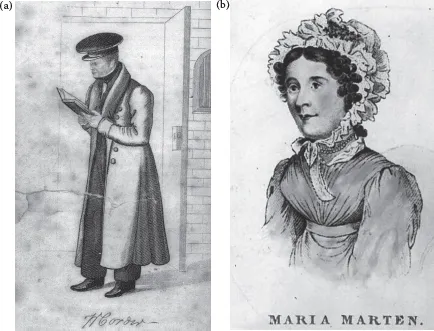
ILLUSTRATION 1.1 (a) William Corder, (b) Maria Martin
Source: Wikimedia.
One way to think about death is as a one-way journey that every human being must take to “The undiscover’d country from whose bourn / No traveller returns”, as Hamlet put it. The medicalized view of death which pervades most Western post-industrialized societies today conceives of an utterly final movement of the body from a state of life to a state of non-life. Another way of thinking about death is as a journey to a new place of being, with the dead body acting as a vehicle of remembrance and communication between the realm of the living and the dead. This latter idea, of the dead having agency or being alive in some sense, is more in line with how most societies have thought about death historically, whether in religion, funerary practices, or secular commemorations. Death is something that constitutes a series of journeys for the deceased body: journeys beyond life, but also journeys into new afterlives through which the corpse becomes a commodity. We are familiar today with the fact that corpses and human organs have significant values for anatomists and other legitimate medical practitioners, but the same holds true for medico–criminal networks and state oligarchies. The circulation of dead bodies in the medical sphere for money or research rightly raises serious ethical concerns for people, but bodies can also be trafficked outside medical spaces, materially in museums and metaphorically in popular entertainments.
The commodification of the corpse breathes new life into it in other very practical ways, making it an object that might contain power as well as value. European folklore records a vast array of beliefs about the continuing agency of the dead body, including beliefs about the ‘healing hand’ of the hanged man or the corpse which bleeds in the company of its killer. The sense of a ‘previous owner’ sometimes reported by organ transplant patients today also echoes nineteenth-century gothic fiction, with its blood transfusions, phantom limbs, and haunted body parts.4 There is also a symbolic universe to take account of whereby the criminal corpse, as a particular sign, enters into the minds of ordinary people who endlessly consume and dismember it. A central rift opens up here between the idea of the corpse as a dead thing, a decaying object, and the idea that it has a kind of subjectivity or post-mortem life.
It is clear that certain dead bodies are set apart from others because they are thought to be attractive, repellent, or socially powerful in a variety of ways. From the gargantuan mausoleums of monarchs and dictators to the unmarked graves of plague victims or unbaptized children, it is obvious that dead bodies have never been treated equally. However, in a disturbing twist, it is often difficult to distinguish between the ways in which criminals have been dismembered, and the ways in which the celebrated dead have also had their bodies picked apart, traded, and paraded by the living. Take, for instance, Saint Chiara of Montefalco, who was eviscerated and embalmed after her death in 1308, and had her heart and gall bladder rooted through by her fellow nuns for miraculous signs of sanctity.5 Or for secular examples, take the journeys of the bones of René Descartes and the skull (or skulls) of Emmanuel Swedenborg, which tell macabre stories of disinterment, theft, and national celebration.6 Furthermore, the manner in which the living collect the body parts of the ‘respectable’ dead frequently blurs any obvious boundaries between deviant and non-deviant behaviour. Just as serial killers exhibit desires to keep mementos of their victims (locks of hair, clothing, organs), so too the families of victims of serial killers, as well as ordinary consumers, seek out or exchange ‘murderabilia’. In other words, the fetish-ness of fetishes or the relic-ness of relics does not appear to depend on whether the desired object has come from the body of a murderer, the body of a victim, the body of Christ, or the body of a celebrity. What links sacred bodies and profane bodies is that they function equally as public spectacles after death – they share the same limelight.7 These ‘other’ bodies become so overloaded with social meaning (benevolent or malevolent) that they can easily be sent on journeys of display to spread certain messages and to ‘rest in pieces’.
The key things which differentiate sacred from profane bodies, of course, are the meanings attributed to dismemberment. Evisceration, dissection, and exhibition are not necessarily disrespectful to the corpse; in fact throughout history these practices were mostly reserved for the social elite. What might be a sign of honour in one context can be a sign of punishment in another: it is always a question of intention and reception. Sometimes a turn of the political screw is all it takes to move a corpse from a position of social honour to a position of criminal deviancy, or vice versa: the journeys of the heads of Oliver Cromwell and Oliver Plunkett are exemplary here.8 There is a lot more to be said about the ambivalence of the corpse in society, but for now I want to highlight a general historical shift in how the criminal dead were treated by the living.
We can draw an illustrative contrast between how the dangerous dead were treated in the early medieval period and how they were treated at the time of Corder’s execution. In Anglo–Saxon England the chief concern in dealing with the corpses of deviants (such as criminals, witches, and suicides) was to neutralize them and make them safe for the society of the living. Ritual practices such as prone burials, dismemberment, and the use of liminal borderlands as burial locations were designed to prevent their return and negate their power in life.9 By contrast, in the modern period the concern was not to prevent haunting or make the criminal dead disappear elsewhere: it was to endlessly reproduce their power in life, to enable their ability to haunt the living, and to lock the notorious corpse into an endless set of spectacular journeys – this was done by dismemberment and remembrance. The executions and dissections of notorious murderers were mass media events in the nineteenth century and the afterlives of some criminal bodies involved popular waxwork exhibitions, ballads, melodramas, and even Staffordshire pottery. This deviant body was not separated or cleansed from society, but was rather incorporated, displayed, and cannibalized. The co-development of consumerism and the society of the spectacle in nineteenth-century Britain meant that the dangerous dead were now more alluring than frightening, and this has a lot to do with what Mark Seltzer identifies as modern society’s obsession with “wound culture”, “the public fascination with torn and opened bodies and torn and opened persons, a collective gathering around shock, trauma, and the wound”.10 The power of the spectacle of open wounds is that it draws people, as consumers, to meet their needs: the need to gawk, to purchase, to collect, to recreate dark desires, and to otherwise fill the sense of lack that thinkers in a variety of traditions have associated with the experience of capitalist modernity.
Working from these perspectives on death as a commencement of a series of journeys, and not a terminus, in the rest of this chapter I focus on the background to Corder’s execution before moving onto the subject of dismemberment in Chapter 2 and remembrance in Chapter 3. Throughout Chapters 1, 2, and 3, I refer the reader to the historical documents and other texts contained in the appendices to support my narrative, but they also act as landmarks on the particular journeys of this criminal corpse.
* * *
Why should Corder’s crime, of a type of offence not at all unusual then as now, become so celebrated? The first reason I will suggest here has something to do with the sense of place. During the reporting of the Maria Martin murder trial in 1828, and in the popular memory of it throughout the twentieth century, Polstead itself came to be a character in the tragedy. For the tens of thousands of people who visited the village, and for the countless others who heard or read about the case from a distance, Polstead was a pretty, picturesque, and quite peaceful place which meant that Corder’s crime came to be represented as a horrific intrusion of the serpent into a “little Eden”.11 Even today, everything about Polstead suggests rural tranquillity and the pastoral scenes associated with the Suffolk master John Constable rather than the dark attractions it became famous for. Situated about nine miles from Colchester, Polstead lies by the River Box and had around 900 inhabitants in the 1820s. Most cottages were clumped together on a hill which overlooked a placid duck pond, the charming Norman-era St. Mary’s Church, and the fields of the Stour Valley towards the village of Stoke-by-Nayland. The majority of the local men worked as agricultural labourers and the village was chiefly known outside the county for its cherries – ‘Polstead blacks’ – and the associated annual festival, usually held in June on the village green.12 Despite the innumerable social and cultural developments that have changed Polstead since the 1820s, the number of inhabitants pretty much remains the same; the main pub in the town, the Cock Inn, still serves ale to passers-by, and the field in front of the Church is still pockmarked by mole hills.
William Corder was born here in 1804, the son of Mary Corder and her husband John, a middling tenant farmer who managed around 300 acres of land for Mary Ann Cook, the Lady of Polstead Hall. Corder attended the local school in Polstead and then went on to study at a private academy in nearby Hadleigh where he was known for thieving from his fellows and was called ‘Foxy’ for his dishonesty. After finishing school Corder was sent to London to join the merchant navy, but he was refu...
Table of contents
- Cover
- Title
- 1 The Murder in the Red Barn
- 2 The Criminal Body Dismembered
- 3 The Criminal Body Remembered
- Appendix 1: Crime, Trial, and Dismemberment
- Appendix 2: Representations and Afterlives
- Bibliography
- Index
Trusted by 375,005 students
Access to over 1.5 million titles for a fair monthly price.
Study more efficiently using our study tools.
Frequently asked questions
Yes, you can cancel anytime from the Subscription tab in your account settings on the Perlego website. Your subscription will stay active until the end of your current billing period. Learn how to cancel your subscription
No, books cannot be downloaded as external files, such as PDFs, for use outside of Perlego. However, you can download books within the Perlego app for offline reading on mobile or tablet. Learn how to download books offline
Perlego offers two plans: Essential and Complete
- Essential is ideal for learners and professionals who enjoy exploring a wide range of subjects. Access the Essential Library with 800,000+ trusted titles and best-sellers across business, personal growth, and the humanities. Includes unlimited reading time and Standard Read Aloud voice.
- Complete: Perfect for advanced learners and researchers needing full, unrestricted access. Unlock 1.5M+ books across hundreds of subjects, including academic and specialized titles. The Complete Plan also includes advanced features like Premium Read Aloud and Research Assistant.
We are an online textbook subscription service, where you can get access to an entire online library for less than the price of a single book per month. With over 1.5 million books across 990+ topics, we’ve got you covered! Learn about our mission
Look out for the read-aloud symbol on your next book to see if you can listen to it. The read-aloud tool reads text aloud for you, highlighting the text as it is being read. You can pause it, speed it up and slow it down. Learn more about Read Aloud
Yes! You can use the Perlego app on both iOS and Android devices to read anytime, anywhere — even offline. Perfect for commutes or when you’re on the go.
Please note we cannot support devices running on iOS 13 and Android 7 or earlier. Learn more about using the app
Please note we cannot support devices running on iOS 13 and Android 7 or earlier. Learn more about using the app
Yes, you can access William Corder and the Red Barn Murder by S. McCorristine in PDF and/or ePUB format, as well as other popular books in Ciencias sociales & Historia británica. We have over 1.5 million books available in our catalogue for you to explore.