eBook - ePub
Identity Discourses and Communities in International Events, Festivals and Spectacles
- English
- ePUB (mobile friendly)
- Available on iOS & Android
eBook - ePub
Identity Discourses and Communities in International Events, Festivals and Spectacles
About this book
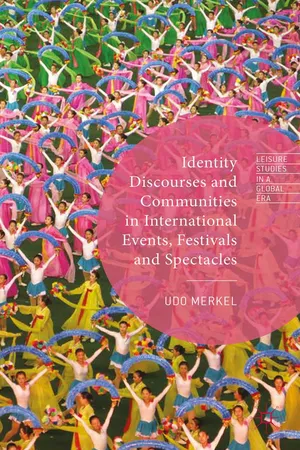
This collection focuses on the multi-layered links between international events and identity discourses. With a unique line-up of international scholars, this book offers a diverse range of exciting case studies, including sports competitions, music festivals, exhibitions, fashion shows and royal celebrations.
Information
Part I
Introduction
1
Making Sense of Identity Discourses in International Events, Festivals and Spectacles
Udo Merkel
This edited collection is concerned with international festivals, celebrations and spectacles, as well as the contributions these events make to our social identities. More precisely, it is about two distinctively different and yet interrelated processes: the construction and presentation of identities. It also explores the intersections of identity and community within various event contexts. The book’s interdisciplinary approach, cross-cultural themes and methodological diversity reflect the complexity of its overriding issue that appears to be en vogue in the realms of everyday discourses, popular culture, journalism and academia. In a nutshell, identity refers to the understanding of individuals in terms of who they are, normally in comparison to others. This ability ‘involves knowing who we are, knowing who others are, them knowing who we are, us knowing who they think we are, and so on’ (Jenkins 2008, p.5). Jenkins also notes that planned events, in particular rites and rituals, play an important role in the formation and development of social identities as they tend to celebrate the essence of an identity and mark the transition from one identity to another. However, this volume is less concerned with small-scale or personal private celebrations that consolidate identity than high-profile, international events, festivals and spectacles.
In February 2014, two global sports spectacles, the Winter Olympics in Sochi and the Super Bowl in New York, attracted global media attention not only because of the sports but also due to their explicit engagement with identity discourses. Although Sochi’s elegant and creative display of Russia’s past, present and future in the opening ceremony was commended for its modest patriotism, there were also concerns about the extravaganza’s historical accuracy, a number of serious omissions and a tendency to romanticize and glamourize the country’s social and political structures (Walker 2014b). Overall, however, the Russians’ attempt to demonstrate to the rest of world who they were, who they are and who they want to be in the future was widely praised. In comparison, Coca Cola’s one-minute commercial during the Super Bowl caused a serous stir, particularly among conservative political commentators. Over 110 million viewers saw an advertisement that can be described as neither innovative nor original. It commenced with a man on a horse wearing a cowboy hat, reflected, visually, on the rich social, cultural and ethnic diversity of the United States in the main part and finished with children running towards the Grand Canyon. All of this was accompanied by a rendition of ‘America the Beautiful’, a patriotic tune that many consider to be the unofficial national anthem of the United States. However, it was sung not only in English but in eight other languages, specifically Arabic, French, Hebrew, Hindi, Keres, Mandarin, Spanish and Tagalog, symbolizing American diversity (Younge 2014). The televized commercial sparked angry, controversial and ugly comments on social media sites such as Facebook and Twitter, suggesting that Coca Cola’s understanding of America’s identity is misguided, a threat to most Americans’ sense of who they are and a misrepresentation of core American values. Others, particularly members of minority ethnic groups, were outraged that they had been appropriated as a marketing tool to increase corporate profits. There were also questions as to whether the company’s attempts to legitimize the Americanness of minority groups should be praised or taken as an insult. After all, the global corporate giant has been frequently criticized for its disregard for fair working conditions, health and environmental concerns.
Debates about modern identities and membership in local, regional, national and international communities not only are part of popular culture but have also become more intense and systematic in the academic world. Donald Getz’s comprehensive and thorough study, ‘The Nature and Scope of Festival Studies’ (2010), which examined 423 research papers, argues that the systematic analysis of festivals has grown into a significant field within events studies. He concludes that academic accounts of international festivals are dominated by three overarching themes: the socio-cultural roles , meaning and significance and the relationship between festivals and tourism and management issues. A closer look at this meta-literature review reveals that the issues of identity and community feature frequently as subheadings in various sections, for example in the context of papers concerned with authenticity, place and attachment, and social and cultural impacts. Therefore, it appears to be fair to suggest that a key characteristic of local, regional, national and international events and festivals alike is their contribution to the formation and expression of identity discourses and narratives. Many events and festivals confirm and reinforce identities, whilst others question and challenge traditional identities; some help to modify and reshape established identities, whereas others generate new identities or intend to reposition existing identities. Identity formation processes explicitly motivate some festivals and events; for others, it is an unintended by-product. With the help of symbolic systems and signifying processes, events and festivals create and offer distinctive meanings, which help individuals to form communities and make sense of who they are. These socio-cultural processes define and shape both individual and collective identities and have done so for some time, as the following three examples will show.
The 1969 Woodstock Festival of Music and Art was a memorable gathering of around half a million young, like-minded US citizens. Most of them questioned mainstream American norms and values, opposed the Vietnam War, supported the civil rights movement, wore unconventional clothes, explored alternative lifestyles, such as communal living, and experimented with sex and drugs. The festival caught the attention of the world as its essence was rooted in and combined music, social responsibility and independent, alternative forms of thinking. But, more importantly, Woodstock defined, shaped and expressed the identity of a new generation of young people, the Woodstock Nation (Hoffman 1993). Although the organizers of Woodstock were neither hippies nor civil rights or anti-war activists, the event brought together and united the energies of various counter-cultural streams, the anti-Vietnam War and pro-peace movement. Woodstock experienced the birth and ‘christening’ of a new identity that offered a different sense of social belonging inspired by a reflective and dynamic relationship between music and citizenship. After the worldwide release of the soundtrack and the film about the event, in 1970, Woodstock became a key source and important reference point for all those who believed that solidarity with other young people around the world would lead to fundamental socio-political changes. As such, the Woodstock Nation slowly turned into Woodstock Transnational (Kramer 2013).
In sharp contrast, football fans in the various European leagues tend to be more conservative and traditional and do not necessarily challenge political but commercial forces. The event, that is the frequent matches of their respective teams, plays a crucial role in their desire to express their identity and experience a sense of community. These occasions provide unique and valuable opportunities for the celebration of distinctively local, sometimes regional, identities. For many traditional fans, attending a football match is about experiencing and expressing a sense of belonging through the emotional engagement with other like-minded fans. The uniform outward appearance of many fans provides a clear expression of their identity, displays their community membership and a sense of belonging (Finn and Giulianotti 2000; Giulianotti 2002; Merkel 1999; Ward and Williams 2010). Their vocal rejection of the increasing commercialization of football and their fight to preserve and maintain traditional, often very masculine, values and cultural practices are not driven by an anti-capitalism agenda. It is primarily about ownership, community and identity issues that are threatened by commercial forces that have repeatedly shown a total disregard for the social significance of football matches, clubs and teams.
Traditions play an equally significant role in the third example that demonstrates the close relationship and intersections between events, identity and community formation. In November 2013, Brazil’s Amazon region hosted the 12th Indigenous Games with more than 1,500 participants from various South and North American tribes and countries (Dana 2013). Some competitions focused on physical strength, agility and endurance. Others drew on important hunting and survival skills of the participants, for example archery. A very small number of activities revealed modern influences, such as football – albeit players were not allowed to run but had to crawl along the ground and could only use their heads to push the ball forward. Of course, this indigenous festival appears to be an unconventional and low-profile alternative to the sporting spectacles in Brazil, the 2014 FIFA World Cup and the 2016 Rio de Janeiro Summer Olympics. However, this coming together of traditional tribal cultures offered these dispersed communities with limited contacts to the outside world a rare chance to interact with each other, unite, celebrate and reflect on their identities.
This trio of examples clearly confirms that identities are social constructs. Their formation occurs within specific socio-economic, political and cultural contexts. They are the outcomes of social interaction and can only be understood properly in relation to the social environment, in particular in relation to other identities and communities. Jenkins argues that ‘identifying ourselves, or others, is a matter of meaning, and meaning always involves interaction: agreement and disagreement, convention and innovation, communication and negotiation’ (2008, p.17). Consequently, he has repeatedly suggested abandoning the ‘social’ in ‘social identity’ as it is superfluous. Furthermore, events do not only offer the attendees a platform for developing, consolidating, modifying and expressing their identity but also give places such as towns, cities and regions a distinctive identity. Such a ‘place identity is now frequently associated (in the minds of potential visitors, investors and residents, at least) with what it sells, what it creates and what it represents in terms of aesthetic attributes’ (Foley et al. 2012, p.77). These events are frequently referred to as hallmark events (Hall 1992) as they cannot be separated from the city or region where they take place.
There is little doubt that most people associate the Notting Hill Carnival and the Wimbledon Championships with London, the Opera Ball with Vienna, the Oktoberfest with Munich, the Running of the Bulls with Pamplona, the Mardi Grass with New Orleans or the Woodstock Festival with upstate New York. In some cases, the legacy of a famous festival can even lead to the emergence of other events and define their essence, characteristics and, ultimately, identity. Woodstock is one of these places. Since 2000, it has been hosting a highly respected, independent film festival. Considering the large number of international film festivals that have been founded over the last two decades, it is no surprise that many struggle to set themselves apart and differentiate themselves from the many others. However, the Woodstock film festival has what every film festival needs, many claim to have, but only very few can really offer – a genuine and distinctive identity. It is not based on choice, design or an expensive marketing campaign but the inevitable result of its famous history that is characterized by creativity and rebellion.
However, the above-mentioned short case studies also raise a significant number of questions about the relationship between events, identity discourses and communities, which this volume intends to explore in detail:
1. What kind of sources do events, festivals and celebrations provide and what kind of input do they offer for both the construction of communities and the expressing of their identities? How do events support the formation of identities? How do they build social capital and foster community spirit?
2. What kind of identity projects do events support? Do they help to preserve and reinforce established identities and communities, or do they challenge them and offer a platform to launch new and alternative identities?
3. What are the specific characteristics of identities and communities that emerge and exist in the context of international events? What do events say about the identity of their participants?
4. How do we best theorize those communities that share a distinctive identity? Are concepts that are derived from classical sociological thinking still able to capture the essence of these communities or are modern, often contested, conceptualizations more useful?
In order to facilitate a better understanding of this collection, I will address some of these issues and questions briefly in this introduction before they are considered in much greater detail in the individual chapters.
Theorizing identity and community: Influential thinkers and thoughts
Although, currently, there appears to be an urgency and preoccupation with questions of identity, academic debates about the significance and changing nature of identity and community have permeated the development of social-scientific thinking and analyses for more than a century. These discussions can be traced back to the origins and early days of both German and French sociology. Some of the most influential, innovative and groundbreaking thinkers, such as Karl Marx, Émile Durkheim and Ferdinand Tönnies, had a keen interest in the way people create communities and form social identities on the basis of a strong sense of shared interests, characteristics, values and beliefs, and reinforced through a variety of cultural practices and rituals. Despite their very different approaches to the study of identity, all agreed that a collective consciousness, which defines membership in, and the solidarity of, a group, is developed through action and interaction of individuals. It creates social integration and holds these communities and, ultimately, society together.
Karl Marx (1818–1883) was primarily interested in the impacts of fundamental socio-economic changes, the emergence of industrial society, the development of capitalism and the dynamics of the new class system. Due to his concern about growing social inequalities, he paid particular attention to the formation of a working-class consciousness, one of the many outcomes of the industrialization process in European societies in the nineteenth century. Although Marx did not use the term ‘identity’, he introduced the sociological concept of class consciousness and differentiated between a ‘class in itself’ and ‘class for itself’. In the context of the working class, or proletariat, a ‘class in itself’ is best understood as a substantial group of people sharing significant social characteristics in relation to the economic system, becoming aware of their likeness and the need to change their disadvantageous position through collective action. Organizing itself and actively pursuing shared interests in order to improve their socio-economic conditions and quality of life turns this group into a ‘class for itself’. According to Marx, an understanding and appreciation of one’s position in the economic system leads to class consciousness, which, in turn, motivates and encourages class action. This involves forming political parties, joining trade unions or even engaging with revolutionary movements. For Marx, the formation of a distinct working-class identity was the outcome of the new economic arrangements of capitalism and, at the same time, a crucial stepping stone in the revolutionary process of overthrowing that system and abolishing class society. Whilst many political commentators tend to explain ‘class consciousness’ simply as identification with other members of one’s own class, Marx’s analysis shows that the existence of a class consciousness requires a unification process that happens through social interaction. For Marx, class is the most significant source of identity and conflict.
Émile Durkheim (1858–1917), a French sociologist, had a keen interest in what holds society together since the traditional and intense bonds of family and church had been replaced by modern economic arrangements with specialized roles and distinctive responsibilities. For Durkheim, any explanation of the existence of society required a detailed and subtle understanding of how collective identities bind people together and generate social integration. Durkheim was deeply concerned that the new socio-economic structures that the industrialization process had created could lead to a disintegration of society. Although he was aware that the increasing population size and growing division of labour had created robust networks of interdependencies, he considered the weakening of a collective conscience to be a serious challenge for modern societies. In his seminal work, The Division of Labour in Society, originally published in 1893, he concludes that social cohesion takes different shapes in particular historical eras (1997). He developed a simple dichotomy to mark the two ends of a continuum that illustrates the transition from tradition to modernity. Durkheim’s differentiation between ‘mechanical solidarity’ and ‘organic solidarity’ describes two types of social organization and the ways individuals are connected.
Mechanical solidarity is characterized by a low division of labour, based on likeness, shared sentiments and responsibilities, a high degree of self-sufficiency and close personal ties. All these elements constitute a simple, pre-industrial version of social cohesion that is crucially supported by religious rituals and ceremonies. In The Elementary Forms of Religious Life, initially published in 1912, Durkheim (2001) has also shown how important rituals are for social cohesion, solidarity and a collective consciousness. He argued that rituals stimulate the experience of collective effervescence, which, in turn, promotes a group identity, strengthens the sense of belonging and stresses the symbolic boundaries between insiders and outsiders. In sharp contrast, organic solidarity is typical for more compl...
Table of contents
- Cover
- Title Page
- Copyright
- Contents
- Acknowledgements
- Notes on Contributors
- Part I: Introduction
- Part II: The Contestation of Local and Regional Identity Discourses and Communities
- Part III: Identity Discourses of Cities and National Communities
- Part IV: Supra-national Events, Communities and Identity Discourses
- Index
Trusted by 375,005 students
Access to over 1.5 million titles for a fair monthly price.
Study more efficiently using our study tools.
Frequently asked questions
Yes, you can cancel anytime from the Subscription tab in your account settings on the Perlego website. Your subscription will stay active until the end of your current billing period. Learn how to cancel your subscription
No, books cannot be downloaded as external files, such as PDFs, for use outside of Perlego. However, you can download books within the Perlego app for offline reading on mobile or tablet. Learn how to download books offline
Perlego offers two plans: Essential and Complete
- Essential is ideal for learners and professionals who enjoy exploring a wide range of subjects. Access the Essential Library with 800,000+ trusted titles and best-sellers across business, personal growth, and the humanities. Includes unlimited reading time and Standard Read Aloud voice.
- Complete: Perfect for advanced learners and researchers needing full, unrestricted access. Unlock 1.5M+ books across hundreds of subjects, including academic and specialized titles. The Complete Plan also includes advanced features like Premium Read Aloud and Research Assistant.
We are an online textbook subscription service, where you can get access to an entire online library for less than the price of a single book per month. With over 1.5 million books across 990+ topics, we’ve got you covered! Learn about our mission
Look out for the read-aloud symbol on your next book to see if you can listen to it. The read-aloud tool reads text aloud for you, highlighting the text as it is being read. You can pause it, speed it up and slow it down. Learn more about Read Aloud
Yes! You can use the Perlego app on both iOS and Android devices to read anytime, anywhere — even offline. Perfect for commutes or when you’re on the go.
Please note we cannot support devices running on iOS 13 and Android 7 or earlier. Learn more about using the app
Please note we cannot support devices running on iOS 13 and Android 7 or earlier. Learn more about using the app
Yes, you can access Identity Discourses and Communities in International Events, Festivals and Spectacles by Udo Merkel in PDF and/or ePUB format, as well as other popular books in Social Sciences & Personality in Psychology. We have over 1.5 million books available in our catalogue for you to explore.