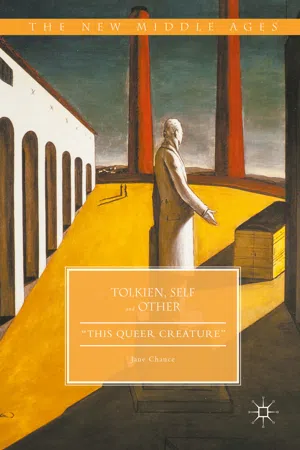
- English
- ePUB (mobile friendly)
- Available on iOS & Android
eBook - ePub
About this book
This book examines key points of J. R. R. Tolkien's life and writing career in relation to his views on humanism and feminism, particularly his sympathy for and toleration of those who are different, deemed unimportant, or marginalized—namely, the Other. Jane Chance argues such empathy derived from a variety of causes ranging from the loss of his parents during his early life to a consciousness of the injustice and violence in both World Wars. As a result of his obligation to research and publish in his field and propelled by his sense of abjection and diminution of self, Tolkien concealed aspects of the personal in relatively consistent ways in his medieval adaptations, lectures, essays, and translations, many only recently published. These scholarly writings blend with and relate to his fictional writings in various ways depending on the moment at which he began teaching, translating, or editing a specific medieval work and, simultaneously, composing a specific poem, fantasy, or fairy-story. What Tolkien read and studied from the time before and during his college days at Exeter and continued researching until he died opens a door into understanding how he uniquely interpreted and repurposed the medieval in constructing fantasy.
Information
© The Author(s) 2016
Jane ChanceTolkien, Self and OtherThe New Middle Ageshttps://doi.org/10.1057/978-1-137-39896-3_11. Introduction: “This Queer Creature”
Jane Chance1
(1)
Andrew W. Mellon Distinguished, Rice University, Houston, USA
On a scrap of paper Tolkien scribbled an essay he originally titled “A Hobby for the Home” in which he confesses to “A Secret Vice,” as he later referred to it in a letter of 1967 and as his son Christopher retitled it. 1 By “Secret Vice,” Tolkien meant the invention of secret languages: he relays an anecdote in the essay about an overheard conversation: “I shall never forget a little man—smaller than myself—whose name I have forgotten,” he claims. Tolkien and the little man were in a “dirty wet marquee” whose odor was of “stale mutton fat,” and on the trestle tables on which they sat they were surrounded by “depressed and wet creatures.” 2 Someone was lecturing on army experiences—“map-reading or camp-hygiene” (a few sentences down Tolkien explains that “military arrangements” prevented the two of them from meeting again, so the memory likely stems from an experience he had while in the army during World War I). All of a sudden this little man says, “in a dreamy voice”—and this entire recollection has a dream quality to it—“Yes, I think I shall express the accusative by a prefix!”
Surely this is fiction, or maybe it is Tolkien masquerading as “the little man”—for he loves this “memorable remark.” What is magnificent to him is that it reflects a “personal pleasure,” like his own for the creation of Sindarin and Quenya, the Elven languages of Middle-earth. He uses other metaphors to note about the little man that “he proved close as an oyster” (not unlike Tolkien himself, who is publicly secretive about his private fears and joys). Tolkien imagines “this queer creature” as inventing languages during wartime, someone who “cheered and comforted himself in the tedium and squalors of ‘training under canvas,’” but so that no one else would hear him or study those languages. Tolkien concludes without affect that the little man likely “was blown to bits in the very moment of deciding upon some ravishing method of indicating the subjunctive.” 3
Of course during his entire life Tolkien invented languages, for he describes children, apparently his nieces, making up a language (by using animal names) called Animalic, and also Nevbosh, or the “New Nonsense,” a play-language in which he participated. But he never said that he spoke Nevbosh—“I was older in secret vice (secret only because apparently bereft of the hope of communication or criticism), if not in years, than the Nevbosh originator.” 4 The next stage in language development, word-form refinement, Tolkien defines as a selfish pleasure, stolen from whatever obligations of family or work one might have, yet, “This must be my excuse for becoming more and more autobiographical—regretfully, and from no arrogance.” 5 While communication between two people is the driver behind most languages, he feels in this activity involving pleasure in sound there is a factor more personal: “From here onwards you must forgive pure egotism … My little man, with his interest in the devices for expression of word-relations, its syntactical devices, is too fleeting a glimpse to use.” 6 As an adult, Tolkien was apparently alone in his vice, as he was in many of his endeavors during his entire life.
Tolkien’s essay, extant in only one manuscript and never published during his lifetime, reveals his desire to create languages as the chief joy in his life, an exemplar of how deeply personal was his commitment to his profession as scholar and to his creation of a fantastic world whose history, peoples, and languages felt like “home” to him. Allegedly, Tolkien wrote the essay, according to Christopher, “a year or more ago” after the Esperanto Congress meeting in Oxford in July 1930. Why Esperanto? This notion of a made-up language intrigued Tolkien, he avers, because it is necessary “for uniting Europe before it is swallowed by non-Europe” and because it was entirely made up by just one man who is “not a philologist.” This purpose leads him to his “stealthy subject … nothing less embarrassing than the unveiling in public of a secret vice”—the inventing of languages. 7 Notably, in the alter-ego he calls “this queer creature” he projects himself as abject and set apart from others, without any companion to speak to, while maintaining his persona as a mirror image who can only “speak” by writing to himself.
Why Tolkien regards this confession as embarrassing is unclear, but the lecture is marked throughout by his inimitable humor and personal references to memories of a stranger—a soldier—likely his own persona or a doppelganger. For that stranger, languages “satisfy either the needs of a secret and persecuted society, or the queer instinct for pretending you belong to one” 8 —“queer” and “persecuted,” the first adjective, often used throughout his works to describe his characters and himself. A page later he ventures that however inventive languages are, and however individualistic, their inventors need an audience to use them because “they are artists and incomplete without an audience.” 9 Certainly he imagines he himself is addicted, like “an opium-smoker.” 10 This invention of languages he describes as driven by “The instinct for ‘linguistic invention’—the fitting of notion to oral symbol, and his pleasure in contemplating that that new relation is established, is rational, and not perverted.” 11 What makes it more pleasurable than simply learning a new language is that it is “more personal and fresh.” 12
What Tolkien would like to do is to explain that, at this higher level—which involves the “perfect construction of an art-language”—one must “construct at least in outline a mythology concomitant.” This, he himself did, by creating the world in which his several languages are spoken, one with an individual flavor, to be achieved by weaving into it “the threads of an individual mythology, individual while working within the scheme of natural human mythopoeia.” This result apparently happens inevitably, for “your language construction will breed a mythology.” 13 And just before he offers several examples of his word-forms, his language, he reminds us, that because its construction reflects his taste, conditioned by imagination, he will always come back to his own language construction, which is “peculiarly mine,” designed by and for him, so may be “too free,” “over-pretty, to be phonetically and semantically sentimental,” for which he begs his listener to “be kindly.” 14 The examples he provides of different languages (and their English translations) of course come from his Elven tongues. And he defines as the virtue of his language construction as “its intimacy, … its peculiarly shy individualism,” the sharing of which involves the “pain of giving away myself.” 15
What Tolkien says about such projection is key to understanding how he sees himself, and others: that is, as an allegory. In letter 163 to W.H. Auden, written on 7 June 1955, he confesses that “In a larger sense, it is I suppose impossible to write any ‘story’ that is not allegorical in proportion as it ‘comes to life’; since each of us is an allegory, embodying in a particular tale and clothed in the garments of time and place, universal truth and everlasting life” (212–13). If this was true for Tolkien, why was it true, and how did he allegorize himself—cover up himself in the clothing of fiction? This important statement, grounded in medieval platonic definitions of allegory, nevertheless suggests that every fantasy character invented by Tolkien in some way embodies its own personal moment in its creator’s mythos as its creator projects his own self, or story, into it at the time and place in the world in which he lives. Benjamin Saxton has noted in his discussion of authorship in Mikhail Bakhtin and Tolkien that “For Tolkien, the act of narration becomes a metaphor for living in the world.” 16 Tolkien’s characters in his narratives allow him to do that by means of allowing them dialogic freedom to express their individual difference. They are very often abject—a term associated with Freudian psychology and Kristevan feminist theory.
Certainly Tolkien himself was shy and abject all his life. I believe he viewed himself as Other. Slavoj Žižek, in “Neighbors and Other Monsters,” taxonomizes types of the Other.
Which must imply that in the neighbor is the monstrous Other, in whom I see myself. In respect to Tolkien, Benjamin Saxton, citing Gary Saul Morson’s concept of “sideshadowing,” argues that Tolkien illustrates characters’ choices by creating a series of “oppositional figures,” or foils for one another: Hobbits Frodo and Gollum, wizards Gandalf and Saruman, kings Théoden and Denethor, and the men and brothers Faramir and Boromir: “They also demonstrate that, for Tolkien’s characters, ‘the other’ is always, to some extent, ‘me.’” The exemplar Saxton uses is Gandalf the White, who says “I am Saruman … as he should have been.” 18First, there is the imaginary other—other people ‘like me,’ my fellow human beings with whom I am engaged in the mirrorlike relationships of competition, mutual recognition, and so forth. Then, there is the symbolic ‘big Other’—the ‘substance’ of our social existence, the impersonal set of rules that coordinate our coexistence. Finally, there is the Other qua Real, the impossible Thing, the ‘inhuman partner,’ the Other with whom no symmetrical dialogue, mediated by the symbolic Order, is possible … The neighbor (Nebenmensch) as the Thing means that, beneath the neighbor as my semblant, my mirror image, there always lurks the unfathomable abyss of radical Otherness, of a monstrous Thing that cannot be gentrified. 17
If this was true for Tolkien, why was it true, and how did he allegorize himself—cover up himself in the clothing of fiction? Tolkien is often most “queer” in his disruption of whatever conventions his world might have expected an Oxford medievalist to follow, which we essentialize as having been the most “Tolkienian,” as if his originality as a thinker and fantasy writer did not set him apart from his peers and as if it were always as valued as it is now. The multiplicity of selves may be normative in the modern age (I think of Hermann Hesse’s Steppenwolf and its image of the individual as a layered onion with many selves—a modernist image, if not exactly a queer one). Tolkien in his own narrative appears more and more postmodern in the fractured self he projects into fantasy through characters such as the everyhobbits Bilbo and Frodo, whom contemporary media pundits perceive as in love, often viewed queerly through a Jacksonian lens. 19 Do we read into him our own postmodern queerness, or is it our own queerly medieval desire as other, to resist and disturb the normative?
Wendy Moffat, who long worked on a queer biography of E.M. Forster, in her 2015 article “The Narrative Case for Queer Biography,” reminds readers that “Queer theory began, not just as a totalizing vision—but rather as a totally anti-essentialist one. The goal was to illustrate how constructed, how unnatural essentialist assumptions about identity were, not merely to observe how power worked on subjects … the depressingly consistent evidence of homophobia reminds the theorist of the complex and often the limited agency of the queer subject.” 20 As a result, Moffat follows Eve Sedgwick in her rejection of teleology for the “unfixed narrative,” inste...
Table of contents
- Cover
- Frontmatter
- 1. Introduction: “This Queer Creature”
- 2. Forlorn and Abject: Tolkien and His Earliest Writing (1914–1924)
- 3. Bilbo as Sigurd in the Fairy-Story Hobbit (1920–1927)
- 4. Tolkien’s Fairy-Story Beowulfs (1926–1940s)
- 5. “Queer Endings” After Beowulf: The Fall of Arthur (1931–1934)
- 6. Apartheid in Tolkien: Chaucer and The Lord of the Rings, Books 1–3 (1925–1943)
- 7. “Usually Slighted”: Gudrún, Other Medieval Women, and The Lord of the Rings, Book 3 (1925–1943)
- 8. The Failure of Masculinity: The Homecoming of Beorhtnoth (1920), Sir Gawain (1925), and The Lord of the Rings, Books 3–6 (1943–1948)
- 9. Conclusion: The Ennoblement of the Humble: The History of Middle-earth
- Backmatter
Trusted by 375,005 students
Access to over 1.5 million titles for a fair monthly price.
Study more efficiently using our study tools.
Frequently asked questions
Yes, you can cancel anytime from the Subscription tab in your account settings on the Perlego website. Your subscription will stay active until the end of your current billing period. Learn how to cancel your subscription
No, books cannot be downloaded as external files, such as PDFs, for use outside of Perlego. However, you can download books within the Perlego app for offline reading on mobile or tablet. Learn how to download books offline
Perlego offers two plans: Essential and Complete
- Essential is ideal for learners and professionals who enjoy exploring a wide range of subjects. Access the Essential Library with 800,000+ trusted titles and best-sellers across business, personal growth, and the humanities. Includes unlimited reading time and Standard Read Aloud voice.
- Complete: Perfect for advanced learners and researchers needing full, unrestricted access. Unlock 1.5M+ books across hundreds of subjects, including academic and specialized titles. The Complete Plan also includes advanced features like Premium Read Aloud and Research Assistant.
We are an online textbook subscription service, where you can get access to an entire online library for less than the price of a single book per month. With over 1.5 million books across 990+ topics, we’ve got you covered! Learn about our mission
Look out for the read-aloud symbol on your next book to see if you can listen to it. The read-aloud tool reads text aloud for you, highlighting the text as it is being read. You can pause it, speed it up and slow it down. Learn more about Read Aloud
Yes! You can use the Perlego app on both iOS and Android devices to read anytime, anywhere — even offline. Perfect for commutes or when you’re on the go.
Please note we cannot support devices running on iOS 13 and Android 7 or earlier. Learn more about using the app
Please note we cannot support devices running on iOS 13 and Android 7 or earlier. Learn more about using the app
Yes, you can access Tolkien, Self and Other by Jane Chance in PDF and/or ePUB format, as well as other popular books in Literature & Literature General. We have over 1.5 million books available in our catalogue for you to explore.