eBook - ePub
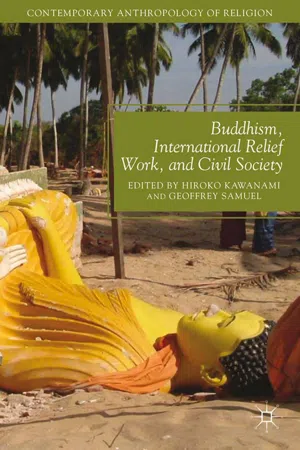
Buddhism, International Relief Work, and Civil Society
- English
- ePUB (mobile friendly)
- Available on iOS & Android
eBook - ePub
Buddhism, International Relief Work, and Civil Society
About this book
Natural disasters in Asian countries have brought global attention to the work of local Buddhist communities and groups. Here, the contributors examine local Buddhist communities and international Buddhist organizations engaged in a variety of relief work in countries including India, Thailand, Sri Lanka, China, and Japan.
Information
Topic
Ciencias socialesSubtopic
Filosofía socialChapter 1
Buddhism and International Aid: A Case Study from Post-tsunami Sri Lanka
Elizabeth J. Harris
Introduction
When a tsunami hit Sri Lanka in two merciless waves between 9.30 and 10.30 a.m. on December 26, 2004, an estimated 30,000 were killed, 800,000 were made homeless, and 70 percent of the island’s coastline was devastated.1 Two distinct areas of the country were affected: the predominantly Sinhala and Buddhist south coast, and the predominantly Tamil and Muslim north and east coasts, the east being the worst devastated. It sparked the largest international aid programme in modern Sri Lankan history in an already charged situation of ethnic conflict and interreligious tension.
In this chapter, I focus on three nongovernmental Buddhist relief initiatives that addressed the post-tsunami situation. The first was developed by the Damrivi Foundation, an indigenous Buddhist organization established in 2003 by academics and professionals who believed that Buddhist insights were needed in sectors such as counselling and medical aid. The second was developed by the Foundation of Goodness, a project that was started in Seenigama and surrounding villages on the southern coast by Kushil Gunasekera, a legally trained businessman and former secretary of the Sri Lanka Cricket Board. The third concerns the house-building projects initiated by Sri Lankan Buddhist monks, using aid from the worldwide Sri Lankan Buddhist diaspora.2 All these projects represent a Buddhist civil society contribution with funding from international and local nongovernmental networks.
In examining these initiatives, I focus on several questions. To what extent did these organizations modify traditional Buddhist models of social involvement, particularly in connection with the role of the monastic sangha? Were their activities a response to Christian or secular social activism? What was the quality of the relationship that each organization maintained with its sponsors? Did the Buddhist underpinning of these organizations result in the victims of the tsunami receiving more effective help than that offered by international or local non-Buddhist aid organizations? Did they, for instance, avoid some of the drawbacks of international aid projects such as the encouraging of dependency, the imposition of inappropriate models of development, or the introduction of target-orientated rather than quality-orientated programs?
The research results presented here draw on three post-tsunami visits to Sri Lanka. The first was four months after the 2004 tsunami, when I traveled to most of the affected coastal areas. The second was in the summer of 2007, when I revisited the east and witnessed some of the rebuilding that had taken place. The last was in 2009, when I carried out the fieldwork for this chapter. Before I examine the work of each organization, I outline the post-tsunami context, with particular reference to the ethnic conflict, interreligious tension, influx of international aid, and the role of civil society.
Background to Sri Lanka’s Ethnic Conflict
The roots of the ethnic conflict in Sri Lanka can be traced to a postindependence (i.e., after 1948) constitution that did not allow the Tamil community, which although a minority in the whole country, was a majority in the north and east, to have any control over these areas. When this became coupled with legislation that the Tamil community perceived as discriminatory, grievances arose. Peaceful methods of political representation by Tamil politicians failed to redress these, leading eventually to violent conflict, as militant youth groups demanding a separate state of Tamil Eelam in the north and east arose in the 1970s. In the decades that followed, periods of civil war alternated with interludes of relative peace, when negotiations between the government and the militant group that gained dominance, the Liberation Tigers of Tamil Eelam (LTTE), began only to fail. The means the LTTE employed in their attempt to bring Tamil Eelam to birth became increasingly authoritarian and terrorist in nature. All communities suffered as a result.3
On February 22, 2002, an agreement on a cease-fire was signed by the government of Sri Lanka and the LTTE, during a period of relative peace.4 This was followed by several rounds of peace talks. When the tsunami struck, however, the peace talks had stalled and the cease-fire had been violated numerous times. Moreover, a change of government in April 2004 had brought to power parties that favored a military rather than a negotiated solution to the conflict. According to journalist Jehan Perera, not only had the ruling party been defeated in the April 2004 election but also the search to lead the “country to ethnic peace through compromise.”5 In effect, therefore, by December 2004, although the cease-fire had not officially been abrogated, the last and most deadly “Eelam War” had begun, with the LTTE retaining military control over much of the north of the country.6
Two-thirds of the coastline affected by the tsunami lay in the war-torn territories of the north and east. Seven to eight thousand people in these areas had already been internally displaced by war and many towns had already been scarred through bombs and grenades.7 When, in April 2005, I visited Mullaitivu, on the northeastern coast, then under the LTTE control, I was astounded by the devastation. Almost the whole of the old town had disappeared. The road that had bordered the sea could hardly be seen. Two Roman Catholic churches near that road now appeared to be on the beach. Further inland, one road had tsunami damage on one side and war damage on the other.
Interreligious Tension
Interreligious tension in modern Sri Lanka can be traced back to the period of European expansionism, during which Sri Lanka suffered the imperialisms of the Portuguese, the Dutch, and the British.8 During the British period, which lasted from the last decade of the eighteenth century to 1948, antagonism arose between Buddhists and Christian missionaries sent to Sri Lanka by independent evangelical missionary societies such as the Church Missionary Society and the Wesleyan Methodist Missionary Society. In the south and central parts of the country, this led to a vigorous Buddhist revival that aimed to defend Buddhism against missionary attack. One element of this revival was demonization of Christianity as uncivilized, predatory, and nihilistic.9
During the twentieth century, indigenous Sri Lankan Christians did much to build trust with their Buddhist neighbors but antagonism between the two religions surfaced periodically, particularly in the latter part of the century, over the accusation that Christians were involved in “unethical conversions,” namely in bribing impoverished villagers to become Christians through promises of material benefits, which were funded lavishly from abroad.10 By May 2004, the level of mistrust was so high that a “Prohibition of Forcible Conversions Bill” was tabled in the parliament by the Jathika Hela Urumaya, a party that had been formed in preparation for the 2004 elections, with the intention of fielding Buddhist monks as candidates. In June 2004, the then minister of Buddha Sāsana, Rathnasiri Wickremenayake, presented another, similar bill.11 Neither had become law by December 2004 but their existence nurtured an atmosphere of mistrust toward the Christian NGOs that started to work in the tsunami-affected regions. Rumors circulated that some were using the tragedy to proselytize.12 After the tsunami, one of the tasks of a Commission of Inquiry appointed by the All Ceylon Buddhist Congress (ACBC) in 2006 was to ascertain whether there was “evidence to support the view that some relief workers both local and foreign who offered to help out the victims of the December 2004 Tsunami disaster made use of that opportunity to convert Buddhists.” The report that ensued found such evidence.13 When, in 2009, I interviewed Jagath Sumathipala, the president of the ACBC, he claimed that conversion was one of the biggest issues after the tsunami and that Buddhists had to become involved in social action to counter it. To this end, he explained, the ACBC had chosen a Divisional Secretariat in Moneragala, a poverty-stricken area in the south, to start empowerment and livelihood projects among the people.
The Influx of International Aid
When news of the tsunami spread in Sri Lanka, there was an outpouring of compassion within the country. People from villages in the interior walked with food supplies in their hands or on their heads to the coast and distributed it to those affected, without discriminating between Sinhala, Tamil, or Muslim victims. Extended family networks gave help to orphans and widows. Secular civil society activists in Colombo arranged for development workers to visit the temporary camps that were eventually set up.
Most significantly, in the south, Buddhist temples became a focus for providing immediate palliative aid. Tents were erected in vihāras (Buddhist monasteries) to house refugees. Members of the monastic sangha used bicycles to ride around the affected areas, inviting everyone in need to come to the vihāras, whether Buddhist, Christian, Hindu, or Muslim. Traditionally, food and material requisites are brought by laypeople into the vihāras. In the immediate aftermath of the tsunami, this action was reversed. Laypeople came to the monks to be fed and sheltered.
Informal aid of this kind was more effective than state aid in the first few days.14 Voluntary initiatives by religious bodies, indigenous NGOs, and individuals were significant during this crucial time. In fact, some reports asserted that there was serious state failure at this time.15
An outpouring of compassion was also seen internationally. Money and goods eventually poured into Sri Lanka both from International Nongovernmental Organizations (INGOs) and governments. The Sri Lankan state attempted to centralize this. A Centre for National Operations was set up and three task forces: Task Force for Rescue and Relief; Task Force for Logistics, Law and Order; Task Force for Rebuilding the Nation (TAFREN).16 One consequence was that power was taken away from local civil society bodies and even from local government. The key players became the Sri Lankan government, the LTTE (with whom a Memorandum of Understanding was signed in June 2005 for the Establishment of a Post-Tsunami Management Structure), the international community (United Nations [UN] bodies, national governments, and international secular and religious NGOs), and the private sector. In the words of political scientist Jayadeva Uyangoda, Sri Lanka became locked “into a complex network of global initiatives.”17
In this context, the international media tended to concentrate on external aid donors rather than indigenous civil society initiatives. It was pointed out to me by more than one Buddhist that an edition of the Time magazine had given three examples of post-tsunami reconstruction, one in Jaffna, one in Batticaloa—both predominantly Tamil Hindu areas—and one organized by the Seventh Day Adventist Church in the south. The indigenous Buddhist aid that was happening at several levels was not mentioned at all. Other coverage represented the West as protector and the East as victim, or international aid organizations as holding the key to rehabilitation rather than local networks.18 This caused resentment among many Buddhists, who judged it to be another instance of an international unwillingness to see Sri Lankan Buddhists and Buddhism in general as committed to compassionate act...
Table of contents
- Cover
- Title
- Chapter 1 Buddhism and International Aid: A Case Study from Post-tsunami Sri Lanka
- Chapter 2 Thai Buddhists’ Encounters with International Relief Work in Post-tsunami Thailand
- Chapter 3 Buddhism and Relief in Myanmar: Reflections on Relief as a Practice of Dāna
- Chapter 4 Transnational Networks of Dharma and Development: International Aid by Japanese Buddhists and the Revival of Buddhism in Post–Khmer Rouge Cambodia
- Chapter 5 Implications of International Relief Work and Civil Society for Japanese Buddhists Affiliated with Traditional Denominations
- Chapter 6 International Relief Work and Spirit Cultivation for Tzu Chi Members
- Chapter 7 Buddhism and Relief Work in Mainland China and Hong Kong
- Chapter 8 Constructing and Contesting Sacred Spaces: International Buddhist Assistance in Bodhgayā
- Afterword
- Notes on Contributors
- Index
Trusted by 375,005 students
Access to over 1.5 million titles for a fair monthly price.
Study more efficiently using our study tools.
Frequently asked questions
Yes, you can cancel anytime from the Subscription tab in your account settings on the Perlego website. Your subscription will stay active until the end of your current billing period. Learn how to cancel your subscription
No, books cannot be downloaded as external files, such as PDFs, for use outside of Perlego. However, you can download books within the Perlego app for offline reading on mobile or tablet. Learn how to download books offline
Perlego offers two plans: Essential and Complete
- Essential is ideal for learners and professionals who enjoy exploring a wide range of subjects. Access the Essential Library with 800,000+ trusted titles and best-sellers across business, personal growth, and the humanities. Includes unlimited reading time and Standard Read Aloud voice.
- Complete: Perfect for advanced learners and researchers needing full, unrestricted access. Unlock 1.5M+ books across hundreds of subjects, including academic and specialized titles. The Complete Plan also includes advanced features like Premium Read Aloud and Research Assistant.
We are an online textbook subscription service, where you can get access to an entire online library for less than the price of a single book per month. With over 1.5 million books across 990+ topics, we’ve got you covered! Learn about our mission
Look out for the read-aloud symbol on your next book to see if you can listen to it. The read-aloud tool reads text aloud for you, highlighting the text as it is being read. You can pause it, speed it up and slow it down. Learn more about Read Aloud
Yes! You can use the Perlego app on both iOS and Android devices to read anytime, anywhere — even offline. Perfect for commutes or when you’re on the go.
Please note we cannot support devices running on iOS 13 and Android 7 or earlier. Learn more about using the app
Please note we cannot support devices running on iOS 13 and Android 7 or earlier. Learn more about using the app
Yes, you can access Buddhism, International Relief Work, and Civil Society by H. Kawanami, G. Samuel, H. Kawanami,G. Samuel in PDF and/or ePUB format, as well as other popular books in Ciencias sociales & Filosofía social. We have over 1.5 million books available in our catalogue for you to explore.