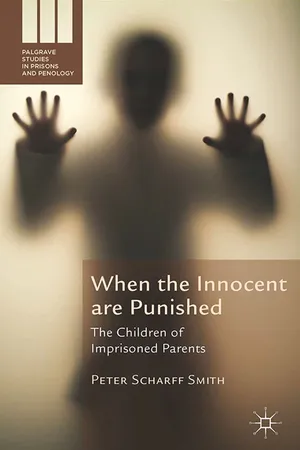
There are millions of children experiencing parental imprisonment all over the world. This book is about their problems, human rights and how they are treated throughout the justice process from the arrest of a parent to imprisonment and release.
eBook - ePub
When the Innocent are Punished
The Children of Imprisoned Parents
- English
- ePUB (mobile friendly)
- Available on iOS & Android
eBook - ePub
When the Innocent are Punished
The Children of Imprisoned Parents
About this book
Information
Part I
Prison, Society and Prisoners’ Children
1
Scenes from Family Life
One Saturday night in Denmark, Malene, Carina and Tenna’s father was arrested. Carina explained that her little sister had hardly woken up before a police officer ordered a dog to jump up onto the bed to sniff out drugs: “My little sister screamed as loud as she could. We had to leave the room so the officer could check it for drugs. When we were on the way out of the room, he opened my drawers and began throwing my underwear and other things all over the place. It was so insulting, I felt like I was the criminal.” The father was arrested, and the girls (who were 18, 16 and 14 years old, respectively) were left behind – apparently without the police having contacted any family members or the social authorities, or even asking if the girls had somewhere to go. Seven days later, the eldest girl visited their father in prison. Tenna, the youngest, didn’t want to go along. She was still very upset and mostly stayed in bed for the two months following the arrest. After three and a half months in remand custody, the girls’ father was sentenced to three years. Malene and Carina had a poor relationship with their mother and her boyfriend, so they continued living in their father’s house. They worked as much as they could after school and studying, but despite their efforts, the house was put on a foreclosure auction after six months. The girls then moved into an apartment, and Carina applied to the municipality for financial assistance. She received half of the rent for three months.1
Alicia was a 15-year-old girl living with her mother in Sweden. One night she was home alone when the police came and searched the apartment. Later her mom came and made her dinner. The police returned: “I remember that I just stayed in kitchen. It was as if I tried to forget that someone else was there. I just stood there and ate my dinner. My mom came out into the kitchen and told me that she had to go but that she would be back in an hour. But she did not return within the hour. I didn’t get to talk with her for a month. I had no one, I was completely alone in the apartment. I didn’t know what to do. The police did not contact me, nor did the social authorities or anyone else. It was difficult because I did not have any good contact with my Dad either.”2
A Norwegian boy remembers the time his mother told him about his father’s sentence: “I remember extremely well when dad got his sentence for 13 years.” The boy was on his way to an after-school activity: “Then my mother tells me that dad has been sent to prison for 13 years. I began to cry. I remember I ran out of the car and hid myself behind a trash bin. That’s when I had really needed someone to talk to.”3
A Danish police officer remember an experience that still haunts him 30 years later:
Once, many years ago, I had to carry out an arrest of a female drunk driver together with another officer. Unfortunately, she managed to get into her apartment before we could get hold of her. When we rang the doorbell, she opened the door and was clearly very intoxicated. Her husband, who didn’t appear to be under the influence, stood behind her with their almost 5-year-old son. We asked the husband to go into another room with the child and explained: “We just need to chat with your wife and take her down to the station for a blood test. It won’t take that long”. But he refused and remained standing where he was. The woman certainly did not want to go to the station and began kicking and fighting. She was a very heavy-built and strong lady and very infuriated, so we couldn’t get her to come with us just like that. We continued to urge the husband to leave with the child, but he refused. The situation with the woman developed and it all ended very unfortunately by us having to get her to lie down with two officers almost sitting on top of her out in the stairwell. And if that wasn’t enough, the husband wouldn’t go away with the boy; he didn’t even have a proper hold on him. Suddenly, the boy attacked me and beat furiously on my back while shouting, “Get away from my mother! Get away from my mother!” I will never forget the boy’s eyes and I often wonder where he is today, how it has affected him and what he thinks about the police and about the episode. It’s almost 28 years ago, so he is an adult man now.4
Ten-year-old Jonas lived with his father and little brother in Denmark. When his father went on a two-week sailing trip, Jonas and his brother moved in with their cousin. But his father didn’t come home after the voyage. For a week Jonas feared that the ship had sunk and his father had perished. Then the police phoned and said his father was remanded in custody. It took three months before the boys were allowed to visit their father, a visit Jonas was looking forward to. The cell was “small and gross”, and a police officer supervised the visit. “When it was time for us to leave we cried and clung to his legs ... . It was so sickening to drive away from the prison knowing that your father was in there.” Sixteen months went by before the case went before the court. This was a trying time for Jonas. He constantly thought about his father, began bullying his classmates and had difficulty keeping up in class. The case ended with an acquittal and DKK 150,000 in compensation. Nine years later, Jonas was still marked by the whole process and very scared of losing his father.5
According to a social worker employed with the Danish social services, “it is not widely recognized that one can have a severe social problem” when you “have a man who is in prison, who might also be the father of your child ... . I can think back on at least ten times where I haven’t thought of the fact that both a child and an adult need help. We (the social services) have failed especially with regard to the perspective of the child. If the prisoner is a parent, there is also a child who practically has lost a mom or dad. We as social workers are usually not afraid to act on this. However, in this situation, it is just not customary”.6
A Danish boy with several younger siblings was 12 years old when both parents were imprisoned on the same day: “Our father was arrested in the afternoon ... . At that time my mother became ill, she fainted and was taken to the hospital ... . She came home and was with us in the evening. Then the police arrived; they came in several cars with the blue lights flashing. They were there to arrest our mother and us kids were put in another car and driven to the children’s home. We were told that they were arrested because of drugs ... . So we were put in the children’s home ... 1½ months passed before we were able to see our mother and 2½ months before we saw our father ... . The children’s home was organised in a way so you lived in groups according to ages; so we didn’t live together but we spent all day together ... . I told the little ones that our mother and father were on holiday. I didn’t know what to tell them, but I thought that if I said they were on holiday, then the little ones would know that our mother and father would come back again.”7
A Danish prison officer remembers a time she was working in the prison visiting area and “praised a little girl’s dress. The girl became very happy and the mother got tears in her eyes just because I was nice. Imagine that so little can mean so much”.8
As a 12 year old, the Danish boy Kristian recounts how as a 7 year old he waited to hear what his father’s sentence would be: “Mum explained that I had to prepare myself that my father would probably be imprisoned. It was sort of like waiting for something that you know will be unpleasant, but you don’t know how bad it will be ... . And it was also as if every time we thought that now we were sure we would be told something, we would have to wait even longer.” Kristian’s father was in remand custody for ten months and then sentenced to 14 years; Kristian has visited his father many times. He clearly remembers his first visit to the prison. The visit was supervised: “An officer had to stand there and listen to what we talked about. We sat in such a small room and it felt as if you were completely surrounded by people you didn’t know.” Today, Kristian quite enjoys visiting his father in prison, but “just not when some of those hard-core types are at work. Then it’s just stupid because, well, you’re allowed to take a drawing in with you one time, and then you’re not the next time. You can’t take a gift inside one time and then you’re allowed to take something along anyway another time and it’s just really annoying. It changes all the time.” When Kristian is asked about the most difficult aspect of having a father in prison, he responds very promptly: “The most difficult thing is that I can’t play football with him. Or do anything else. When he’s in prison, I can hardly do anything together with him.”9
According to a Danish police officer, “it always makes a strong impression when there are children involved, as they are always the losers in all of this. They have under no circumstances chosen the situation they are in, which makes it all distressingly hard.”10
2
When the Innocent are Punished
Prisoners’ children
When a person commits a crime and is punished with imprisonment, it can be a very tough ordeal for the relatives. This is certainly the case when parents are imprisoned and one or more children are left behind. In a sense, the short glimpses of the various “family scenes” in the previous chapter and the children’s own stories and emotional reactions tell us almost everything. The naked, straightforward and almost archetypical accounts of loss, fear and anxiety clearly illustrate how imprisonment can affect some prisoners’ children particularly hard and have extensive negative repercussions on their daily life, well-being and future.
But how shall the state and society approach such an issue when we cannot refrain from prosecuting and punishing persons who commit crimes simply because they are parents? This is certainly not an easy question to answer, and in some ways the issue of prisoners’ children seems to be one of the major Gordian knots facing our modern system of punishment and imprisonment This can seem strange given the fact that there have been prisoners’ children for as long as there have been prisons. We are dealing with a problem that has existed for centuries but has only recently begun to attract serious attention.
Today we know quite a bit about the problems prisoners’ children face. Yet many questions regarding the scope of various problems and the degree to which parental imprisonment causes or perhaps exacerbates these issues are still unanswered. We do know from qualitative research how individual children can experience parental imprisonment as a major life crisis, and we know from quantitative research that parental imprisonment is a risk factor for a number of problems, including antisocial behaviour, offending and possibly mental health problems, drug abuse, school failure and unemployment.1 From the rising number of research studies and qualitative accounts it is clear that, while the physical removal of a parent can be positive for some children, parental imprisonment certainly affect many children’s lives in negative ways, which can include stigmatisation, psychological distress, behavioural changes and economic problems.2
Unfortunately, there are millions of children experiencing parental imprisonment all over the world right now. There are no official statistics on the number of children of imprisoned parents in any country, but several attempts have been made to calculate and investigate this in various ways and the resulting numbers are striking. In the United States in 2007, approximately 810,000 imprisoned fathers and mothers had more than 1.7 million children under the age of 18. One third of those would turn 18 while their parents were still in prison.3 In England, 2007 estimates indicated that 127,000 children experienced parental imprisonment every year.4 In 2006, it was further estimated that on a single day there were 88,000 children of prisoners in England and Wales.5 A more recent estimate based on a study of 3,849 prisoners in England and Wales produced the striking result that approximately 200,000 children had a parent in prison at some point during 2009 – 90.000 on a single day by the end of June that year.6
By looking at the average number of children per prisoner and the prison populations in Europe, the international NGO Eurochips has calculated that around 800,000 children in the European Union are separated from an imprisoned parent on a given day each year. Estimates from several countries in fact indicate that there are typically more children of prisoners than there are prisoners.7 But while prisons and prisoners have been the object of serious research since the latter half of the 19th century, the same thing can by no means be said about the millions of children experiencing parental imprisonment.
Prison and society
Historians normally agree that prisons have existed since the 16th century as institutions specifically constructed to incarcerate a significant number of people for prolonged periods of time.8 In much of this time, and especially during the last 200 years, the effects of imprisonment have been discussed intensively. These many discussions have typically focused on either the effects on the individual prisoner (individual deterrence and rehabilitation) or the possible preventive effect on society at large (general deterrence). The question of how imprisonment has otherwise affected society, particularly the relatives and children of those imprisoned, has by comparison gained sparse attention during the last two centuries.9 One could say that a critical philosophical and sociological literature on prisons and their relation to society appeared during the 1970s – inspired not least by Foucault’s Discipline and Punish – but these writings have generally explored prisons as symbols of modern society and modern technolo...
Table of contents
- Cover
- Title
- Part I Prison, Society and Prisoners’ Children
- Part II Children of Imprisoned Parents: Their Numbers, Problems and Human Rights
- Part III Prisoners’ Children: From Arrest to Release of Their Imprisoned Parents
- Part IV Conclusion
- Appendix: Prison Visits, Interviews and National Surveys
- Notes
- Bibliography
- Index
Trusted by 375,005 students
Access to over 1.5 million titles for a fair monthly price.
Study more efficiently using our study tools.
Frequently asked questions
Yes, you can cancel anytime from the Subscription tab in your account settings on the Perlego website. Your subscription will stay active until the end of your current billing period. Learn how to cancel your subscription
No, books cannot be downloaded as external files, such as PDFs, for use outside of Perlego. However, you can download books within the Perlego app for offline reading on mobile or tablet. Learn how to download books offline
Perlego offers two plans: Essential and Complete
- Essential is ideal for learners and professionals who enjoy exploring a wide range of subjects. Access the Essential Library with 800,000+ trusted titles and best-sellers across business, personal growth, and the humanities. Includes unlimited reading time and Standard Read Aloud voice.
- Complete: Perfect for advanced learners and researchers needing full, unrestricted access. Unlock 1.5M+ books across hundreds of subjects, including academic and specialized titles. The Complete Plan also includes advanced features like Premium Read Aloud and Research Assistant.
We are an online textbook subscription service, where you can get access to an entire online library for less than the price of a single book per month. With over 1.5 million books across 990+ topics, we’ve got you covered! Learn about our mission
Look out for the read-aloud symbol on your next book to see if you can listen to it. The read-aloud tool reads text aloud for you, highlighting the text as it is being read. You can pause it, speed it up and slow it down. Learn more about Read Aloud
Yes! You can use the Perlego app on both iOS and Android devices to read anytime, anywhere — even offline. Perfect for commutes or when you’re on the go.
Please note we cannot support devices running on iOS 13 and Android 7 or earlier. Learn more about using the app
Please note we cannot support devices running on iOS 13 and Android 7 or earlier. Learn more about using the app
Yes, you can access When the Innocent are Punished by Kenneth A. Loparo,Peter Scharff Smith in PDF and/or ePUB format, as well as other popular books in Social Sciences & International Relations. We have over 1.5 million books available in our catalogue for you to explore.