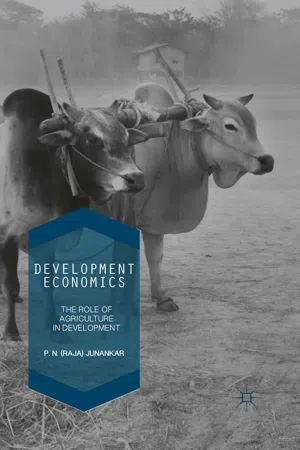
The papers in this book study economic development from the perspective of social justice and economic efficiency; exploring the role of land tenure and productivity in Indian agriculture. Junankar discusses the efficiency of small farms versus large farms, and the role of share-cropping tenancy.
- English
- ePUB (mobile friendly)
- Available on iOS & Android
eBook - ePub
About this book
Information
1
Introduction
The Role of Agriculture in Development
“When the missionaries first came to Africa they had the Bible and we had the land. They said ‘let us pray’. We closed our eyes. When we opened them, we had the Bible and they had the land.” (Bishop Desmond Tutu).
Introduction
Development Economics has moved over the decades from using an historical approach to using theoretical and mathematical approaches. Much of the literature used applied econometric methods to investigate various issues in Development Economics. In recent years, the growth of behavioural and experimental economics has led to the use of randomised control trials to investigate the effectiveness of various policies (World Bank, 2015). However, in the process of the development of the subject, we have lost the social, historical, and political context within which less developed countries (LDCs) operate. Economic development is a broader concept than economic growth. It entails not only an improvement in living standards on average (say in terms of GDP per capita) but also a lowering of poverty and inequality, an improvement in the educational, health and housing standards of people, and an increase in freedom and entitlements.1
In 2000, the United Nations set eight goals (the Millennium Development Goals, MDGs) for member countries to achieve by 2015. These eight goals were:
- Eradicate extreme poverty and hunger
- Achieve universal primary education
- Promote gender equality and empower women
- Reduce child mortality by two-thirds for children under five
- Improve maternal health
- Combat HIV and AIDS, malaria and other diseases
- Ensure environmental sustainability
- Develop a global partnership for development.
The United Nations (2015) has just released its Millennium Development Goals Report 2015. It shows that extreme poverty has declined substantially; primary school enrolment has also increased; and there have been big improvements in gender equality. Child mortality has fallen by more than 50%. The maternal mortality rate has declined by 45%. There have been big improvements in health; improvements have been made to access to drinking water; and there has been improved sanitation. Official development assistance has increased by 66%.
However, this favourable picture hides huge disparities that exist in different countries and regions. Although global poverty has decreased significantly, mainly due to a huge improvement in China, there are a large number of people who still live in poverty in Africa and Asia.
Now LDCs (poor countries) work in a globalised world where international trade is carried out with limited tariffs, foreign investment is sometimes dominant, and domestic policies (taxation, labour market policies, and controls on capital) are restricted by international agreements and the dominance of large multinational oligopolistic companies. Although there are increasing pressures to introduce “free trade” in goods and services (usually in the form of bilateral treaties, rather than a truly free trade regime), there are very significant restrictions on the movement of labour. In the nineteenth century, if there was a famine in one country (e.g. Ireland), there would be a mass migration of people (to the USA): there was an escape valve. If there were wars and religious persecution, there would be significant migration waves to North America, the UK, and Australia. However, today, wars, famines and religious persecution overwhelmingly lead to poverty and homelessness.
Many developing countries were colonised in the nineteenth century and as a result their economies were transformed into producing goods for the colonial power. Some countries in Africa and South America became providers of raw materials (coal, iron, copper, etc.) for Britain and the US, while others became single-crop producers of tea, coffee, sugar, etc. for the colonial powers. Not only were the economies transformed, but so too were the social and cultural traditions. This historical legacy should not be forgotten when we study the development of these poor countries.2
Stages of development
There is a large literature on countries going through specific stages of development. Marx, for example, argued that society goes from (a) “Asiatic production,” to (b) “Ancient production” (communal), to (c) feudal, to (d) capitalist production which would become increasingly monopolistic, and then due to the contradictions of a capitalist society, into (e) a socialist stage (see Junankar, 1982). Finally, when there are no more limits to the production of goods and services, society will move into a communist society. A critical requirement to move from a simple mode of production where people produce for their own consumption is for technology to become more productive so that it can produce a surplus over that necessary for subsistence (see Kriesler, 2013). In a feudal society, the lord of the manor appropriated the surplus. Under capitalism, the capitalists appropriate the surplus and invest it in new capital goods which leads to an increase in production and profits (surplus).
Rostow (1960) proposed in his book Five Stages of Economic Growth: A Non-Communist Manifesto that development takes place in five stages:
(i) Traditional Society,
(ii) Preconditions for Take-Off,
(iii) Take-Off,
(iv) Drive to Maturity, and
(v) Age of High Mass-Consumption.
Traditional society agriculture uses primitive technology. The social organisation was such that production was limited, and the society was primarily an agricultural society. The second stage had society becoming more dynamic with more education, new methods of production being employed, and the beginnings of manufacturing. The third stage of take-off occurred when saving and investment increased significantly, investment in infrastructure took place, and profits were reinvested in new methods of production, etc. The fourth stage, drive to maturity, was a long process where production continued increasing; saving and investment ratios increased to up to 20% of GDP; and new firms and industries were formed. The final stage, Age of Mass Consumption, which he took to be countries like Britain and the US, was one where modern technology had made production efficient and continuous. As this was a non-communist manifesto it is not surprising that he thinks of modernisation being simply dependent on saving and investment increasing without any consideration of what leads to the transition from one stage to another. This thesis has been criticised for not clearly demarcating each “stage” and the process by which the change takes place from one stage to another (see Thirlwall, 2011). In particular, many of the LDCs of today are not operating under the same conditions that (say) Britain or the USA were, since they are affected by the existence of large multinational corporations, and globalisation.
To really identify how societies progress, we need to study the development of an economy that is initially producing agricultural goods mainly for subsistence. At this stage the farmers are not producing a “surplus” that they can engage in trade with others. Early classical economists like Adam Smith, David Ricardo and Karl Marx had emphasised the crucial role of producing a surplus beyond the needs of the population. In much of classical economics, wages were kept at subsistence, either through population growth or through unemployment, which allowed the capitalist to obtain a potential surplus from production. How the surplus was then realised and distributed obviously depended upon the social forms of production. In general, in a capitalist society the surplus is invested in capital goods to increase profits. For Malthus and Ricardo, with diminishing returns in agriculture, the share of the surplus falls and hence investment slows down until society reaches a stationary state. Technical progress in agriculture is a temporary means of delaying the stationary state. For Marx, the surplus created in production is invested, usually in the newest capital goods, hence increasing the surplus in the future. In the process of investment, unemployment (the Industrial Reserve Army) is created as investment is in labour-saving technology, which then puts downward pressure on wages. Eventually, Marx argued, there is a falling rate of profits (as did Ricardo, for a different reason) which slows down investment (accumulation).
It is important to remember, however, that the LDCs are now in a completely different economic environment from that faced by the industrial market economies (say) a hundred years ago. Poor countries have been transformed by colonial activities and are now working in a globalised world with large powerful multinational oligopolistic corporations (see Harcourt and Nolan, 2009). Hence, some of the stylised models of development may not be applicable to the LDCs that are developing today.3
In my opinion, it is possible to think of four phases that LDCs have been going through. The first phase is one where they existed in relative isolation from many other countries with little international trade. In fact, most pre-capitalist societies engaged in international trade: Venetian traders went far and wide, as did Arab traders. The second phase is one of colonisation where Western European countries, such as the UK, France, Holland, and Spain, colonised large parts of Asia, South America, and Africa. In this phase there was a complete transformation of the economy into producing goods for exports to the colonial power. In this phase, colonialism introduced new forms of land tenure, disrupted old established agricultural practices, introduced plantation systems, expropriated fertile lands for the white settlers, changed the labour market systems (e.g. introduced indentured labour), and introduced market/capitalist systems. Subsistence agriculture was replaced by the production of cash crops for exports, and minerals were extracted for exports. This led to the colonial economies becoming completely reliant on single-plantation crops or single-commodity production, and the production of subsistence crops suffered. During this process, the surplus was usually exported to the colonial power and there were few interlinkages with other parts of the economy.
The third phase was one of liberation from colonial domination (see Acemoglu et al., 2001). In the early stages, the 1950s, and 1960s, some of these newly independent countries introduced “import substitution” policies with tariff walls. However, in some ways all that had changed was that instead of rich colonials exploiting the resources, it was now the emancipated bourgeoisie. Over time these countries began importing luxury goods for their elites and this led to balance of payments problems. Eventually, they were forced to devalue their currencies, go cap in hand to the International Monetary Fund for loans which were granted with significant conditi...
Table of contents
- Cover
- Title
- Copyright
- Contents
- List of Figures and Tables
- Foreword
- Preface and Acknowledgements
- 1 Introduction
- 2 Land Tenure, Agricultural Productivity and Taxation
- 3 Poverty, Mobility and Inequality
- 4 Do Farmers in Developing Countries Maximise Profits?
- 5 Informal Labour Markets
- 6 Microfinance and Women’s Empowerment
- Index
Trusted by 375,005 students
Access to over 1.5 million titles for a fair monthly price.
Study more efficiently using our study tools.
Frequently asked questions
Yes, you can cancel anytime from the Subscription tab in your account settings on the Perlego website. Your subscription will stay active until the end of your current billing period. Learn how to cancel your subscription
No, books cannot be downloaded as external files, such as PDFs, for use outside of Perlego. However, you can download books within the Perlego app for offline reading on mobile or tablet. Learn how to download books offline
Perlego offers two plans: Essential and Complete
- Essential is ideal for learners and professionals who enjoy exploring a wide range of subjects. Access the Essential Library with 800,000+ trusted titles and best-sellers across business, personal growth, and the humanities. Includes unlimited reading time and Standard Read Aloud voice.
- Complete: Perfect for advanced learners and researchers needing full, unrestricted access. Unlock 1.5M+ books across hundreds of subjects, including academic and specialized titles. The Complete Plan also includes advanced features like Premium Read Aloud and Research Assistant.
We are an online textbook subscription service, where you can get access to an entire online library for less than the price of a single book per month. With over 1.5 million books across 990+ topics, we’ve got you covered! Learn about our mission
Look out for the read-aloud symbol on your next book to see if you can listen to it. The read-aloud tool reads text aloud for you, highlighting the text as it is being read. You can pause it, speed it up and slow it down. Learn more about Read Aloud
Yes! You can use the Perlego app on both iOS and Android devices to read anytime, anywhere — even offline. Perfect for commutes or when you’re on the go.
Please note we cannot support devices running on iOS 13 and Android 7 or earlier. Learn more about using the app
Please note we cannot support devices running on iOS 13 and Android 7 or earlier. Learn more about using the app
Yes, you can access Development Economics by P. N. (Raja) Junankar in PDF and/or ePUB format, as well as other popular books in Economics & Business General. We have over 1.5 million books available in our catalogue for you to explore.