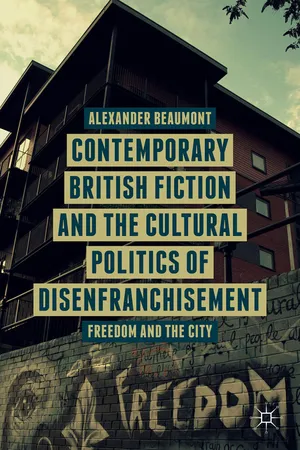
eBook - ePub
Contemporary British Fiction and the Cultural Politics of Disenfranchisement
Freedom and the City
- English
- ePUB (mobile friendly)
- Available on iOS & Android
eBook - ePub
Contemporary British Fiction and the Cultural Politics of Disenfranchisement
Freedom and the City
About this book
By examining the representation of urban space in contemporary British fiction, this book argues that key to the political left's strategy was a model of action which folded politics into culture and elevated disenfranchisement to the status of a political principle.
Information
Topic
LiteraturSubtopic
Literatur AllgemeinIdentifying the Cultural Politics of Disenfranchisement
1
Resistance and Rationalisation: Exile and the Inner Cities in Jeanette Winterson’s The Passion
This book is about fiction published in Britain, concerns itself mostly with the representation of London and interrogates the way in which a Jamaican (Hall) and an Englishman (Gilroy), building on the legacy of a Welshman (Williams), challenged existing categories of British – but more specifically English – cultural identity. It begins in none of these places, however, and it is doubtful whether any of the figures just named would straightforwardly embrace the identities I have ascribed to them: Williams’s place of birth in the Welsh borderlands is indicative of the circumspect way in which the work of all engages with the contingent question of nationality. It is perhaps appropriate, then, that this book begins elsewhere, in Venice, which since at least the Romantic period has functioned as an imaginary site where varied and often competing versions of Englishness have been developed, refined and repudiated. The Italian city-state on the shores of the Adriatic has also frequently served as the backdrop for interrogations of the self, and is a common setting for narratives of death, desire and psychological dissolution in English literature. Soon after arriving in the city in 1816, Lord Byron wrote in a letter to the poet Thomas Moore that he considered it to be ‘the greenest island’ of his imagination because its ‘evident decay’ was in keeping with his own personality, which had been ‘familiar with ruins too long to dislike desolation’ (1982: 136). John Ruskin’s obsessively researched Stones of Venice (2003), published in 1851, is shot through with anxiety over the object of its devotion crumbling into the waters of the Laguna Veneta, never to rise again, and – moving beyond England – Thomas Mann’s 1912 Death in Venice (1998) dramatises the infatuation of an ageing writer with an adolescent boy while its titular city is ravaged by a cholera epidemic. However, if Venice has come to be perennially associated with thanatos in the Western imagination, this tradition experienced a particularly visceral revival in Britain towards the end of the twentieth century. Published within a decade of one another, both Daphne du Maurier’s 1971 short story ‘Don’t Look Now’ (1973) and Ian McEwan’s 1981 novel The Comfort of Strangers (1998b) exploit the city’s unique combination of disorienting geography and atrophied grandeur to dramatise emotional discomfiture and sexual ecstasy, before culminating in acts of shocking and apparently inexplicable violence. They also enjoy a prominent place in the popular consciousness, having been the subject of cinematic adaptations (Roeg 1973; Schrader 1991) cast with well-known performers such as Christopher Walken and Donald Sutherland in the title roles. Both film adaptations can be described today as benchmarks of macabre and melodramatic eroticism.
Although the story told in Jeanette Winterson’s 1987 novel The Passion takes place during the early nineteenth century rather than the present day, it contains many of the same elements as ‘Don’t Look Now’ and The Comfort of Strangers, and reproduces quite a few of the clichés that have marked representations of the so-called city of masks over two centuries. Consequently, we might be inclined to regard it as of limited interest when placed alongside Winterson’s other, ostensibly more original works – 1985’s Oranges Are Not the Only Fruit (2009), 1989’s Sexing the Cherry (2001a) and 1993’s Written on the Body (2001c). However, there is a reason for considering The Passion a unique and compelling contribution not merely to a longstanding tradition of ‘Venetian’ narratives, nor even a historically particular resurgence of the latter, but also to an entire realm of cultural discourse that has had an acute impact on the political experience of the Thatcher and post-Thatcher periods, as well as their attendant literatures. To situate the novel in this way is not to ignore the critical attention it has already attracted. Over the last three decades, Winterson’s fiction has inspired a huge amount of analysis, of which The Passion accounts for a notable part. However, the debate has largely ignored the novel’s historical and geographical context, tending instead to reinforce the broad hermeneutic consensus surrounding Winterson’s work by deploying language borrowed from poststructuralism in order to demonstrate how The Passion challenges patriarchal and heteronormative understandings of gender and sexuality. This approach is certainly justifiable, since the novel’s mercurial setting is amenable to being read in light of the sceptical attitude, held in common by poststructuralist and postmodernist critics, towards essentialised identity categories. Judith Seaboyer notes in her analysis of the novel that, though Venice has long functioned as ‘a theater for narratives of death, fragmentation and decay’, by the late twentieth century it had come ‘to serve a wider purpose than it did for the Romantics’ as a space in which larger ‘concepts of reality, truth, and meaning could be thrown into question by the idea of difference’ (1997: 484). At the moment the novel was published, critical and political sensibilities in the UK and the USA were swinging towards the complex ontologies that would preoccupy third-wave feminism and queer theory, so it is unsurprising that the concerns Seaboyer identifies have played a significant role in steering scholarly inquiry. However, while interpretations focusing on what Lisa Moore has called Winterson’s ‘lesbian postmodernism’ (1995: 116) often produce compelling insights, they sometimes serve to obscure how her work – and especially her early work – reflects trenchantly on the particular historical context in which she was writing. The representation of Venice in The Passion is one instance where such an approach proves rewarding.
Accordingly, this chapter embeds the novel much more firmly within its cultural and political context than has been the case in earlier critical treatments, specifically by examining how its representation of Venice dramatises the unique role of the British inner cities in the culture wars of the 1980s. Over the course of this decade the inner cities became identified in the UK right-wing press as the antithesis of everything that Thatcherism perceived as progress, products of an errant welfare capitalism characterised by fecklessness, violence and dissolution. However, on the political left, inner-city communities were deemed fundamental in resisting both the deterritorialising power of capital and the hypostatising logic of cultural normativity that together comprised Thatcher’s ‘reforming’ agenda. Winterson’s Venice, I want to suggest, places these competing accounts of the inner city in a dialectical relationship with one another, synthesising the spectacularised dilapidation of the former and the political sensibility of the latter in order to identify what Helena Grice and Tim Woods describe as a ‘promise of possibility lying untapped in the history of space’ (2007: 33).
It is the nature of this ‘promise of possibility’ that will be my ultimate focus in this chapter. Both Winterson’s Venice and the British inner cities have been characterised from leftist-progressive perspectives as liberatory spaces in which ontological binaries are challenged and indeterminacy valorised. Yet the precise kind of emancipation they promise has not been subject to as thorough an inquiry as might be expected. The freedom that Napoleonic Venice enjoys is deeply paradoxical: on the one hand, the city is a carceral place that has been deprived of its millennium-old autonomy by a new, totalising hegemon; on the other, it appears uniquely capable of resisting hegemonic processes of governmentality and its denizens remain at liberty to indulge their most ardent passions and transgressive whims. Moreover, this contradiction is far from accidental: Winterson represents the former quite explicitly as a condition of the latter, and in this way The Passion can be said to celebrate a model of freedom that is, rather confusingly, predicated on its opposite. This chapter accounts for such a paradox by arguing that the freedom Winterson’s novel explores and ultimately endorses is not dissimilar to the freedom of the political exile, that simultaneously abject and liberated figure who, in Giorgio Agamben’s terms, is both ‘at the mercy of’ sovereign power and ‘at his own will, freely’, both ‘excluded’ and ‘open to all, free’ (1998: 29). Moreover, it suggests that one way of making sense of The Passion’s endorsement of exile is to read its characterisation of Venice as a comment on the place of the inner cities in the left culturalist thinking of the 1980s. As I suggested in the Introduction, during this time figures such as Hall and Gilroy were advancing a model of freedom in which emancipation became conditional on a withdrawal from formal political structures in favour of the complex network of minority subcultures that was most visibly concentrated in the inner city. The consequence of this strategy was, however, to emphasise the emancipatory potential of disenfranchisement over the possibilities of belonging to a polity in which one might possess, as Hannah Arendt puts it, a ‘place in the world which makes opinions significant and actions effective’ (1968: 296). I want to argue that, in locating its ‘promise of possibility’ in Venetian space, The Passion uncovers a unique logic within left culturalism’s celebration of inner-city subcultures that elevates exile to the status of a political principle, and that this book terms the cultural politics of disenfranchisement.
My aim in this opening chapter is not to set out the implications of this logic programmatically. Rather, I want to illustrate how, in exposing the cultural politics of disenfranchisement to analysis, Winterson’s novel says something important about the relationship between literature, politics and critical theory in late twentieth-century Britain. Consequently, I will not provide a precise definition of the term until the very end, in order to allow its historically particular nature to emerge inductively out of my analysis. As will become clear, to work in the opposite direction would be to risk implying that left culturalist thinkers knowingly abandoned freedom as a political category in the process of developing a praxis equal to the task of challenging Thatcherism. In fact, these thinkers were engaged in a thoroughgoing complication of the very constitution of the concept of freedom at a historical moment when this term was presenting itself, in Nikolas Rose’s words, as ‘the ground upon which governmentality must enact its practices’ (1999: 11), and was thus being put to use by the right in newly oppressive ways that heralded the arrival of the disciplinary regime we now call neoliberalism. The response of left culturalism was to probe the possibilities for a new, performative form of freedom that owed less to the dispossessory and hypostatising logics at work in late capitalism, and that might help in the formulation of a radical response to the new right. Careful reading of The Passion allows us to map the way in which the relationship between subjectivity and urban space was negotiated by thinkers such as Hall and Gilroy in the process of pursuing this project, but, more importantly, it also exposes how disenfranchisement became nested at the heart of their endeavour. The novel can thus be read symptomatically, as a register of the significance of the inner cities to both the right- and left-wing imaginations while Thatcher was in power, but also reflexively, as an important intervention in the development of a specific left-wing response to the particular conjuncture that Britain in the 1980s represented.
Thatcher and Napoleon
Before focusing on the novel’s treatment of Venice and the inner cities, however, it might be helpful to illustrate how The Passion reflects on its political moment in slightly broader terms. The justification for such an approach is located quite easily in Winterson’s biography, which was shaped by an initial enthusiasm for Thatcher that waned soon after the latter’s impact on British public life became visible. In her recent autobiography Why Be Happy When You Could Be Normal?, Winterson describes her teenage self as ‘the ideal prototype for the Reagan/Thatcher revolution’ (2012: 134) and writes, ‘Thatcher was a woman – and that made me feel that I too could succeed’ (138). It is fairly common knowledge that Winterson voted for the Conservative Party in 1979 (2001b: n.p.), but she admits, ‘I did not know that Thatcherism would fund its economic miracle by selling off all our nationalised assets and industries. I did not realise the consequences of privatising society (2012: 140). Yet while such biographical details are noteworthy, it is far more important that a radically contextual reading of The Passion is also justified at a textual level. For while Jago Morrison has suggested that this text ‘presents itself very much as a historical novel’ (2003: 101, emphasis in original), in fact it self-consciously subverts the characteristics of that genre by foregrounding itself as text, rather than as history. Reflecting a trend among British novelists of the period, Winterson’s work from the 1980s often draws attention to the ways in which various narratives – mythical, historical and fictional – are created and maintained, and characterises these narratives as deeply implicated with one another rather than distinct. The Passion is no exception: set during the Napoleonic wars of the early nineteenth century, it ostensibly tells the stories of Henri, a provincial Frenchman who works as Napoleon’s cook, and Villanelle, a Venetian croupier whom her husband sells as a vivandière to the officers of the Grande Armée. However, given that its exposition is punctuated with variations of the phrase ‘I’m telling you stories. Trust me’ (Winterson 1987: 5, 13, 69, 160), and given that it combines a magical realist aesthetic with a particularly slippery form of the first-person address, it is quite easy to situate the novel within the parameters of historiographic metafiction. Consequently, some critics have argued that Winterson invites the reader to extrapolate contemporary insights from her novel’s historical setting and to treat The Passion as a text that ‘recounts a series of events set in the past, but with an eye on their relevance to the present’ (Palmer 1998: 103).
Certainly its characterisation of the Napoleonic regime invites comparison with Thatcherism. David Marquand has remarked that the latter can be thought of as ‘a sort of British Gaullism’ born of ‘a growing sense of despair’ that ‘reflect[ed] the experience of a generation of apparent national decline’ (1988: 60). During the 1980s the right attempted to combat the declension narrative that had come to characterise postwar Britain by deploying a rhetoric that combined jingoism and provincialism in equal parts. However, far from describing a country at ease with its postimperial circumstances, this tendency spoke more loudly of what Gilroy has termed ‘postcolonial melancholia’, a ‘pathology of greatness’ (2004: 97) born of Britain’s ‘inability even to face, never mind actually mourn, the profound change in circumstances and moods that followed the end of the Empire and consequent loss of imperial prestige’ (98). There are striking echoes of this sentiment in The Passion when Winterson describes the French as a ‘lukewarm people’ (1987: 7) who are ‘in love’ (8) with Napoleon primarily because they ‘wanted a ruler and […] wanted him to rule the world’ (30). As Henri tells us, the relationship between France and its ruler is ‘not a contract between equal parties’ but ‘a romance […] an explosion of dreams and desires that can find no outlet in everyday life’ (13). It is for this reason that the country endures the ‘devastation, rape, slaughter, carnage, starvation’ (5) that Napoleon’s rule wreaks, because what really matters to the French is greatness, and ‘[g]reatness like his is difficult to be sensible about’ (30). Thus, when Napoleon amasses an army at Boulogne in preparation for an invasion of Britain that turns out to be a disaster, every one of his soldiers is prepared unquestioningly to die for him; when 2000 men are drowned because the barges Napoleon has ordered to be built for the invasion prove unsuitable for crossing the Channel, ‘[n]o one said, Let’s leave him, let’s hate him’ (25), because the narrative of national greatness he propagates is so succouring for a population that wishes it (still) ruled the world.
In this way, both the French in The Passion and the British – which is to say that particular segment of English society that repeatedly voted for Thatcher during the 1980s – can be described as emotionally in thrall to a redoubtable leader as a consequence of feelings of irrelevance and marginalisation. That such a consonance has more to do with affect than with ideology is all the more appropriate, enabling us to see how, in sketching out the Napoleonic regime, The Passion reflects on the structure of feeling that led to the emergence of Thatcherism in the UK and did much to increase its impact and longevity. It also reveals some of the wittier ways in which the novel might be read as a comment on the historical circumstances in which it was written. When Winterson describes the ‘preposterous […] soldier’s mount’ that Napoleon insists on riding during his coronation (34), it is not unreasonable to recall Jacques-Louis David’s series of paintings Napoleon Crossing the Alps (1801–05), which depict the emperor sitting astride a soldier’s horse, looking simultaneously heroic and curiously feminine. But a similarly heroic – and similarly preposterous – intertext also presents itself in the 1986 photographs of Thatcher atop a Challenger tank, which cemented her image as the ‘Iron Lady’ and led the Daily Telegraph to describe her as ‘a cross between Isadora Duncan and Lawrence of Arabia’ (cited in Menkes 2011: n.p.).
Significantly, the nationalist fervour that binds France to Napoleon is focalised through Henri, the character Winterson most clearly identifies as an imperial French subject but who, with the benefit of hindsight, is capable of commenting most incisively on the melancholy nature of this attachment. Henri describes the emperor as ‘repulsive’ (Winterson 1987: 13), yet for a while he was patently infatuated with him: he recalls that, while his fellow soldiers ‘went out whoring most nights […] I was waiting for Bonaparte’, an implicitly sexual expression that positions him as a doting but marginalised housewife who spends her time confined to the kitchen, ‘learning how to stuff a chicken and slow down the cooking process’ so that she might better please her patriarch (15). Despite his effeminacy, however – and despite the fact that his upbringing is parochial and puritan – Henri’s timidity does not preclude jingoism. When, as he is leaving his small village to join the Grande Armée, a little girl asks, ‘Will you kill people, Henri?’ he replies, ‘Not people, Louise, just the enemy’ (8). Moreover, in what can be read as a satire of the nationalist fervour that Thatcher encouraged during the Falklands/Malvinas conflict, Henri swallows the regime’s xenophobic propaganda without question: he tells us that, at Boulogne, he was sure he ‘knew about the English, how they ate their children and […] committed suicide with unseemly cheerfulness’ (8). Still, after leaving his village he is ‘homesick from the start’ (6) and appears deeply uncomfortable with metropolitan life. When he is called to Paris to help with Napoleon’s coronation, he describes his court dress as ‘impossibly tight’ (34) and is so nervous in the company of the imperial great and good that he is thankful whenever he can retreat to the ‘little room of [his] own’ (36). Thus, while it would be reductive to suggest that Henri represents an archetypal Thatcherite, he can be read as an oblique reference to the mood that enabled Thatcher’s success during the 1980s: he seems to embody the peculiar combination of provincialism, ‘disdain for foreigners and […] “little Englandism”’ that Shirley Robin Letwin identifies as such an essential component of the Conservative agenda during that decade (1993: 22), and he is nothing if not emblematic of a tepid, provincial people prostrating itself before a bellicose and charismatic leader.
One of the most intriguing connections between The Passion and the political circumstances that prevailed in Britain during this period is suggested by Henri’s depressingly pithy description of subjectivity under Napoleon: ‘Soldiers and women. That’s how the world is. Any other role is temporary. Any other role is a gesture’ (Winterson 1987: 45). This speaks of a rigidly normative account of the subject that finds a clear but not entirely straightforward correlative in Thatcherism. Of course, as suggested in the Introduction, the latter drew heavily on the neoliberal ideology of the Mont Pelerin Society and the Chicago School, which conceived of the subject in rather more flexible terms than – in their separate ways – liberalism, nationalism and socialism. This component of Thatcherism considered the subject to be first and foremost a consumer periodically given to reinventing herself, if only by choosing a different brand of chewing gum at the checkout. However, Thatcher famously alloyed (without ever really reconciling) this economic individualism with a rigid, essentialised and homogeneous understanding of Britishness that sought to deny the cultural heterogeneity that was a legacy o...
Table of contents
- Cover
- Title
- Copyright
- Contents
- Acknowledgements
- Introduction: ‘What We Need Now...’
- Part I Identifying the Cultural Politics of Disenfranchisement
- Part II Locating Urban Culture in Twenty-First-Century British Fiction
- Bibliography
- Index
Trusted by 375,005 students
Access to over 1.5 million titles for a fair monthly price.
Study more efficiently using our study tools.
Frequently asked questions
Yes, you can cancel anytime from the Subscription tab in your account settings on the Perlego website. Your subscription will stay active until the end of your current billing period. Learn how to cancel your subscription
No, books cannot be downloaded as external files, such as PDFs, for use outside of Perlego. However, you can download books within the Perlego app for offline reading on mobile or tablet. Learn how to download books offline
Perlego offers two plans: Essential and Complete
- Essential is ideal for learners and professionals who enjoy exploring a wide range of subjects. Access the Essential Library with 800,000+ trusted titles and best-sellers across business, personal growth, and the humanities. Includes unlimited reading time and Standard Read Aloud voice.
- Complete: Perfect for advanced learners and researchers needing full, unrestricted access. Unlock 1.5M+ books across hundreds of subjects, including academic and specialized titles. The Complete Plan also includes advanced features like Premium Read Aloud and Research Assistant.
We are an online textbook subscription service, where you can get access to an entire online library for less than the price of a single book per month. With over 1.5 million books across 990+ topics, we’ve got you covered! Learn about our mission
Look out for the read-aloud symbol on your next book to see if you can listen to it. The read-aloud tool reads text aloud for you, highlighting the text as it is being read. You can pause it, speed it up and slow it down. Learn more about Read Aloud
Yes! You can use the Perlego app on both iOS and Android devices to read anytime, anywhere — even offline. Perfect for commutes or when you’re on the go.
Please note we cannot support devices running on iOS 13 and Android 7 or earlier. Learn more about using the app
Please note we cannot support devices running on iOS 13 and Android 7 or earlier. Learn more about using the app
Yes, you can access Contemporary British Fiction and the Cultural Politics of Disenfranchisement by A. Beaumont in PDF and/or ePUB format, as well as other popular books in Literatur & Literatur Allgemein. We have over 1.5 million books available in our catalogue for you to explore.