This book compares the policies of Australia and Italy towards boat people who have arrived in the two countries since the early 1990s. While the regular and varied inflow of immigrants arriving at national airports, ferry terminals and train stations is seldom witnessed by the public, the arrival of boat people is often played out in the media and consequently attracts disproportionate political and public attention. Both Australia and Italy faced similar dilemmas, but the nature of political debate on the issue, the types of strategies introduced, and the effects that policy changes had on boat people diverged considerably. This book argues that contrasting migration path dependencies, disparate political values within the Left, and varying international obligations best explain the different approaches taken by the two countries to boat people.
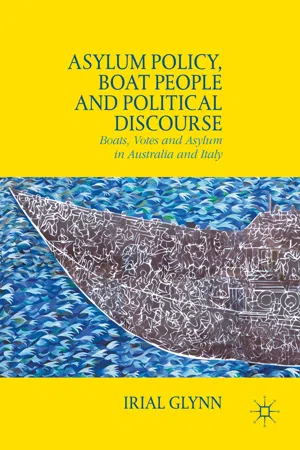
eBook - ePub
Asylum Policy, Boat People and Political Discourse
Boats, Votes and Asylum in Australia and Italy
- English
- ePUB (mobile friendly)
- Available on iOS & Android
eBook - ePub
Asylum Policy, Boat People and Political Discourse
Boats, Votes and Asylum in Australia and Italy
About this book
Information
© The Editor(s) (if applicable) and The Author(s) 2016
Irial GlynnAsylum Policy, Boat People and Political Discourse 10.1057/978-1-137-51733-3_11. Introduction: International Obligations Versus National Interests
Irial Glynn1
(1)
Institute for History, Leiden University, Leiden, The Netherlands
Immigrants arrive daily at national airports, ferry terminals and train stations but this varied inflow is seldom witnessed by the public. The arrival of ‘boat people’ in Australia and Italy since 1989, by contrast, has often been a public event played out in the media before millions. Despite numbers usually remaining low compared to other forms of migration, the issue of boat people has garnered attention in public discourse disproportionate to its size, especially in Australia. This book investigates why two countries facing a similar predicament often acted so differently. Australia has continually implemented harsh measures to restrict and deter boat people, from introducing mandatory detention in the early 1990s to establishing the Pacific and PNG (Papua New Guinea) Solutions in 2001 and 2013. Italy has reacted much more haphazardly, at times welcoming large numbers, as occurred with Albanian boat people in early 1991 and again more recently with the instigation in 2013 of the Mare Nostrum operation. At other times it has detained boat people en masse before returning them, as witnessed by events in Bari in August 1991 involving Albanians, and has also pushed back boat people on the high seas, as happened in 2009 with those departing from Libya. The central argument of this book is that contrasting path dependencies, divergent political values within the Left and varying international obligations best explain the different approaches taken by Australia and Italy to boat people since 1989.
Australia is a traditional country of immigration whereas Italy, until the 1980s, was a traditional country of emigration. This meant that Australia had a long history of receiving and settling newcomers. Most of those who arrived between Australian Federation in 1901 and the 1970s came from European countries. When the country cast off its ‘White Australia Policy’ in the 1970s, successive governments began to put in place an extremely organised immigration system to reassure citizens that they were still fully in control of who entered the territory. This included a specific programme to resettle significant amounts of refugees and humanitarian migrants annually. Boat people appeared to challenge such a system because they arrived uninvited and without having gone through the normal immigration procedures. This caused administrations to continually impose punitive measures on those arriving in such a manner. Italy, by contrast, had minimal experience of settling immigrants after the Second World War, particularly those in search of asylum. During the Cold War, large numbers of refugees passed through Italy en route to resettlement in North America or Australasia. After 1989, Italy remained a country of transit for boat people in need of protection, implicitly letting them travel on to northern European states. Australia and Italy were able to draw on past practices to help them cope with the arrival of boat people, albeit in very different ways.
The two main political parties in Australia, the centre-left Labor Party and the centre-right Liberals, have both imposed parsimonious policies towards boat people since 1989. Labor governments in the 1990s introduced mandatory detention for boat people and repeatedly attempted to reduce their legal entitlements. John Howard’s Liberal-National centre-right coalition continued in this vein from the mid-1990s onwards, particularly after the rise of Pauline Hanson’s anti-immigrant One Nation Party. Significantly, that same administration introduced the Pacific Solution in 2001, which involved the transfer of boat people to distant and remote islands in other jurisdictions in the Pacific. Despite Labor’s initial decision to dismantle the system after its ascent to power in late 2007, it later introduced the highly restrictive PNG Solution following an increase in boat arrivals. In Italy, a much greater divide existed between the Right and the Left. Coalitions in the 2000s involving predominantly right-wing parties, including the anti-immigrant Lega Nord and neo-fascist Alleanza Nazionale parties, attempted to introduce much more restrictive policies for boat people, as exemplified by the pushbacks of boat people arriving from Libya throughout the 2000s. Contrastingly, left-wing dominated coalitions placed an emphasis on employing a more humanitarian response, as demonstrated by their introduction of the relatively generous Turco-Napolitano laws in the late 1990s and the benevolent Mare Nostrum policy in 2013.
Australia is an isolated island located to the southeast of Asia. It remains a member of the by-now mostly symbolic Commonwealth. In addition, it maintains reasonably good relations with the Asian countries located to its north and better relations with New Zealand to the south. This proved crucial when attempting to stem the arrival of boat people. Throughout the 1990s, for example, Australia came to agreements with Cambodia and China to accept repatriated boat people. Relations with Indonesia, which acted as the last port of call for most boat people, were more mixed. Yet, Australia frequently came to some kind of understanding with its neighbour to make it more difficult for boat people to depart.1 Indeed, Indonesia and other Southeast Asian states adopted various policies because of Australian encouragement, as exemplified in the workings of the Bali Ministerial Process on People Smuggling, Trafficking in Persons and Related Transnational Crime, commonly referred to as the Bali Process, a group formed in 2002 to cooperate on migration-related issues.2 Throughout the 2000s, Australia drew on its economic advantages to tempt various Pacific island nations, and more recently Cambodia, to house and resettle boat people in exchange for valuable aid and investment. Despite being part of the G8, Italy did not possess such obvious economic and political hegemony in Europe. It was a founding member of the European Union (EU) and the Council of Europe. As such, it was answerable to the Court of Justice of the EU and the European Court of Human Rights. The decisions of the latter played a fundamental role in dictating Italy’s reaction to the arrival of boat people coming from Libya in the 2010s. If Australia had to answer to the European Court of Human Rights in relation to its externalisation of boat people, it is arguable whether its practice of placing boat people in offshore detention centres on remote Pacific islands could have continued.
Italy’s membership of the EU has also caused it to adopt a number of European measures relating to migration, most notably its membership of the Schengen Accord in the mid-1990s, which allowed individuals and goods to pass internal borders with fellow European states. This facilitated Italy’s continuing status as a country of transit for boat people. Other developments at the EU level, most notably the imposition in 1997 of the Dublin Convention requiring asylum seekers to submit their application in the first EU country they entered, complicated such positions, as did the establishment of the Common European Asylum System in the 2000s. Italy’s economic and diplomatic strength became more apparent in its dealings with poorer countries in the Mediterranean region, most notably with Albania in the 1990s and with Tunisia and Libya in the 2000s. Even then, however, sending countries held an important bargaining tool, as demonstrated by Libya’s changeable stance on deterring boat people from leaving its shores, sometimes facilitating boat people and at other times putting in place extremely restrictive measures.
The Value of Comparison
Despite Australia and Italy being two of the democratic industrialised states best known for receiving boat people in the last quarter of a century, the body of literature on Australia’s reaction to boat people says little or nothing about Italy and the body of literature on Italy’s handling of boat people rarely mentions Australia. Unravelling common and divergent processes that occurred can often be more enlightening than solely describing specific events in one country. As Irene Bloemraad argues, ‘You cannot know what is unique, or common, about a particular case unless you have a comparative point of reference.’ For that reason, she contends that ‘[c]omparative studies can challenge accepted and conventional wisdoms, and lead to innovative new thinking’.3 Caroline Brettell and James Hollifield have similarly noted that comparative research has led to some of the most ‘important and pathbreaking work on migration’ so far produced.4
The current issues facing Australia and Italy are not new—both countries have debated how to deal with boat people since the early 1990s (and in Australia’s case, the late 1970s). Therefore, to understand the processes dictating states’ policies towards boat people and the discourse surrounding policy properly, this study will examine the topic over a much longer time period. Reviewing a small number of events in a short period of time does not always show how or why states’ policies towards boat people evolved the way they did. Australia’s Pacific Solution and Italy’s 2009 agreement with Libya, for example, did not emerge out of nowhere: they were the latest in a long line of attempts to stem the flow of boat people, as this book will illustrate.
Democratic industrialised states’ treatment of boat people is of enduring interest and lasting importance. It is a topic that continues to divide opinions. This book seeks to understand the rationale behind conflicting political views on the topic and to set out the effects that different policies have had on boat people, especially those seeking asylum. It is unlikely that the moral dilemma facing states with regard to boat people will disappear from public view in the near future, given the multiple humanitarian crises currently taking place around the world. It is therefore critical to try to understand how political debates about boat people have shaped and will continue to shape state policies and immigration discourse. Comparing Australia and Italy serves to improve people’s understanding of the politics of boat people in both states. It also allows for the particularities of each to be identified, which may have been ignored in non-comparative studies. Moreover, a study of the two will enable international trends in the politics of boat people to be identified.
Italy, it might be argued, could be compared to various other EU countries that have experienced difficulties dealing with boat people, such as Greece, Spain, and Malta, instead of Australia. But the latter two states have not had to grapple with the issue for as long as Italy, since boat people only became a major topic of debate there in the 2000s.5 Greece, which has come under renewed focus in 2015, also had earlier encounters with boat people but national statistics on arrivals remain unreliable. Furthermore, my lack of knowledge of the Greek language prevented me from analysing national debates on such issues.6 Nevertheless, similarities and differences between Italy and other EU states will be outlined, particularly in Chap. 6.
Comparative studies of Australia’s asylum system mostly contrast it with Anglophone countries such as Canada, the USA, New Zealand and the UK.7 Boat people have featured in some of these other cases, most notably in the USA during the 1980s and early 1990s, yet they have not dominated political and public discussions on immigration to the same extent as has taken place in Australia. Given that boat people are a major part of the story in Italy, a comparison between the two states is especially timely. While various Southeast Asian countries have received boat people in the past, particularly those hailing from Indochina in the 1970s and 1980s, the issue has not beset domestic politics consistently over last the 25 years in the same way as occurred in Australia and Italy. Few Southeast Asian states that received boat people were signatories of the UN Convention on Refugees, which has played a significant role in affecting Australia and Italy’s approach to boat people applying for asylum. Furthermore, these states cannot always be described as democratic and industrialised countries in the same way that Australia and Italy can.
Methodology and Sources
There are two main methodologies usually employed in the social sciences to compare cases, often referred to as a Durkheimian and the Weberian methods.8 The first focuses on studying a large number of cases by considering a range of variables. The other concentrates on studying the context, complexity and difference between usually a smaller number of cases.9 Variable-orientated Durkheimian...
Table of contents
- Cover
- Frontmatter
- 1. Introduction: International Obligations Versus National Interests
- 2. Boat People and Migration Theory
- 3. A New Wave, 1989–1994
- 4. The Rise of the Right, 1995–2000
- 5. Boats and Votes, 2001–2006
- 6. A Moral Dilemma, 2007–2015
- 7. Conclusion: Divergence or Convergence?
- Backmatter
Trusted by 375,005 students
Access to over 1.5 million titles for a fair monthly price.
Study more efficiently using our study tools.
Frequently asked questions
Yes, you can cancel anytime from the Subscription tab in your account settings on the Perlego website. Your subscription will stay active until the end of your current billing period. Learn how to cancel your subscription
No, books cannot be downloaded as external files, such as PDFs, for use outside of Perlego. However, you can download books within the Perlego app for offline reading on mobile or tablet. Learn how to download books offline
We are an online textbook subscription service, where you can get access to an entire online library for less than the price of a single book per month. With over 1.5 million books across 990+ topics, we’ve got you covered! Learn about our mission
Look out for the read-aloud symbol on your next book to see if you can listen to it. The read-aloud tool reads text aloud for you, highlighting the text as it is being read. You can pause it, speed it up and slow it down. Learn more about Read Aloud
Yes! You can use the Perlego app on both iOS and Android devices to read anytime, anywhere — even offline. Perfect for commutes or when you’re on the go.
Please note we cannot support devices running on iOS 13 and Android 7 or earlier. Learn more about using the app
Please note we cannot support devices running on iOS 13 and Android 7 or earlier. Learn more about using the app
Yes, you can access Asylum Policy, Boat People and Political Discourse by Irial Glynn in PDF and/or ePUB format, as well as other popular books in Politics & International Relations & Comparative Politics. We have over 1.5 million books available in our catalogue for you to explore.